

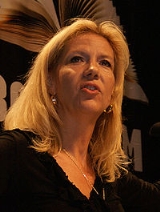
Liza Marklund

Encyclopedia
Eva Elisabeth "Liza" Marklund (born 9 September 1962) is a Swedish
journalist and crime writer. She was born in Pålmark near Piteå
, Norrbotten
. Her novels, most of which feature the fictional character Annika Bengtzon, a newspaper journalist, have been published in thirty languages. Marklund is the co-owner of Sweden's third largest publishing house, Piratförlaget and a columnist in the Swedish tabloid Expressen
. She is also a Unicef ambassador. The Postcard Killers
, a crime thriller written in collaboration with American bestselling author James Patterson
, is Marklund's twelfth book. It was published on January 27, 2010, in Sweden, and became number one on the Swedish bestseller list in February 2010. It was published on 16 August 2010 in the United States. At the end of August, it reached number one in the New York Times best-seller list, making Liza Marklund the second Swedish author (the first one being Stieg Larsson
with the Millennium Trilogy
) ever to reach the number one spot. Marklund lives in Spain
with her husband Mikael.
with Maria Eriksson and one non-fiction
book about female leadership with Lotta Snickare. Marklund's crime novels featuring crime reporter Annika Bengtzon have become international bestseller
s. She won the "Poloni Prize" (Polonipriset) 1998 for "Best Swedish Crime Novel by a Female Writer" and "The Debutant Prize", (Debutantpriset) 1998 for "Best First Novel of the Year" with the crime novel Sprängaren (The Bomber), published in 1998. Marklund was named Author of the Year in Sweden 1999 by the Swedish trade union SKTF
, won the radio network RixFM's Swedish Literary Prize in 2007, and was selected the fifteenth most popular woman in Sweden of 2003 and the fourth most popular woman in Sweden of 2004 in a yearly survey with 1,000 participants, conducted by ICA-kuriren, a publication published by a Swedish supermarket chain.
Her books have been number one bestsellers in all five Nordic countries. In 2002 and 2003, two of Liza Marklund's crime novels were listed on the international bestseller lists by the online magazine Publishing Trends, Prime Time ranking #13 and The Red Wolf ranking #12. In Scandinavia and Germany, her non-fiction novel
s have become the center of a heated controversy.
Starting with The Bomber, in which Annika is already a deft professional, the story then moves back in time several years, to the start of her career and the meeting with her future husband Thomas. By the fifth installment The Red Wolf, the reader is back in the present. Books 6, 7 and 8: Nobels's Last Will, Lifetime and A Place in the Sun, together make up a trilogy, with recurring characters and themes and plots linked to each other.
With The Annika Bengtzon series, Liza Marklund introduced a female main character, the tabloid journalist Annika Bengtzon, in a genre where the main characters had often been men. Current events, like political scandals or women's issues, are often intertwined with the plot, or introduced in subplots. Marklund placed 22nd on the list of the most influential media personality of 2008 in Sweden, a list established yearly by the trade magazine for the advertising industry, Resumé. Prior to The Bomber, there were very few female commercially successful crime writers in Sweden. Marklund was one of the first highly successful Swedish female crime writers.
. The actress Helena Bergström
starred in the role as Annika Bengtzon in both movies. They premiered in 2001 and 2002.
In 2009, the film and TV production company Yellow Bird
bought the rights to adapt an additional six Annika Bengtzon novels for the screen: Studio 69, Prime Time, The Red Wolf, Nobel's Last Will, Lifetime, and A place in the sun. Yellow Bird, which is part of the trans-European production and distribution group Zodiak Ent, produced the films based on Stieg Larsson’s the Millennium trilogy, and the award-winning English-language "Wallander" TV movies, starring Kenneth Branagh
. Like the Millennium trilogy, the total production budget for the series will be around SEK 100m (just under €10m). The names for the main cast, writer and director of the series have not been revealed yet, but filming is expected to start in late 2010.
The last three novels can be considered as a trilogy, within the series.
The pseudonym
used for the main character in the series is "Maria (or Mia) Eriksson", who is also listed as a co-author of the first editions of the two books in the series. After a controversy regarding the truthfulness of the books, "Mia" revealed her identity in 2009 in order to confirm her story. Today she lives with a new husband in Arizona. Since 2006 she has written three additional books about her life and about domestic violence, but without Liza Marklund being involved.
Buried Alive tells the story of "Mia" and "The man with the black eyes", an immigrant from Lebanon, that soon turns into an abusive relationship. They have a child together and they break up, but the abuse continues and is intensified when "Mia" remarries. The welfare state is not able to protect the family, and they are forced into hiding.
"The man with the black eyes" is the antagonist
also in Asyl Den Sanna Fortsättningen på Gömda (Asylum Granted - A True Story), the second book in the series, published 9 years later. The book tells the story of how the abuser forced the woman and her new family to flee abroad. They left Sweden for South America and then spent five years in the United States, attempting to establish asylum
. "Maria Eriksson" submitted her application as a victim of domestic violence
and gender-based abuse
. "Maria Eriksson" was granted asylum on February 25, 2003.
Antonsson criticised that Maria Eriksson's grades and jobs were not factually correct, and that the ethnicity of a boyfriend and his criminal record was not reflected in the books. For example, the hospitalization of "The man with the black eyes" after aggravated assault by "Maria Eriksson's" Chile
an husband, who was convicted and imprisoned for one year due to the assault, was not mentioned in the book.
In response to the criticism, Marklund has stated that she considers the bulk of the story to be factually correct and neither exaggerated nor deceptive. She has noted that the story is supported by hundreds of official documents from the courts and the social services. She has also written that she did not know of the aggravated assault committed by "Mia Eriksson's" Chilean husband, and that she read about for it the first time in Monica Antonsson's book. However, she noted that if Antonsson's information about the records is correct, then the court's decision confirms that the family was being harassed by "Maria Eriksson's" ex-boyfriend.
The controversy has been compared to the controversy surrounding Per Olov Enquist
's Legionärerna and led to academic work studying the audience's relation to documentary novels. The genre is based on a mix of fact and fiction, where the author's own interpretation is part of the genre's conventions. The documentary novel often has a political objective, which in Buried Alive was to bring to the fore an abused woman's exposed situation. The genre also, like many Hollywood movies, uses popular clichés to appeal to a broader audience.
Gömda (Buried Alive) was initially released by Bonniers in 1995 and marketed under the category "autobiography
/biography
" in the publishing industry's catalogue. It was re-worked and re-released by Piratförlaget in 2000 as Buried Alive - A True Story and marketed as a "documentary novel", a term used by Piratförlaget also for the edition published by Bonniers.
In January 2009, the Swedish National Bibliography and the public libraries of Sweden reclassified all editions as fiction
due to questions raised about the factual nature of the book. The classification of Asylum - the True Continuation of Buried Alive was not altered as it had been classified as fiction from the very beginning.
A spokesperson and part-owner of the Piratförlaget, Jan Guillou
, has told the press that the company regrets that the book was marketed as "a true story" and that "based on a true story" would have been better. In Expressen
, the evening tabloid where Marklund works, another part-owner of the publishing company, Ann-Marie Skarp, has stated that readers could not have been fooled by the label "true story" because, she argued, intelligent readers understand that the book is a novel based on reality and that it is not meant to be a biography
.
Kerstin Angelin at the initial publisher, Bonnier Alba, has also commented in the press on the controversy by saying: "The storyline, the bulk of the story, must be correct for it to be called a true story. However, for various reasons one may not want to expose individuals with name and professions, out of concern for them. It is perfectly reasonable that not every detail is true."
Eva Elisabeth "Liza" Marklund (born 9 September 1962) is a Swedish
journalist and crime writer. She was born in Pålmark near Piteå
, Norrbotten
. Her novels, most of which feature the fictional character Annika Bengtzon, a newspaper journalist, have been published in thirty languages. Marklund is the co-owner of Sweden's third largest publishing house, Piratförlaget and a columnist in the Swedish tabloid Expressen
. She is also a Unicef ambassador. The Postcard Killers
, a crime thriller written in collaboration with American bestselling author James Patterson
, is Marklund's twelfth book. It was published on January 27, 2010, in Sweden, and became number one on the Swedish bestseller list in February 2010. It was published on 16 August 2010 in the United States. At the end of August, it reached number one in the New York Times best-seller list, making Liza Marklund the second Swedish author (the first one being Stieg Larsson
with the Millennium Trilogy
) ever to reach the number one spot. Marklund lives in Spain
with her husband Mikael.
with Maria Eriksson and one non-fiction
book about female leadership with Lotta Snickare. Marklund's crime novels featuring crime reporter Annika Bengtzon have become international bestseller
s. She won the "Poloni Prize" (Polonipriset) 1998 for "Best Swedish Crime Novel by a Female Writer" and "The Debutant Prize", (Debutantpriset) 1998 for "Best First Novel of the Year" with the crime novel Sprängaren (The Bomber), published in 1998. Marklund was named Author of the Year in Sweden 1999 by the Swedish trade union SKTF
, won the radio network RixFM's Swedish Literary Prize in 2007, and was selected the fifteenth most popular woman in Sweden of 2003 and the fourth most popular woman in Sweden of 2004 in a yearly survey with 1,000 participants, conducted by ICA-kuriren, a publication published by a Swedish supermarket chain.
Her books have been number one bestsellers in all five Nordic countries. In 2002 and 2003, two of Liza Marklund's crime novels were listed on the international bestseller lists by the online magazine Publishing Trends, Prime Time ranking #13 and The Red Wolf ranking #12. In Scandinavia and Germany, her non-fiction novel
s have become the center of a heated controversy.
Starting with The Bomber, in which Annika is already a deft professional, the story then moves back in time several years, to the start of her career and the meeting with her future husband Thomas. By the fifth installment The Red Wolf, the reader is back in the present. Books 6, 7 and 8: Nobels's Last Will, Lifetime and A Place in the Sun, together make up a trilogy, with recurring characters and themes and plots linked to each other.
With The Annika Bengtzon series, Liza Marklund introduced a female main character, the tabloid journalist Annika Bengtzon, in a genre where the main characters had often been men. Current events, like political scandals or women's issues, are often intertwined with the plot, or introduced in subplots. Marklund placed 22nd on the list of the most influential media personality of 2008 in Sweden, a list established yearly by the trade magazine for the advertising industry, Resumé. Prior to The Bomber, there were very few female commercially successful crime writers in Sweden. Marklund was one of the first highly successful Swedish female crime writers.
. The actress Helena Bergström
starred in the role as Annika Bengtzon in both movies. They premiered in 2001 and 2002.
In 2009, the film and TV production company Yellow Bird
bought the rights to adapt an additional six Annika Bengtzon novels for the screen: Studio 69, Prime Time, The Red Wolf, Nobel's Last Will, Lifetime, and A place in the sun. Yellow Bird, which is part of the trans-European production and distribution group Zodiak Ent, produced the films based on Stieg Larsson’s the Millennium trilogy, and the award-winning English-language "Wallander" TV movies, starring Kenneth Branagh
. Like the Millennium trilogy, the total production budget for the series will be around SEK 100m (just under €10m). The names for the main cast, writer and director of the series have not been revealed yet, but filming is expected to start in late 2010.
The last three novels can be considered as a trilogy, within the series.
The pseudonym
used for the main character in the series is "Maria (or Mia) Eriksson", who is also listed as a co-author of the first editions of the two books in the series. After a controversy regarding the truthfulness of the books, "Mia" revealed her identity in 2009 in order to confirm her story. Today she lives with a new husband in Arizona. Since 2006 she has written three additional books about her life and about domestic violence, but without Liza Marklund being involved.
Buried Alive tells the story of "Mia" and "The man with the black eyes", an immigrant from Lebanon, that soon turns into an abusive relationship. They have a child together and they break up, but the abuse continues and is intensified when "Mia" remarries. The welfare state is not able to protect the family, and they are forced into hiding.
"The man with the black eyes" is the antagonist
also in Asyl Den Sanna Fortsättningen på Gömda (Asylum Granted - A True Story), the second book in the series, published 9 years later. The book tells the story of how the abuser forced the woman and her new family to flee abroad. They left Sweden for South America and then spent five years in the United States, attempting to establish asylum
. "Maria Eriksson" submitted her application as a victim of domestic violence
and gender-based abuse
. "Maria Eriksson" was granted asylum on February 25, 2003.
Antonsson criticised that Maria Eriksson's grades and jobs were not factually correct, and that the ethnicity of a boyfriend and his criminal record was not reflected in the books. For example, the hospitalization of "The man with the black eyes" after aggravated assault by "Maria Eriksson's" Chile
an husband, who was convicted and imprisoned for one year due to the assault, was not mentioned in the book.
In response to the criticism, Marklund has stated that she considers the bulk of the story to be factually correct and neither exaggerated nor deceptive. She has noted that the story is supported by hundreds of official documents from the courts and the social services. She has also written that she did not know of the aggravated assault committed by "Mia Eriksson's" Chilean husband, and that she read about for it the first time in Monica Antonsson's book. However, she noted that if Antonsson's information about the records is correct, then the court's decision confirms that the family was being harassed by "Maria Eriksson's" ex-boyfriend.
The controversy has been compared to the controversy surrounding Per Olov Enquist
's Legionärerna and led to academic work studying the audience's relation to documentary novels. The genre is based on a mix of fact and fiction, where the author's own interpretation is part of the genre's conventions. The documentary novel often has a political objective, which in Buried Alive was to bring to the fore an abused woman's exposed situation. The genre also, like many Hollywood movies, uses popular clichés to appeal to a broader audience.
Gömda (Buried Alive) was initially released by Bonniers in 1995 and marketed under the category "autobiography
/biography
" in the publishing industry's catalogue. It was re-worked and re-released by Piratförlaget in 2000 as Buried Alive - A True Story and marketed as a "documentary novel", a term used by Piratförlaget also for the edition published by Bonniers.
In January 2009, the Swedish National Bibliography and the public libraries of Sweden reclassified all editions as fiction
due to questions raised about the factual nature of the book. The classification of Asylum - the True Continuation of Buried Alive was not altered as it had been classified as fiction from the very beginning.
A spokesperson and part-owner of the Piratförlaget, Jan Guillou
, has told the press that the company regrets that the book was marketed as "a true story" and that "based on a true story" would have been better. In Expressen
, the evening tabloid where Marklund works, another part-owner of the publishing company, Ann-Marie Skarp, has stated that readers could not have been fooled by the label "true story" because, she argued, intelligent readers understand that the book is a novel based on reality and that it is not meant to be a biography
.
Kerstin Angelin at the initial publisher, Bonnier Alba, has also commented in the press on the controversy by saying: "The storyline, the bulk of the story, must be correct for it to be called a true story. However, for various reasons one may not want to expose individuals with name and professions, out of concern for them. It is perfectly reasonable that not every detail is true."
Eva Elisabeth "Liza" Marklund (born 9 September 1962) is a Swedish
journalist and crime writer. She was born in Pålmark near Piteå
, Norrbotten
. Her novels, most of which feature the fictional character Annika Bengtzon, a newspaper journalist, have been published in thirty languages. Marklund is the co-owner of Sweden's third largest publishing house, Piratförlaget and a columnist in the Swedish tabloid Expressen
. She is also a Unicef ambassador. The Postcard Killers
, a crime thriller written in collaboration with American bestselling author James Patterson
, is Marklund's twelfth book. It was published on January 27, 2010, in Sweden, and became number one on the Swedish bestseller list in February 2010. It was published on 16 August 2010 in the United States. At the end of August, it reached number one in the New York Times best-seller list, making Liza Marklund the second Swedish author (the first one being Stieg Larsson
with the Millennium Trilogy
) ever to reach the number one spot. Marklund lives in Spain
with her husband Mikael.
with Maria Eriksson and one non-fiction
book about female leadership with Lotta Snickare. Marklund's crime novels featuring crime reporter Annika Bengtzon have become international bestseller
s. She won the "Poloni Prize" (Polonipriset) 1998 for "Best Swedish Crime Novel by a Female Writer" and "The Debutant Prize", (Debutantpriset) 1998 for "Best First Novel of the Year" with the crime novel Sprängaren (The Bomber), published in 1998. Marklund was named Author of the Year in Sweden 1999 by the Swedish trade union SKTF
, won the radio network RixFM's Swedish Literary Prize in 2007, and was selected the fifteenth most popular woman in Sweden of 2003 and the fourth most popular woman in Sweden of 2004 in a yearly survey with 1,000 participants, conducted by ICA-kuriren, a publication published by a Swedish supermarket chain.
Her books have been number one bestsellers in all five Nordic countries. In 2002 and 2003, two of Liza Marklund's crime novels were listed on the international bestseller lists by the online magazine Publishing Trends, Prime Time ranking #13 and The Red Wolf ranking #12. In Scandinavia and Germany, her non-fiction novel
s have become the center of a heated controversy.
Starting with The Bomber, in which Annika is already a deft professional, the story then moves back in time several years, to the start of her career and the meeting with her future husband Thomas. By the fifth installment The Red Wolf, the reader is back in the present. Books 6, 7 and 8: Nobels's Last Will, Lifetime and A Place in the Sun, together make up a trilogy, with recurring characters and themes and plots linked to each other.
With The Annika Bengtzon series, Liza Marklund introduced a female main character, the tabloid journalist Annika Bengtzon, in a genre where the main characters had often been men. Current events, like political scandals or women's issues, are often intertwined with the plot, or introduced in subplots. Marklund placed 22nd on the list of the most influential media personality of 2008 in Sweden, a list established yearly by the trade magazine for the advertising industry, Resumé. Prior to The Bomber, there were very few female commercially successful crime writers in Sweden. Marklund was one of the first highly successful Swedish female crime writers.
. The actress Helena Bergström
starred in the role as Annika Bengtzon in both movies. They premiered in 2001 and 2002.
In 2009, the film and TV production company Yellow Bird
bought the rights to adapt an additional six Annika Bengtzon novels for the screen: Studio 69, Prime Time, The Red Wolf, Nobel's Last Will, Lifetime, and A place in the sun. Yellow Bird, which is part of the trans-European production and distribution group Zodiak Ent, produced the films based on Stieg Larsson’s the Millennium trilogy, and the award-winning English-language "Wallander" TV movies, starring Kenneth Branagh
. Like the Millennium trilogy, the total production budget for the series will be around SEK 100m (just under €10m). The names for the main cast, writer and director of the series have not been revealed yet, but filming is expected to start in late 2010.
The last three novels can be considered as a trilogy, within the series.
The pseudonym
used for the main character in the series is "Maria (or Mia) Eriksson", who is also listed as a co-author of the first editions of the two books in the series. After a controversy regarding the truthfulness of the books, "Mia" revealed her identity in 2009 in order to confirm her story. Today she lives with a new husband in Arizona. Since 2006 she has written three additional books about her life and about domestic violence, but without Liza Marklund being involved.
Buried Alive tells the story of "Mia" and "The man with the black eyes", an immigrant from Lebanon, that soon turns into an abusive relationship. They have a child together and they break up, but the abuse continues and is intensified when "Mia" remarries. The welfare state is not able to protect the family, and they are forced into hiding.
"The man with the black eyes" is the antagonist
also in Asyl Den Sanna Fortsättningen på Gömda (Asylum Granted - A True Story), the second book in the series, published 9 years later. The book tells the story of how the abuser forced the woman and her new family to flee abroad. They left Sweden for South America and then spent five years in the United States, attempting to establish asylum
. "Maria Eriksson" submitted her application as a victim of domestic violence
and gender-based abuse
. "Maria Eriksson" was granted asylum on February 25, 2003.
Antonsson criticised that Maria Eriksson's grades and jobs were not factually correct, and that the ethnicity of a boyfriend and his criminal record was not reflected in the books. For example, the hospitalization of "The man with the black eyes" after aggravated assault by "Maria Eriksson's" Chile
an husband, who was convicted and imprisoned for one year due to the assault, was not mentioned in the book.
In response to the criticism, Marklund has stated that she considers the bulk of the story to be factually correct and neither exaggerated nor deceptive. She has noted that the story is supported by hundreds of official documents from the courts and the social services. She has also written that she did not know of the aggravated assault committed by "Mia Eriksson's" Chilean husband, and that she read about for it the first time in Monica Antonsson's book. However, she noted that if Antonsson's information about the records is correct, then the court's decision confirms that the family was being harassed by "Maria Eriksson's" ex-boyfriend.
The controversy has been compared to the controversy surrounding Per Olov Enquist
's Legionärerna and led to academic work studying the audience's relation to documentary novels. The genre is based on a mix of fact and fiction, where the author's own interpretation is part of the genre's conventions. The documentary novel often has a political objective, which in Buried Alive was to bring to the fore an abused woman's exposed situation. The genre also, like many Hollywood movies, uses popular clichés to appeal to a broader audience.
Gömda (Buried Alive) was initially released by Bonniers in 1995 and marketed under the category "autobiography
/biography
" in the publishing industry's catalogue. It was re-worked and re-released by Piratförlaget in 2000 as Buried Alive - A True Story and marketed as a "documentary novel", a term used by Piratförlaget also for the edition published by Bonniers.
In January 2009, the Swedish National Bibliography and the public libraries of Sweden reclassified all editions as fiction
due to questions raised about the factual nature of the book. The classification of Asylum - the True Continuation of Buried Alive was not altered as it had been classified as fiction from the very beginning.
A spokesperson and part-owner of the Piratförlaget, Jan Guillou
, has told the press that the company regrets that the book was marketed as "a true story" and that "based on a true story" would have been better. In Expressen
, the evening tabloid where Marklund works, another part-owner of the publishing company, Ann-Marie Skarp, has stated that readers could not have been fooled by the label "true story" because, she argued, intelligent readers understand that the book is a novel based on reality and that it is not meant to be a biography
.
Kerstin Angelin at the initial publisher, Bonnier Alba, has also commented in the press on the controversy by saying: "The storyline, the bulk of the story, must be correct for it to be called a true story. However, for various reasons one may not want to expose individuals with name and professions, out of concern for them. It is perfectly reasonable that not every detail is true."
Sweden
Sweden , officially the Kingdom of Sweden , is a Nordic country on the Scandinavian Peninsula in Northern Europe. Sweden borders with Norway and Finland and is connected to Denmark by a bridge-tunnel across the Öresund....
journalist and crime writer. She was born in Pålmark near Piteå
Piteå
Piteå is a locality and the seat of Piteå Municipality in Norrbotten County, Sweden. The town has 22,650 inhabitants out of a municipal total of 41,000 in 2008.- Geography :...
, Norrbotten
Norrbotten
Norrbotten is a Swedish province in northernmost Sweden. It borders south to Västerbotten, west to Swedish Lapland, and east to Finland.- Administration :...
. Her novels, most of which feature the fictional character Annika Bengtzon, a newspaper journalist, have been published in thirty languages. Marklund is the co-owner of Sweden's third largest publishing house, Piratförlaget and a columnist in the Swedish tabloid Expressen
Expressen
Expressen is one of two nationwide evening tabloid newspapers in Sweden, the other being Aftonbladet. Expressen was founded in 1944; its symbol is a wasp and slogans "it stings" or "Expressen to your rescue", always on the reader's side....
. She is also a Unicef ambassador. The Postcard Killers
The Postcard Killers
The Postcard Killers is a crime novel by Swedish writer Liza Marklund and American author James Patterson.-Plot:A young American couple is murdered while vacationing in Europe. The young woman’s father Jacob Kanon, a New York City police investigator travels to Europe to hunt down the murderer...
, a crime thriller written in collaboration with American bestselling author James Patterson
James Patterson
James B. Patterson is an American author of thriller novels, largely known for his series about American psychologist Alex Cross...
, is Marklund's twelfth book. It was published on January 27, 2010, in Sweden, and became number one on the Swedish bestseller list in February 2010. It was published on 16 August 2010 in the United States. At the end of August, it reached number one in the New York Times best-seller list, making Liza Marklund the second Swedish author (the first one being Stieg Larsson
Stieg Larsson
Karl Stig-Erland Larsson , who wrote professionally as Stieg Larsson, was a Swedish journalist and writer, born in Skelleftehamn outside Skellefteå. He is best known for writing the "Millennium series" of crime novels, which were published posthumously...
with the Millennium Trilogy
Millennium Trilogy
The Millennium series is a series of bestselling novels originally written in Swedish by the late Stieg Larsson. The primary characters in the series are Lisbeth Salander, an intelligent, eccentric woman in her twenties with a photographic memory and poor social skills, and Mikael Blomkvist, an...
) ever to reach the number one spot. Marklund lives in Spain
Spain
Spain , officially the Kingdom of Spain languages]] under the European Charter for Regional or Minority Languages. In each of these, Spain's official name is as follows:;;;;;;), is a country and member state of the European Union located in southwestern Europe on the Iberian Peninsula...
with her husband Mikael.
Literary career
Since her debut in 1995, Liza Marklund has written eight crime novels and co-authored two documentary novelsNon-fiction novel
The non-fiction novel is a literary genre which, broadly speaking, depicts real historical figures and actual events narrated woven together with fictitious allegations and using the storytelling techniques of fiction. The non-fiction novel is an otherwise loosely-defined and flexible genre...
with Maria Eriksson and one non-fiction
Non-fiction
Non-fiction is the form of any narrative, account, or other communicative work whose assertions and descriptions are understood to be fact...
book about female leadership with Lotta Snickare. Marklund's crime novels featuring crime reporter Annika Bengtzon have become international bestseller
Bestseller
A bestseller is a book that is identified as extremely popular by its inclusion on lists of currently top selling titles that are based on publishing industry and book trade figures and published by newspapers, magazines, or bookstore chains. Some lists are broken down into classifications and...
s. She won the "Poloni Prize" (Polonipriset) 1998 for "Best Swedish Crime Novel by a Female Writer" and "The Debutant Prize", (Debutantpriset) 1998 for "Best First Novel of the Year" with the crime novel Sprängaren (The Bomber), published in 1998. Marklund was named Author of the Year in Sweden 1999 by the Swedish trade union SKTF
Swedish Union of Local Government Officers
The Swedish Union of Local Government Officers is a trade union in Sweden. It represents workers in municipalities, county councils and churches....
, won the radio network RixFM's Swedish Literary Prize in 2007, and was selected the fifteenth most popular woman in Sweden of 2003 and the fourth most popular woman in Sweden of 2004 in a yearly survey with 1,000 participants, conducted by ICA-kuriren, a publication published by a Swedish supermarket chain.
Her books have been number one bestsellers in all five Nordic countries. In 2002 and 2003, two of Liza Marklund's crime novels were listed on the international bestseller lists by the online magazine Publishing Trends, Prime Time ranking #13 and The Red Wolf ranking #12. In Scandinavia and Germany, her non-fiction novel
Non-fiction novel
The non-fiction novel is a literary genre which, broadly speaking, depicts real historical figures and actual events narrated woven together with fictitious allegations and using the storytelling techniques of fiction. The non-fiction novel is an otherwise loosely-defined and flexible genre...
s have become the center of a heated controversy.
The Annika Bengtzon series
The Annika Bengtzon series at present consists of eight books. The framework of the Annika Bengtzon series is crime reporter Annika's hectic life, at a bustling tabloid called Kvällspressen in Stockholm, Sweden. Her conflict lies in combining motherhood with her career ambitions.Starting with The Bomber, in which Annika is already a deft professional, the story then moves back in time several years, to the start of her career and the meeting with her future husband Thomas. By the fifth installment The Red Wolf, the reader is back in the present. Books 6, 7 and 8: Nobels's Last Will, Lifetime and A Place in the Sun, together make up a trilogy, with recurring characters and themes and plots linked to each other.
With The Annika Bengtzon series, Liza Marklund introduced a female main character, the tabloid journalist Annika Bengtzon, in a genre where the main characters had often been men. Current events, like political scandals or women's issues, are often intertwined with the plot, or introduced in subplots. Marklund placed 22nd on the list of the most influential media personality of 2008 in Sweden, a list established yearly by the trade magazine for the advertising industry, Resumé. Prior to The Bomber, there were very few female commercially successful crime writers in Sweden. Marklund was one of the first highly successful Swedish female crime writers.
Films
Two novels about Annika Bengtzon, The Bomber and Paradise, have been filmed in Swedish by the English director Colin NutleyColin Nutley
Colin Nutley is an English director successful in the Swedish film industry.-Career:Nutley went to Portsmouth Art College and began his career in British television as a graphic designer. He then turned to drama and documentary film-making for ITV, BBC and Channel 4...
. The actress Helena Bergström
Helena Bergström
Helena Bergström is a Swedish actress.The granddaughter of legendary Swedish actor Olof Widgren and the daughter of Hans Bergström and Kerstin Widgren . Bergström is married to Colin Nutley and is known for playing the female lead in many of his films...
starred in the role as Annika Bengtzon in both movies. They premiered in 2001 and 2002.
In 2009, the film and TV production company Yellow Bird
Yellow Bird
Yellow Bird was a chief in the Walla Walla tribe. He was present during the 1855 treaty council of the Yakima War period. He was later killed and mutilated that same year by Oregon Volunteers who were holding him hostage during the Battle of Walla Walla.-Sources:**...
bought the rights to adapt an additional six Annika Bengtzon novels for the screen: Studio 69, Prime Time, The Red Wolf, Nobel's Last Will, Lifetime, and A place in the sun. Yellow Bird, which is part of the trans-European production and distribution group Zodiak Ent, produced the films based on Stieg Larsson’s the Millennium trilogy, and the award-winning English-language "Wallander" TV movies, starring Kenneth Branagh
Kenneth Branagh
Kenneth Charles Branagh is an actor and film director from Northern Ireland. He is best known for directing and starring in several film adaptations of William Shakespeare's plays including Henry V , Much Ado About Nothing , Hamlet Kenneth Charles Branagh is an actor and film director from...
. Like the Millennium trilogy, the total production budget for the series will be around SEK 100m (just under €10m). The names for the main cast, writer and director of the series have not been revealed yet, but filming is expected to start in late 2010.
Chronology
The Annika Bengtzon series has not been written in the order in which the events in the novels take place. The chronological order is as follows:- Studio 69 (1999) – takes place eight years before the action of The Bomber
- Paradise (2000) – a direct continuation of Studio 69
- Prime time (2002) – the action occurs between Paradise and The Bomber
- The Bomber (1998)
- Den röda vargen (2003) – an independent story which picks up from the end of The Bomber
- Nobels testamente (2006) – takes place some months after The Red Wolf
- Livstid (2007) – a direct sequel to "Nobels testamente"
- En plats i solen (2008) - a direct sequel to Livstid
The last three novels can be considered as a trilogy, within the series.
The Maria Eriksson series
Marklund's literary debut came in 1995 with Gömda (Buried Alive). Based on a true story, the book is about a woman who is abused by her boyfriend and forced into hiding. It was re-worked and re-released in 2000, and the new edition became one of the best selling books of all times in Sweden. A second book in the Maria Eriksson series, Asylum Granted, was published in 2004. It describes how the woman is forced to flee abroad with her family. Finally, on February 2003, she is granted asylum in the United States, on grounds of domestic violence. The story received a lot of attention in Sweden, and was even discussed in the Swedish Parliament.The pseudonym
Pseudonym
A pseudonym is a name that a person assumes for a particular purpose and that differs from his or her original orthonym...
used for the main character in the series is "Maria (or Mia) Eriksson", who is also listed as a co-author of the first editions of the two books in the series. After a controversy regarding the truthfulness of the books, "Mia" revealed her identity in 2009 in order to confirm her story. Today she lives with a new husband in Arizona. Since 2006 she has written three additional books about her life and about domestic violence, but without Liza Marklund being involved.
Buried Alive tells the story of "Mia" and "The man with the black eyes", an immigrant from Lebanon, that soon turns into an abusive relationship. They have a child together and they break up, but the abuse continues and is intensified when "Mia" remarries. The welfare state is not able to protect the family, and they are forced into hiding.
"The man with the black eyes" is the antagonist
Antagonist
An antagonist is a character, group of characters, or institution, that represents the opposition against which the protagonist must contend...
also in Asyl Den Sanna Fortsättningen på Gömda (Asylum Granted - A True Story), the second book in the series, published 9 years later. The book tells the story of how the abuser forced the woman and her new family to flee abroad. They left Sweden for South America and then spent five years in the United States, attempting to establish asylum
Right of asylum
Right of asylum is an ancient juridical notion, under which a person persecuted for political opinions or religious beliefs in his or her own country may be protected by another sovereign authority, a foreign country, or church sanctuaries...
. "Maria Eriksson" submitted her application as a victim of domestic violence
Domestic violence
Domestic violence, also known as domestic abuse, spousal abuse, battering, family violence, and intimate partner violence , is broadly defined as a pattern of abusive behaviors by one or both partners in an intimate relationship such as marriage, dating, family, or cohabitation...
and gender-based abuse
Violence against women
Violence against women is a technical term used to collectively refer to violent acts that are primarily or exclusively committed against women...
. "Maria Eriksson" was granted asylum on February 25, 2003.
Controversy
Swedish journalist Monica Antonsson released a book in 2008 criticising the factual background of Buried Alive. Liza Marklund and her publisher argued that although some changes were made to make identification more difficult, the bulk of the story was factually correct. They conceded, though, that the novel should have been labeled as "based on a true story", rather than as "a true story".Antonsson criticised that Maria Eriksson's grades and jobs were not factually correct, and that the ethnicity of a boyfriend and his criminal record was not reflected in the books. For example, the hospitalization of "The man with the black eyes" after aggravated assault by "Maria Eriksson's" Chile
Chile
Chile ,officially the Republic of Chile , is a country in South America occupying a long, narrow coastal strip between the Andes mountains to the east and the Pacific Ocean to the west. It borders Peru to the north, Bolivia to the northeast, Argentina to the east, and the Drake Passage in the far...
an husband, who was convicted and imprisoned for one year due to the assault, was not mentioned in the book.
In response to the criticism, Marklund has stated that she considers the bulk of the story to be factually correct and neither exaggerated nor deceptive. She has noted that the story is supported by hundreds of official documents from the courts and the social services. She has also written that she did not know of the aggravated assault committed by "Mia Eriksson's" Chilean husband, and that she read about for it the first time in Monica Antonsson's book. However, she noted that if Antonsson's information about the records is correct, then the court's decision confirms that the family was being harassed by "Maria Eriksson's" ex-boyfriend.
The controversy has been compared to the controversy surrounding Per Olov Enquist
Per Olov Enquist
Per Olov Enquist, better known as P. O. Enquist, is a Swedish author. He has worked as a journalist, playwright and novelist...
's Legionärerna and led to academic work studying the audience's relation to documentary novels. The genre is based on a mix of fact and fiction, where the author's own interpretation is part of the genre's conventions. The documentary novel often has a political objective, which in Buried Alive was to bring to the fore an abused woman's exposed situation. The genre also, like many Hollywood movies, uses popular clichés to appeal to a broader audience.
Gömda (Buried Alive) was initially released by Bonniers in 1995 and marketed under the category "autobiography
Autobiography
An autobiography is a book about the life of a person, written by that person.-Origin of the term:...
/biography
Biography
A biography is a detailed description or account of someone's life. More than a list of basic facts , biography also portrays the subject's experience of those events...
" in the publishing industry's catalogue. It was re-worked and re-released by Piratförlaget in 2000 as Buried Alive - A True Story and marketed as a "documentary novel", a term used by Piratförlaget also for the edition published by Bonniers.
In January 2009, the Swedish National Bibliography and the public libraries of Sweden reclassified all editions as fiction
Fiction
Fiction is the form of any narrative or informative work that deals, in part or in whole, with information or events that are not factual, but rather, imaginary—that is, invented by the author. Although fiction describes a major branch of literary work, it may also refer to theatrical,...
due to questions raised about the factual nature of the book. The classification of Asylum - the True Continuation of Buried Alive was not altered as it had been classified as fiction from the very beginning.
A spokesperson and part-owner of the Piratförlaget, Jan Guillou
Jan Guillou
Jan Oskar Sverre Lucien Henri Guillou is a Swedish author and journalist. Among his books are a series of spy fiction novels about a spy named Carl Hamilton, and a trilogy of historical fiction novels about a Knight Templar, Arn Magnusson...
, has told the press that the company regrets that the book was marketed as "a true story" and that "based on a true story" would have been better. In Expressen
Expressen
Expressen is one of two nationwide evening tabloid newspapers in Sweden, the other being Aftonbladet. Expressen was founded in 1944; its symbol is a wasp and slogans "it stings" or "Expressen to your rescue", always on the reader's side....
, the evening tabloid where Marklund works, another part-owner of the publishing company, Ann-Marie Skarp, has stated that readers could not have been fooled by the label "true story" because, she argued, intelligent readers understand that the book is a novel based on reality and that it is not meant to be a biography
Biography
A biography is a detailed description or account of someone's life. More than a list of basic facts , biography also portrays the subject's experience of those events...
.
Kerstin Angelin at the initial publisher, Bonnier Alba, has also commented in the press on the controversy by saying: "The storyline, the bulk of the story, must be correct for it to be called a true story. However, for various reasons one may not want to expose individuals with name and professions, out of concern for them. It is perfectly reasonable that not every detail is true."
UNICEF ambassador
In 2004 Liza Markund was appointed ambassador for the United Nations Children's Fund, UNICEF. The reason was her long interest in issues related to human rights. She travels regularly on behalf of the UNICEF and has, among other things, especially covered questions related to child slavery and children with HIV and Aids in the third world.The Annika Bengtzon novels
- SprängarenSprängarenSprängaren may refer to the following:*The Bomber, a 1998 book by Liza Marklund*Deadline based on the book...
(1998; English translation The Bomber, trans. Kajsa von Hofsten, 2000; The Bomber, trans. Neil SmithNeil Smith-Sports:* Neil Smith , former football player in the National Football League* Neil Smith , English cricketer...
, 2011) - Studio sex (1999; Studio 69, trans. Kajsa von Hofsten, 2002; Exposed, trans. Neil SmithNeil Smith-Sports:* Neil Smith , former football player in the National Football League* Neil Smith , English cricketer...
, 2011) - Paradiset (2000; Paradise, trans. Ingrid Eng-Rundlow, 2004; Vanished, trans. Neil SmithNeil Smith-Sports:* Neil Smith , former football player in the National Football League* Neil Smith , English cricketer...
, 2012) - Prime Time (2002; Prime Time, trans. Ingrid Eng-Rundlow, 2006)
- Den Röda VargenDen Röda VargenThe Red Wolf is a crime novel by Liza Marklund first published in 2003. It is a sequel to her novel The Bomber....
(2003; English translation The Red Wolf, trans. Neil SmithNeil Smith-Sports:* Neil Smith , former football player in the National Football League* Neil Smith , English cricketer...
, 2010) - Nobels testamente (2006; English translation Last Will, trans. Neil SmithNeil Smith-Sports:* Neil Smith , former football player in the National Football League* Neil Smith , English cricketer...
, 2012) - Livstid (2007)
- En plats i solenEn plats i solen- Personnel :*Joakim Berg – lyrics and music*Martin Sköld – music on track 1, 2, 4, 7, 8, 9*Kent – production*Stefan Boman – production and mixing*Joshua – production on track 2, 3, 5*Hoffe Stannow – mastering*Martin Brengesjö – instrument technician...
(2008; English translation A Place in the Sun)
The Maria Eriksson novels
- Gömda - en sann historia (Buried Alive - A True Story, 1995; updated edition 2000)
- Asyl - den sanna fortsättningen på Gömda (Asylum Granted - A True Story, 2004)
Miscellaneous
- Härifrån till jämställdheten (co-written with Lotta Snickare; 1998)
- Det finns en särskild plats i helvetet för kvinnor som inte hjälper varandra (co-written with Lotta Snickare; 2005)
- The Postcard KillersThe Postcard KillersThe Postcard Killers is a crime novel by Swedish writer Liza Marklund and American author James Patterson.-Plot:A young American couple is murdered while vacationing in Europe. The young woman’s father Jacob Kanon, a New York City police investigator travels to Europe to hunt down the murderer...
(with James PattersonJames PattersonJames B. Patterson is an American author of thriller novels, largely known for his series about American psychologist Alex Cross...
; 2010)
Awards
- The Poloni Prize (Polonipriset) 1998 for Best Swedish Crime Novel by a Female Writer (for "The Bomber")
- The Debutant Prize (Debutantpriset) 1998 for Best First Novel of the Year (for "The Bomber")
- Swedish Union's Award 1999 for Author of the Year (for "Studio 69")
External links
- Official website
- Swedish website
- Unicef's official website
- Piratförlaget's website
- Expressen's website
Eva Elisabeth "Liza" Marklund (born 9 September 1962) is a Swedish
Sweden
Sweden , officially the Kingdom of Sweden , is a Nordic country on the Scandinavian Peninsula in Northern Europe. Sweden borders with Norway and Finland and is connected to Denmark by a bridge-tunnel across the Öresund....
journalist and crime writer. She was born in Pålmark near Piteå
Piteå
Piteå is a locality and the seat of Piteå Municipality in Norrbotten County, Sweden. The town has 22,650 inhabitants out of a municipal total of 41,000 in 2008.- Geography :...
, Norrbotten
Norrbotten
Norrbotten is a Swedish province in northernmost Sweden. It borders south to Västerbotten, west to Swedish Lapland, and east to Finland.- Administration :...
. Her novels, most of which feature the fictional character Annika Bengtzon, a newspaper journalist, have been published in thirty languages. Marklund is the co-owner of Sweden's third largest publishing house, Piratförlaget and a columnist in the Swedish tabloid Expressen
Expressen
Expressen is one of two nationwide evening tabloid newspapers in Sweden, the other being Aftonbladet. Expressen was founded in 1944; its symbol is a wasp and slogans "it stings" or "Expressen to your rescue", always on the reader's side....
. She is also a Unicef ambassador. The Postcard Killers
The Postcard Killers
The Postcard Killers is a crime novel by Swedish writer Liza Marklund and American author James Patterson.-Plot:A young American couple is murdered while vacationing in Europe. The young woman’s father Jacob Kanon, a New York City police investigator travels to Europe to hunt down the murderer...
, a crime thriller written in collaboration with American bestselling author James Patterson
James Patterson
James B. Patterson is an American author of thriller novels, largely known for his series about American psychologist Alex Cross...
, is Marklund's twelfth book. It was published on January 27, 2010, in Sweden, and became number one on the Swedish bestseller list in February 2010. It was published on 16 August 2010 in the United States. At the end of August, it reached number one in the New York Times best-seller list, making Liza Marklund the second Swedish author (the first one being Stieg Larsson
Stieg Larsson
Karl Stig-Erland Larsson , who wrote professionally as Stieg Larsson, was a Swedish journalist and writer, born in Skelleftehamn outside Skellefteå. He is best known for writing the "Millennium series" of crime novels, which were published posthumously...
with the Millennium Trilogy
Millennium Trilogy
The Millennium series is a series of bestselling novels originally written in Swedish by the late Stieg Larsson. The primary characters in the series are Lisbeth Salander, an intelligent, eccentric woman in her twenties with a photographic memory and poor social skills, and Mikael Blomkvist, an...
) ever to reach the number one spot. Marklund lives in Spain
Spain
Spain , officially the Kingdom of Spain languages]] under the European Charter for Regional or Minority Languages. In each of these, Spain's official name is as follows:;;;;;;), is a country and member state of the European Union located in southwestern Europe on the Iberian Peninsula...
with her husband Mikael.
Literary career
Since her debut in 1995, Liza Marklund has written eight crime novels and co-authored two documentary novelsNon-fiction novel
The non-fiction novel is a literary genre which, broadly speaking, depicts real historical figures and actual events narrated woven together with fictitious allegations and using the storytelling techniques of fiction. The non-fiction novel is an otherwise loosely-defined and flexible genre...
with Maria Eriksson and one non-fiction
Non-fiction
Non-fiction is the form of any narrative, account, or other communicative work whose assertions and descriptions are understood to be fact...
book about female leadership with Lotta Snickare. Marklund's crime novels featuring crime reporter Annika Bengtzon have become international bestseller
Bestseller
A bestseller is a book that is identified as extremely popular by its inclusion on lists of currently top selling titles that are based on publishing industry and book trade figures and published by newspapers, magazines, or bookstore chains. Some lists are broken down into classifications and...
s. She won the "Poloni Prize" (Polonipriset) 1998 for "Best Swedish Crime Novel by a Female Writer" and "The Debutant Prize", (Debutantpriset) 1998 for "Best First Novel of the Year" with the crime novel Sprängaren (The Bomber), published in 1998. Marklund was named Author of the Year in Sweden 1999 by the Swedish trade union SKTF
Swedish Union of Local Government Officers
The Swedish Union of Local Government Officers is a trade union in Sweden. It represents workers in municipalities, county councils and churches....
, won the radio network RixFM's Swedish Literary Prize in 2007, and was selected the fifteenth most popular woman in Sweden of 2003 and the fourth most popular woman in Sweden of 2004 in a yearly survey with 1,000 participants, conducted by ICA-kuriren, a publication published by a Swedish supermarket chain.
Her books have been number one bestsellers in all five Nordic countries. In 2002 and 2003, two of Liza Marklund's crime novels were listed on the international bestseller lists by the online magazine Publishing Trends, Prime Time ranking #13 and The Red Wolf ranking #12. In Scandinavia and Germany, her non-fiction novel
Non-fiction novel
The non-fiction novel is a literary genre which, broadly speaking, depicts real historical figures and actual events narrated woven together with fictitious allegations and using the storytelling techniques of fiction. The non-fiction novel is an otherwise loosely-defined and flexible genre...
s have become the center of a heated controversy.
The Annika Bengtzon series
The Annika Bengtzon series at present consists of eight books. The framework of the Annika Bengtzon series is crime reporter Annika's hectic life, at a bustling tabloid called Kvällspressen in Stockholm, Sweden. Her conflict lies in combining motherhood with her career ambitions.Starting with The Bomber, in which Annika is already a deft professional, the story then moves back in time several years, to the start of her career and the meeting with her future husband Thomas. By the fifth installment The Red Wolf, the reader is back in the present. Books 6, 7 and 8: Nobels's Last Will, Lifetime and A Place in the Sun, together make up a trilogy, with recurring characters and themes and plots linked to each other.
With The Annika Bengtzon series, Liza Marklund introduced a female main character, the tabloid journalist Annika Bengtzon, in a genre where the main characters had often been men. Current events, like political scandals or women's issues, are often intertwined with the plot, or introduced in subplots. Marklund placed 22nd on the list of the most influential media personality of 2008 in Sweden, a list established yearly by the trade magazine for the advertising industry, Resumé. Prior to The Bomber, there were very few female commercially successful crime writers in Sweden. Marklund was one of the first highly successful Swedish female crime writers.
Films
Two novels about Annika Bengtzon, The Bomber and Paradise, have been filmed in Swedish by the English director Colin NutleyColin Nutley
Colin Nutley is an English director successful in the Swedish film industry.-Career:Nutley went to Portsmouth Art College and began his career in British television as a graphic designer. He then turned to drama and documentary film-making for ITV, BBC and Channel 4...
. The actress Helena Bergström
Helena Bergström
Helena Bergström is a Swedish actress.The granddaughter of legendary Swedish actor Olof Widgren and the daughter of Hans Bergström and Kerstin Widgren . Bergström is married to Colin Nutley and is known for playing the female lead in many of his films...
starred in the role as Annika Bengtzon in both movies. They premiered in 2001 and 2002.
In 2009, the film and TV production company Yellow Bird
Yellow Bird
Yellow Bird was a chief in the Walla Walla tribe. He was present during the 1855 treaty council of the Yakima War period. He was later killed and mutilated that same year by Oregon Volunteers who were holding him hostage during the Battle of Walla Walla.-Sources:**...
bought the rights to adapt an additional six Annika Bengtzon novels for the screen: Studio 69, Prime Time, The Red Wolf, Nobel's Last Will, Lifetime, and A place in the sun. Yellow Bird, which is part of the trans-European production and distribution group Zodiak Ent, produced the films based on Stieg Larsson’s the Millennium trilogy, and the award-winning English-language "Wallander" TV movies, starring Kenneth Branagh
Kenneth Branagh
Kenneth Charles Branagh is an actor and film director from Northern Ireland. He is best known for directing and starring in several film adaptations of William Shakespeare's plays including Henry V , Much Ado About Nothing , Hamlet Kenneth Charles Branagh is an actor and film director from...
. Like the Millennium trilogy, the total production budget for the series will be around SEK 100m (just under €10m). The names for the main cast, writer and director of the series have not been revealed yet, but filming is expected to start in late 2010.
Chronology
The Annika Bengtzon series has not been written in the order in which the events in the novels take place. The chronological order is as follows:- Studio 69 (1999) – takes place eight years before the action of The Bomber
- Paradise (2000) – a direct continuation of Studio 69
- Prime time (2002) – the action occurs between Paradise and The Bomber
- The Bomber (1998)
- Den röda vargen (2003) – an independent story which picks up from the end of The Bomber
- Nobels testamente (2006) – takes place some months after The Red Wolf
- Livstid (2007) – a direct sequel to "Nobels testamente"
- En plats i solen (2008) - a direct sequel to Livstid
The last three novels can be considered as a trilogy, within the series.
The Maria Eriksson series
Marklund's literary debut came in 1995 with Gömda (Buried Alive). Based on a true story, the book is about a woman who is abused by her boyfriend and forced into hiding. It was re-worked and re-released in 2000, and the new edition became one of the best selling books of all times in Sweden. A second book in the Maria Eriksson series, Asylum Granted, was published in 2004. It describes how the woman is forced to flee abroad with her family. Finally, on February 2003, she is granted asylum in the United States, on grounds of domestic violence. The story received a lot of attention in Sweden, and was even discussed in the Swedish Parliament.The pseudonym
Pseudonym
A pseudonym is a name that a person assumes for a particular purpose and that differs from his or her original orthonym...
used for the main character in the series is "Maria (or Mia) Eriksson", who is also listed as a co-author of the first editions of the two books in the series. After a controversy regarding the truthfulness of the books, "Mia" revealed her identity in 2009 in order to confirm her story. Today she lives with a new husband in Arizona. Since 2006 she has written three additional books about her life and about domestic violence, but without Liza Marklund being involved.
Buried Alive tells the story of "Mia" and "The man with the black eyes", an immigrant from Lebanon, that soon turns into an abusive relationship. They have a child together and they break up, but the abuse continues and is intensified when "Mia" remarries. The welfare state is not able to protect the family, and they are forced into hiding.
"The man with the black eyes" is the antagonist
Antagonist
An antagonist is a character, group of characters, or institution, that represents the opposition against which the protagonist must contend...
also in Asyl Den Sanna Fortsättningen på Gömda (Asylum Granted - A True Story), the second book in the series, published 9 years later. The book tells the story of how the abuser forced the woman and her new family to flee abroad. They left Sweden for South America and then spent five years in the United States, attempting to establish asylum
Right of asylum
Right of asylum is an ancient juridical notion, under which a person persecuted for political opinions or religious beliefs in his or her own country may be protected by another sovereign authority, a foreign country, or church sanctuaries...
. "Maria Eriksson" submitted her application as a victim of domestic violence
Domestic violence
Domestic violence, also known as domestic abuse, spousal abuse, battering, family violence, and intimate partner violence , is broadly defined as a pattern of abusive behaviors by one or both partners in an intimate relationship such as marriage, dating, family, or cohabitation...
and gender-based abuse
Violence against women
Violence against women is a technical term used to collectively refer to violent acts that are primarily or exclusively committed against women...
. "Maria Eriksson" was granted asylum on February 25, 2003.
Controversy
Swedish journalist Monica Antonsson released a book in 2008 criticising the factual background of Buried Alive. Liza Marklund and her publisher argued that although some changes were made to make identification more difficult, the bulk of the story was factually correct. They conceded, though, that the novel should have been labeled as "based on a true story", rather than as "a true story".Antonsson criticised that Maria Eriksson's grades and jobs were not factually correct, and that the ethnicity of a boyfriend and his criminal record was not reflected in the books. For example, the hospitalization of "The man with the black eyes" after aggravated assault by "Maria Eriksson's" Chile
Chile
Chile ,officially the Republic of Chile , is a country in South America occupying a long, narrow coastal strip between the Andes mountains to the east and the Pacific Ocean to the west. It borders Peru to the north, Bolivia to the northeast, Argentina to the east, and the Drake Passage in the far...
an husband, who was convicted and imprisoned for one year due to the assault, was not mentioned in the book.
In response to the criticism, Marklund has stated that she considers the bulk of the story to be factually correct and neither exaggerated nor deceptive. She has noted that the story is supported by hundreds of official documents from the courts and the social services. She has also written that she did not know of the aggravated assault committed by "Mia Eriksson's" Chilean husband, and that she read about for it the first time in Monica Antonsson's book. However, she noted that if Antonsson's information about the records is correct, then the court's decision confirms that the family was being harassed by "Maria Eriksson's" ex-boyfriend.
The controversy has been compared to the controversy surrounding Per Olov Enquist
Per Olov Enquist
Per Olov Enquist, better known as P. O. Enquist, is a Swedish author. He has worked as a journalist, playwright and novelist...
's Legionärerna and led to academic work studying the audience's relation to documentary novels. The genre is based on a mix of fact and fiction, where the author's own interpretation is part of the genre's conventions. The documentary novel often has a political objective, which in Buried Alive was to bring to the fore an abused woman's exposed situation. The genre also, like many Hollywood movies, uses popular clichés to appeal to a broader audience.
Gömda (Buried Alive) was initially released by Bonniers in 1995 and marketed under the category "autobiography
Autobiography
An autobiography is a book about the life of a person, written by that person.-Origin of the term:...
/biography
Biography
A biography is a detailed description or account of someone's life. More than a list of basic facts , biography also portrays the subject's experience of those events...
" in the publishing industry's catalogue. It was re-worked and re-released by Piratförlaget in 2000 as Buried Alive - A True Story and marketed as a "documentary novel", a term used by Piratförlaget also for the edition published by Bonniers.
In January 2009, the Swedish National Bibliography and the public libraries of Sweden reclassified all editions as fiction
Fiction
Fiction is the form of any narrative or informative work that deals, in part or in whole, with information or events that are not factual, but rather, imaginary—that is, invented by the author. Although fiction describes a major branch of literary work, it may also refer to theatrical,...
due to questions raised about the factual nature of the book. The classification of Asylum - the True Continuation of Buried Alive was not altered as it had been classified as fiction from the very beginning.
A spokesperson and part-owner of the Piratförlaget, Jan Guillou
Jan Guillou
Jan Oskar Sverre Lucien Henri Guillou is a Swedish author and journalist. Among his books are a series of spy fiction novels about a spy named Carl Hamilton, and a trilogy of historical fiction novels about a Knight Templar, Arn Magnusson...
, has told the press that the company regrets that the book was marketed as "a true story" and that "based on a true story" would have been better. In Expressen
Expressen
Expressen is one of two nationwide evening tabloid newspapers in Sweden, the other being Aftonbladet. Expressen was founded in 1944; its symbol is a wasp and slogans "it stings" or "Expressen to your rescue", always on the reader's side....
, the evening tabloid where Marklund works, another part-owner of the publishing company, Ann-Marie Skarp, has stated that readers could not have been fooled by the label "true story" because, she argued, intelligent readers understand that the book is a novel based on reality and that it is not meant to be a biography
Biography
A biography is a detailed description or account of someone's life. More than a list of basic facts , biography also portrays the subject's experience of those events...
.
Kerstin Angelin at the initial publisher, Bonnier Alba, has also commented in the press on the controversy by saying: "The storyline, the bulk of the story, must be correct for it to be called a true story. However, for various reasons one may not want to expose individuals with name and professions, out of concern for them. It is perfectly reasonable that not every detail is true."
UNICEF ambassador
In 2004 Liza Markund was appointed ambassador for the United Nations Children's Fund, UNICEF. The reason was her long interest in issues related to human rights. She travels regularly on behalf of the UNICEF and has, among other things, especially covered questions related to child slavery and children with HIV and Aids in the third world.The Annika Bengtzon novels
- SprängarenSprängarenSprängaren may refer to the following:*The Bomber, a 1998 book by Liza Marklund*Deadline based on the book...
(1998; English translation The Bomber, trans. Kajsa von Hofsten, 2000; The Bomber, trans. Neil SmithNeil Smith-Sports:* Neil Smith , former football player in the National Football League* Neil Smith , English cricketer...
, 2011) - Studio sex (1999; Studio 69, trans. Kajsa von Hofsten, 2002; Exposed, trans. Neil SmithNeil Smith-Sports:* Neil Smith , former football player in the National Football League* Neil Smith , English cricketer...
, 2011) - Paradiset (2000; Paradise, trans. Ingrid Eng-Rundlow, 2004; Vanished, trans. Neil SmithNeil Smith-Sports:* Neil Smith , former football player in the National Football League* Neil Smith , English cricketer...
, 2012) - Prime Time (2002; Prime Time, trans. Ingrid Eng-Rundlow, 2006)
- Den Röda VargenDen Röda VargenThe Red Wolf is a crime novel by Liza Marklund first published in 2003. It is a sequel to her novel The Bomber....
(2003; English translation The Red Wolf, trans. Neil SmithNeil Smith-Sports:* Neil Smith , former football player in the National Football League* Neil Smith , English cricketer...
, 2010) - Nobels testamente (2006; English translation Last Will, trans. Neil SmithNeil Smith-Sports:* Neil Smith , former football player in the National Football League* Neil Smith , English cricketer...
, 2012) - Livstid (2007)
- En plats i solenEn plats i solen- Personnel :*Joakim Berg – lyrics and music*Martin Sköld – music on track 1, 2, 4, 7, 8, 9*Kent – production*Stefan Boman – production and mixing*Joshua – production on track 2, 3, 5*Hoffe Stannow – mastering*Martin Brengesjö – instrument technician...
(2008; English translation A Place in the Sun)
The Maria Eriksson novels
- Gömda - en sann historia (Buried Alive - A True Story, 1995; updated edition 2000)
- Asyl - den sanna fortsättningen på Gömda (Asylum Granted - A True Story, 2004)
Miscellaneous
- Härifrån till jämställdheten (co-written with Lotta Snickare; 1998)
- Det finns en särskild plats i helvetet för kvinnor som inte hjälper varandra (co-written with Lotta Snickare; 2005)
- The Postcard KillersThe Postcard KillersThe Postcard Killers is a crime novel by Swedish writer Liza Marklund and American author James Patterson.-Plot:A young American couple is murdered while vacationing in Europe. The young woman’s father Jacob Kanon, a New York City police investigator travels to Europe to hunt down the murderer...
(with James PattersonJames PattersonJames B. Patterson is an American author of thriller novels, largely known for his series about American psychologist Alex Cross...
; 2010)
Awards
- The Poloni Prize (Polonipriset) 1998 for Best Swedish Crime Novel by a Female Writer (for "The Bomber")
- The Debutant Prize (Debutantpriset) 1998 for Best First Novel of the Year (for "The Bomber")
- Swedish Union's Award 1999 for Author of the Year (for "Studio 69")
External links
- Official website
- Swedish website
- Unicef's official website
- Piratförlaget's website
- Expressen's website
Eva Elisabeth "Liza" Marklund (born 9 September 1962) is a Swedish
Sweden
Sweden , officially the Kingdom of Sweden , is a Nordic country on the Scandinavian Peninsula in Northern Europe. Sweden borders with Norway and Finland and is connected to Denmark by a bridge-tunnel across the Öresund....
journalist and crime writer. She was born in Pålmark near Piteå
Piteå
Piteå is a locality and the seat of Piteå Municipality in Norrbotten County, Sweden. The town has 22,650 inhabitants out of a municipal total of 41,000 in 2008.- Geography :...
, Norrbotten
Norrbotten
Norrbotten is a Swedish province in northernmost Sweden. It borders south to Västerbotten, west to Swedish Lapland, and east to Finland.- Administration :...
. Her novels, most of which feature the fictional character Annika Bengtzon, a newspaper journalist, have been published in thirty languages. Marklund is the co-owner of Sweden's third largest publishing house, Piratförlaget and a columnist in the Swedish tabloid Expressen
Expressen
Expressen is one of two nationwide evening tabloid newspapers in Sweden, the other being Aftonbladet. Expressen was founded in 1944; its symbol is a wasp and slogans "it stings" or "Expressen to your rescue", always on the reader's side....
. She is also a Unicef ambassador. The Postcard Killers
The Postcard Killers
The Postcard Killers is a crime novel by Swedish writer Liza Marklund and American author James Patterson.-Plot:A young American couple is murdered while vacationing in Europe. The young woman’s father Jacob Kanon, a New York City police investigator travels to Europe to hunt down the murderer...
, a crime thriller written in collaboration with American bestselling author James Patterson
James Patterson
James B. Patterson is an American author of thriller novels, largely known for his series about American psychologist Alex Cross...
, is Marklund's twelfth book. It was published on January 27, 2010, in Sweden, and became number one on the Swedish bestseller list in February 2010. It was published on 16 August 2010 in the United States. At the end of August, it reached number one in the New York Times best-seller list, making Liza Marklund the second Swedish author (the first one being Stieg Larsson
Stieg Larsson
Karl Stig-Erland Larsson , who wrote professionally as Stieg Larsson, was a Swedish journalist and writer, born in Skelleftehamn outside Skellefteå. He is best known for writing the "Millennium series" of crime novels, which were published posthumously...
with the Millennium Trilogy
Millennium Trilogy
The Millennium series is a series of bestselling novels originally written in Swedish by the late Stieg Larsson. The primary characters in the series are Lisbeth Salander, an intelligent, eccentric woman in her twenties with a photographic memory and poor social skills, and Mikael Blomkvist, an...
) ever to reach the number one spot. Marklund lives in Spain
Spain
Spain , officially the Kingdom of Spain languages]] under the European Charter for Regional or Minority Languages. In each of these, Spain's official name is as follows:;;;;;;), is a country and member state of the European Union located in southwestern Europe on the Iberian Peninsula...
with her husband Mikael.
Literary career
Since her debut in 1995, Liza Marklund has written eight crime novels and co-authored two documentary novelsNon-fiction novel
The non-fiction novel is a literary genre which, broadly speaking, depicts real historical figures and actual events narrated woven together with fictitious allegations and using the storytelling techniques of fiction. The non-fiction novel is an otherwise loosely-defined and flexible genre...
with Maria Eriksson and one non-fiction
Non-fiction
Non-fiction is the form of any narrative, account, or other communicative work whose assertions and descriptions are understood to be fact...
book about female leadership with Lotta Snickare. Marklund's crime novels featuring crime reporter Annika Bengtzon have become international bestseller
Bestseller
A bestseller is a book that is identified as extremely popular by its inclusion on lists of currently top selling titles that are based on publishing industry and book trade figures and published by newspapers, magazines, or bookstore chains. Some lists are broken down into classifications and...
s. She won the "Poloni Prize" (Polonipriset) 1998 for "Best Swedish Crime Novel by a Female Writer" and "The Debutant Prize", (Debutantpriset) 1998 for "Best First Novel of the Year" with the crime novel Sprängaren (The Bomber), published in 1998. Marklund was named Author of the Year in Sweden 1999 by the Swedish trade union SKTF
Swedish Union of Local Government Officers
The Swedish Union of Local Government Officers is a trade union in Sweden. It represents workers in municipalities, county councils and churches....
, won the radio network RixFM's Swedish Literary Prize in 2007, and was selected the fifteenth most popular woman in Sweden of 2003 and the fourth most popular woman in Sweden of 2004 in a yearly survey with 1,000 participants, conducted by ICA-kuriren, a publication published by a Swedish supermarket chain.
Her books have been number one bestsellers in all five Nordic countries. In 2002 and 2003, two of Liza Marklund's crime novels were listed on the international bestseller lists by the online magazine Publishing Trends, Prime Time ranking #13 and The Red Wolf ranking #12. In Scandinavia and Germany, her non-fiction novel
Non-fiction novel
The non-fiction novel is a literary genre which, broadly speaking, depicts real historical figures and actual events narrated woven together with fictitious allegations and using the storytelling techniques of fiction. The non-fiction novel is an otherwise loosely-defined and flexible genre...
s have become the center of a heated controversy.
The Annika Bengtzon series
The Annika Bengtzon series at present consists of eight books. The framework of the Annika Bengtzon series is crime reporter Annika's hectic life, at a bustling tabloid called Kvällspressen in Stockholm, Sweden. Her conflict lies in combining motherhood with her career ambitions.Starting with The Bomber, in which Annika is already a deft professional, the story then moves back in time several years, to the start of her career and the meeting with her future husband Thomas. By the fifth installment The Red Wolf, the reader is back in the present. Books 6, 7 and 8: Nobels's Last Will, Lifetime and A Place in the Sun, together make up a trilogy, with recurring characters and themes and plots linked to each other.
With The Annika Bengtzon series, Liza Marklund introduced a female main character, the tabloid journalist Annika Bengtzon, in a genre where the main characters had often been men. Current events, like political scandals or women's issues, are often intertwined with the plot, or introduced in subplots. Marklund placed 22nd on the list of the most influential media personality of 2008 in Sweden, a list established yearly by the trade magazine for the advertising industry, Resumé. Prior to The Bomber, there were very few female commercially successful crime writers in Sweden. Marklund was one of the first highly successful Swedish female crime writers.
Films
Two novels about Annika Bengtzon, The Bomber and Paradise, have been filmed in Swedish by the English director Colin NutleyColin Nutley
Colin Nutley is an English director successful in the Swedish film industry.-Career:Nutley went to Portsmouth Art College and began his career in British television as a graphic designer. He then turned to drama and documentary film-making for ITV, BBC and Channel 4...
. The actress Helena Bergström
Helena Bergström
Helena Bergström is a Swedish actress.The granddaughter of legendary Swedish actor Olof Widgren and the daughter of Hans Bergström and Kerstin Widgren . Bergström is married to Colin Nutley and is known for playing the female lead in many of his films...
starred in the role as Annika Bengtzon in both movies. They premiered in 2001 and 2002.
In 2009, the film and TV production company Yellow Bird
Yellow Bird
Yellow Bird was a chief in the Walla Walla tribe. He was present during the 1855 treaty council of the Yakima War period. He was later killed and mutilated that same year by Oregon Volunteers who were holding him hostage during the Battle of Walla Walla.-Sources:**...
bought the rights to adapt an additional six Annika Bengtzon novels for the screen: Studio 69, Prime Time, The Red Wolf, Nobel's Last Will, Lifetime, and A place in the sun. Yellow Bird, which is part of the trans-European production and distribution group Zodiak Ent, produced the films based on Stieg Larsson’s the Millennium trilogy, and the award-winning English-language "Wallander" TV movies, starring Kenneth Branagh
Kenneth Branagh
Kenneth Charles Branagh is an actor and film director from Northern Ireland. He is best known for directing and starring in several film adaptations of William Shakespeare's plays including Henry V , Much Ado About Nothing , Hamlet Kenneth Charles Branagh is an actor and film director from...
. Like the Millennium trilogy, the total production budget for the series will be around SEK 100m (just under €10m). The names for the main cast, writer and director of the series have not been revealed yet, but filming is expected to start in late 2010.
Chronology
The Annika Bengtzon series has not been written in the order in which the events in the novels take place. The chronological order is as follows:- Studio 69 (1999) – takes place eight years before the action of The Bomber
- Paradise (2000) – a direct continuation of Studio 69
- Prime time (2002) – the action occurs between Paradise and The Bomber
- The Bomber (1998)
- Den röda vargen (2003) – an independent story which picks up from the end of The Bomber
- Nobels testamente (2006) – takes place some months after The Red Wolf
- Livstid (2007) – a direct sequel to "Nobels testamente"
- En plats i solen (2008) - a direct sequel to Livstid
The last three novels can be considered as a trilogy, within the series.
The Maria Eriksson series
Marklund's literary debut came in 1995 with Gömda (Buried Alive). Based on a true story, the book is about a woman who is abused by her boyfriend and forced into hiding. It was re-worked and re-released in 2000, and the new edition became one of the best selling books of all times in Sweden. A second book in the Maria Eriksson series, Asylum Granted, was published in 2004. It describes how the woman is forced to flee abroad with her family. Finally, on February 2003, she is granted asylum in the United States, on grounds of domestic violence. The story received a lot of attention in Sweden, and was even discussed in the Swedish Parliament.The pseudonym
Pseudonym
A pseudonym is a name that a person assumes for a particular purpose and that differs from his or her original orthonym...
used for the main character in the series is "Maria (or Mia) Eriksson", who is also listed as a co-author of the first editions of the two books in the series. After a controversy regarding the truthfulness of the books, "Mia" revealed her identity in 2009 in order to confirm her story. Today she lives with a new husband in Arizona. Since 2006 she has written three additional books about her life and about domestic violence, but without Liza Marklund being involved.
Buried Alive tells the story of "Mia" and "The man with the black eyes", an immigrant from Lebanon, that soon turns into an abusive relationship. They have a child together and they break up, but the abuse continues and is intensified when "Mia" remarries. The welfare state is not able to protect the family, and they are forced into hiding.
"The man with the black eyes" is the antagonist
Antagonist
An antagonist is a character, group of characters, or institution, that represents the opposition against which the protagonist must contend...
also in Asyl Den Sanna Fortsättningen på Gömda (Asylum Granted - A True Story), the second book in the series, published 9 years later. The book tells the story of how the abuser forced the woman and her new family to flee abroad. They left Sweden for South America and then spent five years in the United States, attempting to establish asylum
Right of asylum
Right of asylum is an ancient juridical notion, under which a person persecuted for political opinions or religious beliefs in his or her own country may be protected by another sovereign authority, a foreign country, or church sanctuaries...
. "Maria Eriksson" submitted her application as a victim of domestic violence
Domestic violence
Domestic violence, also known as domestic abuse, spousal abuse, battering, family violence, and intimate partner violence , is broadly defined as a pattern of abusive behaviors by one or both partners in an intimate relationship such as marriage, dating, family, or cohabitation...
and gender-based abuse
Violence against women
Violence against women is a technical term used to collectively refer to violent acts that are primarily or exclusively committed against women...
. "Maria Eriksson" was granted asylum on February 25, 2003.
Controversy
Swedish journalist Monica Antonsson released a book in 2008 criticising the factual background of Buried Alive. Liza Marklund and her publisher argued that although some changes were made to make identification more difficult, the bulk of the story was factually correct. They conceded, though, that the novel should have been labeled as "based on a true story", rather than as "a true story".Antonsson criticised that Maria Eriksson's grades and jobs were not factually correct, and that the ethnicity of a boyfriend and his criminal record was not reflected in the books. For example, the hospitalization of "The man with the black eyes" after aggravated assault by "Maria Eriksson's" Chile
Chile
Chile ,officially the Republic of Chile , is a country in South America occupying a long, narrow coastal strip between the Andes mountains to the east and the Pacific Ocean to the west. It borders Peru to the north, Bolivia to the northeast, Argentina to the east, and the Drake Passage in the far...
an husband, who was convicted and imprisoned for one year due to the assault, was not mentioned in the book.
In response to the criticism, Marklund has stated that she considers the bulk of the story to be factually correct and neither exaggerated nor deceptive. She has noted that the story is supported by hundreds of official documents from the courts and the social services. She has also written that she did not know of the aggravated assault committed by "Mia Eriksson's" Chilean husband, and that she read about for it the first time in Monica Antonsson's book. However, she noted that if Antonsson's information about the records is correct, then the court's decision confirms that the family was being harassed by "Maria Eriksson's" ex-boyfriend.
The controversy has been compared to the controversy surrounding Per Olov Enquist
Per Olov Enquist
Per Olov Enquist, better known as P. O. Enquist, is a Swedish author. He has worked as a journalist, playwright and novelist...
's Legionärerna and led to academic work studying the audience's relation to documentary novels. The genre is based on a mix of fact and fiction, where the author's own interpretation is part of the genre's conventions. The documentary novel often has a political objective, which in Buried Alive was to bring to the fore an abused woman's exposed situation. The genre also, like many Hollywood movies, uses popular clichés to appeal to a broader audience.
Gömda (Buried Alive) was initially released by Bonniers in 1995 and marketed under the category "autobiography
Autobiography
An autobiography is a book about the life of a person, written by that person.-Origin of the term:...
/biography
Biography
A biography is a detailed description or account of someone's life. More than a list of basic facts , biography also portrays the subject's experience of those events...
" in the publishing industry's catalogue. It was re-worked and re-released by Piratförlaget in 2000 as Buried Alive - A True Story and marketed as a "documentary novel", a term used by Piratförlaget also for the edition published by Bonniers.
In January 2009, the Swedish National Bibliography and the public libraries of Sweden reclassified all editions as fiction
Fiction
Fiction is the form of any narrative or informative work that deals, in part or in whole, with information or events that are not factual, but rather, imaginary—that is, invented by the author. Although fiction describes a major branch of literary work, it may also refer to theatrical,...
due to questions raised about the factual nature of the book. The classification of Asylum - the True Continuation of Buried Alive was not altered as it had been classified as fiction from the very beginning.
A spokesperson and part-owner of the Piratförlaget, Jan Guillou
Jan Guillou
Jan Oskar Sverre Lucien Henri Guillou is a Swedish author and journalist. Among his books are a series of spy fiction novels about a spy named Carl Hamilton, and a trilogy of historical fiction novels about a Knight Templar, Arn Magnusson...
, has told the press that the company regrets that the book was marketed as "a true story" and that "based on a true story" would have been better. In Expressen
Expressen
Expressen is one of two nationwide evening tabloid newspapers in Sweden, the other being Aftonbladet. Expressen was founded in 1944; its symbol is a wasp and slogans "it stings" or "Expressen to your rescue", always on the reader's side....
, the evening tabloid where Marklund works, another part-owner of the publishing company, Ann-Marie Skarp, has stated that readers could not have been fooled by the label "true story" because, she argued, intelligent readers understand that the book is a novel based on reality and that it is not meant to be a biography
Biography
A biography is a detailed description or account of someone's life. More than a list of basic facts , biography also portrays the subject's experience of those events...
.
Kerstin Angelin at the initial publisher, Bonnier Alba, has also commented in the press on the controversy by saying: "The storyline, the bulk of the story, must be correct for it to be called a true story. However, for various reasons one may not want to expose individuals with name and professions, out of concern for them. It is perfectly reasonable that not every detail is true."
UNICEF ambassador
In 2004 Liza Markund was appointed ambassador for the United Nations Children's Fund, UNICEF. The reason was her long interest in issues related to human rights. She travels regularly on behalf of the UNICEF and has, among other things, especially covered questions related to child slavery and children with HIV and Aids in the third world.The Annika Bengtzon novels
- SprängarenSprängarenSprängaren may refer to the following:*The Bomber, a 1998 book by Liza Marklund*Deadline based on the book...
(1998; English translation The Bomber, trans. Kajsa von Hofsten, 2000; The Bomber, trans. Neil SmithNeil Smith-Sports:* Neil Smith , former football player in the National Football League* Neil Smith , English cricketer...
, 2011) - Studio sex (1999; Studio 69, trans. Kajsa von Hofsten, 2002; Exposed, trans. Neil SmithNeil Smith-Sports:* Neil Smith , former football player in the National Football League* Neil Smith , English cricketer...
, 2011) - Paradiset (2000; Paradise, trans. Ingrid Eng-Rundlow, 2004; Vanished, trans. Neil SmithNeil Smith-Sports:* Neil Smith , former football player in the National Football League* Neil Smith , English cricketer...
, 2012) - Prime Time (2002; Prime Time, trans. Ingrid Eng-Rundlow, 2006)
- Den Röda VargenDen Röda VargenThe Red Wolf is a crime novel by Liza Marklund first published in 2003. It is a sequel to her novel The Bomber....
(2003; English translation The Red Wolf, trans. Neil SmithNeil Smith-Sports:* Neil Smith , former football player in the National Football League* Neil Smith , English cricketer...
, 2010) - Nobels testamente (2006; English translation Last Will, trans. Neil SmithNeil Smith-Sports:* Neil Smith , former football player in the National Football League* Neil Smith , English cricketer...
, 2012) - Livstid (2007)
- En plats i solenEn plats i solen- Personnel :*Joakim Berg – lyrics and music*Martin Sköld – music on track 1, 2, 4, 7, 8, 9*Kent – production*Stefan Boman – production and mixing*Joshua – production on track 2, 3, 5*Hoffe Stannow – mastering*Martin Brengesjö – instrument technician...
(2008; English translation A Place in the Sun)
The Maria Eriksson novels
- Gömda - en sann historia (Buried Alive - A True Story, 1995; updated edition 2000)
- Asyl - den sanna fortsättningen på Gömda (Asylum Granted - A True Story, 2004)
Miscellaneous
- Härifrån till jämställdheten (co-written with Lotta Snickare; 1998)
- Det finns en särskild plats i helvetet för kvinnor som inte hjälper varandra (co-written with Lotta Snickare; 2005)
- The Postcard KillersThe Postcard KillersThe Postcard Killers is a crime novel by Swedish writer Liza Marklund and American author James Patterson.-Plot:A young American couple is murdered while vacationing in Europe. The young woman’s father Jacob Kanon, a New York City police investigator travels to Europe to hunt down the murderer...
(with James PattersonJames PattersonJames B. Patterson is an American author of thriller novels, largely known for his series about American psychologist Alex Cross...
; 2010)
Awards
- The Poloni Prize (Polonipriset) 1998 for Best Swedish Crime Novel by a Female Writer (for "The Bomber")
- The Debutant Prize (Debutantpriset) 1998 for Best First Novel of the Year (for "The Bomber")
- Swedish Union's Award 1999 for Author of the Year (for "Studio 69")
External links
- Official website
- Swedish website
- Unicef's official website
- Piratförlaget's website
- Expressen's website