

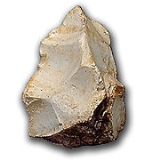
Lithic core

Encyclopedia
In archaeology
, a lithic core is a distinctive artifact
that results from the practice of lithic reduction
. In this sense, a core is the scarred nucleus resulting from the detachment of one or more flake
s from a lump of source material or tool stone
, usually by using a hard hammer percussor such as a hammerstone
. The core is marked with the negative scars of these flakes. The surface area of the core which received the blows necessary for detaching the flakes is referred to as the striking platform. The core may be discarded or shaped further into a core tool, such as can be seen in some types of handaxe.
The purpose of lithic reduction may be to rough out a blank for later refinement into a projectile point
, knife
, or other stone tool
, or it may be performed in order to obtain sharp flake
s, from which a variety of simple tools can be made. Generally, the presence of a core is indicative of the latter process, since the former process usually leaves no core. Cores may be subdivided into specific types by a lithic analyst. Type frequencies, as well as the general types of materials at an archaeological site
, can give the lithic analyst a better understanding of the lithic reduction processes occurring at that site.
Archaeology
Archaeology, or archeology , is the study of human society, primarily through the recovery and analysis of the material culture and environmental data that they have left behind, which includes artifacts, architecture, biofacts and cultural landscapes...
, a lithic core is a distinctive artifact
Artifact (archaeology)
An artifact or artefact is "something made or given shape by man, such as a tool or a work of art, esp an object of archaeological interest"...
that results from the practice of lithic reduction
Lithic reduction
Lithic reduction involves the use of a hard hammer precursor, such as a hammerstone, a soft hammer fabricator , or a wood or antler punch to detach lithic flakes from a lump of tool stone called a lithic core . As flakes are detached in sequence, the original mass of stone is reduced; hence the...
. In this sense, a core is the scarred nucleus resulting from the detachment of one or more flake
Lithic flake
In archaeology, a lithic flake is a "portion of rock removed from an objective piece by percussion or pressure," and may also be referred to as a chip or spall, or collectively as debitage. The objective piece, or the rock being reduced by the removal of flakes, is known as a core. Once the proper...
s from a lump of source material or tool stone
Tool stone
The term tool stone has multiple meanings.In archaeology, a tool stone is a type of stone that is used to manufacture stone tools.Alternatively, the term can be used to refer to stones used as the raw material for tools....
, usually by using a hard hammer percussor such as a hammerstone
Hammerstone
In archaeology, a hammerstone is a hard cobble used to strike off lithic flakes from a lump of tool stone during the process of lithic reduction. The hammerstone is a rather universal stone tool which appeared early in most regions of the world including Europe, India and North America...
. The core is marked with the negative scars of these flakes. The surface area of the core which received the blows necessary for detaching the flakes is referred to as the striking platform. The core may be discarded or shaped further into a core tool, such as can be seen in some types of handaxe.
The purpose of lithic reduction may be to rough out a blank for later refinement into a projectile point
Projectile point
In archaeological terms, a projectile point is an object that was hafted to a projectile, such as a spear, dart, or arrow, or perhaps used as a knife....
, knife
Knife
A knife is a cutting tool with an exposed cutting edge or blade, hand-held or otherwise, with or without a handle. Knives were used at least two-and-a-half million years ago, as evidenced by the Oldowan tools...
, or other stone tool
Stone tool
A stone tool is, in the most general sense, any tool made either partially or entirely out of stone. Although stone tool-dependent societies and cultures still exist today, most stone tools are associated with prehistoric, particularly Stone Age cultures that have become extinct...
, or it may be performed in order to obtain sharp flake
Lithic flake
In archaeology, a lithic flake is a "portion of rock removed from an objective piece by percussion or pressure," and may also be referred to as a chip or spall, or collectively as debitage. The objective piece, or the rock being reduced by the removal of flakes, is known as a core. Once the proper...
s, from which a variety of simple tools can be made. Generally, the presence of a core is indicative of the latter process, since the former process usually leaves no core. Cores may be subdivided into specific types by a lithic analyst. Type frequencies, as well as the general types of materials at an archaeological site
Archaeological site
An archaeological site is a place in which evidence of past activity is preserved , and which has been, or may be, investigated using the discipline of archaeology and represents a part of the archaeological record.Beyond this, the definition and geographical extent of a 'site' can vary widely,...
, can give the lithic analyst a better understanding of the lithic reduction processes occurring at that site.