
All Topics  
Leyland Motors Ltd

 
Leyland Motors Ltd

   Email Print
   Bookmark   Link


Leyland Motors Ltd


Leyland Motors Limited was a British
United Kingdom

The United Kingdom of Great Britain and Northern Ireland, commonly known as the United Kingdom , the UK or Britain,is a sovereign state located off the northwestern coast of continental Europe....
 vehicle manufacturer of lorries
Lorry

Lorry may refer to:Transport:* Lorry or truck, a large motor vehicle* Lorry, called a tippler in the UK, an open Gondola #Lorry with a tipping trough...
 and bus
Bus

A bus is a road vehicle designed to carry passengers. A bus can generally seat a maximum of anywhere from 8 to 200 passengers; many more passengers than a minivan....
es. It gave its name to the British Leyland Motor Corporation
British Leyland Motor Corporation

British Leyland was a vehicle manufacturing company formed in the United Kingdom in 1968 as British Leyland Motor Corporation Ltd . It was partly nationalization in 1975 with the government creating a new holding company called British Leyland Ltd which became BL Ltd in 1978....
 formed when it merged with British Motor Holdings
British Motor Holdings

British Motor Holdings Ltd was a United Kingdom motor company created in an attempt to halt the decline in Britain's manufacturing base in the 1960s....
, later to become British Leyland after effectively becoming nationalised. British Leyland later changed its name to simply BL, then in 1986 Rover Group
Rover Group

Rover Group plc was the name that was given by the British government, in 1986, to the nationalisation vehicle manufacturer British Leyland or BL....
.

and Motors has a long history dating from 1896, when the Sumner and Spurrier families founded the Lancashire Steam Motor Company in the town of Leyland
Leyland, Lancashire

Leyland is a town in the South Ribble of Lancashire, England. Lying approximately six miles south of the city of Preston, Leyland has a population of around 40,000....
 in North West England.


Discussion
Ask a question about 'Leyland Motors Ltd'
Start a new discussion about 'Leyland Motors Ltd'
Answer questions from other users
Full Discussion Forum


Encyclopedia


Leyland Motors Limited was a British
United Kingdom

The United Kingdom of Great Britain and Northern Ireland, commonly known as the United Kingdom , the UK or Britain,is a sovereign state located off the northwestern coast of continental Europe....
 vehicle manufacturer of lorries
Lorry

Lorry may refer to:Transport:* Lorry or truck, a large motor vehicle* Lorry, called a tippler in the UK, an open Gondola #Lorry with a tipping trough...
 and bus
Bus

A bus is a road vehicle designed to carry passengers. A bus can generally seat a maximum of anywhere from 8 to 200 passengers; many more passengers than a minivan....
es. It gave its name to the British Leyland Motor Corporation
British Leyland Motor Corporation

British Leyland was a vehicle manufacturing company formed in the United Kingdom in 1968 as British Leyland Motor Corporation Ltd . It was partly nationalization in 1975 with the government creating a new holding company called British Leyland Ltd which became BL Ltd in 1978....
 formed when it merged with British Motor Holdings
British Motor Holdings

British Motor Holdings Ltd was a United Kingdom motor company created in an attempt to halt the decline in Britain's manufacturing base in the 1960s....
, later to become British Leyland after effectively becoming nationalised. British Leyland later changed its name to simply BL, then in 1986 Rover Group
Rover Group

Rover Group plc was the name that was given by the British government, in 1986, to the nationalisation vehicle manufacturer British Leyland or BL....
.

History


Beginning

Leyland Motors has a long history dating from 1896, when the Sumner and Spurrier families founded the Lancashire Steam Motor Company in the town of Leyland
Leyland, Lancashire

Leyland is a town in the South Ribble of Lancashire, England. Lying approximately six miles south of the city of Preston, Leyland has a population of around 40,000....
 in North West England. The company's first vehicle was a 1.5-ton-capacity steam powered van. The Lancashire Steam Motor Company was renamed Leyland Motors in 1907 when they took over Coulthards of Preston
Preston

Preston is a city and non-metropolitan district of Lancashire, in North West England. It is located on the north bank of the River Ribble, and was granted City status in the United Kingdom in 2002, becoming England's 50th city in the 50th year of Elizabeth II of the United Kingdom's reign....
. They also built a second factory in the neighbouring town of Chorley
Chorley

Chorley is a market town in Lancashire, in North West England. The town's wealth came principally from the cotton industry. As recently as the 1970s the skyline was dominated by numerous factory chimneys, but most are now demolished: remnants of the industrial past include Morrison's chimney and a few other mill buildings, and the streets of...
 which still remains today as the headquarters of the LEX leasing and parts company.

In 1920 Leyland Motors produced the Leyland 8 luxury touring car, a development of which was driven by J.G. Parry-Thomas
J.G. Parry-Thomas

John Godfrey Parry-Thomas was a Welsh people engineer and motor-racing driver who at one time held the Land Speed Record. He was the first driver to be killed in pursuit of the land speed record....
 at Brooklands. Parry-Thomas was later killed in attempt on the land speed record when a chain drive broke. At the other extreme, they also produced the Trojan Utility Car
Trojan (automobile)

Trojan was a Great Britain automobile automobile manufacturer; the eponymous marque thereof was produced between 1914 and 1974....
 in the Kingston on Thames factory from 1922 to 1928.

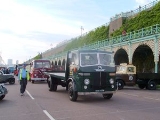
Leyland Reg Kog 676
Three generations of Spurriers controlled Leyland Motors from its foundation until the retirement of Sir Henry Spurrier
Henry Spurrier

Sir Henry Spurrier was a United Kingdom engineer and industrialist, and the third generation of the Spurrier family to head Leyland Motors....
 in 1964. Sir Henry inherited control of Leyland Motors from his father in 1942, and successfully guided its growth during the postwar years. Whilst the Spurrier family were in control the company enjoyed excellent labour relations—reputedly never losing a day's production through industrial action.

World War 2

During the war
World War II

World War II, or the Second World War , was a global military conflict which involved a Participants in World War II, including all of the great powers, organised into two opposing military alliances: the Allies of World War II and the Axis powers....
, Leyland Motors along with most vehicle manufacturers was involved in war production. Leyland built the Cromwell tank
Cromwell tank

The Tank, Cruiser, Mk VIII, Cromwell , named after the English Civil War leader Oliver Cromwell, was one of the most successful series of cruiser tanks fielded by United Kingdom in World War II....
 at its works from 1943.

After the war, Leyland Motors continued military manufacture with the Centurion tank
Centurion tank

The Centurion was the primary United Kingdom main battle tank of the postwar period, and has proven itself be a successful tank design for most of the postwar decades; the Centurion's success has been mainly due to its thick armour, adaptability of its chassis to other roles, and numerous upgrades....
.

Post war

In 1946, AEC and Leyland Motors worked to form the British United Traction Ltd.

In 1955, through an equity agreement, manufacture of commercial vehicles under license from Leyland Motors commenced in Madras, India
India

India, officially the Republic of India , is a country in South Asia. It is the List of countries and outlying territories by total area country by geographical area, the List of countries by population country, and the most populous liberal democracy in the world....
 at the new Ashok factory. The products were branded as Ashok Leyland
Ashok Leyland

Ashok Leyland is a commercial vehicle manufacturing company based in Chennai, India. It is the second largest commercial vehicle company in India in the medium and heavy commercial vehicle segment with a market share of 28% ....
.

On the other hand, Leyland Motors acquired other companies in the post war years:
  • 1951: Albion Motors
    Albion Motors

    Albion Motors of Scotstoun, Glasgow was a Scotland automobile manufacturer, later it concentrated on building commercial vehicles. Today the company is a subsidiary of American Axle, and manufactures axles, driveline systems, chassis systems, crankshafts and chassis components....
  • 1953: Collaboration with Danish Automobile Building
    Danish Automobile Building

    Danish Automobile Building was a Danish bus manufacturer based in Silkeborg. It was in existence from 1912 until 2002.DAB was founded in 1912 in Silkeborg by a Mr....
     (DAB), a bus manufacturer, later with a majority stake in the 1970s
  • 1955: Scammell Lorries Ltd—military and specialist lorry manufacturer
  • 1960: Standard
    Standard Motor Company

    The Standard Motor Company was founded in Coventry, England in 1903 by Reginald Walter Maudslay . The Standard name was last used in Britain in 1963, and in India in 1987....
     Triumph
    Triumph Motor Company

    The Triumph Motor Company had its origins in 1885 when Siegfried Bettmann and Moritz Schulte from Germany founded Bettmann & Co and started selling Triumph bicycles, from premises in London and from 1889 started making his own machines in Coventry, England....
    , cars, vans and some agricultural machinery interests
  • 1962: Associated Commercial Vehicles (ACV), which incorporated AEC, Thornycroft
    Thornycroft

    Thornycroft was a United Kingdom-based vehicle manufacturer which built Coach es, buses, and trucks from 1896 until 1977....
    , Park Royal Vehicles
    Park Royal Vehicles

    Dating its origins back to 1889, Park Royal Vehicles along with its Leeds-based subsidiary Charles H. Roe was one of Britain's leading coachbuilders and Bus manufacturing based at Park Royal, West London, United Kingdom....
     and Charles H. Roe
    Charles H. Roe

    Charles H. Roe Ltd. was a Yorkshire coachbuilder company. It was reformed in 1923 based at Cross Gates, Leeds Carriage Works, in Leeds. Then in 1947 was taken over by Park Royal Vehicles two years later along with parent company Park Royal Vehicles, it became part of Associated Equipment Company#Post war in 1949, which was merged with L...
    . Then Leyland Motors was renamed Leyland Motor Corporation
  • 1965: Minority (25%) interests in Bristol Commercial Vehicles
    Bristol Commercial Vehicles

    Bristol Commercial Vehicles Ltd was a manufacturer of buses and trucks based in Bristol, England....
     and Eastern Coach Works
    Eastern Coach Works

    Eastern Coach Works Ltd was a bus and railbus body building company based in Lowestoft, England....
  • 1967: Rover
    Rover (car)

    The Rover Company was a British automobile manufacturing company originally founded as Starley & Sutton Co. of Coventry in 1878. After developing the template for the modern bicycle with its Rover Safety Bicycle of 1885, the company moved into the automotive industry....
     cars


Donald Stokes took over as head of the company in 1964 and in 1968 it merged with British Motor Holdings
British Motor Holdings

British Motor Holdings Ltd was a United Kingdom motor company created in an attempt to halt the decline in Britain's manufacturing base in the 1960s....
 (BMH) to form the British Leyland Motor Corporation
British Leyland Motor Corporation

British Leyland was a vehicle manufacturing company formed in the United Kingdom in 1968 as British Leyland Motor Corporation Ltd . It was partly nationalization in 1975 with the government creating a new holding company called British Leyland Ltd which became BL Ltd in 1978....
 (BLMC). BMH brought with it more famous British goods vehicle and bus and coach marque
Marque

A marque is a brand name, especially in the automobile industry. For example, Chevrolet and Pontiac are marques of their maker, General Motors Corporation ....
s, including Daimler
Daimler Motor Company

The Daimler Motor Company was a United Kingdom motor vehicle manufacturing company, founded in 1896, and based in Coventry. The company became a subsidiary of Birmingham Small Arms in 1910, and was acquired by Jaguar Cars in 1960....
, Guy
Guy Motors

Guy Motors was a British company based in Fallings Park, Wolverhampton that made cars, lorries, buses, and trolleybuses. They were established in 1914 by Sydney Guy who had been the Works Manager of nearby Sunbeam Car Company....
, BMC
British Motor Corporation

The British Motor Corporation was a United Kingdom vehicle company, formed by the merger of the Austin Motor Company and the Nuffield Organisation in 1952....
, Austin
Austin Motor Company

The Austin Motor Company was a United Kingdom manufacturer of automobiles that rose to be a major motorcar brand, the dominant partner after merger with Morris in 1952 but declining after absorption into the British Leyland Motor Corporation, and its subsequent troubles....
 and Morris
Morris Motor Company

The Morris Motor Company was a United Kingdom automobile manufacturing company. After the incorporation of the company into larger corporations, the Morris name remained in use as a marque until 1984 when British Leyland's Austin Rover Group decided to concentrate on the more popular Austin Motor Company marque....
 into the new organization.

British Leyland era

British Leyland Logo
The BLMC group was difficult to manage because of the many companies under its control, often making similar products. This, and other reasons, led to financial difficulties and in December 1974 British Leyland had to receive a guarantee from the British government.

In 1975, after the publication of the Ryder Report
Ryder Report (British Leyland)

The Ryder Report was the official report produced for the Government of the United Kingdom in 1975 by Sir Don Ryder, newly appointed head of the United Kingdom's National Enterprise Board who was given the task of reporting on the British Leyland Motor Corporation and listing recommendations for its future....
, BLMC nationalised as British Leyland (BL) and split into 4 divisions with the bus and truck production becoming the Leyland Truck & Bus division within the Land Rover Leyland Group
Land Rover Group

Land Rover Group was a division of British Leyland and later the Rover Group that was in existence between 1981 and 1987. LRG brought British Leyland's light commercial vehicle production under one management, consisting of the Land Rover utility 4x4 range, the Range Rover luxury 4x4 and the former LDV Pilot van range ....
. This division was spilt into Leyland Bus and Leyland Trucks
Leyland Trucks

Leyland Trucks is the UK's leading medium & heavy duty truck manufacturer and is based in the town of Leyland, Lancashire, Lancashire. It emerged from the bankruptcy of DAF NV as the result of a management buy-out in 1993, and was acquired by PACCAR in 1998, of which it is now a subsidiary....
 in 1981. In 1986 BL changed its name to Rover Group
Rover Group

Rover Group plc was the name that was given by the British government, in 1986, to the nationalisation vehicle manufacturer British Leyland or BL....
. The equity stake in Ashok Leyland was controlled by Land Rover Leyland International Holdings, and sold in 1987.

Leyland name post-British Leyland


Buses
The bus operations were divested as a management buy-out to form Leyland Bus
Leyland Bus

Leyland Bus was a United Kingdom bus manufacturer. It emerged from the Rover Group as a management buyout of the bus business. It was subsequently acquired by Volvo Buses and the name disappeared in 1993....
, and was subsequently bought by Volvo Buses
Volvo Buses

Volvo Buses is a subsidiary and a business area of Volvo which became an independent division in 1968.It is the world's second largest bus manufacturer, with a complete range of heavy buses for passenger transportation....
 in 1988, which discontinued most of its product range.

Trucks
  • 1987 The Leyland Trucks division of Rover Group (formerly BL) merged with DAF Trucks
    DAF Trucks

    DAF Trucks NV is a Netherlands truck manufacturing company and a division of PACCAR. Its headquarters and main plant are in Eindhoven. Cabs and axle assembly are produced at its Westerlo plant in Belgium....
     of The Netherlands, and was floated on the Dutch stock exchange as DAF NV
    DAF NV

    DAF NV was a commercial vehicle manufacturing company based in the Netherlands and the United Kingdom. In 1993 DAF NV became insolvent....
    . The new company traded as Leyland DAF
    Leyland DAF

    Leyland DAF was a commercial vehicle manufacturing company based in the United Kingdom, and a division of DAF NV. In 1993 DAF NV became insolvent and Leyland DAF went into receivership....
     in the UK, and as DAF elsewhere.
  • 1993 DAF NV went into bankruptcy. The UK truck division was bought through a management buy-out and became Leyland Trucks
    Leyland Trucks

    Leyland Trucks is the UK's leading medium & heavy duty truck manufacturer and is based in the town of Leyland, Lancashire, Lancashire. It emerged from the bankruptcy of DAF NV as the result of a management buy-out in 1993, and was acquired by PACCAR in 1998, of which it is now a subsidiary....
    . The van division was also bought through a management buy-out and became LDV Limited
    LDV Limited

    For other uses see LDVLDV Group Limited, formerly Leyland DAF Vans, is a UK van manufacturer, based in the Ward End area of Birmingham, and is a wholly owned subsidiary of the Russian GAZ group....
    . The Spare Parts Operation (Multipart) was also subject to a management buy-out before eventually becoming part of the LEX organisation.
  • 1998 Leyland Trucks was acquired by the US truck manufacturer PACCAR
    PACCAR

    Paccar Inc is the Truck#Heavy_trucks_market_worldwide manufacturer of heavy-duty trucks in the world , and has substantial manufacture in light and medium vehicles through its various subsidiaries....
    . Leyland Trucks now operates as a division of PACCAR
    PACCAR

    Paccar Inc is the Truck#Heavy_trucks_market_worldwide manufacturer of heavy-duty trucks in the world , and has substantial manufacture in light and medium vehicles through its various subsidiaries....
     from the Leyland
    Leyland

    Articles beginning Leyland include:* LeylandAlliance* Leyland Band* Leyland Brothers* Leyland Cypress* Leyland * Leyland, Lancashire** Leyland police station...
     Assembly Plant in North West England manufacturing around 14,000 trucks per year of which about a third are sold in the EU.


Products

De2817

Buses

Historically, Leyland Motors was a major manufacturer of buses used in the United Kingdom
United Kingdom

The United Kingdom of Great Britain and Northern Ireland, commonly known as the United Kingdom , the UK or Britain,is a sovereign state located off the northwestern coast of continental Europe....
 and world-wide, being probably most famous for the trend-setting Atlantean
Leyland Atlantean

The Leyland Atlantean was a model of double-decker bus built by Leyland Motors Ltd in the United Kingdom from 1958 to 1986.It pioneered the design of rear-engined, front entrance double deck buses in the UK, allowing for the introduction of "one person operated" buses, dispensing with the need for a Conductor ....
 rear-engined double decker bus design produced between 1956 and 1986.

See List of Leyland buses
List of Leyland buses

This is a list of all known passenger chassis and integral bus vehicles manufactured by Leyland Motors Ltd and successors from 1919 until closure....
 for the list of bus products.


Trucks


1920s
  • Q-type 4 ton
  • SQ2 7 ton
  • SWQ2 10 ton six-wheeler


1930s
  • Beaver
  • Bison
  • Buffalo
  • Bull
  • Hippo
  • Octopus 22 ton eight-wheeler
  • Steer


1940s
  • Comet


1960s
  • Leyland 90
  • Beaver
  • Comet
  • Steer
  • FG


1970s
  • Terrier
  • Boxer
  • Clydesdale
  • Marathon


The Marathon was Leyland's answer to the booming "max cap" truck fad at the start of the 1970s. Imports such as the Volvo F88 and Scania 110/140 were selling very well in the UK due to the previously unheard of levels of driver comfort, reliability, quality and performance.

Leyland had insufficient money for development of a complete new vehicle at the time, so designers were instructed to utilise as many existing in-house components as possible. It was perceived at the time that the resulting model would be a stopgap until the new T45 range was ready for production toward the latter half of the 1970s.

The cab was a re-worked version of the "Ergomatic" tilt cab of 1965, heavily modified with different lower panels, raised height etc, and was available in day and sleeper cab form. Engines were decided from the outset to be in the higher power category to be competitive with rival vehicles, the only existing engine within the Leyland empire suitable for such an application following the demise of the ill-fated fixed-head 500 series was the AEC AV760 straight six, which was turbocharged and designated the TL12. Other engine options included a 200bhp leyland L11, cummins 10 and 14 litre engines at 250/330 bhp. Production began in 1973, and various shortcomings were noted- including below par heating and ventilation, and pronounced cab roll. however roadtesters of the time were very impressed by the truck's power and performance. In 1977 the "marathon 2" was launched, an updated and revised vehicle that attempted to address some of the previous criticisms of the earlier vehicle. relatively few marathons of all types were sold before production ended in 1979 with the introduction of the T45 "roadtrain" range of vehicles.

1980s
  • Roadrunner


This was Leyland's answer to the Ford cargo in the non-HGV 7.5 ton truck sector. Launched in 1984, it utilised a A Leyland straight six engine until 1986 when a 5.9 cummins was introduced. It was notable at the time for its low level passenger side windscreen, featured as a safety aid to enable the driver to see the kerb, although this was deleted on later models. The basic cab had a long service life, becoming later on the Leyland daf 45 and finally the Daf LF.
  • T45 Roadtrain
The Leyland Roadtrain was a range of heavy goods vehicle tractor units manufactured by Leyland Trucks between 1980 and 1990. The nomenclature "T45" refers to the truck range design as a whole and encompasses models such as the lightweight 7.5 ton roadrunner, Freighter (4 wheel rigid truck) constructor (multi axle rigid tipper or mixer chassis-its chassis owing much to the outgoing scammell 8 wheeler handyman) and Cruiser (basic spec low weight tractor unit) The roadtrain itself was a max weight model with distance work in mind.

The cab design was a joint effort between Leyland, BRS and Ogle design and was seen as the height of modernity when compared with its predecessors, the idea being to have one basic design to replace the various different outgoing models (for example, the Bathgate built G cab on the Terrier, the Ergomatic cabbed Lynx, Beaver etc). This did indeed make good economic sense, however there has been speculation that Leyland did in fact alienate a number of customers who had traditionally purchased other marques from within the Leyland empire—Albion, AEC, scammell, etc.—who were now left with no alternative but to have a Leyland branded vehicle or purchase from elsewhere.

Throughout its production run engine choices included the AEC-based TL12, a straight carry over from the preceding "stopgap" model Marathon range, The Rolls-Royce Eagle 265/300 and the Cummins 290 L10 and 14-litre 350 coupled to a Spicer or Eaton transmission, although all versions produced a distinctive whine from the propshaft knuckle joint when approaching . The TL12 engine was dropped early on in the production run, most large fleet buyers choosing the Rolls-Royce engine.

The Roadtrain was available in day and sleeper cabbed form, in high and low datum versions—this refers to the cab height—high datum versions were intended as long haul vehicles with higher mounted cabs and more internal space. 6x2 versions were built in high cab form only on a chassis that was basically that of the ageing scammell trunker.

In 1986 the high roofed Roadtrain interstate was introduced, a top of the range long distance truck with standing room inside.

The Roadtrain was a common sight throughout most of the 1980s, with a great many of the major fleet users in the UK such as Tesco, Blue Circle (unusually with high datum day cabs) and BRS running them. The Firm of Swain's based at Rochester in Kent had a number of roadtrains in its fleet which enjoyed a comparatively long service life (up until the late 1990s) before being replaced by the newer daf 85.

Production ended in 1990 with the sale of Leyland Trucks to Dutch firm DAF, although as a postscript DAF relaunched the model in low datum form (it was already manufacturing the large DAF 95) as the DAF 80, using the Roadtrain cab with the DAF 330 ATi engine (quite ironic, given that this engine had its roots in the Leyland O.680). This model was produced for a relatively short time until 1993 with the launch of the brand new cabbed DAF 85.

Due partly to the cab's propensity to rust and also to the admittedly short life of commercial vehicles, any Roadtrain in commercial operation is now a very rare sight indeed, although a small number of vehicle remain in use throughout the country as recovery vehicles.

The army made use of an 8x8 version of roadtrain as a hook loader until recently.

Diesel Multiple Units

  • British Rail British United Traction
    British Rail British United Traction

    British United Traction was a joint company owned by the Associated Equipment Company and Leyland Motors which produced railway equipment and trolleybuses....
  • Pacer (train)
    Pacer (train)

    Pacer is the operational name of the British Rail Class British Rail Class 140, British Rail Class 141, British Rail Class 142, British Rail Class 143 and British Rail Class 144 diesel multiple unit railbuses, built between 1984 and 1987....
  • British Rail Class 155
    British Rail Class 155

    The British Rail Class 155 "Super-Sprinter " is a diesel multiple unit. These DMUs were built by British Leyland at Workington between 1987 and 1988 as part of British Rail's replacement of its ageing diesel fleet which were First-Generation....


See also

  • British Leyland Motor Corporation
    British Leyland Motor Corporation

    British Leyland was a vehicle manufacturing company formed in the United Kingdom in 1968 as British Leyland Motor Corporation Ltd . It was partly nationalization in 1975 with the government creating a new holding company called British Leyland Ltd which became BL Ltd in 1978....
  • Leyland Trucks
    Leyland Trucks

    Leyland Trucks is the UK's leading medium & heavy duty truck manufacturer and is based in the town of Leyland, Lancashire, Lancashire. It emerged from the bankruptcy of DAF NV as the result of a management buy-out in 1993, and was acquired by PACCAR in 1998, of which it is now a subsidiary....
  • Leyland Bus
    Leyland Bus

    Leyland Bus was a United Kingdom bus manufacturer. It emerged from the Rover Group as a management buyout of the bus business. It was subsequently acquired by Volvo Buses and the name disappeared in 1993....
  • Ashok Leyland
    Ashok Leyland

    Ashok Leyland is a commercial vehicle manufacturing company based in Chennai, India. It is the second largest commercial vehicle company in India in the medium and heavy commercial vehicle segment with a market share of 28% ....


External links