

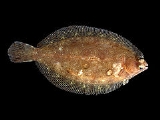
Lemon sole

Encyclopedia
The lemon sole, Microstomus kitt, is a flatfish
of the family Pleuronectidae
. It is native to shallow seas around Northern Europe
, where it lives on stony bottoms down to depths of about 200 metres (656.2 ft). It grows up to 65 centimetres (25.6 in) in length and reaches about 3 kilograms (6.6 lb) in weight.
It is a popular food fish.
also curves. The underside of the fish is white. Adults can reach lengths of up to 65 centimetres (25.6 in), but most measure around 20–30 cm (7.9–11.8 in).
fishing quota
, or Total Allowable Catch (TAC), for lemon sole (and witch
) was 6,175 tonnes, of which 3,716 tonnes were caught, mostly by UK fishermen. The quota for 2008 was 6,793 tonnes and the quota for 2009 was 6,793 tonnes.
The Marine Conservation Society
rates lemon sole at 2/3 on its sustainability scale (where 1 is best and 5 is worst) depending on how and where it is caught.
Flatfish
The flatfish are an order of ray-finned fish, also called the Heterosomata, sometimes classified as a suborder of Perciformes. In many species, both eyes lie on one side of the head, one or the other migrating through and around the head during development...
of the family Pleuronectidae
Pleuronectidae
Righteye flounders are a family, Pleuronectidae, of flounders. They are called "righteye flounders" because most species lie on the sea bottom on their left side, with both eyes on the right side. The Paralichthyidae are the opposite, with their eyes on the left side.Their dorsal and anal fins are...
. It is native to shallow seas around Northern Europe
Northern Europe
Northern Europe is the northern part or region of Europe. Northern Europe typically refers to the seven countries in the northern part of the European subcontinent which includes Denmark, Estonia, Latvia, Lithuania, Norway, Finland and Sweden...
, where it lives on stony bottoms down to depths of about 200 metres (656.2 ft). It grows up to 65 centimetres (25.6 in) in length and reaches about 3 kilograms (6.6 lb) in weight.
It is a popular food fish.
Identification
The lemon sole is a right-eyed flatfish with a small head and mouth and smooth, slimy skin. The upper surface is reddish brown in colour, mottled with pink and orange and flecks of yellow and green, and a prominent orange patch is typically found behind the pectoral fin, around which the lateral lineLateral line
The lateral line is a sense organ in aquatic organisms , used to detect movement and vibration in the surrounding water. Lateral lines are usually visible as faint lines running lengthwise down each side, from the vicinity of the gill covers to the base of the tail...
also curves. The underside of the fish is white. Adults can reach lengths of up to 65 centimetres (25.6 in), but most measure around 20–30 cm (7.9–11.8 in).
Fishing
In 2007 the European UnionEuropean Union
The European Union is an economic and political union of 27 independent member states which are located primarily in Europe. The EU traces its origins from the European Coal and Steel Community and the European Economic Community , formed by six countries in 1958...
fishing quota
Common Fisheries Policy
The Common Fisheries Policy is the fisheries policy of the European Union . It sets quotas for which member states are allowed to catch what amounts of each type of fish, as well as encouraging the fishing industry by various market interventions...
, or Total Allowable Catch (TAC), for lemon sole (and witch
Torbay sole
The witch or Torbay sole is a right-eyed flatfish found in the North Atlantic.The species lives on soft bottoms between 45 and 1460 m and prefers temperatures of 2–6 °C. It eats mostly crustaceans, worms and brittlestars. It spawns from May to September...
) was 6,175 tonnes, of which 3,716 tonnes were caught, mostly by UK fishermen. The quota for 2008 was 6,793 tonnes and the quota for 2009 was 6,793 tonnes.
The Marine Conservation Society
Marine Conservation Society
The Marine Conservation Society a UK charity for the protection of the seas around the United Kingdom, and for the protection of their shores and wildlife.According to their website MCS's Vision is:Their website also states:...
rates lemon sole at 2/3 on its sustainability scale (where 1 is best and 5 is worst) depending on how and where it is caught.
See also
Several other species of flatfish are known as lemon soles:- English soleEnglish soleThe English sole, Parophrys vetulus, is a flatfish of the family Pleuronectidae. It is a demersal fish that lives on sandy and muddy bottoms in estuaries and near shore areas, at depths of up to . It reaches up to in length, and can weigh up to...
, Parophrys vetulus. - Southern lemon soleSouthern lemon soleThe southern lemon sole, Pelotretis flavilatus, is a righteye flounder, the only species in the genus Pelotretis, found around New Zealand in enclosed waters such as estuaries, harbours, mudflats, and sandflats, in waters less than 385 m in depth...
, Pelotretis flavilatus. - Winter flounderWinter flounderThe winter flounder, Pseudopleuronectes americanus, is a right-eyed flatfish of the family Pleuronectidae. It is native to coastal waters of the western north Atlantic coast, from Labrador, Canada to Georgia, United States...
, Pseudopleuronectes americanus. - South African lemon sole, Solea fulvomarginata.