

LaserJet

Encyclopedia
Xerography
Xerography is a dry photocopying technique invented by Chester Carlson in 1938, for which he was awarded on October 6, 1942. Carlson originally called his invention electrophotography...
(DEP) laser printer
Laser printer
A laser printer is a common type of computer printer that rapidly produces high quality text and graphics on plain paper. As with digital photocopiers and multifunction printers , laser printers employ a xerographic printing process, but differ from analog photocopiers in that the image is produced...
s marketed by the American computer-company Hewlett-Packard
Hewlett-Packard
Hewlett-Packard Company or HP is an American multinational information technology corporation headquartered in Palo Alto, California, USA that provides products, technologies, softwares, solutions and services to consumers, small- and medium-sized businesses and large enterprises, including...
(HP). The HP LaserJet was the world's first desktop laser printer.
Technology
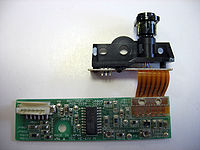
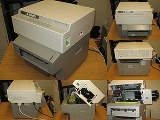
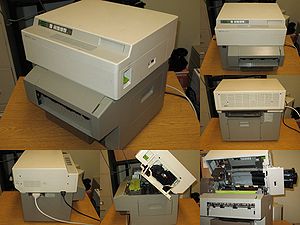
The first HP LaserJet and the first Apple LaserWriter
LaserWriter
The LaserWriter was a laser printer with built-in PostScript interpreter introduced by Apple in 1985. It was one of the first laser printers available to the mass market...
used the same print engine, the Canon CX engine. HP chose to use their in-house developed Printer Control Language (PCL) as opposed to Apple, which adopted the PostScript
PostScript
PostScript is a dynamically typed concatenative programming language created by John Warnock and Charles Geschke in 1982. It is best known for its use as a page description language in the electronic and desktop publishing areas. Adobe PostScript 3 is also the worldwide printing and imaging...
language, as developed by Adobe Systems
Adobe Systems
Adobe Systems Incorporated is an American computer software company founded in 1982 and headquartered in San Jose, California, United States...
. The use of a less-ambitious and simpler Page Description Language allowed HP to deliver its LaserJet to the market about a year before Apple's CX based product, and for $1000 less. The sharing of an identical Canon engine in two competing products continued with the HP LaserJet II/III and the Apple LaserWriter II, which both used the Canon LBP-SX print engine.
1980s
HP introduced the first laser printer for IBM compatible personal computerPersonal computer
A personal computer is any general-purpose computer whose size, capabilities, and original sales price make it useful for individuals, and which is intended to be operated directly by an end-user with no intervening computer operator...
s in May 1984 at the National Computer Conference (COMDEX). It was a 300-dpi
Dots per inch
Dots per inch is a measure of spatial printing or video dot density, in particular the number of individual dots that can be placed in a line within the span of 1 inch . The DPI value tends to correlate with image resolution, but is related only indirectly.- DPI measurement in monitor...
, 8 ppm printer that sold for $3,495 with the price reduced to $2,995 in September of 1985, and featured an 8 MHz Motorola 68000
Motorola 68000
The Motorola 68000 is a 16/32-bit CISC microprocessor core designed and marketed by Freescale Semiconductor...
processor and could print in a variety of character fonts.It was controlled using PCL3
Printer Command Language
Printer Command Language, more commonly referred to as PCL, is a page description language developed by Hewlett-Packard as a printer protocol and has become a de facto industry standard. Originally developed for early inkjet printers in 1984, PCL has been released in varying levels for thermal,...
. Due to the high cost of memory, the first LaserJet only had 128 kilobytes of memory, and a portion of that was reserved for use by the controller.
The HP LaserJet printer had high print quality, could print horizontally or vertically, and produce graphics. It was ideal for printing memos, letters, and spreadsheets. It was virtually silent, so people could talk on the phone while sitting next to the HP LaserJet printer as it was printing.
The first LaserJet was a high-speed replacement for text-only daisy wheel impact printers
Daisy wheel printer
Daisy wheel printers use an impact printing technology invented in 1969 by David S. Lee at Diablo Data Systems. It uses interchangeable pre-formed type elements, each with typically 96 glyphs, to generate high-quality output comparable to premium typewriters such as the IBM Selectric, but two to...
and dot matrix printer
Dot matrix printer
A dot matrix printer or impact matrix printer is a type of computer printer with a print head that runs back and forth, or in an up and down motion, on the page and prints by impact, striking an ink-soaked cloth ribbon against the paper, much like the print mechanism on a typewriter...
s. By using control codes it was possible to change the printed text style using font patterns stored in permanent ROM
Read-only memory
Read-only memory is a class of storage medium used in computers and other electronic devices. Data stored in ROM cannot be modified, or can be modified only slowly or with difficulty, so it is mainly used to distribute firmware .In its strictest sense, ROM refers only...
in the printer. Although unsupported by HP, because the Laserjet used the same basic PCL language (PCL Level III) spoken by HP's other printers it was possible to use the Laserjet on HP 3000
HP 3000
The HP 3000 series is a family of minicomputers released by Hewlett-Packard in 1973. It was designed to be the first minicomputer delivered with a full featured operating system with time-sharing. The first models were withdrawn from the market until speed improvements could be made. It ultimately...
multiuser systems.
The LaserJet Plus followed in September 1985, priced at US$3,995. It introduced "soft fonts", treatments like bold
Emphasis (typography)
In typography, emphasis is the exaggeration of words in a text with a font in a different style from the rest of the text—to emphasize them.- Methods and use :...
and italic
Italic type
In typography, italic type is a cursive typeface based on a stylized form of calligraphic handwriting. Owing to the influence from calligraphy, such typefaces often slant slightly to the right. Different glyph shapes from roman type are also usually used—another influence from calligraphy...
and other features including a parallel
IEEE 1284
IEEE 1284 is a standard that defines bi-directional parallel communications between computers and other devices.-History:In the 1970s, Centronics developed the now-familiar printer parallel port that soon became a de facto standard...
(Centronics
Centronics
Centronics Data Computer Corporation was a pioneering American manufacturer of computer printers, now remembered primarily for the parallel interface that bears its name.-The beginning:Centronics began as a division of Wang Laboratories...
) interface. It also included 512 kilobytes of memory, which was just enough to print graphics at 300 dpi that covered about 70% of the letter-size page area.
In March 1986 HP introduced the LaserJet D+, which included the LaserJet print engine and formatter but with 2 paper trays. The original MSRP was $4,495. In 1986, desktop publishing
Desktop publishing
Desktop publishing is the creation of documents using page layout software on a personal computer.The term has been used for publishing at all levels, from small-circulation documents such as local newsletters to books, magazines and newspapers...
came to the world of IBM PCs and compatibles, after its origin on the Apple Macintosh
Macintosh
The Macintosh , or Mac, is a series of several lines of personal computers designed, developed, and marketed by Apple Inc. The first Macintosh was introduced by Apple's then-chairman Steve Jobs on January 24, 1984; it was the first commercially successful personal computer to feature a mouse and a...
and Apple LaserWriter
LaserWriter
The LaserWriter was a laser printer with built-in PostScript interpreter introduced by Apple in 1985. It was one of the first laser printers available to the mass market...
. The HP LaserJet family, along with Aldus PageMaker
Adobe PageMaker
PageMaker was one of the first desktop publishing programs, introduced in 1985 by Aldus Corporation, initially for the then-new Apple Macintosh and in 1987 for PCs running Windows 1.0....
and Microsoft Windows
Microsoft Windows
Microsoft Windows is a series of operating systems produced by Microsoft.Microsoft introduced an operating environment named Windows on November 20, 1985 as an add-on to MS-DOS in response to the growing interest in graphical user interfaces . Microsoft Windows came to dominate the world's personal...
, was central to the PC-based solution, and while lacking the perceived elegance of Apple's approach, this multi-vendor solution was available to a mass audience for the first time.
HP introduced the mass-market
Mass market
The mass market is a general business term describing the largest group of consumers for a specified industry product. It is the opposite extreme of the term niche market.-General:...
laser printer, the LaserJet series II, in March 1987. The HP LaserJet II was designed from the ground up as a laser printer with correct order page output as opposed to being leveraged from the Canon PC-20 personal copier. The HP LaserJet II used PCL4, improved features, more memory and fonts for a market price of $2,695.
Also in March 1987, the LaserJet 2000 was launched. A high-end, networkable printer, the LaserJet 2000 offered a duty cycle of 70,000 pages per month and the standard 300-dpi output, initially priced at $19,995.
The HP LaserJet IID was released in the fall of 1988, It was the first desktop laser printer capable of duplexing. It was also the first HP LaserJet with an HP designed and manufactured formatter.
In September 1989, HP introduced the first "personal" version of the HP LaserJet printer series, the LaserJet IIP. Priced at US$1,495 by HP, and half the size and price of its predecessor, the LaserJet II, it offered 300-dpi output and 4 ppm printing with PCL 4
Printer Command Language
Printer Command Language, more commonly referred to as PCL, is a page description language developed by Hewlett-Packard as a printer protocol and has become a de facto industry standard. Originally developed for early inkjet printers in 1984, PCL has been released in varying levels for thermal,...
enhancements such as support for compressed bitmapped fonts and raster images. It was also the first no ozone print engine. Retailers predicted a street price of $1000 or less, making it the world’s first sub-$1,000 laser printer. The LaserJet IIP (and its very similar successor, the IIIP) were extremely reliable except for scanner failures, diagnosable by the lack of the familiar "dentist drill" whine and a "52" error displayed on the control panel; aftermarket replacement scanner assemblies remain readily available to this day.
1990s

Resolution enhancement technology
Resolution enhancement technology is a form of image processing technology used to manipulate dot characteristics popular among laser printer and inkjet printer manufacturers...
, which dramatically increased print quality, and HP PCL 5. Thanks to PCL 5, text scaling became easy, and thus customers were no longer restricted to 10- and 12-point type sizes. This had a dramatic effect on word processing
Word processing
Word processing is the creation of documents using a word processor. It can also refer to advanced shorthand techniques, sometimes used in specialized contexts with a specially modified typewriter.-External links:...
software market.
The HP LaserJet IIID was the same as the HP LaserJet III except it had 2 paper trays and duplex printing. It sold for $4,995 in the fall of 1990.
The first mass-market Ethernet network
Jetdirect
JetDirect is the name of a technology sold by Hewlett-Packard that allows computer printers to be directly attached to a Local Area Network. The "JetDirect" designation covers a range of models from the external 1 and 3 port parallel print servers known as the 300x and 500x, to the internal EIO...
printer, the HP LaserJet IIISi, debuted in March 1991. Priced at $5,495, it featured a high-speed, 17 ppm engine, 5MB of memory, 300-dpi output, Image REt and such paper handling features as job stacking and optional duplex printing
Duplex printing
Duplex printing is a feature of computer printers and multifunction printers that allows the automatic printing of a sheet of paper on both sides...
. The LaserJet IIISi also was HP’s first printer to offer onboard Adobe PostScript
PostScript
PostScript is a dynamically typed concatenative programming language created by John Warnock and Charles Geschke in 1982. It is best known for its use as a page description language in the electronic and desktop publishing areas. Adobe PostScript 3 is also the worldwide printing and imaging...
as opposed to the font-cartridge solution offered on earlier models.
In October 1992 HP introduced its first printer with 600-dpi output and Microfine toner, the LaserJet 4
HP LaserJet 4
The HP LaserJet 4 is a group of monochrome laser printers produced in the early to mid-1990s as part of the LaserJet series by Hewlett Packard . The 4 series has various models, including the standard LaserJet 4 for business use, the 4L for personal use and the 4P for small businesses...
, bringing publication-quality printing to the desktop for a cost of US$2,199. This model also introduced TrueType
TrueType
TrueType is an outline font standard originally developed by Apple Computer in the late 1980s as a competitor to Adobe's Type 1 fonts used in PostScript...
fonts to Laserjets; this ensured that the printer fonts exactly matched the fonts displayed on the computer screen. (TrueType fonts could print on an original LaserJet Plus or later, but they would be printed as graphics, making the printing slow and restricted to a limited page area or reduced resolution.)The HP LaserJet 4 had a new Canon engine to enable the 600dpi.
Instant on fusing was introduced with the HP LaserJet 4L in the spring of 1993. It included a new low cost print engine. It sold for $1,229.
In April 1994 HP shipped its 10-millionth LaserJet printer.
In September 1994 HP introduced the Color LaserJet, the corporation's first color laser-printer. The printer had an average cost per page of less than 10 cents. The Color LaserJet offered 2 ppm color printing and 10 ppm for black text, 8MB of memory, 45 built-in fonts, a 1,250-sheet paper tray and enhanced PCL 5 with color. Priced at $7,295.
In March 1995 HP introduced the LaserJet 5
HP LaserJet 5
The HP LaserJet 5 is a group of monochrome laser printers produced in the mid-1990s as part of the LaserJet series by Hewlett Packard . It was the successor to the HP LaserJet 4 series of printers; after the LaserJet 5 series, HP introduced a new naming convention for its LaserJet line...
family of printers. They supported HP PCL
Printer Command Language
Printer Command Language, more commonly referred to as PCL, is a page description language developed by Hewlett-Packard as a printer protocol and has become a de facto industry standard. Originally developed for early inkjet printers in 1984, PCL has been released in varying levels for thermal,...
6, a printer-language which gave noticeably faster output – especially with complex, graphics-intensive documents. They also featured 600-dpi output with REt, and a 12 ppm engine. Prices started from $1,629.
In 1996 HP introduced the network-ready LaserJet 5Si, a major revision and upgrade to the 3Si (IIISi) and 4Si, which had used the Canon NX engine. The 5Si, based on the Canon WX engine, could thus provide 11"x17" printing at an unprecedented 24 pages per minute and at 600 dpi with resolution enhancement. An internal duplexer enabled full-speed double-sided printing. Automatic personality switching (between PCL and PostScript), a feature that first appeared on the 4SiMX, was standard on the 5SiMX. The 5Si series were true workhorses, but initial models were somewhat hobbled by a vulnerability to slightly low voltage (i.e. crashing if mains voltage was less than 120 Volts) as well as a weak clutch in Tray 3 (thus resulting in paper jamming for Tray 3 as well as the optional 2,000-sheet Tray 4), and also a weak solenoid in the manual feed tray (Tray 1). These paper-handling issues were easily dealt with. Many 5Si LaserJets remain in service today.
In 1997 HP introduced the HP LaserJet 4000
HP LaserJet 4000 series
The LaserJet 4000 series is Hewlett-Packard's medium-duty monochrome laser printer range and the successor to the LaserJet 5 series.The LaserJet 4000 series, like most of Hewlett-Packard's laser printer series, follow the standard nomenclature for denoting factory-included features.* n = network...
family of printers. They included features from the HP LaserJet 5 plus higher resolution of 1200 dpi. These are mostly used in offices, and most recently in people's homes mainly to replace the HP LaserJet 4/5 series if the user had them previously. In 1999 HP released the HP LaserJet 4050 series, which was identical to the HP 4000 but with a faster formatter and an easily accessible paper-registration area (where the paper is stopped, registered, and then advanced for printing; a flip-up cover here made clearing of this component easier.) The 4000 series, as well as the 4050 and the 4100, used partly external duplexers.
The world’s first mass-market all-in-one laser device, the HP LaserJet 3100, debuted in April 1998. Users could print, fax, copy, and scan with a single appliance.
In July 1998 HP shipped its 30-millionth LaserJet printer.
In February 1999 HP introduced the LaserJet 2100 printer series
– the world’s first personal laser printers in their class to offer high-quality 1200x1200-dpi resolution without significant performance loss.
In the network laser-printer market, the 5Si series was succeeded by the 8000, and later by the 8100 and 8150. The 8000 brought 1200x1200-dpi resolution, which was continued in the 8100 and 8150. The 8100 and 8150 brought faster printing (32 pages per minute), but this speed was only realized for single-sided (simplex) printing; double-sided printing remained at 24 pages per minute. These models, which used the Canon WX engine, provided excellent durability and good maintainability.
2000s
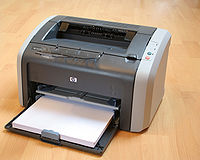
In September 2001 HP entered the low-end laser printer market with the introduction of the LaserJet 1000: the first sub-$250 LaserJet and the lowest-priced monochrome (black and white) HP LaserJet printer to date. It offered 10 ppm, an HP Instant-on fuser, 600 dpi with HP REt boosting output effectively to 1200 dpi, a 2.5-cent cost per page, and a 7,000-page monthly duty cycle.
In 2002, the 8150 was discontinued and was replaced by the 9000 series, which produced 50 pages per minute and used an internal duplexer. Meanwhile, the 4100 was replaced by the 4200 (later 4250) and 4300 (later 4350), which brought speeds of up to 55 pages per minute.
In 2003 HP shipped its 75-millionth LaserJet printer.
In November 2003, HP entered the $24-billion copier market with the LaserJet 9055/9065/9085 MFPs(multifunction printers), a copier-based line of high-volume multifunction printers.
In May 2004, HP celebrated the 20th anniversary of the original LaserJet and ThinkJet printers.
In 2006, total HP LaserJet sales had reached 100 million.
HP has several lines of monochrome and color printers and multifunction products (copy, scan, and/or fax included) that range from 20–55 ppm and range in price from $149 to several thousand dollars.
Evolution of the LaserJet control panel

A 4L's four status LEDs will also light in unusual patterns to indicate service requirements; for example, a lit error light and a lit ready light would indicate a fuser problem (usually just needs to be reseated – most 4L problems can be resolved by simply disassembling the printer, cleaning it, then reassembling it). This was much more cryptic than the alphanumeric display of earlier models like the II/IID, III/IIID, IIP, and IIIP, as it was impossible to determine the meaning of the patterns of LEDs without comparing them against a manual (or having their meaning memorized, which some technicians exposed to them often might actually do, intentionally or not). Interestingly, the 4L used early light pipes, with surface-mounted LEDs on the control board on the left side of the printer, and plastic channels to conduct light from the lit status LEDs to the top of the printer. The LaserJet 4/4 Plus/4M/4M Plus retained an alphanumeric display, and in fact upgraded from the LCD displays of earlier models by using a 16-character alphanumeric dot-matrix vacuum fluorescent display. To this day, professional-grade LaserJets retain more comprehensive displays.
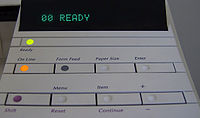
Before the 4L, the control panel typically had buttons with names like Online, Menu, Shift, Continue, Reset, +, -, and Form Feed. It also included status indicators like Online and Ready. Users without a technical background, especially those who has not used a printer before the late 1990s, might not understand these indicators, or might think they are conflicting or ambiguous. It may not be intuitive to new users that a printer that is ready but offline does not print, and while being able to take the printer off line (effectively disconnecting it from the computer) without shutting it down can be very useful, this distinction may appear as an extra complication to users who want to casually use the printer merely as an information appliance.
When a Windows PC controls a LaserJet, the "Form Feed" button seldom does anything when pressed. It has a small indicator light, and was usually used with very simple DOS programs that did not eject the last page after sending data to the printer, though it could also be useful to print the data in the printer's memory if a program failed in the middle of sending a page to be printed. (In certain cases, this might be the only way to recover one's data in the event of a system crash that occurred while printing.) The Form Feed button would print whatever was remaining in memory and prepare the printer to accept any new data as the start of a new page. Note that for at least some LaserJet models, notably the LaserJet 4[M][Plus], the printer must be switched off-line before the Form Feed button will work. Most users of dot-matrix printers in the 1980s probably found the Online and Form Feed functions obvious, as most dot-matrix printers had these buttons and they worked similarly. The indicator on the Form Feed button illuminates when there is received data in the printer's buffer; this makes it much easier to predict what will happen if the printer is put online and a new job is sent to it, or if sending of a job in progress is resumed.
Also, the "Online" button is actually a toggle switch, such that if the printer is already online, pressing Online makes the printer go offline and can be used to stop a runaway print job. Pressing Shift-Reset will then reset the printer, clearing the remainder of the unwanted document from the printer's memory, so that it will not continue to print it when brought back on line. (Before resetting the printer, it is necessary to make the computer stop sending data for the print job to the printer, if it hasn't already finished sending that job, through the computer's software. Otherwise, when the printer is put back online, it will start receiving the job from somewhere in the middle, which will likely cause the same runaway problem to recur.)

HP LaserJet 4000 series
The LaserJet 4000 series is Hewlett-Packard's medium-duty monochrome laser printer range and the successor to the LaserJet 5 series.The LaserJet 4000 series, like most of Hewlett-Packard's laser printer series, follow the standard nomenclature for denoting factory-included features.* n = network...
in 1997, the control panel was completely redesigned. The Shift button, which might have been confusing, was gone. There was a Menu, an Item and a Value button. Each of these might be clicked left of right. There was a Select button, a large green Go button, and a small orange Cancel Job button. Configuration through the control panel was easier and more intuitive: you navigate in the menus with the Menu button. Then, you navigate in the items within the menu with the Item button. To change an item's value, you use the Value button which had - (decrease) and + (increase). You could use the Select button to select a particular choice. Also the display was adapted too, it was a blue-backlit two-line LCD display.
But by 1999 personal computers had embraced the Windows 95 era and many of the original manual control buttons like Form Feed were no longer necessary, because the Windows 95 print-spooler subsystem offered even simple Windows applications a much greater control over the printer than was available to DOS applications, which had to each independently rebuild and re-engineer basic printer management systems from scratch. This new Windows-oriented interface was highly intuitive and obvious to the casual user, who needed little familiarization with the printer to use it effectively.
Raw, unformatted, text-only support still exists, but the professional LaserJet printers keep it hidden away. Most professional LaserJet printers include a PCL menu where the number of copies, the font style, portrait or landscape printing, and the number of lines-per-page can be defined. These settings are ignored by graphical PCL/Postscript print drivers, and are only used for those rare situations where a LaserJet is used to emulate a lineprinter.
Key innovations
- Spring 1984 – First HP LaserJet
- Fall 1991 – First HP Color LaserJet
- Spring 1997 – First printer-based multifunction device
- Spring 2006 – World’s smallest-footprint LaserJet
- Summer 2011 – HP Extraordinary Colors
Industry firsts
- Spring 1984 – Personal laser printing
- March 1991 – Ethernet network printing
- April 1993 – Web Jetadmin
- November 2005 – Universal Print Driver
Models
The model numbers do not necessarily have anything to do with the order of product development or the type of print-engine technology. For example, the LaserJet 1018 printer has newer, smaller, and more energy-efficient technology than the LaserJet 4000. The 1018 also features USB while the older 4000 does not.Mono
- HP LaserJet Original Printer series
- HP LaserJet Printer (March 1984)
- HP LaserJet Plus Printer (November 1985)
- HP LaserJet 500 Plus Printer (March 1986)
- HP LaserJet II Printer series (March 1987)
- HP LaserJet Series II Printer
- HP LaserJet IID Printer (1988)
- HP LaserJet IIp Printer (1989)
- HP LaserJet IIp Plus Printer (1989)
- HP LaserJet III Printer series (March 1990)
- HP LaserJet III Printer (1990)
- HP LaserJet IIID Printer (1990)
- HP LaserJet IIIp Printer (1991)
- HP LaserJet IIISi Printer (March 1991)
- HP LaserJet 4HP LaserJet 4The HP LaserJet 4 is a group of monochrome laser printers produced in the early to mid-1990s as part of the LaserJet series by Hewlett Packard . The 4 series has various models, including the standard LaserJet 4 for business use, the 4L for personal use and the 4P for small businesses...
Printer series- HP LaserJet 4 (October 1992) / 4M Printer series
- HP LaserJet 4 Plus / 4M Plus Printer series
- HP LaserJet 4L / mL Printer series
- HP LaserJet 4p / mp Printer series
- HP LaserJet 4Si Printer series
- HP LaserJet 4v / mv Printer series (1994)
- HP LaserJet 5HP LaserJet 5The HP LaserJet 5 is a group of monochrome laser printers produced in the mid-1990s as part of the LaserJet series by Hewlett Packard . It was the successor to the HP LaserJet 4 series of printers; after the LaserJet 5 series, HP introduced a new naming convention for its LaserJet line...
Printer series- HP LaserJet 5 / m / n Printer series
- HP LaserJet 5 (April 1996)
- HP LaserJet 5L Printer series
- HP LaserJet 5p / mp Printer series
- HP LaserJet 5Si Printer series
- HP LaserJet 6 Printer series
- HP LaserJet 6L Printer series
- HP LaserJet 6L Pro Printer
- HP LaserJet 6p/mp Printer series
- HP LaserJet 1000 Printer series
- HP LaserJet 1000 Printer (2001)
- HP LaserJet 1005 Printer
- HP LaserJet 1010 Printer series
- HP LaserJet 1012HP LaserJet 1012The HP LaserJet 1012 is a low-end, monochrome laser printer from Hewlett-Packard that retails for US $199.99 and was designed as an inexpensive laser alternative to Inkjet printers for home and small office use...
Printer - HP LaserJet 1015 Printer
- HP LaserJet 1018 Printer
- HP LaserJet 1020HP LaserJet 1020The HP LaserJet 1020 is a low cost, low volume, monochromatic laser printer. It was a replacement for the HP LaserJet 1012 but seems to suffer from many of the same flaws and problems owing to overheating and lack of internal cooling...
Printer series - HP LaserJet 1022 Printer series
- HP LaserJet 1100 Printer series
- HP LaserJet 1150 Printer
- HP LaserJet 1160 Printer Series
- HP LaserJet 1200 Printer series
- HP LaserJet 1300 Printer series
- HP LaserJet 1320 Printer series
- HP LaserJet 2000 Printer series (March 1987)
- HP LaserJet 2000 Printer series
- HP LaserJet 2100 Printer series (February 1999)
-
- HP LaserJet 2200 Printer series (2001)
- HP LaserJet 2300HP LaserJet 2300 seriesThe Laserjet 2300 Series was a line of grayscale laser printers sold by Hewlett-Packard. The printer was aimed at small & medium business use.-Variations :The 2300 Series came in several configurations and variations:* LaserJet 2300Standard model....
Printer series - HP LaserJet 2400 Printer series
- HP LaserJet 3000 Printer series
- HP LaserJet 3100 Printer series
- HP LaserJet 3200 Printer series
- HP LaserJet 4000 Printer seriesHP LaserJet 4000 seriesThe LaserJet 4000 series is Hewlett-Packard's medium-duty monochrome laser printer range and the successor to the LaserJet 5 series.The LaserJet 4000 series, like most of Hewlett-Packard's laser printer series, follow the standard nomenclature for denoting factory-included features.* n = network...
(1997)- HP LaserJet 4000 Printer series (1997)
- HP LaserJet 4050 Printer series (1999)
- HP LaserJet 4100 Printer series (2001)
- HP LaserJet 4200 Printer series (2002)
- HP LaserJet 4240n Printer
- HP LaserJet 4250 Printer series
- HP LaserJet 4300 Printer series
- HP LaserJet 4350 Printer series
- HP LaserJet 5000 Printer series
- HP LaserJet 5000 Printer series
- HP LaserJet 5100 Printer series
- HP LaserJet 5200 Printer series
- HP LaserJet 8000 Printer series (1998)
- HP LaserJet 8000 Printer series
- HP LaserJet 8100 Printer series
- HP LaserJet 8150 Printer series
- HP LaserJet 9000 Printer series (2002)
- HP LaserJet 9000 Printer series
- HP LaserJet 9040 Printer series
- HP LaserJet 9050 Printer series
- HP LaserJet P2000 Printer series
- HP LaserJet P2015 Printer series
- HP LaserJet P3000HP LaserJet P3000 seriesThe HP LaserJet P3000 series is a series of black & white laser business printers. Unveiled in October 2006, they are a direct replacement for the LaserJet 2400 series of printers.- Models :...
Printer series (2006)- HP LaserJet Enterprise P3010 series (2009)
- HP LaserJet P4010 Printer series
- HP LaserJet P4500 Printer series
-
HP LaserJet Companionthe LaserJet Companion is a sheet-fed monochrome scanner that connected to the parallel port of a LaserJet and provided copy functionality; as well as software scanning and fax functions.
Color
- HP Color LaserJet Original Printer series
- HP Color LaserJet (September 1994)
- HP Color LaserJet CP4000 Printer series
- HP Color LaserJet CP4005 Printer series
- HP Color LaserJet 5 Printer series
- HP Color LaserJet 5/5m Printer series
- HP Color LaserJet 1000 Printer series
- HP Color LaserJet 1500 Printer series
- HP Color LaserJet 1600 Printer
- HP Color LaserJet 2000 Printer series
- HP Color LaserJet 2500 Printer series
- HP Color LaserJet 2550 Printer series
- HP Color LaserJet 2600n Printer
- HP Color LaserJet 2605 Printer series
- HP Color LaserJet 2700 Printer series
- HP Color LaserJet 3000 Printer series
- HP Color LaserJet 3000 Printer series
- HP Color LaserJet 3500 Printer series
- HP Color LaserJet 3550 Printer series
- HP Color LaserJet 3600 Printer series
- HP Color LaserJet 3700 Printer series
- HP Color LaserJet 3800 Printer series
- HP Color LaserJet 4000 Printer series
- HP Color LaserJet 4500 Printer series (1998)
- HP Color LaserJet 4550 Printer series
- HP Color LaserJet 4600 Printer series
- HP Color LaserJet 4610n Printer
- HP Color LaserJet 4650 Printer series
- HP Color LaserJet 4700 Printer series
- HP Color LaserJet 5000 Printer series
- HP Color LaserJet 5500 Printer series
- HP Color LaserJet 5550 Printer series
- HP Color LaserJet 8000 Printer series
- HP Color LaserJet 8500 Printer series
- HP Color LaserJet 8550 Printer series
- HP Color LaserJet 9000 Printer series
- HP Color LaserJet 9500 Printer series
(Source: HP.com)
Model suffixes
Printers with factory-installed options have different model-numbers to denote the different options included and to differentiate a specific model from others in its series. These suffixes include:- D for a duplexerDuplex printingDuplex printing is a feature of computer printers and multifunction printers that allows the automatic printing of a sheet of paper on both sides...
, a device which enables fully automatic, hands-free double-sided printing. - T for an additional paper-tray (enables two different paper types to be kept available, or in certain models, to load paper while the printer is printing). (Some D models, with no T suffix, had two trays built in, as did the LaserJet 500 Plus.)
- S for a Paper Stacker, a device which increases the output bin capacity.
- N for built-in, MIO or EIO slot JetDirectJetdirectJetDirect is the name of a technology sold by Hewlett-Packard that allows computer printers to be directly attached to a Local Area Network. The "JetDirect" designation covers a range of models from the external 1 and 3 port parallel print servers known as the 300x and 500x, to the internal EIO...
(network) card - W for built-in wireless network card
- H for High-capacity (heavy-duty model, sometimes combined with M to indicate Heavy Media)
- L for Light (only 1 paper tray)
- P for Personal, meant for "personal or small workgroup" use
- ph+ for Paper handling (e.g. Stapler-stacker), or S/SL for stapler/stacker.
- M for Macintosh (PostScript module present); (sometimes?) also extra memory to support PostScript (as in 4M/4M Plus)
- X for combination duplexing, networkable printer with additional tray. Replaced the DTN suffix.
Example: A LaserJet 4000X would come with a duplexer and a built in JetDirect
Jetdirect
JetDirect is the name of a technology sold by Hewlett-Packard that allows computer printers to be directly attached to a Local Area Network. The "JetDirect" designation covers a range of models from the external 1 and 3 port parallel print servers known as the 300x and 500x, to the internal EIO...
card, as well as an extra paper tray.
Upgrading memory of older models
Many older LaserJets and other HP printers (including LaserJet 4+, 4MV, 4MP, 4P, 5, 5M, 5MP, 5N, 5P, 5se, 5Si MOPIER, 5Si, 5Si NX, 6MP, 6P, 6Pse, 6Pxi, C3100A; DesignJet 330, 350C, 700, 750C, 750C Plus; DeskJet: 1600C, 1600CM, 1600CN; and PaintJet XL300) used proprietary 72-pin HP SIMMSIMM
A SIMM, or single in-line memory module, is a type of memory module containing random access memory used in computers from the early 1980s to the late 1990s. It differs from a dual in-line memory module , the most predominant form of memory module today, in that the contacts on a SIMM are redundant...
s for memory expansion. These are essentially industry-standard 72-bit SIMMs with non-standard Presence Detect
Serial Presence Detect
Serial presence detect refers to a standardized way to automatically access information about a computer memory module. Earlier 72-pin SIMMs included 5 pins which provided 5 bits of parallel presence detect data, but the 168-pin DIMM standard changed to a serial presence detect to encode much...
(PD) connections. One can often adapt a standard 72-pin SIMM of appropriate capacity to support HP PD by soldering wires to pads, a simple task. HP printers of this type specify that RAM not faster than 70ns be used; this is probably due to a limitation of the PD decoding, and faster RAM can actually be used so long as the PD encoding indicates a speed of 70ns or slower. All printers will work with FPM (Fast Page Mode) memory; many, but not all, will work with EDO memory.
Even older models, such as the LaserJet II, IID, III, IIID, and 4/4M (i.e. not 4 Plus), used proprietary memory expansion boards. For example, the II and IID models used a roughly 4" square memory expansion board populated with DIP DRAM chips and a two-row header connector (with pins on standard 0.1" centers).
External links
- HP Virtual museum: LaserJet printer
- Twenty Years of Innovation: HP LaserJet and Inkjet Printers 1984–2004
- "HP celebrates 25th anniversary of its LaserJet printer". Idaho StatesmanIdaho StatesmanThe Idaho Statesman is a U.S. daily newspaper serving the Boise, Idaho metropolitan area. The paper has a circulation of 61,000 daily, 83,038 Sunday, and employs about 300 people. It is owned by The McClatchy Company....
. - 25 Years of the LaserJet