
|
|
|
|
Daisy wheel printer
|
| |
|
| |
A daisy wheel printer is a printing technology which produces high-quality output comparable to that produced by high-end typewriters such as the IBM Selectric. It was used in computer printers and typewriters from the early 1970s, before falling from use in printers in the late 1980s following the introduction of cheap laser and inkjet printers which could produce high-quality output at far higher speeds. It is now found only in electronic typewriters.
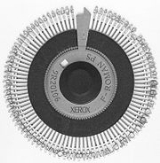
heart of the system is a readily replaceable metal or plastic "daisy wheel" holding an entire character set as raised characters moulded on each "petal".

Discussion
Ask a question about 'Daisy wheel printer'
Start a new discussion about 'Daisy wheel printer'
Answer questions from other users
|
Encyclopedia
A daisy wheel printer is a printing technology which produces high-quality output comparable to that produced by high-end typewriters such as the IBM Selectric. It was used in computer printers and typewriters from the early 1970s, before falling from use in printers in the late 1980s following the introduction of cheap laser and inkjet printers which could produce high-quality output at far higher speeds. It is now found only in electronic typewriters.
Description
The heart of the system is a readily replaceable metal or plastic "daisy wheel" holding an entire character set as raised characters moulded on each "petal". In use, a servo motor rotates the daisy wheel to position the required character between the hammer and the ribbon. The solenoid-operated hammer then fires, driving the character type on to the ribbon and paper to print the character on the paper. The daisy wheel and hammer are mounted on a sliding carriage similar to that used by dot matrix printers.
Different fonts and sizes can be used by replacing the daisy wheel, and software allowed for convenient wheel change, usually spacing the carriage to the center of the platen and prompting the user to change the wheel before continuing printing. However, printing a document which frequently alternated fonts and thus required frequent wheel changes was still an arduous task.
Most daisy wheel machines offered a bold type facility, though this is mostly found on later or high-end machines. Bold printing was accomplished by double or triple striking the specified character(s); servo-based printers would advance the carriage fractionally for a wider (and therefore blacker) character, while cheaper machines would perform a carriage return without a line feed to return to the beginning of the line, space through all non-bold text, and restrike each bolded character. The inherent imprecision in attempting to restrike on exactly the same spot after a carriage return provided the same effect as the more expensive servo-based printers, with the unique side effect that as the printer aged and wore, bold text would become bolder.
Like all other impact printers, daisy wheel printers are noisy. Unlike the more familiar whine of a dot matrix printer, a high speed daisy wheel printer sounded like intermittent machine gun fire.
Thimble printers
Thimble printers were closely related to daisy wheel printers, but instead of a flat wheel the petals were bent to form a cup-shaped "thimble" print element. Introduced by NEC in 1977 as their "Spinwriter" series, the replaceable thimbles each held 128 characters.
History
In 1972 a team at Diablo Systems led by engineer David S. Lee developed the first commercially successful daisy-wheel printer, a device that was faster and more flexible than IBM's golf-ball devices, being capable of 30 cps (characters per second), whereas IBM's Selectric operated at 10 cps.
Xerox acquired Diablo that same year, following which Lee departed to set up Qume Corporation in 1973. Xerox's Office Product Division had already been buying Diablo printers for its Redactron text editors. After 7 years trying to make Diablo profitable, the OPD focused on developing and selling the Diablo 630 which was mostly bought by companies such as DEC. The Diablo 630 was capable of producing letter quality output that was as good as that produced by an IBM Selectric or Selectric-based printer, but at a lower cost. A further advantage over the Selectric-based printers, was that it supported the entire ASCII printing character set. Its servo-controlled carriage also permitted the use of proportional spaced fonts, where characters occupy a different amount of horizontal space according to their width.
The decision was taken to use Diablo's daisy wheel technology in a typewriter that would sell for less than $500 and an automated factory was constructed near Dallas, which took less than 30 minutes to assemble a Xerox typewriter due to the low number of parts. The Xerox typewriter was well received but never achieved the projected sales numbers due to the advent of the PC and word processing software. The typewriter was later modified to be compatible with PCs but the engineering which made it a low cost device reduced its flexibility.
By the mid-1980s daisy wheel technology was rapidly becoming obsolete due to the growing spread of affordable laser and inkjet machines, and daisy wheel machines soon disappeared except for the small remaining typewriter market.
Graphics
Although the daisy wheel principle is basically inappropriate for printing bitmap graphics, there were of course attempts to do so. Many of the faster daisy wheel printers supported a relatively coarse and extremely slow graphics mode by printing the bitmap entirely out of full stops. This required a mechanism capable of pixel by pixel movement, both horizontally and vertically, and so the simpler printers were incapable of it. This was never a particularly useful printing technique, given the slow speed and the poor quality, but as it still used the standard daisywheel it was capable of printing a logo onto a letterhead and then the following letter, all in a single unattended print run.
Serious consideration was even given to optimising graphic printing by changing the glyphs on the daisy wheel to a set that would be able to print all the required bitmap combinations more quickly, without requiring an impact for every single dot. This also had the advantage that the vertical dot combinations could be printed from a single impact, and so no longer requiring fine rotation control of the platen roller. However this did use a specialised daisy wheel and so printing of a letter and letterhead was required to be a two-step process with a manual wheel change in-between. As the development of this technique coincided with affordable laser printers becoming widespread in offices, it was never a popular technique.
See also
|
| |
|
|