

Lacey V. Murrow Memorial Bridge

Encyclopedia
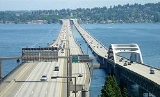
The Lacey V. Murrow Memorial Bridge is a floating bridge
that carries the eastbound lanes of Interstate 90 across Lake Washington
from Seattle to Mercer Island, Washington
. It is the second longest floating bridge on Earth at 6620 ft (2,017.8 m), whereas the longest is the Evergreen Point Floating Bridge
just a few miles to the north on the same lake, built 23 years later. The third longest is the Hood Canal Bridge
, also in Washington State, about 30 miles to the northwest of the Evergreen Point Floating Bridge.
Along with the east portals of the Mount Baker Ridge Tunnel, the bridge is an official City of Seattle landmark. While the bridge originally had an opening span at the center of the bridge to allow a horizontal opening of 202 feet (61.6 m) for major waterborne traffic, the only boat passages currently are elevated fixed spans at the termini with 29 feet (8.8 m) of vertical clearance.
, who came to be called the "father of the bridge". Lightfoot began campaigning for the bridge in 1930, enlisting the support of Miller Freeman. The original two-way, four-lane toll bridge
was designed by the engineer Homer Hadley (1885–1967) and constructed of reinforced concrete. Construction began January 1, 1939 and was completed in 1940. The construction cost for the project was on the order of $9,000,000 including approaches. It was partially financed by a bond issue of $4,184,000. Tolls were removed in 1949. It sank in a storm on November 25, 1990, while it was undergoing refurbishing and repair. The current bridge was built in 1993. The eponymous Lacey V. Murrow was the second Director of the Washington State Highway Department and a highly decorated US Air Force officer who served in World War II. He was the oldest brother of CBS commentator Edward R. Murrow
.
Formerly known as the "Lake Washington Floating Bridge", the original bridge was built under a 1 1/2-year contract awarded to the Puget Sound Bridge and Dredging Company (the project was led by engineer Peter John Jensen) in the amount of $3,254,000. It included a movable span that could be retracted into a pocket in the center of the fixed span to permit large boats to pass. This design resulted in a roadway "bulge" that required vehicles to swerve twice across polished steel joints as they passed the bulge. A "reversible lane
" system, indicated by lighted overhead lane control signals with arrow and 'X' signs, compounded the hazard by putting one lane of traffic on the "wrong" side of the bulge at different times of day in an effort to alleviate rush-hour traffic into or out of Seattle. There were many serious collisions on the bridge. The problems grew worse as the traffic load increased over the years and far outstripped the designed capacity. Renovation or replacement was essential and a parallel bridge, the Homer M. Hadley Memorial Bridge
, was completed in 1989.
 In 1990, while under construction, the original bridge sank because of a series of human errors and decisions. The process started because the bridge needed resurfacing and was to be widened by means of cantilevered additions in order to meet the necessary lane-width specifications of the Interstate Highway System. The Washington State Department of Transportation
(WSDOT) decided to use hydrodemolition
(high-pressure water) to remove unwanted material (the sidewalks on the bridge deck). Water from this hydrodemolition was considered contaminated under environmental law
and could not be allowed to flow into Lake Washington. Engineers then analyzed the pontoon
s of the bridge, and realized that they were over-engineered and the water could be stored temporarily in the pontoons. The watertight doors for the pontoons were therefore removed.
A large storm on November 22, 23, and 24, 1990 (the Thanksgiving
holiday weekend), filled some of the pontoons with rain and lake water. On November 24, workers noticed that the bridge was about to sink, and started pumping out some of the pontoons. However, on November 25, 2790 ft (850.4 m) of the bridge sank, dumping the contaminated water into the lake along with tons of bridge material. The bridge sank when one pontoon filled and dragged the rest down because they were cabled together and there was no way to separate the sections under load. Fortunately, no one was hurt or killed, since the bridge was closed for renovation and the sinking took some time. All of the sinking was captured on film and shown on live TV.
, about a decade earlier under similar circumstances. It is now known that another major floating bridge in Washington, the Evergreen Point Floating Bridge
, is under-engineered for local environmental conditions.
Pontoon bridge
A pontoon bridge or floating bridge is a bridge that floats on water and in which barge- or boat-like pontoons support the bridge deck and its dynamic loads. While pontoon bridges are usually temporary structures, some are used for long periods of time...
that carries the eastbound lanes of Interstate 90 across Lake Washington
Lake Washington
Lake Washington is a large freshwater lake adjacent to the city of Seattle. It is the largest lake in King County and the second largest in the state of Washington, after Lake Chelan. It is bordered by the cities of Seattle on the west, Bellevue and Kirkland on the east, Renton on the south and...
from Seattle to Mercer Island, Washington
Mercer Island, Washington
Mercer Island is a city in King County, Washington, United States and the name of the island in Lake Washington on which the city sits. The population was 22,699 at the 2010 census....
. It is the second longest floating bridge on Earth at 6620 ft (2,017.8 m), whereas the longest is the Evergreen Point Floating Bridge
Evergreen Point Floating Bridge
The Governor Albert D. Rosellini Bridge—Evergreen Point is the longest floating bridge on Earth at and carries State Route 520 across Lake Washington from Seattle to Medina.The Evergreen Point of the bridge's original name is the westernmost of the three small Eastside...
just a few miles to the north on the same lake, built 23 years later. The third longest is the Hood Canal Bridge
Hood Canal Bridge
The Hood Canal Bridge is a floating bridge located in the U.S. state of Washington that carries Washington State Route 104 across Hood Canal and connects the Olympic and Kitsap Peninsulas. At long, The Hood Canal Bridge (officially William A. Bugge Bridge) is a floating bridge located in the U.S....
, also in Washington State, about 30 miles to the northwest of the Evergreen Point Floating Bridge.
Along with the east portals of the Mount Baker Ridge Tunnel, the bridge is an official City of Seattle landmark. While the bridge originally had an opening span at the center of the bridge to allow a horizontal opening of 202 feet (61.6 m) for major waterborne traffic, the only boat passages currently are elevated fixed spans at the termini with 29 feet (8.8 m) of vertical clearance.
History
The bridge was the brainchild of George LightfootGeorge Lightfoot
George Washington Lightfoot was most commonly known as the "father" of the Lake Washington Floating Bridge. Lightfoot was a very important citizen of early Mercer Island. He also was a vaudeville musician who performed under the stage name, "The Jolly Hobo Globetrotter".-References:* Gellay, J....
, who came to be called the "father of the bridge". Lightfoot began campaigning for the bridge in 1930, enlisting the support of Miller Freeman. The original two-way, four-lane toll bridge
Toll bridge
A toll bridge is a bridge over which traffic may pass upon payment of a toll, or fee.- History :The practice of collecting tolls on bridges probably harks back to the days of ferry crossings where people paid a fee to be ferried across stretches of water. As boats became impractical to carry large...
was designed by the engineer Homer Hadley (1885–1967) and constructed of reinforced concrete. Construction began January 1, 1939 and was completed in 1940. The construction cost for the project was on the order of $9,000,000 including approaches. It was partially financed by a bond issue of $4,184,000. Tolls were removed in 1949. It sank in a storm on November 25, 1990, while it was undergoing refurbishing and repair. The current bridge was built in 1993. The eponymous Lacey V. Murrow was the second Director of the Washington State Highway Department and a highly decorated US Air Force officer who served in World War II. He was the oldest brother of CBS commentator Edward R. Murrow
Edward R. Murrow
Edward Roscoe Murrow, KBE was an American broadcast journalist. He first came to prominence with a series of radio news broadcasts during World War II, which were followed by millions of listeners in the United States and Canada.Fellow journalists Eric Sevareid, Ed Bliss, and Alexander Kendrick...
.
Formerly known as the "Lake Washington Floating Bridge", the original bridge was built under a 1 1/2-year contract awarded to the Puget Sound Bridge and Dredging Company (the project was led by engineer Peter John Jensen) in the amount of $3,254,000. It included a movable span that could be retracted into a pocket in the center of the fixed span to permit large boats to pass. This design resulted in a roadway "bulge" that required vehicles to swerve twice across polished steel joints as they passed the bulge. A "reversible lane
Reversible lane
A reversible lane , called a counterflow lane or contraflow lane in transport engineering nomenclature, is a lane in which traffic may travel in either direction, depending on certain conditions...
" system, indicated by lighted overhead lane control signals with arrow and 'X' signs, compounded the hazard by putting one lane of traffic on the "wrong" side of the bulge at different times of day in an effort to alleviate rush-hour traffic into or out of Seattle. There were many serious collisions on the bridge. The problems grew worse as the traffic load increased over the years and far outstripped the designed capacity. Renovation or replacement was essential and a parallel bridge, the Homer M. Hadley Memorial Bridge
Homer M. Hadley Memorial Bridge
The Third Lake Washington Bridge, officially the Homer M. Hadley Memorial Bridge, is the fifth-longest floating bridge in the world, at 5,811 feet...
, was completed in 1989.
1990 disaster
Washington State Department of Transportation
The Washington State Department of Transportation , was established in 1905. The agency, led by a Secretary and overseen by the Governor, is a Washington governmental agency that constructs, maintains, and regulates the use of the state's transportation infrastructure...
(WSDOT) decided to use hydrodemolition
Hydrodemolition
Hydrodemolition is a concrete removal technique which utilizes high-pressure water to remove deteriorated and sound concrete as well as asphalt and grout. This process provides an excellent bonding surface for repair material and new coating applications...
(high-pressure water) to remove unwanted material (the sidewalks on the bridge deck). Water from this hydrodemolition was considered contaminated under environmental law
Environmental law
Environmental law is a complex and interlocking body of treaties, conventions, statutes, regulations, and common law that operates to regulate the interaction of humanity and the natural environment, toward the purpose of reducing the impacts of human activity...
and could not be allowed to flow into Lake Washington. Engineers then analyzed the pontoon
Pontoon (boat)
A pontoon is a flotation device with buoyancy sufficient to float itself as well as a heavy load. A pontoon boat is a flattish boat that relies on pontoons to float. Pontoons may be used on boats, rafts, barges, docks, floatplanes or seaplanes. Pontoons may support a platform, creating a raft. A...
s of the bridge, and realized that they were over-engineered and the water could be stored temporarily in the pontoons. The watertight doors for the pontoons were therefore removed.
A large storm on November 22, 23, and 24, 1990 (the Thanksgiving
Thanksgiving
Thanksgiving Day is a holiday celebrated primarily in the United States and Canada. Thanksgiving is celebrated each year on the second Monday of October in Canada and on the fourth Thursday of November in the United States. In Canada, Thanksgiving falls on the same day as Columbus Day in the...
holiday weekend), filled some of the pontoons with rain and lake water. On November 24, workers noticed that the bridge was about to sink, and started pumping out some of the pontoons. However, on November 25, 2790 ft (850.4 m) of the bridge sank, dumping the contaminated water into the lake along with tons of bridge material. The bridge sank when one pontoon filled and dragged the rest down because they were cabled together and there was no way to separate the sections under load. Fortunately, no one was hurt or killed, since the bridge was closed for renovation and the sinking took some time. All of the sinking was captured on film and shown on live TV.
Precedents and lessons for the future
WSDOT lost another floating bridge, the Hood Canal BridgeHood Canal Bridge
The Hood Canal Bridge is a floating bridge located in the U.S. state of Washington that carries Washington State Route 104 across Hood Canal and connects the Olympic and Kitsap Peninsulas. At long, The Hood Canal Bridge (officially William A. Bugge Bridge) is a floating bridge located in the U.S....
, about a decade earlier under similar circumstances. It is now known that another major floating bridge in Washington, the Evergreen Point Floating Bridge
Evergreen Point Floating Bridge
The Governor Albert D. Rosellini Bridge—Evergreen Point is the longest floating bridge on Earth at and carries State Route 520 across Lake Washington from Seattle to Medina.The Evergreen Point of the bridge's original name is the westernmost of the three small Eastside...
, is under-engineered for local environmental conditions.