

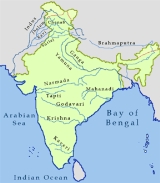
Krishna River

Overview
- This article is about an Indian river. For other meanings, see Krishna (disambiguation)Krishna (disambiguation)Krishna is a Sanskrit word that means 'black' or 'dark blue'. It may refer to:* Krishna, Hindu deity.* Krishna Janmashtami Hindu festival.Certain other figures within Hinduism also have names transliterated as Krishna...
and KrishnaveniKrishnaveniKrishnaveni or Krishna Veni may mean:* Krishna River, third biggest river in India. Veni means braid of hair in Sanskrit.* Krishnaveni, a famous Telugu actress, singer and producer....
.
The Krishna River (Marathi
Marathi language
Marathi is an Indo-Aryan language spoken by the Marathi people of western and central India. It is the official language of the state of Maharashtra. There are over 68 million fluent speakers worldwide. Marathi has the fourth largest number of native speakers in India and is the fifteenth most...
: कृष्णा नदी, Kannada: ಕೃಷ್ಣಾ ನದಿ , Telugu
Telugu language
Telugu is a Central Dravidian language primarily spoken in the state of Andhra Pradesh, India, where it is an official language. It is also spoken in the neighbouring states of Chattisgarh, Karnataka, Maharashtra, Orissa and Tamil Nadu...
: కృష్ణా నది), is one of the longest rivers in central-southern India
India
India , officially the Republic of India , is a country in South Asia. It is the seventh-largest country by geographical area, the second-most populous country with over 1.2 billion people, and the most populous democracy in the world...
, about 1300 kilometres (807.8 mi). It is also referred to as Krishnaveni in its original nomenclature. The Krishna River is the fourth largest river in India after the Ganges, the Godavari and the Narmada
Narmada River
The Narmada , also called Rewa is a river in central India and the fifth largest river in the Indian subcontinent. It is the third largest river that completely flows within India after Ganges and Godavari...
.
Krishna river rises at Mahabaleswar near the Jor village in the extreme north of Wai taluka,district satara
Satara
Satara is a city located in the Satara District of Maharashtra state of India. The town is 2320 ft. above sea-level, near the confluence of the Krishna and its tributary river Venna. The city was the capital of the Maratha empire in the 17th century, hence one of the the historical cities of...
, Maharashtra
Maharashtra
Maharashtra is a state located in India. It is the second most populous after Uttar Pradesh and third largest state by area in India...
in the west and meets the Bay of Bengal
Bay of Bengal
The Bay of Bengal , the largest bay in the world, forms the northeastern part of the Indian Ocean. It resembles a triangle in shape, and is bordered mostly by the Eastern Coast of India, southern coast of Bangladesh and Sri Lanka to the west and Burma and the Andaman and Nicobar Islands to the...
at Hamasaladeevi
Hamasaladeevi
Hamsaladeevi is a village in Krishna District in Andhra Pradesh close to where one branch of River Krishna meets the Indian Ocean. It is also known as "Swan Island"....
in Andhra Pradesh
Andhra Pradesh
Andhra Pradesh , is one of the 28 states of India, situated on the southeastern coast of India. It is India's fourth largest state by area and fifth largest by population. Its capital and largest city by population is Hyderabad.The total GDP of Andhra Pradesh is $100 billion and is ranked third...
, on the east coast.
Unanswered Questions
