


Knowth

Encyclopedia
Neolithic
The Neolithic Age, Era, or Period, or New Stone Age, was a period in the development of human technology, beginning about 9500 BC in some parts of the Middle East, and later in other parts of the world. It is traditionally considered as the last part of the Stone Age...
passage grave
Passage grave
thumb|250px|right|A simple passage tomb in [[Carrowmore]] near [[Sligo]] in IrelandA passage grave or passage tomb consists of a narrow passage made of large stones and one or multiple burial chambers covered in earth or stone. Megaliths are usually used in the construction of passage tombs, which...
and an ancient monument of Brú na Bóinne
Brú na Bóinne
is a World Heritage Site in County Meath, Ireland and is the largest and one of the most important prehistoric megalithic sites in Europe.-The site:...
in the valley of the River Boyne
River Boyne
The River Boyne is a river in Leinster, Ireland, the course of which is about long. It rises at Trinity Well, Newbury Hall, near Carbury, County Kildare, and flows towards the Northeast through County Meath to reach the Irish Sea between Mornington, County Meath and Baltray, County Louth. Salmon...
in Ireland
Ireland
Ireland is an island to the northwest of continental Europe. It is the third-largest island in Europe and the twentieth-largest island on Earth...
.
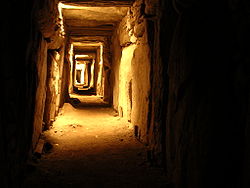
Knowth is the largest of all passage graves situated within the Brú na Bóinne complex. The site consists of one large mound (known as Site 1) and 17 smaller satellite tombs. Essentially Knowth (Site 1) is a large mound (about 12 metres (39.4 ft) high and 67 metres (219.8 ft) in diameter, covering roughly a hectare) and contains two passages, placed along an east-west line. It is encircled by 127 kerbstones (three of which are missing and four of which are badly damaged). The large mound has been esitimated to date from between 2500 and 2000 BCE. The passages are independent of each other, and each leads to a burial chamber. The eastern passage leads to a cruciform
Cruciform
Cruciform means having the shape of a cross or Christian cross.- Cruciform architectural plan :This is a common description of Christian churches. In Early Christian, Byzantine and other Eastern Orthodox forms of church architecture this is more likely to mean a tetraconch plan, a Greek cross,...
chamber, not unlike that found at Newgrange
Newgrange
Newgrange is a prehistoric monument located in County Meath, on the eastern side of Ireland, about one kilometre north of the River Boyne. It was built around 3200 BC , during the Neolithic period...
. It contains three recesses and basin stones into which the cremated remains of the dead were placed.
The right-hand recess is larger and more elaborately decorated with megalithic art
Megalithic art
Megalithic art refers to the use of large stones as an artistic medium. Although some modern artists and sculptors make use of large stones in their work, the term is more generally used to describe art carved onto megaliths in prehistoric Europe....
than the others, which is typical for Irish passage graves of this type. The reason for this is unknown. The western passage ends in an undifferentiated chamber. This chamber is separated from the passage by a sillstone. The chamber seems to have also contained a basin stone. This was later removed and is now located about two-thirds down the passageway.
Megalithic art
Megalithic art
Megalithic art refers to the use of large stones as an artistic medium. Although some modern artists and sculptors make use of large stones in their work, the term is more generally used to describe art carved onto megaliths in prehistoric Europe....
in all of Western Europe
Western Europe
Western Europe is a loose term for the collection of countries in the western most region of the European continents, though this definition is context-dependent and carries cultural and political connotations. One definition describes Western Europe as a geographic entity—the region lying in the...
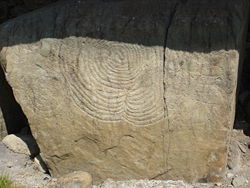
. Over 200 decorated stones were found during excavations at Knowth. Much of the artwork is found on the kerbstones, particularly approaching the entrances to the passages. Many of the motifs found at Knowth are typical: spirals, lozenges and serpentiform. However, the megalithic art at Knowth contains a wide variety of images, such as crescent shapes. Interestingly, much of this artwork was carved on the backs of the stones. This type of megalithic art is known as hidden art. This suggests all manner of theories as regards the function of megalithic art within the Neolithic community who built the monuments in the Boyne valley. It is possible that they intended the art to be hidden. It is also possible that they simply recycled the stones and reused the other side.
History
There is some evidence for late Neolithic and Bronze Age activity on the site at Knowth. Most of this stems from the existence of a grooved wareGrooved ware
Grooved ware is the name given to a pottery style of the British Neolithic. Its manufacturers are sometimes known as the Grooved ware people. Unlike the later Beaker ware, Grooved culture was not an import from the continent but seems to have developed in Orkney, early in the 3rd millennium BC, but...
timber circle located near the entrance to the eastern passage. Archeological evidence suggests that this was used as a ritual or sacred area after the great mound at Knowth had already fallen into disuse. Evidence for ritual consists of a large number of votive offerings found in and around the immediate areas of the timbers that formed the circle. The Normans used Knowth as a motte in the 12th century.
The hill at Knowth fell into disrepair, and the mound or cairn slipped, causing the entrances to both passages to be covered. The site remained practically unused for a period of two thousand years. The site was briefly used as a burial site; some 35 cist graves were found on the site during excavations. These seem to be Celtic burials. Many of the bodies found were female. One particularly interesting grave contained the bodies of two young men, decapitated and buried together with a gaming set.
In the late Iron age
Iron Age
The Iron Age is the archaeological period generally occurring after the Bronze Age, marked by the prevalent use of iron. The early period of the age is characterized by the widespread use of iron or steel. The adoption of such material coincided with other changes in society, including differing...
and early Christian period, it became a hill fort
Hill fort
A hill fort is a type of earthworks used as a fortified refuge or defended settlement, located to exploit a rise in elevation for defensive advantage. They are typically European and of the Bronze and Iron Ages. Some were used in the post-Roman period...
with encircling ditches and souterrain
Souterrain
Souterrain is a name given by archaeologists to a type of underground structure associated mainly with the Atlantic Iron Age. These structures appear to have been brought northwards from Gaul during the late Iron Age. Regional names include earth houses, fogous and Pictish houses...
s added. By this stage, Knowth became a habitational site for the first time. Two ditches were dug, one at the base of the mound behind the kerbstones, and the other at the top. At this stage, the entrances to both passages seem to have been discovered. Evidence for this include early Christian graffiti on the stones in the eastern chamber. Four names were carved in ogham
Ogham
Ogham is an Early Medieval alphabet used primarily to write the Old Irish language, and occasionally the Brythonic language. Ogham is sometimes called the "Celtic Tree Alphabet", based on a High Medieval Bríatharogam tradition ascribing names of trees to the individual letters.There are roughly...
. It seems it was at this stage that the basin stone from the western chamber was moved in an attempt to remove it and was abandoned in the passage because it got stuck. At this time, Knowth was a very significant political site and was the capital of the Kingdom of Northern Brega
Kings of Brega
-Overview:Brega took its name from Mag Breg, the plain of Brega, in modern County Meath, County Louth and County Dublin, Ireland. They formed part of the Uí Néill kindred, belonging to the Síl nÁedo Sláine branch of the southern Uí Néill. The kingdom of Brega included the Hill of Tara, the site...
.
Normans
The Normans were the people who gave their name to Normandy, a region in northern France. They were descended from Norse Viking conquerors of the territory and the native population of Frankish and Gallo-Roman stock...
invasion of Ireland
Ireland
Ireland is an island to the northwest of continental Europe. It is the third-largest island in Europe and the twentieth-largest island on Earth...
, Knowth fell into the hands of the monks at Mellifont abbey. It seems that the mound was then again used as a grange or farm. Stone walls were built on top of the mound, and stone buildings within the walls. After the dissolution of the monasteries, the site was used mainly for agricultural purposes until most of the site was purchased by the state in 1939.
Because of the east-west orientation of the passages at Knowth, suggestions of astronomical alignment with the equinox
Equinox
An equinox occurs twice a year, when the tilt of the Earth's axis is inclined neither away from nor towards the Sun, the center of the Sun being in the same plane as the Earth's equator...
es exist. The alignment at Knowth does not occur today. This is due to a number of factors. First of all, the passages were discovered by later settlers and were, to some extent, destroyed or incorporated into souterrains. In other words, the original entrances to the passages were distorted or destroyed, so it is difficult to establish if an alignment existed in the first place. Secondly, the recent excavations (1962 onwards) under Prof. George Eogan resulted in the erection of a concrete slab wall inside the mounds west entrance, restricting any investigation into the possible alignments. It seems likely that the passages were intended to align. Also, the alignments of ancient monuments can change due to Milankovitch cycles
Milankovitch cycles
Milankovitch theory describes the collective effects of changes in the Earth's movements upon its climate, named after Serbian civil engineer and mathematician Milutin Milanković, who worked on it during First World War internment...
.
A brief excavation of the site was carried out in 1941 by Professor Macallister. However, major full-scale excavations began on the site in 1962 and were undertaken by Professor George Eogan of University College Dublin
University College Dublin
University College Dublin ) - formally known as University College Dublin - National University of Ireland, Dublin is the Republic of Ireland's largest, and Ireland's second largest, university, with over 1,300 faculty and 17,000 students...
. When his excavations began, very little was known about the full extent of the site. The entrances to the western and eastern passages were discovered in 1967 and 1968 respectively, and, slowly, the layers of activity at the site of Knowth were uncovered. The excavation has produced numerous books and reports on the findings. The archaeological excavation of Knowth East ended any chance of research on alignments when Professor George Eogan erected a concrete wall across the east-passage entrance. The most extensive research on alignments and astronomy at Knowth was carried out by American-Irish researcher Martin Brennan (author of The Stars and the Stones: Ancient Art and Astronomy in Ireland - Thames and Hudson 1983.).
Access to Knowth
Access to Knowth is by guided tour only. There is no direct access. All tours begin at the Brú na Bóinne Visitor CentreBrú na Bóinne Visitor Centre
The Brú na Bóinne Visitor Centre is the starting point for all visits to the monuments of Newgrange and Knowth in Ireland.-Background:The Visitor Centre is located near the village of Donore, County Meath...
in Donore, County Meath
County Meath
County Meath is a county in Ireland. It is part of the Mid-East Region and is also located in the province of Leinster. It is named after the ancient Kingdom of Mide . Meath County Council is the local authority for the county...
. There is no access to the grave chambers of Knowth. Visitors are able to see down the eastern passage and visit the modern interpretive room constructed just off this passage.
Kings of Cnogba/Knowth
- List incomplete: see Mac Shamhráin, 2004.
- Congal mac Áed Sláine, died 634
- Conaig mac Congal (a quo Uí Chonaing), d. 662
- Congalach mac Conaing, d. 696
- Amalgaid mac Congalach, d. 718
- Conaing mac Amalgaid, d. 742
- Congalach mac Conaing, d. 778
- ...
- Flannacan mac Cellach (descendant of Congalach), d. 896
- Máel Finnia mac Flannacán, d. 903
- Máel Mithig mac Flannacán, d. 919
- Congalach mac Mael Mithig (rí Cnogba), d. 956