
Home      Discussion      Topics      Dictionary      Almanac
Signup       Login
Dung beetle

Dung beetle

Overview
Dung beetles are beetles that feed partly or exclusively on feces
Feces
Feces, faeces, or fæces is a waste product from an animal's digestive tract expelled through the anus or cloaca during defecation.-Etymology:...

. All of these species
Species
In biology, a species is one of the basic units of biological classification and a taxonomic rank. A species is often defined as a group of organisms capable of interbreeding and producing fertile offspring. While in many cases this definition is adequate, more precise or differing measures are...

 belong to the superfamily Scarabaeoidea
Scarabaeoidea
Scarabaeoidea is a superfamily of beetles, the only subgroup of the infraorder Scarabaeiformia. Around 35,000 species are placed in this superfamily and some 200 new species are described each year...

; most of them to the subfamilies Scarabaeinae
Scarabaeinae
The scarab beetle subfamily Scarabaeinae consists of species collectively called true dung beetles. Most of the beetles of this subfamily feed exclusively on dung...

 and Aphodiinae
Aphodiinae
The subfamily Aphodiinae consists of species often labelled "Aphodiine dung beetles". Many of the beetles of this subfamily feed on dung, though not exclusively....

 of the family Scarabaeidae
Scarabaeidae
The family Scarabaeidae as currently defined consists of over 30,000 species of beetles worldwide. The species in this large family are often called scarabs or scarab beetles. The classification of this family is fairly unstable, with numerous competing theories, and new proposals appearing quite...

. This beetle can also be referred to as the scarab beetle. As most species of Scarabaeinae feed exclusively on feces, that subfamily is often dubbed true dung beetles. There are dung-feeding beetles which belong to other families, such as the Geotrupidae (the earth-boring dung beetle). The Scarabaeinae alone comprises more than 5,000 species.
Discussion
Ask a question about 'Dung beetle'
Start a new discussion about 'Dung beetle'
Answer questions from other users
Full Discussion Forum
 
Unanswered Questions
Encyclopedia
Dung beetles are beetles that feed partly or exclusively on feces
Feces
Feces, faeces, or fæces is a waste product from an animal's digestive tract expelled through the anus or cloaca during defecation.-Etymology:...

. All of these species
Species
In biology, a species is one of the basic units of biological classification and a taxonomic rank. A species is often defined as a group of organisms capable of interbreeding and producing fertile offspring. While in many cases this definition is adequate, more precise or differing measures are...

 belong to the superfamily Scarabaeoidea
Scarabaeoidea
Scarabaeoidea is a superfamily of beetles, the only subgroup of the infraorder Scarabaeiformia. Around 35,000 species are placed in this superfamily and some 200 new species are described each year...

; most of them to the subfamilies Scarabaeinae
Scarabaeinae
The scarab beetle subfamily Scarabaeinae consists of species collectively called true dung beetles. Most of the beetles of this subfamily feed exclusively on dung...

 and Aphodiinae
Aphodiinae
The subfamily Aphodiinae consists of species often labelled "Aphodiine dung beetles". Many of the beetles of this subfamily feed on dung, though not exclusively....

 of the family Scarabaeidae
Scarabaeidae
The family Scarabaeidae as currently defined consists of over 30,000 species of beetles worldwide. The species in this large family are often called scarabs or scarab beetles. The classification of this family is fairly unstable, with numerous competing theories, and new proposals appearing quite...

. This beetle can also be referred to as the scarab beetle. As most species of Scarabaeinae feed exclusively on feces, that subfamily is often dubbed true dung beetles. There are dung-feeding beetles which belong to other families, such as the Geotrupidae (the earth-boring dung beetle). The Scarabaeinae alone comprises more than 5,000 species.

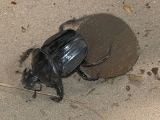
Many dung beetles, known as rollers, are noted for rolling dung into spherical balls, which are used as a food source or brooding chambers. Other dung beetles, known as tunnelers, bury the dung wherever they find it. A third group, the dwellers, neither roll nor burrow: they simply live in manure. They are often attracted by the dung burrowing owls
Burrowing Owl
The Burrowing Owl is a tiny but long-legged owl found throughout open landscapes of North and South America. Burrowing Owls can be found in grasslands, rangelands, agricultural areas, deserts, or any other open dry area with low vegetation. They nest and roost in burrows, such as those excavated...

 collect.

Ecology and behavior


Dung beetles live in many different habitats, including desert, farm
Farm
A farm is an area of land, or, for aquaculture, lake, river or sea, including various structures, devoted primarily to the practice of producing and managing food , fibres and, increasingly, fuel. It is the basic production facility in food production. Farms may be owned and operated by a single...

land, forest
Forest
A forest, also referred to as a wood or the woods, is an area with a high density of trees. As with cities, depending where you are in the world, what is considered a forest may vary significantly in size and have various classification according to how and what of the forest is composed...

, and grassland
Grassland
Grasslands are areas where the vegetation is dominated by grasses and other herbaceous plants . However, sedge and rush families can also be found. Grasslands occur naturally on all continents except Antarctica...

s. They do not prefer extremely cold or dry weather. They are found on all continents except Antarctica.

Dung beetles eat dung excreted by herbivore
Herbivore
Herbivores are organisms that are anatomically and physiologically adapted to eat plant-based foods. Herbivory is a form of consumption in which an organism principally eats autotrophs such as plants, algae and photosynthesizing bacteria. More generally, organisms that feed on autotrophs in...

s and omnivore
Omnivore
Omnivores are species that eat both plants and animals as their primary food source...

s, and prefer that produced by the former. Many of them also feed on mushrooms and decaying
Decomposition
Decomposition is the process by which organic material is broken down into simpler forms of matter. The process is essential for recycling the finite matter that occupies physical space in the biome. Bodies of living organisms begin to decompose shortly after death...

 leaves
Leaf
A leaf is an organ of a vascular plant, as defined in botanical terms, and in particular in plant morphology. Foliage is a mass noun that refers to leaves as a feature of plants....

 and fruit
Fruit
In broad terms, a fruit is a structure of a plant that contains its seeds.The term has different meanings dependent on context. In non-technical usage, such as food preparation, fruit normally means the fleshy seed-associated structures of certain plants that are sweet and edible in the raw state,...

s. One type living in South America, Deltochilum valgum
Deltochilum valgum
Deltochilum valgum is a nocturnal species of dung beetle in the family Scarabaeidae, which has evolved a predatory lifestyle. While most other members of its family feed on faeces, D. valgum is highly specialised for eating millipedes; such a transition from scavenger to carnivore is rare.D. valgum...

, is a carnivore preying upon millipedes. Those that eat dung do not need to eat or drink anything else, because the dung provides all the necessary nutrient
Nutrient
A nutrient is a chemical that an organism needs to live and grow or a substance used in an organism's metabolism which must be taken in from its environment. They are used to build and repair tissues, regulate body processes and are converted to and used as energy...

s.
Most dung beetles search for dung using their sensitive sense of smell
Olfaction
Olfaction is the sense of smell. This sense is mediated by specialized sensory cells of the nasal cavity of vertebrates, and, by analogy, sensory cells of the antennae of invertebrates...

. Some of the smaller species simply attach themselves to the dung-providers to wait for their reward. After capturing the dung, a dung beetle will roll it, following a straight line despite all obstacles. Sometimes dung beetles will try to steal the dung ball from another beetle, so the dung beetles have to move rapidly away from a dung pile once they have rolled their ball to prevent it from being stolen. Dung beetles can roll up to 50 times their weight. Male Onthophagus taurus beetles can pull 1,141 times their own body weight: the equivalent of an average person pulling six double-decker buses full of people. In 2003, researchers found one species of dung beetle (the African Scarabaeus zambesianus) navigates by using polarization patterns in moonlight
Moonlight
Moonlight is the light that reaches Earth from the Moon. This light does not originate from the Moon, but from sunlight. The Moon does not, however, reflect sunlight like a mirror, but it reflects light from those portions of its surface which the Sun's light strikes. See diffuse reflection.In...

. The discovery is the first proof any animal can use polarized moonlight for orientation.

The "rollers" roll and bury a dung ball either for food storage or for making a brooding ball. In the latter case, two beetles, one male and one female, will be seen around the dung ball during the rolling process. Usually it is the male that rolls the ball, with the female hitch-hiking or simply following behind. In some cases the male and the female roll together. When a spot with soft soil is found, they stop and bury the dung ball. They will then mate
Mating
In biology, mating is the pairing of opposite-sex or hermaphroditic organisms for copulation. In social animals, it also includes the raising of their offspring. Copulation is the union of the sex organs of two sexually reproducing animals for insemination and subsequent internal fertilization...

 underground. After the mating, both or one of them will prepare the brooding ball. When the ball is finished, the female lays eggs inside it, a form of mass provisioning
Mass provisioning
Mass provisioning is a term used in entomology to refer to a form of parental behavior in which an adult stocks all of the food for each offspring in a small chamber prior to laying the egg...

. Some species do not leave after this stage, but remain to safeguard their offspring.

The dung beetle goes through a complete metamorphosis. The larvae live in brood balls made with dung prepared by their parents. During the larval stage, the beetle feeds on the dung surrounding it.

The behavior of the beetles was much misunderstood until the pioneering studies of Jean Henri Fabre
Jean Henri Fabre
Jean-Henri Casimir Fabre was a French entomologist and author.-Life:Fabre was born in Saint-Léons in Aveyron, France....

. For example, Fabre corrected the myth that a dung beetle would seek aid from other dung beetles when confronted by obstacles. By painstaking observations and experiments, he found the seeming helpers were, in fact, robbers awaiting an opportunity to steal the roller's food source:

Benefits and uses


Dung beetles play a remarkable role in agriculture
Agriculture
Agriculture is the cultivation of animals, plants, fungi and other life forms for food, fiber, and other products used to sustain life. Agriculture was the key implement in the rise of sedentary human civilization, whereby farming of domesticated species created food surpluses that nurtured the...

. By burying and consuming dung, they improve nutrient recycling and soil structure. They also protect livestock, such as cattle
Cattle
Cattle are the most common type of large domesticated ungulates. They are a prominent modern member of the subfamily Bovinae, are the most widespread species of the genus Bos, and are most commonly classified collectively as Bos primigenius...

, by removing the dung which, if left, could provide habitat for pests
Pest (animal)
A pest is an animal which is detrimental to humans or human concerns. It is a loosely defined term, often overlapping with the related terms vermin, weeds, parasites and pathogens...

 such as flies
Fly
True flies are insects of the order Diptera . They possess a pair of wings on the mesothorax and a pair of halteres, derived from the hind wings, on the metathorax...

. Therefore, many countries have introduced
Biological pest control
Biological control of pests in agriculture is a method of controlling pests that relies on predation, parasitism, herbivory, or other natural mechanisms...

 the creature for the benefit of animal husbandry
Animal husbandry
Animal husbandry is the agricultural practice of breeding and raising livestock.- History :Animal husbandry has been practiced for thousands of years, since the first domestication of animals....

. In developing countries, the beetle is especially important as an adjunct for improving standards of hygiene. The American Institute of Biological Sciences
American Institute of Biological Sciences
The American Institute of Biological Sciences is a non-profit scientific association that is dedicated to advancing biological research and education.-Overview:...

 reports that dung beetles save the United States cattle industry an estimated US$
United States dollar
The United States dollar , also referred to as the American dollar, is the official currency of the United States of America. It is divided into 100 smaller units called cents or pennies....

380 million annually through burying above-ground livestock faeces.

In Australia, the Commonwealth Scientific and Industrial Research Organisation
Commonwealth Scientific and Industrial Research Organisation
The Commonwealth Scientific and Industrial Research Organisation is the national government body for scientific research in Australia...

 (CSIRO) commissioned the Australian Dung Beetle Project
Australian Dung Beetle Project
The Australian Dung Beetle Project , conceived and led by Dr. George Bornemissza, of the Commonwealth Scientific and Industrial Research Organisation , was an international scientific research and biological control project with the primary goal to introduce foreign species of dung beetle to...

 (1965-1985) which, led by Dr. George Bornemissza
George Bornemissza
George Francis Bornemissza is a Hungarian-born entomologist and ecologist. He studied science at the University of Budapest before obtaining his PhD in zoology at the University of Innsbruck in Austria in 1950. At the end of that year he emigrated to Australia...

, sought to introduce species of dung beetles from South Africa and Europe. The successful introduction of 23 species was made, most notably Onthophagus gazella and Euoniticellus intermedius, which have resulted in the improvement of the quality and fertility of Australian cattle pastures, along with a reduction in the population of pestilent bush flies by around 90 percent.

An application has been made by Landcare Research to import up to 11 species of dung beetle into New Zealand
New Zealand
New Zealand is an island country in the south-western Pacific Ocean comprising two main landmasses and numerous smaller islands. The country is situated some east of Australia across the Tasman Sea, and roughly south of the Pacific island nations of New Caledonia, Fiji, and Tonga...

. As well as improving pasture soils the Dung Beetle Release Strategy Group say that it result in a reduction in greenhouse gas
Greenhouse gas
A greenhouse gas is a gas in an atmosphere that absorbs and emits radiation within the thermal infrared range. This process is the fundamental cause of the greenhouse effect. The primary greenhouse gases in the Earth's atmosphere are water vapor, carbon dioxide, methane, nitrous oxide, and ozone...

 emissions from the agricultural sector.

Like many other insects, the (dried) dung beetle, called qianglang (蜣蜋) in Chinese, is used in Chinese herbal medicine. It is recorded in the "Insect section" (蟲部) of the Compendium of Materia Medica, where it is recommended for the cure of 10 diseases.

Scarab in Ancient Egypt


Several species of the dung beetle, most notably the species Scarabaeus
Scarabaeus
The genus Scarabaeus consists of a number of Old World dung beetle species, including the "sacred scarab beetle", Scarabaeus sacer. These beetles feed exclusively on dung, which they accomplish by rolling a piece of dung some distance from where it was deposited, and burying it in order to feed on...

 sacer
(often referred to as the sacred scarab), enjoyed a sacred status among the ancient Egypt
Ancient Egypt
Ancient Egypt was an ancient civilization of Northeastern Africa, concentrated along the lower reaches of the Nile River in what is now the modern country of Egypt. Egyptian civilization coalesced around 3150 BC with the political unification of Upper and Lower Egypt under the first pharaoh...

ians.
Popular interpretation in modern academia theorizes the hieroglyphic image of the beetle represents a triliteral phonetic
Egyptian language
Egyptian is the oldest known indigenous language of Egypt and a branch of the Afroasiatic language family. Written records of the Egyptian language have been dated from about 3400 BC, making it one of the oldest recorded languages known. Egyptian was spoken until the late 17th century AD in the...

 that Egyptologists transliterate as xpr or ḫpr and translate as "to come into being", "to become" or "to transform". The derivative term xprw or ḫpr(w) is variously translated as "form", "transformation", "happening", "mode of being" or "what has come into being", depending on the context. It may have existential, fictional, or ontologic significance.

The scarab was linked to Khepri
Khepri
This article is about the Egyptian god. For the type of robot, see Khepera mobile robot.In Egyptian mythology, Khepri is the name of a major god. Khepri is associated with the dung beetle , whose behavior of maintaining spherical balls of dung represents the forces which move the sun...

 ("he who has come into being"), the god of the rising sun
Sun
The Sun is the star at the center of the Solar System. It is almost perfectly spherical and consists of hot plasma interwoven with magnetic fields...

. The ancients believed that the dung beetle was only male in gender, and reproduced by depositing semen
Semen
Semen is an organic fluid, also known as seminal fluid, that may contain spermatozoa. It is secreted by the gonads and other sexual organs of male or hermaphroditic animals and can fertilize female ova...

 into a dung ball. The supposed self-creation of the beetle resembles that of Khepri, who creates himself out of nothing. Moreover, the dung ball rolled by a dung beetle resembles the sun. Plutarch
Plutarch
Plutarch then named, on his becoming a Roman citizen, Lucius Mestrius Plutarchus , c. 46 – 120 AD, was a Greek historian, biographer, essayist, and Middle Platonist known primarily for his Parallel Lives and Moralia...

 wrote:

The ancient Egyptians believed that Khepri renewed the sun every day before rolling it above the horizon, then carried it through the other world after sunset, only to renew it, again, the next day. Some New Kingdom
New Kingdom
The New Kingdom of Egypt, also referred to as the Egyptian Empire is the period in ancient Egyptian history between the 16th century BC and the 11th century BC, covering the Eighteenth, Nineteenth, and Twentieth Dynasties of Egypt....

 royal tombs exhibit a threefold image of the sun god, with the beetle as symbol of the morning sun. The astronomical ceiling in the tomb of Ramses VI portrays the nightly "death" and "rebirth" of the sun as being swallowed by Nut
Nut (goddess)
In the Ennead of Egyptian mythology, Nut was the goddess of the sky.-Goddess of the sky:...

, goddess of the sky, and re-emerging from her womb as Khepri.

The image of the scarab, conveying ideas of transformation, renewal, and resurrection, is ubiquitous in ancient Egyptian religious and funerary art
Funerary art
Funerary art is any work of art forming, or placed in, a repository for the remains of the dead. Tomb is a general term for the repository, while grave goods are objects—other than the primary human remains—which have been placed inside...

.

Excavations of ancient Egyptian sites have yielded images of the scarab in bone, ivory
Ivory
Ivory is a term for dentine, which constitutes the bulk of the teeth and tusks of animals, when used as a material for art or manufacturing. Ivory has been important since ancient times for making a range of items, from ivory carvings to false teeth, fans, dominoes, joint tubes, piano keys and...

, stone, Egyptian faience
Egyptian faience
Egyptian faience is a non-clay based ceramic displaying surface vitrification which creates a bright lustre of various blue-green colours. Having not been made from clay it is often not classed as pottery. It is called "Egyptian faience" to distinguish it from faience, the tin glazed pottery...

, and precious metals, dating from the Sixth Dynasty and up to the period of Roman rule. They are generally small, bored to allow stringing on a necklace, and the base bears a brief inscription or cartouche
Cartouche
In Egyptian hieroglyphs, a cartouche is an ellipse with a horizontal line at one end, indicating that the text enclosed is a royal name, coming into use during the beginning of the Fourth Dynasty under Pharaoh Sneferu, replacing the earlier serekh...

. Some have been used as seal
Impression seal
The impression seal is a common seal that leaves an impression, typically in clay and less often in wax. In antiquity they were common, largely because they served to authenticate legal documents, such as tax receipts, contracts, wills and decrees...

s. Pharaoh
Pharaoh
Pharaoh is a title used in many modern discussions of the ancient Egyptian rulers of all periods. The title originates in the term "pr-aa" which means "great house" and describes the royal palace...

s sometimes commissioned the manufacture of larger images with lengthy inscriptions, such as the commemorative scarab
The lion hunts of Amenhotep III during the first ten years of his reign
The Lion-Hunts of Amenhotep III During the First Ten Years of his Reign is one of a group of five historical and commemorative scarabs made during the reign of Amenhotep III. The set of five scarabs were presumably used to validate, and proclaim his choice of Tiye as his wife...

 of Queen Tiye
Tiye
Tiye was the daughter of Yuya and Tjuyu . She became the Great Royal Wife of the Egyptian pharaoh Amenhotep III....

. Massive sculptures of scarabs can be seen at Luxor Temple
Luxor Temple
Luxor Temple is a large Ancient Egyptian temple complex located on the east bank of the River Nile in the city today known as Luxor and was founded in 1400 BCE.,...

, at the Serapeum in Alexandria (see Serapis
Serapis
Serapis or Sarapis is a Graeco-Egyptian name of God. Serapis was devised during the 3rd century BC on the orders of Ptolemy I of Egypt as a means to unify the Greeks and Egyptians in his realm. The god was depicted as Greek in appearance, but with Egyptian trappings, and combined iconography...

) and elsewhere in Egypt.

The scarab was of prime significance in the funerary cult of ancient Egypt. Scarabs, generally, though not always, were cut from green stone, and placed on the chest of the deceased. Perhaps the most famous example of such "heart scarabs" is the yellow-green pectoral
Pectoral (Ancient Egypt)
The Pectorals of ancient Egypt were a form of jewellery, often represented as a brooch. This was mostly worn by richer people.One type, was the pectoral with a necklace, as a form of attachment, to be suspended from the neck, but to lay upon the breast...

 scarab found among the entombed provisions of Tutankhamen. It was carved from a large piece of Libyan desert glass
Libyan desert glass
Libyan desert glass , or great sand sea glass is a substance found in areas in the Libyan Desert. Fragments of desert glass can be found over large areas, up to tens of kilometers.- Geologic origin :...

. The purpose of the "heart scarab" was to ensure that the heart would not bear witness against the deceased at judgement in the Afterlife. Other possibilities are suggested by the "transformation spells" of the Coffin Texts, which affirm that the soul of the deceased may transform (xpr) into a human being, a god, or a bird and reappear in the world of the living.

One scholar comments on other traits of the scarab connected with the theme of death and rebirth:
In contrast to funerary contexts, some of ancient Egypt's neighbors adopted the scarab motif for seal
Scaraboid seal
The Scaraboid seal is a category of the impression seals of Egypt. It is also a category of Jewellery and amulets, though as a seal it is of minor size ....

s of varying types. The best-known of these being Judean LMLK seal
LMLK seal
LMLK seals were stamped on the handles of large storage jars mostly in and around Jerusalem during the reign of King Hezekiah based on several complete jars found in situ buried under a destruction layer caused by Sennacherib at Lachish...

s (8 of 21 designs contained scarab beetles), which were used exclusively to stamp impressions on storage jars during the reign of Hezekiah
Hezekiah
Hezekiah was the son of Ahaz and the 14th king of Judah. Edwin Thiele has concluded that his reign was between c. 715 and 686 BC. He is also one of the most prominent kings of Judah mentioned in the Hebrew Bible....

.

The scarab remains an item of popular interest thanks to modern fascination with the art and beliefs of ancient Egypt. Scarab beads in semiprecious stones or glazed ceramics can be purchased at most bead shops, while at Luxor Temple a massive ancient scarab has been roped off to discourage visitors from rubbing the base of the statue "for luck".

In literature


In Aesop's fable "The Dung Beetle and the Eagle", the eagle kills a hare despite the beetle's appeals. The beetle takes revenge by twice destroying the eagle's eggs. The eagle, in despair, flies up to Olympus
Mount Olympus
Mount Olympus is the highest mountain in Greece, located on the border between Thessaly and Macedonia, about 100 kilometres away from Thessaloniki, Greece's second largest city. Mount Olympus has 52 peaks. The highest peak Mytikas, meaning "nose", rises to 2,917 metres...

 and places her latest eggs in Zeus
Zeus
In the ancient Greek religion, Zeus was the "Father of Gods and men" who ruled the Olympians of Mount Olympus as a father ruled the family. He was the god of sky and thunder in Greek mythology. His Roman counterpart is Jupiter and his Etruscan counterpart is Tinia.Zeus was the child of Cronus...

's lap, beseeching the god to protect them. When the beetle finds out what the eagle has done, it stuffs itself with dung, goes straight up to Zeus and flies right into his face. Zeus is startled at the sight of the unpleasant creature and jumps to his feet. The eggs are broken. Zeus then learns of the beetle's plea which the eagle had ignored. He scolds the eagle and urges the beetle to stay away from the bird. But his efforts to persuade the beetle fail; so he changes the breeding season of the eagles to take place at a time when the beetles are not above ground.

Aristophanes
Aristophanes
Aristophanes , son of Philippus, of the deme Cydathenaus, was a comic playwright of ancient Athens. Eleven of his forty plays survive virtually complete...

 alluded to Aesop's fable several times in his plays. In Peace
Peace (play)
Peace is an Athenian Old Comedy written and produced by the Greek playwright Aristophanes. It won second prize at the City Dionysia where it was staged just a few days before the ratification of the Peace of Nicias , which promised to end the ten year old Peloponnesian War...

, the hero rides up to Olympus to free the goddess Peace from her prison. His steed is an enormous dung beetle which has been fed so much dung that it has grown to monstrous size.

In Franz Kafka
Franz Kafka
Franz Kafka was a culturally influential German-language author of short stories and novels. Contemporary critics and academics, including Vladimir Nabokov, regard Kafka as one of the best writers of the 20th century...

's The Metamorphosis
The Metamorphosis
The Metamorphosis is a novella by Franz Kafka, first published in 1915. It is often cited as one of the seminal works of short fiction of the 20th century and is widely studied in colleges and universities across the western world...

, the transformed character of Gregor Samsa is called an "old dung beetle" (alter Mistkäfer) by the charwoman.

The inadvertent theft of a prized scarab forms the backdrop to Something Fresh
Something Fresh
Something Fresh is a novel by P. G. Wodehouse. It was first published as a book in the United States, by D. Appleton & Company on September 3, 1915, under the title Something New, having previously appeared under that title as a serial in the Saturday Evening Post between June 26 and August 14,...

, the first of the celebrated Blandings Castle
Blandings Castle
Blandings Castle is a recurring fictional location in the stories of British comic writer P. G. Wodehouse, being the seat of Lord Emsworth , home to many of his family, and setting for numerous tales and adventures, written between 1915 and 1975.The series of stories which take place at the castle,...

novels of P.G. Wodehouse.

In Richard Marsh
Richard Marsh
Richard Marsh may refer to:* Richard Marsh , the pseudonym of author Richard Heldman* Richard Marsh, Bishop of Durham , Lord Chancellor of England and Bishop of Durham* Richard Marsh , British Touring Car Championship racer...

's gothic novel The Beetle: A Mystery (1987),a beetle with supernatural powers comes to England to haunt politician Paul Lessingham.

See also Edgar Allan Poe
Edgar Allan Poe
Edgar Allan Poe was an American author, poet, editor and literary critic, considered part of the American Romantic Movement. Best known for his tales of mystery and the macabre, Poe was one of the earliest American practitioners of the short story and is considered the inventor of the detective...

's "The Gold-Bug
The Gold-Bug
"The Gold-Bug" is a short story by Edgar Allan Poe. Set on Sullivan's Island, South Carolina, the plot follows William Legrand, who was recently bitten by a gold-colored bug. His servant Jupiter fears him to be going insane and goes to Legrand's friend, an unnamed narrator who agrees to visit his...

".

See also

  • Catharsius
    Catharsius
    Catharsius is a genus of Scarabaeidae or scarab beetles in the superfamily Scarabaeoidea.It contains about 100 species of intermediate to large size , black or brown, living in the tropical areas of the Old World. Tropical Africa contains about 85 species, with the remaining 15 in tropical Asia...

    , an important dung beetle genus in African and Asian environments
  • Addo Elephant National Park
    Addo Elephant National Park
    Addo Elephant National Park is an elephant park situated close to Port Elizabeth in South Africa and is recognized as one of the country's twenty national parks.- History :...

    , site of the largest remaining population of the endangered flightless dung beetle (Circellium bacchus).
  • List of dung beetle and chafer (Scarabaeoidea) species recorded in Britain
  • Rotating locomotion in living systems

Further reading

  • Buchberger, Hannes (1993). Transformation und Transformat. Sargtextstudien I. Wiesbaden: Harrassowitz Verlag. ISBN 3-447-03078-X.
  • Cambefort, Yves (1994). Le scarabee et les dieux. Essai sur la signification symbolique et mythique des coleopteres. Paris: Editions Boubee. ISBN 2-85004-079-7.
  • Cooney, K.M. and Johnna Tyrrell (2005). "Scarabs in the Los Angeles County Museum of Art".PalArch's Journal of Archaeology of Egypt/Egyptology 4(1-3):1-98.
  • Faulkner, Raymond O.
    Raymond O. Faulkner
    Dr Raymond Oliver Faulkner, FSA, was an English Egyptologist and philologist of the ancient Egyptian language....

    (2002). A Concise Dictionary of Middle Egyptian. Oxford: Griffith Institute. ISBN 0-900416-32-7.
  • Halffter, Gonzalo and Eric G. Matthews (1966). "The Natural History of Dung Beetles: Of the Subfamily Scarabaeinae". Folia Entomológica Mexicana 12-14:1-312 (rpt. Palermo: Medical Books, 1999).
  • Hanski, Ilkka and Yves Cambefort (ed.s) (1991). Dung Beetle Ecology. Princeton: Princeton University Press. ISBN 0-691-08739-3.
  • Imamori, Mitsuhiko (1991). [Sacred Dung Beetles (in Japanese)]. Tokio: Heibon-sha (with a chapter on Egyptian scarabs by Y. Cambefort). ISBN 4-582-52928-3.
  • Taylor, John H. (2004). Mummy: The Inside Story. London: British Museum Press. ISBN 0-7141-1962-8.
  • Wilkinson, Richard H. (1994). Symbol & Magic in Egyptian Art. London: Thames and Hudson. ISBN 0-500-23663-1.
  • Connor Hillo, The scarab is the symbol of Re, the sun god of Egypt. The Egyptians thought that the dung ball was equated to the sun in the sky (while rolling).
  • Jill Aisthorpe, Department of Primary Industries and Fisheries, Queensland government, and Penny Edwards, Dung beetles – biology and life cycles

External links