


Kepler-16b

Encyclopedia
Kepler-16b is an extrasolar planet
. It is a Saturn
-mass planet consisting of half rock and half gas, and it orbits a binary star
, Kepler-16
, with a period of 229 days. "[It] is the first confirmed, unambiguous example of a circumbinary planet
– a planet orbiting not one, but two stars," said Josh Carter of the Harvard-Smithsonian Center for Astrophysics
, one of the discovery team.
The planet was discovered using the space observatory
aboard NASA
's Kepler spacecraft. Scientists were able to detect the planet using the transit method, when they noticed the dimming of one of the system's stars even when the other was not eclipsing it. Furthermore, timing all the eclipses and transits of the planet and stars in the system has allowed for unusually high precision
in the calculations of the sizes and masses of objects
in the Kepler-16 system. The leader of the planet's discovery team, Laurance Doyle
of the SETI Institute
in Mountain View
, California
, said of this precision, "I believe this is the best-measured planet outside the solar system
." For example, the planet's radius is known to within 0.3%, better than that of any other known exoplanet (as of September 2011).
Kepler-16b is also unusual in that it falls inside the radius that was thought to be the inner limit for planet formation in a binary star system. According to Sara Seager
, a planetary expert at the Massachusetts Institute of Technology
, it was thought that for a planet to have a stable orbit around such a system, it would need to be at least seven times as far from the stars as the stars are from each other. Kepler-16b's orbit is only about half that distance.
As seen from Earth, the planet will cease transiting one star as soon as 2014, and will stop crossing the second and brighter star in 2018. After that, the planet will remain undetectable using the transit method until around 2042.
The planet is probably not habitable as the ground temperature is around -100 C.
 In the announcement paper, the discovery team stated: "Following the convention of Ref. 22, we can denote the third body Kepler-16 (AB)-b, or simply “b” when there is no ambiguity." It is listed as Kepler-16 (AB)-b on the SIMBAD
Astronomical Database. The Extrasolar Planets Encyclopaedia
lists it as Kepler-16 (AB) b.
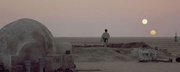
Astronomers have informally referred to Kepler-16b as "Tatooine
," after the fictional planet orbiting two suns that is a key setting in the Star Wars
film series. "Again and again we see that the science is stranger and weirder than fiction" said John Knoll, a visual effects supervisor at Industrial Light & Magic who worked on several of the movies.
Extrasolar planet
An extrasolar planet, or exoplanet, is a planet outside the Solar System. A total of such planets have been identified as of . It is now known that a substantial fraction of stars have planets, including perhaps half of all Sun-like stars...
. It is a Saturn
Saturn
Saturn is the sixth planet from the Sun and the second largest planet in the Solar System, after Jupiter. Saturn is named after the Roman god Saturn, equated to the Greek Cronus , the Babylonian Ninurta and the Hindu Shani. Saturn's astronomical symbol represents the Roman god's sickle.Saturn,...
-mass planet consisting of half rock and half gas, and it orbits a binary star
Binary star
A binary star is a star system consisting of two stars orbiting around their common center of mass. The brighter star is called the primary and the other is its companion star, comes, or secondary...
, Kepler-16
Kepler-16
Kepler-16 is a binary star system in the constellation of Cygnus that was targeted by the Kepler spacecraft. Both stars are smaller than the Sun; the primary, Kepler-16A, is a class K red dwarf, and the secondary, Kepler-16B, is a class M red dwarf...
, with a period of 229 days. "[It] is the first confirmed, unambiguous example of a circumbinary planet
Circumbinary planet
A circumbinary planet is a planet that orbits two stars instead of one.Because of the close proximity and orbit of some binary stars, the only way for planets to form is by forming outside the orbit of the two stars....
– a planet orbiting not one, but two stars," said Josh Carter of the Harvard-Smithsonian Center for Astrophysics
Harvard-Smithsonian Center for Astrophysics
The Harvard–Smithsonian Center for Astrophysics is one of the largest and most diverse astrophysical institutions in the world, where scientists carry out a broad program of research in astronomy, astrophysics, earth and space sciences, and science education...
, one of the discovery team.
The planet was discovered using the space observatory
Space observatory
A space observatory is any instrument in outer space which is used for observation of distant planets, galaxies, and other outer space objects...
aboard NASA
NASA
The National Aeronautics and Space Administration is the agency of the United States government that is responsible for the nation's civilian space program and for aeronautics and aerospace research...
's Kepler spacecraft. Scientists were able to detect the planet using the transit method, when they noticed the dimming of one of the system's stars even when the other was not eclipsing it. Furthermore, timing all the eclipses and transits of the planet and stars in the system has allowed for unusually high precision
Accuracy and precision
In the fields of science, engineering, industry and statistics, the accuracy of a measurement system is the degree of closeness of measurements of a quantity to that quantity's actual value. The precision of a measurement system, also called reproducibility or repeatability, is the degree to which...
in the calculations of the sizes and masses of objects
Astronomical object
Astronomical objects or celestial objects are naturally occurring physical entities, associations or structures that current science has demonstrated to exist in the observable universe. The term astronomical object is sometimes used interchangeably with astronomical body...
in the Kepler-16 system. The leader of the planet's discovery team, Laurance Doyle
Laurance Doyle
Laurance R. Doyle is a scientist who received his PhD from the Ruprecht Karl University of Heidelberg. He has worked at the SETI Institute since 1987 where he is a principal investigator and astrophysicist. His main area of study has been the formation and detection of extrasolar planets, but he...
of the SETI Institute
SETI Institute
The SETI Institute is a not-for-profit organization whose mission is to “explore, understand and explain the origin, nature and prevalence of life in the universe”. SETI stands for the "search for extraterrestrial intelligence". One program is the use of both radio and optical telescopes to search...
in Mountain View
Mountain View, California
-Downtown:Mountain View has a pedestrian-friendly downtown centered on Castro Street. The downtown area consists of the seven blocks of Castro Street from the Downtown Mountain View Station transit center in the north to the intersection with El Camino Real in the south...
, California
California
California is a state located on the West Coast of the United States. It is by far the most populous U.S. state, and the third-largest by land area...
, said of this precision, "I believe this is the best-measured planet outside the solar system
Solar System
The Solar System consists of the Sun and the astronomical objects gravitationally bound in orbit around it, all of which formed from the collapse of a giant molecular cloud approximately 4.6 billion years ago. The vast majority of the system's mass is in the Sun...
." For example, the planet's radius is known to within 0.3%, better than that of any other known exoplanet (as of September 2011).
Kepler-16b is also unusual in that it falls inside the radius that was thought to be the inner limit for planet formation in a binary star system. According to Sara Seager
Sara Seager
Sara Seager is a Canadian-American astronomer who is currently a professor at the Massachusetts Institute of Technology and known for her work on extrasolar planets. She was born in Toronto, Canada. In 1994, she earned the degree of Bachelor of Science in Mathematics and Physics from the...
, a planetary expert at the Massachusetts Institute of Technology
Massachusetts Institute of Technology
The Massachusetts Institute of Technology is a private research university located in Cambridge, Massachusetts. MIT has five schools and one college, containing a total of 32 academic departments, with a strong emphasis on scientific and technological education and research.Founded in 1861 in...
, it was thought that for a planet to have a stable orbit around such a system, it would need to be at least seven times as far from the stars as the stars are from each other. Kepler-16b's orbit is only about half that distance.
As seen from Earth, the planet will cease transiting one star as soon as 2014, and will stop crossing the second and brighter star in 2018. After that, the planet will remain undetectable using the transit method until around 2042.
The planet is probably not habitable as the ground temperature is around -100 C.
Name
SIMBAD
SIMBAD is an astronomical database of objects beyond the Solar System...
Astronomical Database. The Extrasolar Planets Encyclopaedia
Extrasolar Planets Encyclopaedia
The Extrasolar Planets Encyclopedia is an astronomy website, founded in Paris, France at the Meudon Observatory by Jean Schneider in February 1995, which maintains a database of all the currently known and candidate extrasolar planets, with individual "note" pages for each planet and a full list...
lists it as Kepler-16 (AB) b.
Astronomers have informally referred to Kepler-16b as "Tatooine
Tatooine
Tatooine is a fictional planet and setting for many key scenes in the Star Wars saga, appearing in every Star Wars film except The Empire Strikes Back, although it is mentioned at the end of the movie...
," after the fictional planet orbiting two suns that is a key setting in the Star Wars
Star Wars
Star Wars is an American epic space opera film series created by George Lucas. The first film in the series was originally released on May 25, 1977, under the title Star Wars, by 20th Century Fox, and became a worldwide pop culture phenomenon, followed by two sequels, released at three-year...
film series. "Again and again we see that the science is stranger and weirder than fiction" said John Knoll, a visual effects supervisor at Industrial Light & Magic who worked on several of the movies.