
All Topics  
Keloid

 
Keloid

   Email Print
   Bookmark   Link


Keloid


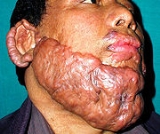
A keloid is a type of hypertrophic scar with mainly type I and some type III collagen which results in an overgrowth of tissue at the site of a healed skin injury. Keloids are firm, rubbery lesions or shiny, fibrous nodules
Nodule (medicine)

For use of the term nodule in dermatology, see Nodule_In medicine, a nodule refers to a relatively hard, roughly spherical abnormal structure....
, and can vary from pink to flesh-colored or red to dark brown in color. A keloid scar is benign
Benign

A benign tumor is a tumor that lacks all three of the malignant properties of a cancer. Thus, by definition, a benign tumor does not grow in an unlimited, aggressive manner, does not invade surrounding tissue , and does not metastasize....
, non-contagious, and usually accompanied by severe itchiness, sharp pains, and changes in texture.


Discussion
Ask a question about 'Keloid'
Start a new discussion about 'Keloid'
Answer questions from other users
Full Discussion Forum


Encyclopedia


A keloid is a type of hypertrophic scar with mainly type I and some type III collagen which results in an overgrowth of tissue at the site of a healed skin injury. Keloids are firm, rubbery lesions or shiny, fibrous nodules
Nodule (medicine)

For use of the term nodule in dermatology, see Nodule_In medicine, a nodule refers to a relatively hard, roughly spherical abnormal structure....
, and can vary from pink to flesh-colored or red to dark brown in color. A keloid scar is benign
Benign

A benign tumor is a tumor that lacks all three of the malignant properties of a cancer. Thus, by definition, a benign tumor does not grow in an unlimited, aggressive manner, does not invade surrounding tissue , and does not metastasize....
, non-contagious, and usually accompanied by severe itchiness, sharp pains, and changes in texture. In severe cases, it can affect movement of skin. (Keloids should not be confused with hypertrophic scars, which are raised scars that do not grow beyond the boundaries of the original wound.)

Occurrence

2006michellerobertsonear
Keloids expand in claw-like growths over normal skin. They have the capability to hurt with a needle-like pain or to itch without warning, although the degree of sensation varies from patient to patient.

If the keloid becomes infected, it may ulcerate. The only treatment is to remove the scar completely. However, the probability that the resulting surgery scar will also become a keloid is high, usually greater than 50%.

Keloids form within scar tissue
Scar

Scars are areas of fibrous biological tissue that replace normal skin after injury. A scar results from the biologic process of wound repair in the skin and other biological tissue of the body....
. Collagen
Collagen

Collagen is the main protein of connective tissue in animals and the most abundant protein in mammals, making up about 25% to 35% of the whole-body protein content....
, used in wound repair, tends to overgrow in this area, sometimes producing a lump many times larger than that of the original scar. Although they usually occur at the site of an injury, keloids can also arise spontaneously. They can occur at the site of a piercing and even from something as simple as a pimple or scratch. They can occur as a result of severe acne
Acne vulgaris

Acne vulgaris is a skin condition caused by changes in the pilosebaceous units . Severe acne is inflammation, but acne can also manifest in noninflammatory forms....
 or chickenpox
Chickenpox

Chickenpox or chicken pox is a highly contagious illness caused by primary infection with varicella zoster virus . It generally begins with a vesicular skin rash appearing in two or three waves, mainly on the body and head rather than the hands and becoming itchy raw pockmarks, small open sores which heal mostly without scarring....
 scarring, infection at a wound site, repeated trauma to an area, excessive skin tension during wound closure or a foreign body in a wound. Keloids can sometimes be sensitive to chlorine.

Biologically, keloids are fibrotic tumors characterized by a collection of atypical fibroblasts with excessive deposition of extracellular matrix components, especially collagen, fibronectin, elastin, and proteoglycans. Generally, keloids contain relatively acellular centers and thick, abundant collagen bundles that form nodules in the deep dermal portion of the lesion. Keloids present a therapeutic challenge that must be addressed, as these lesions can cause significant pain, pruritus (itching), and physical disfigurement. They may not improve in appearance over time and can limit mobility if located over a joint.

Keloids affect both sexes equally, although the incidence in young female patients has been reported to be higher than in young males, probably reflecting the greater frequency of earlobe piercing among women. There is a fifteen times higher frequency of occurrence in highly pigmented people. It is speculated that people who possess any degree of African descent, regardless of skin color, may be especially susceptible to keloid occurrences.

History in medicine

Keloids were described by Egyptian surgeons around 1700 BC. Baron Jean-Louis Alibert
Jean-Louis-Marc Alibert

Jean-Louis-Marc Alibert was a French dermatologist who was born in Villefranche-de-Rouergue, Aveyron. Originally planning to enter the priesthood, Alibert did not begin studying medicine until he was 26 years old....
 (1768-1837) identified the keloid as an entity in 1806. He called them cancroide, later changing the name to cheloide to avoid confusion with cancer. The word is derived from the Greek chele, meaning crab's claw, and the suffix -oid, meaning like. For many years, Alibert's clinic at L'Hôpital Saint-Louis was the world’s center for dermatology
Dermatology

Dermatology is the branch of medicine dealing with the skin and Skin disease, a unique specialty with both medical and surgical aspects. The name of this specialty originated in the form of the words dermologie and, a little later, dermatologia ....
.

Intentional keloids

The Olmec
Olmec

The Olmec were an ancient Pre-Columbian people living in the tropical lowlands of south-central Mexico, in what are roughly the modern-day Mexican state of Veracruz and Tabasco....
 of Mexico in pre-Columbian
Pre-Columbian

The pre-Columbian era incorporates all archaeology of the Americas in the history of the Americas before the appearance of significant European influences on the Americas continents....
 times used keloid scarification
Scarification

Scarifying involves scratching, etching, or some sort of superficial cutting or incision. Scarification, in botany, involves cutting the seed coat using abrasion, thermal stress, or chemicals to encourage germination....
 as a means of decoration. In the modern era, women of the Nubia
Nubia

Nubia is a region in Southern Egypt along the Nile and in what is now northern Sudan. Most of Nubia is situated in Sudan with about a quarter of its territory in Egypt....
-Kush in Sudan
Sudan

Sudan is a country in northeastern Africa. It is the largest in the African continent and the Arab World, and List of countries and outlying territories by total area by area....
 are intentionally scarified with facial keloids as a means of decoration. The Nuer
Nuer

The Nuer are a confederation of tribes located in Southern Sudan and western Ethiopia. Collectively, the Nuer form one of the largest ethnic groups in East Africa....
 and Nuba
Nuba

Nuba is a collective term used here for the peoples who inhabit the Nuba Mountains, in Kordofan province, Sudan, Africa. Although the term is used to describe them as if they composed a single group, the Nuba are multiple distinct strains and use different forms of speech....
 use lip plugs, keloid tattoos along the forehead, keloid tattoos along the chin and above the lip, and cornrows. As a part of a ritual, the people of Papua, New Guinea cut their skin and insert clay or ash into the wounds so as to develop permanent bumps (known as keloids or weals). This painful ritual honors members of their tribe who are celebrated for their courage and endurance.

Locations of keloids

Keloids can develop in any place that an abrasion has occurred. They can be the result of pimples, insect bites, scratching, burns, or other skin trauma. Keloid scars can develop after surgery. They are more common in some sites such as central chest, the back and shoulders and the ear lobes.

Incidence


People of all ages can develop a keloid. Children under 11 are less likely to develop keloids, even when they get their ears pierced. Keloids may also develop from pseudofoliculitis barbae, continued shaving when one has razor bumps will cause irritation to the bumps, infection and over time keloids will form. It would thus be wise for a man with razor bumps to stop shaving for a while and have the skin repair itself first before undertaking any form of hair removal. It is also speculated that the tendency to form keloids is hereditary and may be passed down from generation to generation.

Treatments

No treatment for keloids is considered to be 100% effective. Some of the treatments that are currently available are described below. These treatments have varying degrees of effectiveness. All the invasive methods of treatment like surgery carry a serious risk of the keloid recurring and becoming bigger than it previously was.

  • Mederma
    Mederma

    Mederma is an onion-extract-based topical gel produced by Merz Pharmaceuticals of Greensboro, North Carolina. Mederma's marketing claims it can make scars "softer, smoother, and less noticeable"....
     — Contains allium cepa.


  • Contractubex Gel / Hexilak Gel — These gels contain allium cepa
    Onion

    Onion is a term used for many plants in the genus Allium. They are known by the common name "onion" but, used without qualifiers, it usually refers to Allium cepa....
     extract, heparin and allantoin. Developed for the treatment of post-thyroidectomy scars, these gels are now indicated for the treatment of all post traumatic (burns, acne, piercings) or post surgery scars and keloids. Treatment is simple but requires perseverance. They have shown exceptional results, especially in newer scars. The earlier the initiation of treatment, the better the prognosis. This is now the first line of approach in conservative treatment of keloids.


  • Natural treatments — Some scar treatments contain mucin from the snail helix aspersa müller. The secretion from the snail regulates the skin healing and scar formation process. Topical application of treatments with this ingredient on keloid scars regulates and/or decreases dermal fibroblast proliferation and excess collagen production, and thus prevents and reduces keloid scars and hyperthropic scars.


  • Surgery — Surgery
    Surgery

    Surgery is a medical specialty that uses operative manual and instrumental techniques on a patient to investigate and/or treat a pathological condition such as disease or injury, to help improve bodily function or appearance, or sometimes for some other reason....
     requires great care during and after the operation. Keloids that return after being excised may be larger than the original. There is a 50% chance of recurrence after surgical removal. However, keloids are less likely to return if surgical removal is combined with other treatments. Surgical or laser excision may be followed by intralesional injections of a corticosteroid. Plastic closure of the skin including techniques such as v-plasty or w-plasty to reduce skin tension are known to reduce recurrence of keloids following excision
    Excision

    Excision means "to remove by cutting".* In surgery, an excision is the complete removal of an organ or a tumor from a body, as opposed to a biopsy....
    .


  • Dressings
    Dressing (medical)

    A dressing is an adjunct used by a person for application to a wound in order to promote healing and/or prevent further harm. A dressing is designed to be in direct contact with the wound, which makes it different from a bandage, which is primarily used to hold a dressing in place....
     — Moistened wound coverings made of silicone gel (such as Dermatix) or silastic
    Silastic

    Silastic is a trademark registered in 1948 by Dow Corning Corporation for flexible, inert silicone elastomer. Today, the Silastic trademark refers to silicone elastomers, silicone tubing and some cross-linked polydimethylsiloxane materials manufactured by Dow Corning, the owner of the global trademark....
     have been shown in studies to reduce keloid prominence over time. This treatment is safe and painless, although some patients may experience increased itchiness from wearing the dressing for an extended period of time.


  • Steroid injections — Steroid
    Steroid

    A steroid is a terpenoid lipid characterized by a carbon skeleton with four fused rings, generally arranged in a 6-6-6-5 fashion.Steroids vary by the functional groups attached to these rings and the oxidation state of the rings....
     injections are best used as the scar begins to thicken or if the person is a known keloid former. A series of injections with triamcinolone acetonide
    Triamcinolone acetonide

    Triamcinolone acetonide is a more potent type of triamcinolone, being about 8 times as effective as prednisone. Triamcinolone acetonide should not be used by those with tuberculosis or untreated fungal, bacterial, viral or herpes infections without consulting a doctor first....
     or another corticosteroid
    Corticosteroid

    Corticosteroids are a class of steroid hormones that are produced in the adrenal cortex. Corticosteroids are involved in a wide range of physiology systems such as stress , immune system and regulation of inflammation, carbohydrate metabolism, protein catabolism, blood electrolyte levels, and behavior....
     may reduce keloid size and irritation. However, injections are often uncomfortable and in large and/or hard scars can be difficult to perform, requiring local anesthetic for people over 16, and full anesthetic for people under. The treatment area can become very painful as the anesthetic wears off.


  • Compression — Compression bandages applied to the site over several months, sometimes for as long as six to twelve months, may lead to a reduction in the size of the keloid. This is the best treatment for preventing new scars.


  • Cryosurgery — Cryosurgery
    Cryosurgery

    Cryosurgery is the application of extreme cold to destroy abnormal or diseased tissue. The term comes from the Greek words cryo and surgery meaning "hand work" or "handiwork"....
     is an excellent treatment for keloids which are small and occur on lightly pigmented skin. It is often combined with monthly cortisone injections. The use of cryotherapy is limited since it causes skin blanching. It freezes the skin and causes sludging of the circulation beneath, effectively creating an area of localized frostbite. There is a slough of skin and keloid with re-epithelization.


  • Radiation therapy
    Radiation therapy

    Radiation therapy is the medicine use of ionizing radiation as part of cancer oncology to control malignant cell s . Radiotherapy may be used for curative or Adjuvant chemotherapy cancer treatment....
     — Electron beam radiation can be used at levels which do not penetrate the body deeply enough to affect internal organs. Orthovoltage radiation
    Orthovoltage X-rays

    Orthovoltage X-rays are produced by X-ray tubes operating at voltages in the 200–500 kilovolt range, and therefore an energy in the 200–500 kiloelectronvolt range ....
     is more penetrating and slightly more effective. Radiation treatments reduce scar formation if they are used soon after a surgery while the surgical wound is healing. This is one of the most effective procedures.


  • Laser
    Laser

    A laser is a device that emits light through a process called stimulated emission. The term laser is an acronym for light amplification by stimulated emission of radiation....
     therapy — This is an alternative to conventional surgery for keloid removal. Lasers produce a superficial peel but often do not reduce the bulk of the keloid. The use of dye-tuned laser
    Dye laser

    A dye laser is a laser which uses an organic compound dye as the lasing medium, usually as a liquid solution. Compared to gases and most solid state lasing media, a dye can usually be used for a much wider range of wavelengths....
    s has not shown better results than that of cold lasers. A relatively new approach is to combine laser therapy with steroid injections.


  • Newer treatments — Drugs that are used to treat autoimmune diseases
    Autoimmunity

    Autoimmunity is the failure of an organism to recognize its own constituent parts as self, which results in an immune response against its own cells and tissues....
     or cancer
    Cancer

    Cancer is a class of diseases in which a group of cell display uncontrolled growth , invasion , and sometimes metastasis . These three malignant properties of cancers differentiate them from benign tumors, which are self-limited, do not invade or metastasize....
     have shown promise. These include alpha-interferon, 5-fluorouracil and bleomycin
    Bleomycin

    Bleomycin is a glycopeptide antibiotic produced by the bacterium Streptomyces verticillus. Bleomycin refers to a family of structurally related compounds....
    . However, there is a need for further study and evaluation of this treatment technique.


Case presentation


This is a young male with bilateral keloid formation on the plantar surfaces of both feet. He has never been treated for this condition. There are other much smaller keloids located at small inlets on the glabrous (hairless) skin.
Keloid 01
Keloid 02
Keloid 03


External links

  • Current Keloid Genetics Research http://keloids.org
  • Treating the infection underneath