

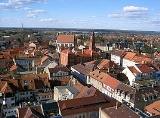
Kamenz

Encyclopedia
Kamenz is a Lusatia
n town in eastern Saxony
, Germany
, with a population of 18,243, and is part of the Bautzen district
. The town is located about 40 km (24.9 mi) northeast of Dresden
and about 30 km (18.6 mi) northwest of Bautzen
.
The philosopher and poet Gotthold Ephraim Lessing
was born in Kamenz, as was convicted criminal Bruno Hauptmann
.
and river Schwarze Elster
at the end of the 12th century. The Via Regia was an important trade route between Belgium
and Silesia
.
In 1225 the town was mentioned the first time and in 1319 it became independent. The League of six towns of Upper Lusatia
had been founded by Kamenz and five other lusatian towns for protection against robber barons in 1346. In 1707 a fire destroyed large parts of the old town.
The philosopher and poet Gotthold Ephraim Lessing
was born in Kamenz in 1729.
Lusatia
Lusatia is a historical region in Central Europe. It stretches from the Bóbr and Kwisa rivers in the east to the Elbe valley in the west, today located within the German states of Saxony and Brandenburg as well as in the Lower Silesian and Lubusz voivodeships of western Poland...
n town in eastern Saxony
Saxony
The Free State of Saxony is a landlocked state of Germany, contingent with Brandenburg, Saxony Anhalt, Thuringia, Bavaria, the Czech Republic and Poland. It is the tenth-largest German state in area, with of Germany's sixteen states....
, Germany
Germany
Germany , officially the Federal Republic of Germany , is a federal parliamentary republic in Europe. The country consists of 16 states while the capital and largest city is Berlin. Germany covers an area of 357,021 km2 and has a largely temperate seasonal climate...
, with a population of 18,243, and is part of the Bautzen district
Bautzen (district)
Bautzen is a district in the Free State of Saxony in Germany including the former districts of Bischofswerda and Kamenz. It is bounded by the Czech Republic, the district of Sächsische Schweiz-Osterzgebirge, the district-free city Dresden and the districts of Meißen and Görlitz...
. The town is located about 40 km (24.9 mi) northeast of Dresden
Dresden
Dresden is the capital city of the Free State of Saxony in Germany. It is situated in a valley on the River Elbe, near the Czech border. The Dresden conurbation is part of the Saxon Triangle metropolitan area....
and about 30 km (18.6 mi) northwest of Bautzen
Bautzen
Bautzen is a hill-top town in eastern Saxony, Germany, and administrative centre of the eponymous district. It is located on the Spree River. As of 2008, its population is 41,161...
.
The philosopher and poet Gotthold Ephraim Lessing
Gotthold Ephraim Lessing
Gotthold Ephraim Lessing was a German writer, philosopher, dramatist, publicist, and art critic, and one of the most outstanding representatives of the Enlightenment era. His plays and theoretical writings substantially influenced the development of German literature...
was born in Kamenz, as was convicted criminal Bruno Hauptmann
Bruno Hauptmann
Bruno Richard Hauptmann was a German ex-convict sentenced to death for the abduction and murder of the 20-month-old son of Charles Lindbergh and Anne Morrow Lindbergh. The Lindbergh kidnapping became known as "The Crime of the Century".-Background:Hauptmann was born in Kamenz in the German Empire,...
.
History
At the location of today's old town a castle had been built to secure the crossing of route Via RegiaVia Regia
Via Regia, i.e. "Royal Highway", denotes a mediæval historic road. The term, in the usual sense, means not just a specific road, rather a type of road. It was legally associated with the king and remained under his special protection and guarantee of public peace.There were many such roads in the...
and river Schwarze Elster
Schwarze Elster
The Black Elster or Schwarze Elster is a 179 km long river in eastern Germany, in the states Saxony, Brandenburg and Saxony-Anhalt, right tributary of the Elbe. Its source is in the Upper Lusatia region, near Elstra....
at the end of the 12th century. The Via Regia was an important trade route between Belgium
Belgium
Belgium , officially the Kingdom of Belgium, is a federal state in Western Europe. It is a founding member of the European Union and hosts the EU's headquarters, and those of several other major international organisations such as NATO.Belgium is also a member of, or affiliated to, many...
and Silesia
Silesia
Silesia is a historical region of Central Europe located mostly in Poland, with smaller parts also in the Czech Republic, and Germany.Silesia is rich in mineral and natural resources, and includes several important industrial areas. Silesia's largest city and historical capital is Wrocław...
.
In 1225 the town was mentioned the first time and in 1319 it became independent. The League of six towns of Upper Lusatia
League of six towns of Upper Lusatia
The Lusatian League was a historical alliance of six towns in the Bohemian, later Saxon region of Upper Lusatia, that existed from 1346 until 1815. The member towns were Bautzen , Görlitz , Kamenz , Lauban, Löbau and Zittau...
had been founded by Kamenz and five other lusatian towns for protection against robber barons in 1346. In 1707 a fire destroyed large parts of the old town.
The philosopher and poet Gotthold Ephraim Lessing
Gotthold Ephraim Lessing
Gotthold Ephraim Lessing was a German writer, philosopher, dramatist, publicist, and art critic, and one of the most outstanding representatives of the Enlightenment era. His plays and theoretical writings substantially influenced the development of German literature...
was born in Kamenz in 1729.
Theater
- Stadttheater (City theater)
- Hutbergbühne Kamenz (an open-air stage for up to 10,000 visitors)
Museums
- Museum der Westlausitz (Museum of Western Lusatia)
- Lessingmuseum (Museum of Lessing)
Buildings
- Town hall of Kamenz (build 1848 to 1849, Italian NeorenaissanceRenaissanceThe Renaissance was a cultural movement that spanned roughly the 14th to the 17th century, beginning in Italy in the Late Middle Ages and later spreading to the rest of Europe. The term is also used more loosely to refer to the historical era, but since the changes of the Renaissance were not...
) - Andreasbrunnen (Andreas Fountain), on the market square
- Red Tower, Mönchsmauer (monk wall), Pichschuppen (parts of the medieval town battlement)
- Protestant main church St. Marien (build 1275 - 1479, late gothic architectureGothic architectureGothic architecture is a style of architecture that flourished during the high and late medieval period. It evolved from Romanesque architecture and was succeeded by Renaissance architecture....
) - minster St. Annen (1499)
- catechismCatechismA catechism , i.e. to indoctrinate) is a summary or exposition of doctrine, traditionally used in Christian religious teaching from New Testament times to the present...
church (1358) - Lessing memorial (place where birth house of Lessing was situated)
- Lessing-Haus
Nature
- Hutberg (294 m) - mountain with park, with RhododendronRhododendronRhododendron is a genus of over 1 000 species of woody plants in the heath family, most with showy flowers...
- about 32% of the nature of the DistrictKamenz (district)Kamenz was a Kreis in the north-east of the Free State of Saxony, Germany. Neighboring districts were Oberspreewald-Lausitz, Spree-Neiße, Niederschlesischer Oberlausitzkreis, Bautzen - Budyšin, Sächsische Schweiz, the district-free city Dresden - Drježdźany, and the districts Meißen and...
is under protection - there is a good network of routes for riding by bicycle and hiking
Events
- Blütenlauf auf dem Hutberg (Run on the Hutberg)
- Lessing Days (every year, January and February)
- Fête de la MusiqueFête de la MusiqueThe Fête de la Musique, also known as World Music Day, is a music festival taking place on June 21.-History:The idea was first broached in 1976 by American musician Joel Cohen, then employed by the national French radio station France Musique. Cohen proposed an all-night music celebration at the...
every year on June 21 - Forstfest (Forest Festival), every year in the week of August 24 (St Bartholomew's Day)
- Kamenzer Nasenfest (Nose Festival), Festival with the so called nose market every year on October 3
- carnival
- Popular German band SilbermondSilbermondSilbermond is a German rock band from Bautzen, Saxony. The band consists of Stefanie Kloß, Andreas Nowak, Johannes and Thomas Stolle.-Biography:...
, originally from the nearby town of BautzenBautzenBautzen is a hill-top town in eastern Saxony, Germany, and administrative centre of the eponymous district. It is located on the Spree River. As of 2008, its population is 41,161...
, have made it a personal tradition to play the final concert of their album tours at Kamenz's Hutbergbühne stadium.