


Kaiser-Frazer

Encyclopedia
Joseph W. Frazer
Joseph Washington Frazer was a 20th-century American automobile company executive employed in succession by Chrysler, Willys-Overland, Graham-Paige and Kaiser-Frazer Corporation...
and industrialist Henry J. Kaiser
Henry J. Kaiser
Henry John Kaiser was an American industrialist who became known as the father of modern American shipbuilding. He established the Kaiser Shipyard which built Liberty ships during World War II, after which he formed Kaiser Aluminum and Kaiser Steel. Kaiser organized Kaiser Permanente health care...
. In 1947, the company acquired the automotive assets of Graham-Paige
Graham-Paige
Graham-Paige was an American automobile manufacturer founded by brothers Joseph B. Graham and Robert C. Graham , and Canadian Ray Austin in 1927. Automobile production ceased in 1940, and its automotive assets were acquired by Kaiser-Frazer in 1947...
, of which Frazer had been president before the Second World War. The concern was the only new US automaker to achieve success after World War II
World War II
World War II, or the Second World War , was a global conflict lasting from 1939 to 1945, involving most of the world's nations—including all of the great powers—eventually forming two opposing military alliances: the Allies and the Axis...
, if only for a few years.
History
.jpg)
Big Three automobile manufacturers
The Big Three, when used in relation to the automotive industry, most generally refers to the three major American automotive companies:Ford, General Motors, and Chrysler...
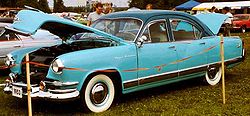
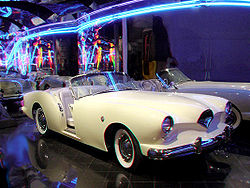
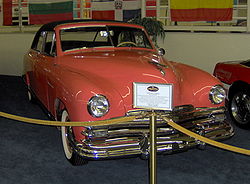
" were still marketing their pre-war designs, the Kaisers and Frazers made quite an exciting entrance. Kaiser and Frazer would continue to share bodies and engines through 1950 with different exterior and interior trim.
Henry Kaiser had no automotive marketing experience while Joseph Frazer did, having been president of the Graham-Paige Corporation prior to the Second World War. Henry Kaiser believed in pressing on in the face of adversity; Joseph Frazer was more pragmatic. As the market for K-F products slowed in 1949 with the introduction of new designs from the Big Three, Kaiser pushed for more production creating an oversupply of cars that took until mid-1950 to sell. Kaiser and Frazer continued at odds until Frazer left the company in 1951, and the Frazer nameplate was dropped after a short 10,000 unit production run. In 1952 the Kaiser-Frazer Corporation was renamed Kaiser Motors
Kaiser Motors
Kaiser Motors Corporation made automobiles at Willow Run, Michigan, United States, from 1945 to 1953. In 1953, Kaiser merged with Willys-Overland to form Willys Motors Incorporated, moving its production operations to the Willys plant at Toledo, Ohio...
Corporation and continued building passenger cars until 1955.
In 1953 Kaiser bought the ailing Willys-Overland company for US$63,381,175 and merged the Kaiser and Willys operations together under the name Willys Motors. The decision was then made to exit the passenger car market, which was accomplished at the end of the 1955 model year. By 1956, Willys Motors was building only utility vehicles, many for export, and was turning a healthy profit.
In 1970, the Kaiser Jeep Corporation, as the company had been renamed in 1963, was sold to American Motors Corporation which continued to manufacture Jeep vehicles until AMC itself was purchased by Chrysler in 1987 for $360 million. Chrysler wanted the Jeep vehicle line and had estimated that for them to create a similar competing product and build a reputation to match would have cost in excess of $1 billion.
Production of Kaiser-Frazer models was centered at Willow Run, Michigan
Willow Run
The Willow Run manufacturing plant, located between Ypsilanti and Belleville, Michigan, was constructed during World War II by Ford Motor Company for the mass production of the B-24 Liberator military aircraft....
. Willow Run, the largest building in the world at that time, was built by the U.S. government just prior to World War II for Henry Ford
Henry Ford
Henry Ford was an American industrialist, the founder of the Ford Motor Company, and sponsor of the development of the assembly line technique of mass production. His introduction of the Model T automobile revolutionized transportation and American industry...
to build B-24 Liberator bombers. Once the war ended, Ford had no interest in the facility, setting the War Assets Administration off in a search for someone to lease or buy the building. When K-F expressed interest in the facility, the WAA offered them an attractive five-year lease rate. K-F also had manufacturing facilities in Jefferson MI; Long Beach CA; Portland OR; Leaside, Ontario, Canada; Haifa, Israel; Kawasaki, Japan; Mexico City and Rotterdam (known as "Nekaf" Nederlandse Kaiser-Frazer fabrieken). U.S. production was concentrated at Toledo, OH upon the purchase of Willys-Overland starting in 1953; the Willow Run facility had been sold to General Motors after GM suffered a disastrous fire at their Livonia, MI Hydramatic automatic transmission plant and needed a facility quickly to resume production.
Kaiser Frazer Products
Henry J
Henry J
The Henry J was an American automobile built by the Kaiser-Frazer Corporation and named after its chairman, Henry J. Kaiser. Production of six-cylinder models began in July 1950, and four-cylinder production started shortly after Labor Day, 1950. Official public introduction was September 28, 1950....
, a small economy car including Corsair.
Darrin, the first production fiberglass sports car in the USA, beating Corvette to market by one month.
Frazer includes Standard, Deluxe and Manhattan sedans and the Vagabond hatchback. The 1951 Frazer Manhattan convertible was the last four-door American convertible until the 1961 Lincoln Continental.
Willys, including "Aero-Willys" and all sub-trim levels include Aero-Lark, Aero Ace et al.
Jeep
Jeep
Jeep is an automobile marque of Chrysler . The first Willys Jeeps were produced in 1941 with the first civilian models in 1945, making it the oldest off-road vehicle and sport utility vehicle brand. It inspired a number of other light utility vehicles, such as the Land Rover which is the second...
, including pick-ups, CJ Vehicles, all steel wagons, Wagoneer and Jeepster marques.
Allstate
Allstate (automobile)
The Allstate was an American automobile offered for sale through the Allstate auto accessory chain of Sears, Roebuck during the 1952 and 1953 model years.-History:...
, designed to sell through and by Sears-Roebuck department stores in the southern USA, a slightly restyled Henry J. The cars were equipped with Allstate products (tires, battery, etc.). The modest styling changes distinguishing the Allstate from the Henry J were executed by Alex Tremulis
Alex Tremulis
Alexander Sarantos Tremulis was an industrial designer in the North American automotive industry...
, the designer of the 1948 Tucker Sedan
1948 Tucker Sedan
The 1948 Tucker Sedan or Tucker '48 Sedan was an advanced automobile conceived by Preston Tucker and briefly produced in Chicago in 1948...
.
Kaiser in Argentina
In 1951 Argentina sent their emissary, Brigadier Juan Ignacio San Martín, to the United States in an attempt to convince an auto manufacturer to build cars in Argentina. In 1954 Kaiser was the only one to accept the offer with the rest believing the market was too small to justify the investment. Also, they didn't have the rugged products Kaiser did. On January 19, 1955 Kaiser and the government of Argentina signed an agreement to permit Kaiser to manufacture automobiles and trucks in Argentina. In February, Kaiser created a wholly owned subsidiary named Kaiser Automotores, the holding company which in turn owned part of the newly created Industrias Kaiser Argentina S.A. (IKAIndustrias Kaiser Argentina
Industrias Kaiser Argentina S.A. or IKA was an Argentine motor company established in 1956 in Córdoba Province as a joint venture with Kaiser Motors of the United States....
), the manufacturing and marketing arm. Other partners in IKA included the government-owned vehicle manufacturer IAME and private investors. In August Kaiser applied for and got an import license to bring in 1,021 completed cars, manufacturing equipment and spare parts from the USA. Groundbreaking for the new factory was in March 1955 with the first Jeep vehicle rolling out of the plant on 27 April 1956.
The new Argentine factory was built in the city of Santa Isabel in the province of Córdoba with the Kaiser Manhattan being rechristened the Kaiser Carabela — named after a type of Spanish sailing ship. The USA vinyl and fabric interior was replaced with a more rugged leather interior, the speedometer
Speedometer
A speedometer is a gauge that measures and displays the instantaneous speed of a land vehicle. Now universally fitted to motor vehicles, they started to be available as options in the 1900s, and as standard equipment from about 1910 onwards. Speedometers for other vehicles have specific names...
was recalibrated in kilometers with the temperature, oil, and fuel gauge
Fuel gauge
A fuel gauge is an instrument used to indicate the level of fuel contained in a tank. Commonly used in cars, these may also be used for any tank including underground storage tanks.As used in cars, the gauge consists of two parts:...
annotations in Spanish and the spring rates were increased to accommodate the unimproved Argentine roads. Oddly, the dash castings with annotations for vent, heater, headlight and wiper controls remained in English. No consideration was given to offering an automatic transmission due to the anticipated difficulty in obtaining service in remote towns. Production started on the Carabela on 25 July 1958 and, in the remaining months of year, 2,158 cars were built. IKA was also building Jeep vehicles at the Cordoba factory and assembled 20,454 Jeeps in 1958 alone. The combined Carabela-Jeep production of 22,612 units was 81% of all vehicles manufactured in Argentina in 1958 with the only competition being a state-run utility vehicle manufacturer. Many have questioned the wisdom of building IKA automobile factory in remote Santa Isabel which was far from ports and transportation hubs but the primary reason is that Córdoba was General San Martín's home province and he had a close, influential relationship with President Juan Perón.
In 1962 the Carabela, the "Gran coche argentino" (the Great Argentine Car), ended production with some 15,000 cars assembled providing elegant transportation for the doctors, bankers and other notables in Argentina. The Carabela had some stable mates in 1960-62 in the form of an Alfa Romeo 1900 sedan derivative named the Bergantin (another type of Spanish sailing ship) and an Argentine-manufactured Renault Dauphine (badged IKA Dauphine). In 1962 Rambler variants licensed from AMC would replace all of these. The final form of the AMC variants was the potent Torino which saw a lot of racing on international circuits. In 1970 Kaiser sold IKA to Renault.
Kaiser Frazer in the Netherlands
In 1947 a Dutch company was created named Nederlandse Kaiser-Frazer Fabrieken (NEKAF) with a new factory constructed in Rotterdam. NEKAF assembled 6,000 1949 Kaiser knock-down kits imported from the USA using some local content (batteries, tires, interior carpets, glass) and ignition and electrical system parts from France and England. Kaiser cars were assembled through 1954 with NEKAF exporting to Europe, South America and the Middle East.USA built Jeep vehicles were imported into The Netherlands by S.A. Ateliers de La Dyle under an agreement with Willys Overland. Once Willys was purchased by Kaiser, the Willys agreement was transferred to NEKAF. In March 1954 assembly of the Jeep CJ-3B started and was followed by the FC-150, FC-170, the pickup truck, station wagon, CJ-5 and DJ-3A. On 21 January 1955 NEKAF signed a contract with the Royal Netherlands Army to supply 4,000 M-38A1 jeeps with the first delivery to the army on 28 May of the same year. The vehicles were knock down kits imported from the USA with some local content like with the 1949 Kaiser assembly. NEKAF delivered an additional 1,624 vehicles to the army through 1959 until production was taken over by Kemper & Van Twist Diesel who delivered another 2,237 jeep vehicles through 1963 although these were still commonly known as NEKAFs.
The NEKAF jeeps differed from the USA version by adding side reflectors (white in front and red at the rear), low intensity "city lights" mounted on the front fenders and front and rear mounted directional signals. In a bid to reduce the costs, the Ministry of War, having invested already in clothing for the crews, ordered the cabin heaters to be deleted. This modification entailed considerable redesign of the engine cooling unit which eventually led to increased cost of the vehicles (some 12,000 Dutch Florins each). The jeeps, dubbed NEKAF by the military, started to enter service in 1956 and remained so well into the 1990s albeit on reservist duties. The NEKAF jeep saw action in the brief Dutch Indonesian war in 1962, but particularly during the UNIFIL operation in which an armoured infantry battalion participated from 1979 till 1983, the NEKAF turned out to be a robust and reliable vehicle in South Lebanon. Upon withdrawal of the Dutch batallion all UNIFIL NEKAFs were dismantled and sold locally as scrap, save three NEKAFs that were secretly withheld and privately driven back to the Netherlands. One of these sole surviving UNIFIL NEKAFs is now in the collection of the Legermuseum Delft (the Dutch Army Museum).
See also
- Kaiser MotorsKaiser MotorsKaiser Motors Corporation made automobiles at Willow Run, Michigan, United States, from 1945 to 1953. In 1953, Kaiser merged with Willys-Overland to form Willys Motors Incorporated, moving its production operations to the Willys plant at Toledo, Ohio...
- Kaiser JeepKaiser JeepKaiser Jeep was the result of the merger between the Kaiser-Frazer Corporation, an independent automaker based in Willow Run, Michigan, and the Toledo, Ohio-based Willys-Overland Company....
- List of automobile manufacturers