
All Topics  
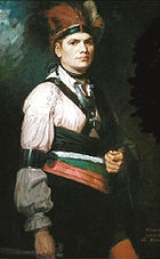
Joseph Brant

 
Joseph Brant

   Email Print
   Bookmark   Link


Joseph Brant


Thayendanegea or Joseph Brant (c.
Circa

Circa means "in approximately", generally referring to a year. It is widely used in genealogy and historical writing, when the dates of events are approximately known....
 1743 – 24 November 1807) was a Mohawk
Mohawk nation

Mohawk are an Indigenous peoples of the Americas of North America originally from the Mohawk Valley in upstate New York to southern Quebec and eastern Ontario....
 leader and British
Kingdom of Great Britain

The Kingdom of Great Britain, also known as the United Kingdom of Great Britain, was a country in North-West Europe, in existence from 1707 to 1801....
 military officer during the American Revolution
American Revolutionary War

The American Revolutionary War , also known as the American War of Independence, began as a war between the Kingdom of Great Britain and Thirteen Colonies on the North America, and ended in a global war between several European great powers....
. Brant was perhaps the most well-known North American Indian of his generation. He met many of the most significant people of the age, including George Washington
George Washington

George Washington was the leader of the Continental Army in the American Revolutionary War and served as the List of Presidents of the United States President of the United States of the United States of Americas ....
 and King George III
George III of the United Kingdom

George III was Kingdom of Great Britain and Kingdom of Ireland from 25 October 1760 until the union of these two countries on 1 January 1801, after which he was King of the United Kingdom of Great Britain and Ireland until his death....
. The American folk image emphasized the wartime atrocities his forces committed against settlers in the Mohawk Valley; in Canada, he was remembered for his efforts to regain land for the Mohawk people.

arch, 1743, Brant was born at Cuyahoga Ohio Country on the banks of the Cuyahoga River
Cuyahoga River

The Cuyahoga River is located in Northeast Ohio in the United States. Outside of Ohio, the river is most famous for being "the river which caught fire", helping to spur the environmental movement in the late 1960s....
, near present-day Akron, Ohio
Akron, Ohio

Akron is a city in the U.S. state of Ohio and the county seat of Summit County, Ohio. In 2007, its population was estimated to be 207,934. The municipality is located in northeastern Ohio on the Cuyahoga River between Cleveland, Ohio to the north and Canton, Ohio to the south, approximately 60 miles west of the Pennsylvania border....
.


Discussion
Ask a question about 'Joseph Brant'
Start a new discussion about 'Joseph Brant'
Answer questions from other users
Full Discussion Forum


Encyclopedia


Thayendanegea or Joseph Brant (c.
Circa

Circa means "in approximately", generally referring to a year. It is widely used in genealogy and historical writing, when the dates of events are approximately known....
 1743 – 24 November 1807) was a Mohawk
Mohawk nation

Mohawk are an Indigenous peoples of the Americas of North America originally from the Mohawk Valley in upstate New York to southern Quebec and eastern Ontario....
 leader and British
Kingdom of Great Britain

The Kingdom of Great Britain, also known as the United Kingdom of Great Britain, was a country in North-West Europe, in existence from 1707 to 1801....
 military officer during the American Revolution
American Revolutionary War

The American Revolutionary War , also known as the American War of Independence, began as a war between the Kingdom of Great Britain and Thirteen Colonies on the North America, and ended in a global war between several European great powers....
. Brant was perhaps the most well-known North American Indian of his generation. He met many of the most significant people of the age, including George Washington
George Washington

George Washington was the leader of the Continental Army in the American Revolutionary War and served as the List of Presidents of the United States President of the United States of the United States of Americas ....
 and King George III
George III of the United Kingdom

George III was Kingdom of Great Britain and Kingdom of Ireland from 25 October 1760 until the union of these two countries on 1 January 1801, after which he was King of the United Kingdom of Great Britain and Ireland until his death....
. The American folk image emphasized the wartime atrocities his forces committed against settlers in the Mohawk Valley; in Canada, he was remembered for his efforts to regain land for the Mohawk people.

Early years

In March, 1743, Brant was born at Cuyahoga Ohio Country on the banks of the Cuyahoga River
Cuyahoga River

The Cuyahoga River is located in Northeast Ohio in the United States. Outside of Ohio, the river is most famous for being "the river which caught fire", helping to spur the environmental movement in the late 1960s....
, near present-day Akron, Ohio
Akron, Ohio

Akron is a city in the U.S. state of Ohio and the county seat of Summit County, Ohio. In 2007, its population was estimated to be 207,934. The municipality is located in northeastern Ohio on the Cuyahoga River between Cleveland, Ohio to the north and Canton, Ohio to the south, approximately 60 miles west of the Pennsylvania border....
. This was during the hunting season when Mohawks traveled to the area. He was named Thayendanegea, which can mean two wagers (sticks) bound together for strength, or possibly "he who places two bets." He was a Mohawk of the Wolf Clan (his mother's clan). Fort Hunter church records indicated that his parents were Christians and their names were Peter and Margaret Tehonwaghkwangearahkwa. His father Peter died before 1753. Other sources cite the father's name as Nickus Kanagaradankwa.

After his father's death, his mother Margaret, or Owandah, the niece of Tiaogeara , a Caughnawaga sachem
Sachem

Sachem may refer to:* Sachem, a Native American leader* A leader of Tammany Hall* The Sachem award, which replaced the Sagamore of the Wabash as Indiana's highest civilian honor...
, returned to New York with Joseph and his older sister Mary
Mary Brant

Ko?watsi?tsiai??ni or Mary Brant was an important Mohawk nation woman in the era of the American Revolution. Brant had considerable influence within the Iroquois confederacy, more than her more famous younger brother Joseph Brant....
 (known as Molly). They settled in Canajoharie
Canajoharie (town), New York

Canajoharie is a town in Montgomery County, New York, New York, United States. The population was 3,797 at the 2000 census. The town of Canajoharie is located south of the Mohawk River on the south border of the county....
. This town on the Mohawk River
Mohawk River

The Mohawk River is a long river in the U.S. state of New York. It is the largest tributary of the Hudson River and it meets it in the Capital Region, a few miles north of the city of Albany, New York....
 in east-central New York
New York

The State of New York is a U.S. state in the Mid-Atlantic States and Northeastern United States regions of the United States and is the nation's List of U.S....
 was where they had lived before her family had their expedition to the Ohio River. On 9 September 1753 in Fort Hunter
Fort Hunter, New York

Fort Hunter, New York is a hamlet in the town of Florida, Montgomery County, New York in Montgomery County, New York, New York, United States, on the Mohawk River at Schoharie Creek....
 (Church of England), his mother married again, to a widower named Brant Canagaraduncka, who was a Mohawk sachem. Her new husband's family ties with the British were shown by his grandfather Sagayendwarahton, or "Old Smoke", having visited England in 1710.

The marriage bettered Margaret's fortunes and the family lived in the best house in Canajoharie. Her new alliance conferred little status on her children, however, as Mohawk titles and leadership positions descended through the female line.

Brant's stepfather was a friend of William Johnson, the influential and wealthy British Superintendent for Northern Indian Affairs, who was knighted for his service. He also served as a General. During Johnson's frequent visits to the Mohawks, he always stayed at the Brants' house. Brant's half sister Molly Brant married Sir William Johnson. Johnson was an agent for the British and a highly successful trader. The wealth of his mansion Johnson Hall impressed young Brant so much that he decided to stay with his half sister Molly and Johnson. Johnson took an interest in the youth and helped him in his education as well as in meeting influential leaders in the colony.

Starting at about age 15, Brant took part in a number of French and Indian War
French and Indian War

The French and Indian War was the North American chapter of the Seven Years' War, known in Canada as the War of the Conquest. The name refers to the two main enemies of the British: the royal French forces and the various Indigenous peoples of the Americas forces allied with them....
 expeditions, including James Abercrombie
James Abercrombie (general)

James Abercrombie or Abercromby was a British Army general and commander-in-chief of forces in North America during the French and Indian War, best known for the disastrous British losses in the 1758 Battle of Carillon....
’s 1758 invasion of Canada via Lake George
Lake George (New York)

Lake George, nicknamed the Queen of American Lakes, is a long, narrow lake at the southeast base of the Adirondack Mountains, northern New York, United States The lake extends about 32.2 miles on a north-south axis and varies from 1 to 3 miles in width....
, William Johnson's 1759 Battle of Fort Niagara
Battle of Fort Niagara

The Battle of Fort Niagara was one of the final battles in the French and Indian War, the North American theatre of the Seven Years' War. The British attack on Fort Niagara was part of a campaign to remove French fortifications from the Great Lakes and Ohio Country regions, allowing for a western invasion of New France in conjunction with Jam...
, and Jeffery Amherst's 1760 siege of Montreal
Montreal

Montreal, or Montr?al, is the largest city in the Provinces and territories of Canada of Quebec and the List of largest cities and second largest cities by country List of the 100 largest municipalities in Canada by population....
 via the St. Lawrence River. He was one of 182 Indians who received a silver medal from the British for his service.

In 1761, Johnson arranged for three Mohawks, including Joseph, to be educated at Eleazar Wheelock
Eleazar Wheelock

Eleazar Wheelock was an American Congregational church minister, orator, educator, and founder of Dartmouth College.He was born in Windham, Connecticut to Ralph Wheelock and Ruth Huntington....
's "Moor's Indian Charity School" in Connecticut. This was the forerunner of Dartmouth College
Dartmouth College

Dartmouth College is a private university, coeducational university located in Hanover, New Hampshire, New Hampshire. Incorporated as "Trustees of Dartmouth College,"...
, later established in New Hampshire. Brant studied under the guidance of the Reverend Eleazar Wheelock. Wheelock wrote that Brant was "of a sprightly genius, a manly and gentle deportment, and of a modest, courteous and benevolent temper." Brant learned to speak, read, and write English. Brant met Samuel Kirkland
Samuel Kirkland

Rev. Samuel Kirkland was a Presbyterian missionary among the Oneida tribe and Tuscarora people in North America. He was the founder of the Hamilton-Oneida Academy ....
 at the school. In 1763, Johnson prepared to place Brant at King's College in New York City. The outbreak of Pontiac's Rebellion
Pontiac's Rebellion

Pontiac's Rebellion was a war launched in 1763 by North American First Nations who were dissatisfied with Kingdom of Great Britain policies in the Great Lakes region after the British victory in the French and Indian War/Seven Years' War ....
 upset these plans and Brant returned home. After Pontiac's rebellion, Johnson thought it was not safe for Brant to return to the school.

In March 1764, Brant participated in one of the Iroquois
Iroquois

The Iroquois Confederacy is a group of First Nations/Native Americans in the United States that originally consisted of five nations: the Mohawk nation, the Oneida tribe, the Onondaga , the Cayuga nation, and the Seneca nation....
 war parties that attacked Delaware
Delaware

Delaware is a U.S. state located on the East Coast of the United States in the Mid-Atlantic States region of the United States. The state takes its name from Thomas West, 3rd Baron De La Warr, a British nobleman and Virginia's first colonial governor, after whom Cape Henlopen was originally named....
 Indian villages in the Susquehanna
Susquehanna River

The Susquehanna River is a river located in the northeastern United States. At approximately 444 mi long, it is the longest river on the East Coast of the United States and the 16th longest in the United States....
 and Chemung
Chemung River

The Chemung River is a tributary of the Susquehanna River, approximately 45 mi long, in south central New York and northern Pennsylvania in the United States....
 valleys. They destroyed three good-sized towns, burning 130 houses and killing the natives' cattle. No enemy warriors were seen.

On July 22, 1765, in Canajoharie, Brant married Peggie (also known as Margaret). Said to be the daughter of a Virginia gentleman, Peggie was a white captive sent back East from western Indians. They moved into Brant's parents' house. The house soon became Brant's after his stepfather's death. He also owned a large and fertile farm of near the village of Canajoharie
Canajoharie

Canajoharie may refer to:* Canajoharie , New York* Canajoharie , New York* Canajoharie Central School District* Canajoharie and Catskill Railroad...
 on the south shore of the Mohawk River. He raised corn, and kept cattle, sheep, horses, and hogs. He also kept a small store. Brant dressed in "the English mode" wearing "a suit of blue broad cloth." With Johnson's encouragement, the Mohawks made Brant a war chief and their primary spokesman. In March 1771, his wife died from consumption
Tuberculosis

Tuberculosis is a common and often deadly infectious disease caused by mycobacterium, mainly Mycobacterium tuberculosis . Tuberculosis usually attacks the lungs but can also affect the central nervous system, the lymphatic system, the circulatory system, the genitourinary system, the gastrointestinal system, bones, joints, and even the...
.

In the spring of 1772, Brant moved to Fort Hunter
Fort Hunter, New York

Fort Hunter, New York is a hamlet in the town of Florida, Montgomery County, New York in Montgomery County, New York, New York, United States, on the Mohawk River at Schoharie Creek....
 to live with the Reverend John Stuart. He became Stuart's interpreter and teacher of Mohawk, collaborating with him to translate the Anglican catechism and the Gospel of Mark
Gospel of Mark

The Gospel of Mark is the second of the four canonical gospels in the New Testament and was probably the first of the three synoptic gospels to be written....
 into the Mohawk language
Mohawk language

Mohawk is a Native Americans in the United States language spoken by the Mohawk nation in the United States and Canada. It is part of the Iroquoian family....
. Brant became Anglican
Anglicanism

Anglicanism is a tradition of Christianity faith. Churches in this tradition either have historical connections to the Church of England or have similar beliefs, worship and church structures....
, a faith he held for the remainder of his life.

In 1773, Brant moved back to Canajoharie
Canajoharie

Canajoharie may refer to:* Canajoharie , New York* Canajoharie , New York* Canajoharie Central School District* Canajoharie and Catskill Railroad...
 and married Peggie's half-sister Susanna.

American Revolution

Brant spoke at least three and possibly all of the Six Nations
Six Nations

Six Nations may refer to:* Iroquois Confederacy, a group of First Nations/Native Americans that originally consisted of five nations, later six...
' languages. From 1766 on he was a translator for the department of Indian affairs. In 1775, he was appointed departmental secretary with the rank of Captain for the new British Superintendent's Indian warriors from Canajoharie
Canajoharie

Canajoharie may refer to:* Canajoharie , New York* Canajoharie , New York* Canajoharie Central School District* Canajoharie and Catskill Railroad...
. They went to Canada
Canada

Canada is a country occupying most of northern North America, extending from the Atlantic Ocean in the east to the Pacific Ocean in the west and northward into the Arctic Ocean....
, arriving in Montreal
Montreal

Montreal, or Montr?al, is the largest city in the Provinces and territories of Canada of Quebec and the List of largest cities and second largest cities by country List of the 100 largest municipalities in Canada by population....
 on July 17. His wife and children went to Onoquaga.

On November 11, 1775, Guy Johnson
Guy Johnson

Guy Johnson was an Ireland-born military officer and diplomat for the The Crown during the American Revolutionary War. He was the son of either John or Warren Johnson of Smithstown, Dunshaughlin, County Meath, the two younger brothers of Sir William Johnson....
 took Brant along with him when he traveled to London
London

London is the capital of both England and the United Kingdom, and the most populous municipality in the European Union. An important settlement for two millennia, History of London goes back to its founding by the Roman Empire....
. Brant hoped to persuade the Crown to address past Mohawk land grievances. The British government promised the Iroquois people land in Canada
Canada

Canada is a country occupying most of northern North America, extending from the Atlantic Ocean in the east to the Pacific Ocean in the west and northward into the Arctic Ocean....
 if Brant and the Iroquois nations would fight on the British side in what was shaping up as open rebellion by the American colonists. In London, Brant became a celebrity and was interviewed for publication by James Boswell
James Boswell

James Boswell, 9th Laird of Auchinleck was a lawyer, diarist, and author born in Edinburgh, Scotland; he is best known for his biography of Samuel Johnson....
. While in public, he carefully dressed in the Indian style. He also became a Mason, and received his ritual apron personally from King George III.

Brant returned to Staten Island, New York, in July 1776. He participated with Howe
William Howe, 5th Viscount Howe

William Howe, 5th Viscount Howe, Order of the Bath, Privy Council of Great Britain was a United Kingdom General who was Commander-in-Chief of British forces during the American Revolutionary War, one of the three Howe brothers....
's forces as they prepared to retake New York
New York and New Jersey campaign

The New York and New Jersey campaign was a series of battles in the American Revolutionary War between Kingdom of Great Britain forces under William Howe, 5th Viscount Howe and an American army under General George Washington....
. Although the details of his service that summer and fall were not officially recorded, Brant was said to have distinguished himself for bravery. He was thought to be with Clinton, Cornwallis, and Percy in the flanking movement at Jamaica Pass in the Battle of Long Island
Battle of Long Island

}|-||-||}The Battle of Long Island, also known as the Battle of Brooklyn or the Battle of Brooklyn Heights, fought on August 27, 1776, was the first major battle in the American Revolutionary War following the United States Declaration of Independence, the largest battle of the entire conflict, and the first battle in which...
 in August 1776. This helped create a lifelong friendship with Lord Percy, later Duke of Northumberland, the only lasting friendship Brant shared with a white man.

In November, Brant left New York City and traveled northwest through colonist-held territory. Disguised, traveling at night and sleeping during the day, he reached Onoquaga where he met up with his family. At the end of December he was at Fort Niagara
Fort Niagara

Fort Niagara is a fortification originally built to protect the interests of New France in North America. It is located near Youngstown, New York, on the eastern bank of the Niagara River at its mouth, on Lake Ontario....
. He traveled from village to village in the confederacy urging the Iroquois to abandon neutrality and to enter the war on the side of the British. The Iroquois
Iroquois

The Iroquois Confederacy is a group of First Nations/Native Americans in the United States that originally consisted of five nations: the Mohawk nation, the Oneida tribe, the Onondaga , the Cayuga nation, and the Seneca nation....
 balked at Brant's plans. Joseph Louis Cook
Joseph Louis Cook

Joseph Louis Cook was a Mohawk nation chief in the 18th and early 19th centuries. He supported the United States during the American Revolutionary War, and became the highest ranking Native American officer in the Continental Army....
, a Mohawk leader who supported the American colonists, became a lifelong enemy of Brant's.

The full council of the Six Nations had previously decided on a policy of neutrality and had signed a treaty of neutrality at Albany in 1775. They considered Brant a minor war chief and the Mohawks a relatively weak people. Frustrated, Brant freelanced by heading in the spring to Onoquaga to conduct war his way. Few Onoquaga villagers joined him, but in May he was successful in recruiting Loyalists who wished to strike back against the colonists. This group became known as Brant's Volunteers
Brant's Volunteers

Brant's Volunteers was an irregular corp raised in spring of 1777 during the American Revolutionary War by Joseph Brant which fought on the British side in the Province of New York....
. In June, he led them to Unadilla
Unadilla (village), New York

Unadilla is a village located in the Unadilla , New York in Otsego County, New York, New York, USA. The population was 1,127 at the 2000 census....
 to obtain supplies. There he was confronted by 380 men of the Tryon County militia
Tryon County militia

Militia RegimentsOn March 8, 1772, The Province of New York passed a bill for the establishment of organized militia in each county. In 1775, at the start of the American Revolution, the Tryon County militia comprised four regiments, formed according to their geographical locations:...
 led by Nicholas Herkimer
Nicholas Herkimer

Nicholas Herkimer was a militia general in the American Revolutionary War, who died of wounds after the Battle of Oriskany. He was the son of immigrants Catherine Petrie and Johan Jost Herchheimer from the German Electoral Palatinate living in German Flatts, New York in the Mohawk River in the Colony of New York....
. Herkimer requested that the Iroquois remain neutral while Brant said the Indians owed their loyalty to the King.

Northern Campaign

In July, 1777 the Six Nations council decided to abandon neutrality and enter the war on the British side. Brant was not present at this council. Sayenqueraghta and Cornplanter
Cornplanter

Gai?nt'wak? was a Seneca tribe war-chief. He was the son of a Seneca mother and a Netherlands father. He also carried the name John O'Bail after his fur trader father....
 were named to be the war chiefs of the confederacy. Brant had previously been made a war chief of the Mohawks; the other major Mohawk war chief was John Deseronto
John Deseronto

Captain John Deseronto He was born in the 1740s, most likely in the Mohawk valley. He was educated in a white school and had acculturated to their customs....
.

In July, Brant led his Volunteers north to link up with St. Leger at Fort Oswego
Fort Oswego

Fort Oswego was an important frontier post for Kingdom of Great Britain traders in the 18th century. A trading post was established in 1722 with a log palisade, and List of Colonial Governors of New York William Burnet ordered a fort built at the site in 1727....
. In August 1777, Brant played a major role at the Battle of Oriskany
Battle of Oriskany

}|-||}The Battle of Oriskany was one of the bloodiest battles in the American Revolutionary War and a significant engagement of the Saratoga campaign....
 in support of a major offensive
Saratoga campaign

}|-||-||}The Saratoga campaign was a series of battles in 1777 during the American Revolutionary War for control of the Hudson River.The campaign ended in the climactic Battles of Saratoga which resulted in the capture of the British Army under John Burgoyne....
 led by General John Burgoyne
John Burgoyne

General John Burgoyne was a Kingdom of Great Britain army officer, politician and dramatist. During the American War of Independence, on October 17, 1777, at the Battle of Saratoga he surrendered his Convention Army....
. After St. Leger's retreat, Brant traveled to Burgoyne's main army and told him the news of St. Leger's retreat from Fort Stanwix. Burgoyne's restrictions on native warfare caused Brant to depart for Fort Niagara
Fort Niagara

Fort Niagara is a fortification originally built to protect the interests of New France in North America. It is located near Youngstown, New York, on the eastern bank of the Niagara River at its mouth, on Lake Ontario....
, where he spent the winter planning the next year's campaign. His wife Susanna likely died at Fort Niagara that winter.

In April 1778, Brant returned to Onoquaga, becoming the most active partisan commander. He and his Volunteers raided colonists in the Mohawk Valley, stealing their cattle, burning their houses, and killing many. On May 30, he led an attack on Cobleskill (Battle of Cobleskill
Battle of Cobleskill

}The Battle of Cobleskill occurred on May 30 ? June 1, 1778, in Cobleskill, New York.The battle marked the beginning of a phase in which the Iroquois at the behest of the British burned numerous villages on what was then the United States western frontier in western New York and Pennsylvania including the Cherry Valley massacre and the...
) and in September, along with Captain William Caldwell
William Caldwell (ranger)

William Caldwell was probably the son of William and Rebecka Caldwell of County Fermanagh, Northern Ireland. He immigrated to North America in 1773, and fought in several conflicts on the North American continent as a British soldier....
, he led a mixed force of Indians and Loyalists in a raid on German Flatts.

In October, 1778, Continental soldiers and local militia attacked Brant's base of Onoquaga while Brant's Volunteers were away on a raid. The American commander described Onoquaga as "the finest Indian town I ever saw; on both sides [of] the river there was about 40 good houses, square logs, shingles & stone chimneys, good floors, glass windows." The soldiers burned the houses, killed the cattle, chopped down the apple trees, spoiled the growing corn crop, and killed some native children they found in the corn fields. On November 11, 1778 Brant was a leader in the Cherry Valley massacre
Cherry Valley massacre

}|-||-|}The Cherry Valley massacre was an attack by Kingdom of Great Britain and Seneca tribe Indian forces on a fort and village in eastern New York on November 11, 1778, during the American Revolutionary War, and has been described as one of the most horrific frontier massacres of the Revolution....
 conducted for revenge.

In February, 1779, Brant traveled to Montreal to meet with Frederick Haldimand
Frederick Haldimand

Sir Frederick Haldimand, Order of the Bath was a United Kingdom army officer and governor.Haldimand was born, baptised and died in Yverdon-les-Bains as Fran?ois-Louis-Fr?d?ric Haldimand and spent his early military career, from 1740 to 1756, in Europe; in the army of the King of Sardinia, the Prussian Army, and then with the Swiss Mercen...
, who had replaced Carleton as Commander and Governor in Canada. Haldimand gave Brant a commission of Captain of the Northern Confederated Indians. He also promised provisions, but no pay, for his Volunteers. Haldimand pledged that after the war had ended, the government would restore the Mohawks to their state before the conflict started.

In May, Brant returned to Fort Niagara
Fort Niagara

Fort Niagara is a fortification originally built to protect the interests of New France in North America. It is located near Youngstown, New York, on the eastern bank of the Niagara River at its mouth, on Lake Ontario....
 where, with his new salary and plunder from his raids, he acquired a farm on the Niagara River
Niagara River

The Niagara River flows north from Lake Erie to Lake Ontario. It serves as part of the border between the Province of Ontario in Canada and New York State in the United States....
, six miles (10 km) from the fort. To work the farm and to serve the household, he used slaves he had captured on his raids. Brant bought a black slave, a seven-year-old African-American girl named Sophia Burthen Pooley; she travelled with him and his family for many years before he sold her to an Englishman for $100. He built a small chapel for the Indians who started living nearby. He started living with Catherine Adonwentishon Croghan, whom he married in the winter of 1780. She was the daughter of the prominent American colonist and Indian agent, George Croghan
George Croghan

George Croghan was a prominent Colonial America colonist and early advocate of westward expansion. He was an experienced Indian agent and fur trader....
 and a Mohawk mother, Catharine Tekarihoga. Through her mother, Catharine Adonwentishon was head of the Turtle clan, the first in rank in the Mohawk Nation. Her birthright was to name the Tekarihoga, the principal sachem of the Mohawk nation.

Brant's honors and gifts caused jealousy among rival chiefs, in particular Sayenqueraghta. A British general said that Brant "would be much happier and would have more weight with the Indians, which he in some measure forfeits by their knowing that he receives pay." In late 1779, Haldimand decided when a commission for Brant as a colonel arrived from Lord Germain, to pocket it and not tell Brant.

In early July, 1779, the British learned of plans for a major American expedition into Seneca country. In an attempt to disrupt the Americans' plans, John Butler
John Butler

John Butler may refer to:*John Butler , General Manager in the National Football League*John Butler , catcher in Major League Baseball from 1901?1907...
 sent Brant and his Volunteers on a quest for provisions and to gather intelligence on the Delaware in the vicinity of Minisink. After stopping at Onaquaga
Onaquaga

Onaquaga was a large Iroquois village, located on both sides of the Susquehanna River near present-day Windsor, New York until it was destroyed along with nearby Unadilla , New York, by the Continental Army in October, 1778....
, Brant attacked and defeated the Americans at the Battle of Minisink
Battle of Minisink

}|-||}The Battle of Minisink was a battle of the American Revolutionary War fought at Minisink Ford, New York, on July 22, 1779. It was the only major skirmish of the Revolutionary War fought in the northern Delaware Valley....
 on July 22, 1779. Brant's raid failed to disrupt the American expedition, however.

In the Sullivan Campaign, the Americans sent a large force deep into Iroquois
Iroquois

The Iroquois Confederacy is a group of First Nations/Native Americans in the United States that originally consisted of five nations: the Mohawk nation, the Oneida tribe, the Onondaga , the Cayuga nation, and the Seneca nation....
 territory to defeat the Iroquois
Iroquois

The Iroquois Confederacy is a group of First Nations/Native Americans in the United States that originally consisted of five nations: the Mohawk nation, the Oneida tribe, the Onondaga , the Cayuga nation, and the Seneca nation....
 and to destroy their villages. The Iroquois
Iroquois

The Iroquois Confederacy is a group of First Nations/Native Americans in the United States that originally consisted of five nations: the Mohawk nation, the Oneida tribe, the Onondaga , the Cayuga nation, and the Seneca nation....
 were defeated on August 29, 1779 at the Battle of Newtown
Battle of Newtown

}|-||}The Battle of Newtown , was the only major battle of the Sullivan Expedition, an armed offensive led by General John Sullivan that was ordered by the Continental Congress to end the threat of the Iroquois who had sided with the Kingdom of Great Britain in the American Revolutionary War....
. The American colonists swept away all Indian resistance in New York, burned their villages, and forced the Iroquois to fall back to Fort Niagara
Fort Niagara

Fort Niagara is a fortification originally built to protect the interests of New France in North America. It is located near Youngstown, New York, on the eastern bank of the Niagara River at its mouth, on Lake Ontario....
. Brant was wintering at Fort Niagara in 1779-80.

Brant resumed small-scale attacks on the Mohawk Valley
Mohawk Valley

The Mohawk Valley region of the U.S. state of New York is the area surrounding the Mohawk River, sandwiched between the Adirondack Mountains and Catskill Mountains....
. In February, 1780, he and his party set out and in April attacked Harpersfield
Harpersfield, New York

See also Harpersfield Township, Ashtabula County, Ohio, Ohio.Harpersfield is a town in Delaware County, New York, New York, United States....
. In mid-July, 1780 Brant led an attack on the Oneida
Oneida

Oneida may refer to:...
 village of Kanonwalohale. Some of the Oneida surrendered, but most took refuge at Fort Stanwix
Fort Stanwix

Fort Stanwix was a colonial fort whose construction was started on August 26, 1758, by British General John Stanwix, at the location of present-day Rome, New York, but was not completed until about 1762....
. Brant's raiders destroyed the Oneida houses, horses, and crops.

They then went further east where they attacked towns on both sides of the Mohawk River: Canajoharie
Canajoharie

Canajoharie may refer to:* Canajoharie , New York* Canajoharie , New York* Canajoharie Central School District* Canajoharie and Catskill Railroad...
 and Fort Plank. On their return they divided into small parties to attack Schoharie
Old Stone Fort (Schoharie, NY)

Located in the village of Schoharie , New York, Schoharie County, New York New York, the Old Stone Fort was originally built as a church in 1772....
, Cherry Valley
Cherry Valley (town), New York

Cherry Valley is a town in Otsego County, New York, New York, United States. The population was 1,266 at the 2000 census.Within the Town of Cherry Valley is a village, also called Cherry Valley , New York....
, and German Flatts. They then took part in a third major raid on the Mohawk Valley with Butler's Rangers
Butler's Rangers

Butler's Rangers was a British provincial regiment composed of Loyalist s in the American Revolutionary War, raised by Loyalist John Butler ....
 and King's Royal Regiment of New York
King's Royal Regiment of New York

The King's Royal Regiment of New York was one of the first Loyalist regiments raised in Canada during the American Revolutionary War.Raised by exiled Loyalist leader Sir John Johnson from American refugees fleeing Patriot persecution, the regiment served with distinction throughout the war, launching raids and relief missions into the Mo...
. Brant was wounded in the heel at the Battle of Klock's Field
Battle of Klock's Field

}|}On October 19, 1780, after destroying homes and farm buildings in the area around Stone Arabia, John Johnson 's army of Loyalists - consisting of units from the King's Royal Regiment of New York, Butler's Rangers, and Brant's Volunteers - struck southwards towards the settlements along the Mohawk valley....
. He burned his former hometown of Canajoharie because it had become inhabited by American settlers.

In April 1781 Brant was sent west to Fort Detroit
Fort Detroit

Fort Pontchartrain du D?troit or Fort D?troit was a fort established by the France officer Antoine de la Mothe Cadillac in 1701. The location of the former fort is now in the city of Detroit, Michigan in the U.S....
 to help defend against Virginian George Rogers Clark
George Rogers Clark

George Rogers Clark was a soldier from Virginia and the highest ranking American military officer on the northwestern frontier during the American Revolutionary War....
's expedition into the Ohio Country
Ohio Country

The Ohio Country was the name used in the 18th century for the regions of North America west of the Appalachian Mountains and in the region of the upper Ohio River south of Lake Erie....
. In August 1781, Brant completely defeated
Lochry's Defeat

}|-||}Lochry's Defeat, also known as the Lochry massacre, was a battle fought on August 24, 1781, near present-day Aurora, Indiana, in the United States....
 a detachment of Clark's army, ending the threat to Detroit. He was wounded in the leg and spent the winter 1781-1782 at Fort Detroit
Fort Detroit

Fort Pontchartrain du D?troit or Fort D?troit was a fort established by the France officer Antoine de la Mothe Cadillac in 1701. The location of the former fort is now in the city of Detroit, Michigan in the U.S....
. From 1781 to 1782, Brant tried to keep the disaffected western tribes loyal to the Crown before and after the British surrender at Yorktown.

In June 1782 Brant and his Indians went to Fort Oswego
Fort Oswego

Fort Oswego was an important frontier post for Kingdom of Great Britain traders in the 18th century. A trading post was established in 1722 with a log palisade, and List of Colonial Governors of New York William Burnet ordered a fort built at the site in 1727....
, where they helped rebuild the fort. In July 1782, he and 460 Iroquois left for a raid on Fort Herkimer and Fort Dayton, but they did not accomplish much. Sometime during this raid, a letter from Frederick Haldimand
Frederick Haldimand

Sir Frederick Haldimand, Order of the Bath was a United Kingdom army officer and governor.Haldimand was born, baptised and died in Yverdon-les-Bains as Fran?ois-Louis-Fr?d?ric Haldimand and spent his early military career, from 1740 to 1756, in Europe; in the army of the King of Sardinia, the Prussian Army, and then with the Swiss Mercen...
 arrived recalling the party and asking for a cessation of hostilities. Brant denounced the defensive policy as a betrayal of the Iroquois and urged the Indians to continue the war, but they were unable to do so without British supplies.

In the Treaty of Paris (1783)
Treaty of Paris (1783)

The Treaty of Paris, signed on September 3, 1783, ratified by the Congress of the Confederation on January 14, 1784 and by the King of Great Britain on April 9, 1784 , formally ended the American Revolutionary War between the Kingdom of Great Britain and United States, which had rebelled against British rule starting in 1775....
 that ended the war, Britain and the United States ignored the sovereignty of the Indians. They determined that the sovereign Six Nations' lands would become part of the territory of the United States. British promises of protection of their domain had been an important factor in inducing the Iroquois to ally with the British and they were bitterly disappointed with the results. The Treaty of Fort Stanwix (1784)
Treaty of Fort Stanwix (1784)

The Treaty of Fort Stanwix was a treaty signed in October 1784 at Fort Stanwix, located in present-day Rome, New York, between the United States and Native Americans in the United States....
 served as a peace treaty between the Americans and the Iroquois.

"Monster Brant"

Brant became infamous for the Wyoming Valley massacre
Wyoming Valley massacre

}|-||}The Battle of Wyoming was an encounter during the American Revolutionary War between Patriot and Loyalist accompanied by Iroquois raiders that took place in Wyoming Valley, Pennsylvania, on July 3, 1778....
 of 1778, which he was believed to have led, although in fact he was not present at the battle. During the war, he was known as the Monster Brant. Stories of his massacres and atrocities added to an American hatred of Indians that soured relations for 50 years. In later years, historians have argued that he had been a force for restraint in the violence that accompanied the campaign in the Mohawk Valley. They have discovered times when he displayed his compassion and humanity, especially towards women, children, and non-combatants. Colonel Ichabod Alden
Ichabod Alden

Ichabod Alden was an American Revolutionary War officer and commanding officer during the Cherry Valley Massacre.The great-grandson of the Mayflower pilgrim John Alden, Ichabod Alden was born in Duxbury, Massachusetts....
 said that he "should much rather fall into the hands of Brant than either of them [Loyalists and Tories]." As an example, Lt. Col. William Stacy
William Stacy

William Stacy was an officer of the Continental Army during the American Revolutionary War, and a pioneer to the Ohio Country. Published histories describe Colonel William Stacy's involvement in a variety of events during the American Revolutionary War, such as rallying the Militia on a village common in Massachusetts, participating in the...
 of the Continental Army
Continental Army

The American Continental Army was an army formed after the outbreak of the American Revolutionary War by the colonies that became the United States. Established by a resolution of the Continental Congress on June 15, 1775, the army was created to coordinate the military efforts of the Thirteen Colonies in their struggle against the rule of Kingdom...
 was the highest ranking officer captured during the Cherry Valley massacre. Several accounts indicate that during the fighting, or shortly thereafter, Col. Stacy was stripped naked, tied to a stake, and was about to be tortured and killed, but was spared by Brant. Like Brant, Stacy was a Freemason. Stacy was reported to have made an appeal as one Freemason to another, and Brant intervened.

In 1797, when Brant traveled through New York, the governor provided him with a bodyguard because of threats against him.

After War Years

Joseph Brant By Gilbert Stuart 1786
(See Haldimand Proclamation
Haldimand Proclamation

The Haldimand Proclamation was a decree that granted land to the Iroquois who had served on the British side during the American Revolution. The decree was issued by the Governor of the Province of Quebec , Frederick Haldimand, on October 25, 1784....
, also Six Nations of the Grand River)

In 1783, Brant consulted with Haldimand on Indian land issues. At Brant's urging, British General Sir Frederick Haldimand
Frederick Haldimand

Sir Frederick Haldimand, Order of the Bath was a United Kingdom army officer and governor.Haldimand was born, baptised and died in Yverdon-les-Bains as Fran?ois-Louis-Fr?d?ric Haldimand and spent his early military career, from 1740 to 1756, in Europe; in the army of the King of Sardinia, the Prussian Army, and then with the Swiss Mercen...
 made a grant of land for a Mohawk reserve on the Grand River
Grand River (Ontario)

The Grand River is a large river in southwestern Ontario, Canada. From its source, it flows south through Grand Valley, Ontario, Fergus, Ontario, Elora, Ontario, Waterloo, Ontario, Kitchener, Ontario, Cambridge, Ontario, Paris, Ontario, Brantford, Ontario, Caledonia, Ontario, and Cayuga, Ontario before emptying into the north shore of Lake Er...
 in Ontario
Ontario

Ontario is a Provinces and territories of Canada located in the Central Canada part of Canada, the largest by population and second largest, after Quebec, in total area....
 in October, 1784. In the fall of 1784, at a meeting at Buffalo Creek, the clan matrons decided that the Six Nations
Six Nations

Six Nations may refer to:* Iroquois Confederacy, a group of First Nations/Native Americans that originally consisted of five nations, later six...
 should divide, with half going to the Haldimand grant and the other half staying in New York. Brant built his own house at Brant's Town which was described as "a handsome two story house, built after the manner of the white people. Compared with the other houses, it may be called a palace." He had about twenty white and black servants and slaves. Brant thought the government made too much over the keeping of slaves, as captives were used for servants in Indian practice. He had a good farm of mixed crops and also kept cattle, sheep, and hogs.

In the summer of 1783, Brant initiated the formation of the Western Confederacy
Western Confederacy

The Western Confederacy, also known as Western Indian Confederacy, was a loose confederation of North American Indians in the Great Lakes region following the American Revolutionary War ....
. The Iroquois
Iroquois

The Iroquois Confederacy is a group of First Nations/Native Americans in the United States that originally consisted of five nations: the Mohawk nation, the Oneida tribe, the Onondaga , the Cayuga nation, and the Seneca nation....
 and twenty-nine other Indian nations agreed to defend the Fort Stanwix Treaty line of 1768 by denying any nation the ability to cede any land without common consent. In November, 1785 Brant traveled to London to ask for assistance in defending the Indian confederacy from attack by the Americans. The government granted Brant a generous pension and agreed to fully compensate the Mohawk for their loses, but they did not promise to support the Confederacy. (In contrast to the settlement which the Mohawk received, Loyalists were compensated for only a fraction of their property losses.) He also took a trip to Paris, returning to Canada in June, 1786.

In 1790, after Americans attacked the Western Confederacy in the Northwest Indian War
Northwest Indian War

The Northwest Indian War , also known as Little Turtle's War and by various other names, was a war fought between the United States and a large confederation of Native Americans in the United States for control of the Northwest Territory, which ended with a decisive U.S....
, member tribes asked Brant and the Six Nations
Six Nations

Six Nations may refer to:* Iroquois Confederacy, a group of First Nations/Native Americans that originally consisted of five nations, later six...
 to enter the war on their side. Brant refused; he instead asked Lord Dorchester, Governor of the Province of Quebec, for British assistance. Dorchester also refused, but later in 1794, he did provide the Indians with arms and provisions.

In 1792, the American government invited Brant to Philadelphia, then capital of the United States, where he met the President and his cabinet. The Americans offered him a large pension, and a reservation in the United States for the Mohawks to try to lure them back. Brant refused, but Pickering said the Brant did take some cash payments. George Washington told Knox in 1794 "to buy Captain Brant off at almost any price." Brant attempted a compromise peace settlement between the Western Confederacy and the Americans, but he failed. The war continued, and the Indians were defeated in 1794 at the Battle of Fallen Timbers
Battle of Fallen Timbers

The Battle of Fallen Timbers was the final battle of the Northwest Indian War, a struggle between American Indians in the United Statess and the United States for control of the Northwest Territory ....
. The unity of the Western Confederacy was broken with the peace Treaty of Greenville
Treaty of Greenville

The Treaty of Greenville was signed at Fort Greenville , on August 3, 1795, between a coalition of Native Americans in the United States and the United States following the Native American loss at the Battle of Fallen Timbers....
 in 1795.

In early 1797, Brant traveled to Philadelphia to meet the British Minister Robert Liston and United States government officials. He assured the Americans that he "would never again take up the tomahawk against the United States." At this time the British were at war with France and Spain. While Brant was meeting with the French minister Pierre August Adet, Brant stated: "[H]e would offer his services to the French Minister Adet, and march his Mohawks to assist in effecting a revolution & overturning the British government in the province." When he returned home, there were fears of a French attack. Russell ? wrote: "the present alarming aspect of affairs - when we are threatened with an invasion by the French and Spaniards from the Mississippi, and the information we have received of emissaries being dispersed among the Indian tribes to incite them to take up the hatchet against the King's subjects." He also wrote that Brant "only seeks a feasible excuse for joining the French, should they invade this province." London ordered Russell to prohibit the Indians from alienating their land. With the prospects of war to appease Brant, Russell confirmed Brant's land sales. Brant then declared: "[T]hey would now all fight for the King to the last drop of their blood."

In late 1800 and early 1801 Brant wrote to Governor George Clinton
George Clinton (vice president)

George Clinton was an United States soldier and politician. He was the first Governor of New York, and then the Vice President of the United States under Thomas Jefferson and James Madison....
 to secure a large tract of land near Sandusky, Ohio
Sandusky, Ohio

Sandusky is a city in the U.S. state of Ohio and the county seat of Erie County, Ohio. The municipality is located in northern Ohio and is situated on the shores of Lake Erie, almost exactly half-way between Toledo, Ohio to the west and Cleveland, Ohio to the east....
 which could serve as a refuge. He planned its use for the Grand River Indians if they suffered defeat. In September, 1801 Brant was reported as saying: "He says he will go away, yet the Grand River Lands will [still] be in his hands, that no man shall meddle with it amongst us. He says the British Government shall not get it, but the Americans shall and will have it, the Grand River Lands, because the war is very close to break out." In January 1802, the Executive Council of Upper Canada learned of this plot, led by Aaron Burr
Aaron Burr

Aaron Burr, Jr. was an United States politician, American Revolutionary War hero, and adventurer. He served as the List of Vice Presidents of the United States Vice President of the United States , under Thomas Jefferson....
 and George Clinton, to overthrow British rule and to create a republican state to join the United States. September, 1802, the planned date of invasion, passed uneventfully and the plot evaporated.

Brant bought about from the Mississauga Indians at the head of Burlington Bay
Burlington Bay

Burlington Bay, also known as Hamilton Harbour, is a branch of Lake Ontario bounded on the northwest by the City of Burlington, Ontario, on the south by the City of Hamilton, Ontario, and on the east by Hamilton Beach and Burlington Beach ....
. Simcoe would not allow such a sale between Indians, so he bought this tract of land from the Mississauga and gave it to Brant. Around 1802, Brant moved there and built a mansion that was intended to be a half-scale version of Johnson Hall. He had a prosperous farm in the colonial style with of crops.

Joseph Brant

Death

Joseph Brant died in his house at the head of Lake Ontario (site of what would become the city of Burlington, Ontario
Burlington, Ontario

Burlington is a city located at the western end of Lake Ontario, lying between the north shore of Lake Ontario and the ridge of the Niagara Escarpment....
) on November 24, 1807. His last words, spoken to his adopted nephew John Norton
John Norton (Mohawk chief)

The Mohawk Nation chief Major John Norton played a prominent role in the War of 1812, leading Iroquois warriors from Six Nations of the Grand River into battle against American invaders at Battle of Queenston Heights, Battle of Stoney Creek, and Battle of Chippawa....
, reflect his lifelong commitment to his people: "Have pity on the poor Indians. If you have any influence with the great, endeavor to use it for their good."

In 1850, his remains were carried 34 miles (55 km) in relays on the shoulders of young men of Grand River to a tomb at Her Majesty's Chapel of the Mohawks
Mohawk Chapel

Her Majesty's Royal Chapel of the Mohawks, the oldest church in Ontario, is one of six Royal chapels outside of the United Kingdom, and one of two in Canada....
 in Brantford
Brantford, Ontario

Brantford is a city located on the Grand River in south-western Ontario, Canada. This single-tier municipality is part of Brant County, Ontario....
.

Legacy

Brant acted as a tireless negotiator for the Six Nations to control their land without crown oversight or control. He used British fears of his dealings with the Americans and the French to extract concessions. His conflicts with British administrators in Canada regarding tribal land claims were exacerbated by his relations with the American leaders.

Brant was a war chief, and not a hereditary Mohawk sachem. His decisions could and were sometimes overruled by the sachems and clan matrons. However, his natural ability, his early education, and the connections he was able to form made him one of the great leaders of his people and of his time. The situation of the Six Nations on the Grand River was better than that of the Iroquois who remained in New York. His lifelong mission was to help the Indian to survive the transition from one culture to another, transcending the political, social and economic challenges of one the most volatile, dynamic periods of American history. He put his loyalty to the Six Nations before loyalty to the British. His life cannot be summed up in terms of success or failure, although he had known both. More than anything, Brant's life was marked by frustration and struggle.

His attempt to create pan-tribal unity proved unsuccessful, though his efforts would be taken up a generation later by the Shawnee
Shawnee

The Shawnee, Shaawanwaki, Shaawanooki and Shaawanowi lenaweeki, are a people native to North America. They originally inhabited the areas of Ohio, Virginia, West Virginia, Western Maryland, Kentucky, and Pennsylvania....
 leader Tecumseh
Tecumseh

Tecumseh , also Tecumtha or Tekamthi, was a famous Native Americans in the United States leader of the Shawnee. He spent much of his life attempting to rally various native American tribes in a mutual defense of their lands, which eventually led to his death in the War of 1812....
.

Honors


During his lifetime, Brant was the subject of many portrait artists. Two in particular signify his place in American, Canadian, and British history:
  • George Romney
    George Romney (painter)

    George Romney was a noted England portrait Painting....
    's portrait, painted during the first trip to England in 1775-1776, hangs in the National Gallery of Canada
    National Gallery of Canada

    The National Gallery of Canada , located in the capital city Ottawa, Ontario, is one of Canada's premier art galleries. The Gallery is housed in a glass and granite building on Sussex Drive with a notable view of the Canadian Parliament buildings on Parliament Hill....
     in Ottawa
    Ottawa

    Ottawa is the Capital of Canada. The city has population of 812,000, the List of the 100 largest municipalities in Canada by population municipality in the country and second largest in Ontario....
    .
  • The Charles Willson Peale
    Charles Willson Peale

    Charles Willson Peale was an United States Painting, soldier and naturalist....
     portrait was painted during his visit to Philadelphia in 1797 and hangs in the art gallery in the former Second Bank of the United States
    Second Bank of the United States

    The Second Bank of the United States was opened in January 1817, six years after the First Bank of the United States lost its charter. The Second Bank of the United States was headquartered in Carpenters' Hall, Philadelphia, the same as the First Bank, and had branches throughout the nation....
     building at Independence National Historical Park
    Independence National Historical Park

    Independence National Historical Park preserves several sites associated with the American Revolution in Philadelphia, Pennsylvania, United States....
     in Philadelphia. Brant always changed from his regular clothes to dress in Indian fashion for the portraits.


  • Brant's house in Burlington was demolished in 1932. The present Joseph Brant Museum was constructed c. 1800 on land Brant once owned. An Ontario Historical Plaque was erected by the province to commemorate the Brant House's role in Ontario's heritage.


  • The City of Brantford
    Brantford, Ontario

    Brantford is a city located on the Grand River in south-western Ontario, Canada. This single-tier municipality is part of Brant County, Ontario....
    , the County of Brant
    Brant, Ontario

    The County of Brant is a List of Ontario counties#Single-tier municipalities and a Census divisions of Canada in the Canadian province of Ontario....
    , Ontario, is located on part of his land grant and named for him. The town of Brant, New York
    Brant, New York

    Brant is a town in Erie County, New York, New York, United States. As of the 2000 U.S. census, the town had a population of 1,906. The town was named after the Mohawk nation leader Joseph Brant....
     was also named for him.


  • Joseph Brant Memorial Hospital
    Joseph Brant Memorial Hospital

    The Hospital derived its name from Joseph Brant, a Mohawk Indian who was a renowned political figure in the early history of Thayendanegea region. The Joseph Brant Hospital stands on part of the land which was owned by him....
     in Burlington is named for Brant and stands on land he had owned.


  • A statue of Brant was dedicated in 1886 and is located in Victoria Square, Brantford.


  • The township of Tyendinaga
    Tyendinaga, Ontario

    Tyendinaga is a township in the Canada province of Ontario, located in Hastings County, Ontario. The township had a population of 3,769 in the 2001 Canadian census....
     and the Tyendinaga Mohawk Territory
    Tyendinaga Mohawk Territory, Ontario

    Tyendinaga Mohawk Territory is an 73 km? Mohawk nation Indian reserve on the Bay of Quinte in southeastern Ontario, Canada, east of Belleville, Ontario and immediately to the west of Deseronto, Ontario....
     Indian reserve
    Indian reserve

    In Canada, an Indian reserve is specified by the Indian Act as a "tract of land, the legal title to which is vested in Elizabeth II of the United Kingdom, that has been set apart by Her Majesty for the use and benefit of a band." The Act also specifies that land reserved for the use and benefit of a band which is not vested in the Crown is...
     are named for Brant by his traditional Mohawk name, in an alternate spelling.


  • The neighborhood of Tyandaga in Burlington was also named for him.


  • Thayendanegea (Joseph Brant) is one of the 14 leading Canadian military figures commemorated at the Valiants Memorial
    Valiants Memorial

    The Valiants Memorial is a military monument located in the Canada capital of Ottawa, commemorating fourteen signal figures from the military history of the country....
     in Ottawa
    Ottawa

    Ottawa is the Capital of Canada. The city has population of 812,000, the List of the 100 largest municipalities in Canada by population municipality in the country and second largest in Ontario....
    .


  • A dormitory at the Royal Military College of Canada
    Royal Military College of Canada

    The Royal Military College of Canada , is the military academy of the Canadian Forces, and is a degree-granting university. RMC is the only federal institution in Canada with degree granting powers....
     is named after Joseph Brant.


Children

With Christine he had two children:
  • Isaac He died from a wound his father gave him in self-defence.
  • Christine.


With Catherine Crogan he had seven children:
  • Joseph
  • Jacob (1786-1847)
  • John: He was named, Terkarihoga, after the death of Henry, by his mother Catherine. He did not marry.
  • Margaret
  • Catherine
  • Mary
  • Elizabeth: She married William Johnson Kerr, grandson of Sir William Johnson and Molly Brant. Their child subsequently became Chief.


By this marriage to Catherine, Brant was also related to John Smoke Johnson
John Smoke Johnson

Chief John Smoke Johnson or Sakayengwaraton , was a Mohawk Nation leader. Johnson fought for the Crown in the War of 1812 and was made a Pine Tree Chief....
, a grandson of Sir William Johnson and relative of Chief Hendrick.

Notable Descendants

  • Lieutenant Cameron D. Brant, was the first of thirty members of the Six Nations, as well as the first Native North American, to die in WWI. He was killed in the 2nd Battle of Ypres on 23 April 1915 after leading his men "over the top."


  • Another Joseph Brant descendant (4th great-grandson), Terence M. Walton, was the youngest veteran of the Korean War era, having enlisted in the U.S. Army at age 14.


Alternate spellings

Brant signed his name in various ways, including:
  • Tyandaga
  • Thayendanegea
  • Thaienteneka
  • Thayendanega
  • Joseph Thayendanegea
  • Joseph Brant
  • Jos. Brant
  • Brant


Footnotes


External links

  • , argues that it is misleading to describe Brant and other Iroquois leaders as "Loyalists" in the American Revolution