

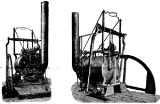
John Urpeth Rastrick

Encyclopedia
John Urpeth Rastrick was one of the first English
steam locomotive
builders. In partnership with James Foster
, he formed Foster, Rastrick and Company
, the locomotive construction company that built the Stourbridge Lion
in 1829 for export to the Delaware and Hudson Railroad in America
.
, Northumberland
, to John Rastrick and Mary (Urpeth). He attended local public schools; at age 15, in 1795 he was apprenticed in his father's engineer
ing practice. In 1802 he was hired by the Ketley Iron Works in Shropshire
.
, Shropshire.
 While at Bridgnorth, Rastrick helped Richard Trevithick
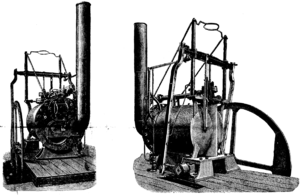
develop his ideas for the high pressure steam engine and locomotive, and he later testified in a parliamentary enquiry that he had built the locomotive that had been demonstrated in London in 1808. He also produced much equipment for Trevithick's abortive South American adventure.
On 1 April 1814, he was awarded UK patent number 3,799 for his steam engine
design. Rastrick oversaw the construction of the Chepstow Bridge
, which opened in 1816. The partnership between Rastrick and Hazledine was a troubled one, ending in a dispute in 1817. He worked independently for a short period, but in 1819 he formed a partnership with James Foster
, and he moved his family to Stourbridge
.
s, and rolling mills, wrought iron rails, 'bearers' (beams) for some of the famous buildings of the age, etc. In 1822 Rastrick became the engineer for the Stratford and Moreton Tramway
an early horse-drawn line.
The partnership was also responsible for the first steam locomotive
s for the Delaware and Hudson Canal Company, the Stourbridge Lion
in 1829.
. After extensive travels to view the early railways of the age their report favoured rope haulage on economic grounds. They did however include the rider that there were some benefits to locomotive haulage not least their probable technical improvement. Given such a marginal judgement the directors of the company decided to hold a competition to test the locomotives on offer. Rastrick was one of three judges at the Rainhill Trials
of 1829 which conclusively proved the benefits of Stephenson's Rocket
locomotive. Rastrick's diaries and notebook of the trial are valuable records of the performance of locomotives of that era.
. He then became consultant engineer, overseeing the railway's construction over difficult terrain. He was involved with the design and construction of the Merstham
, Balcombe
and Patcham tunnels
and the Ouse Valley Viaduct
.
He also constructed the Brighton and Chichester Railway
and the Brighton Lewes and Hastings Railway
which were eventually amalgamated with the London and Brighton Railway and London and Croydon Railway
to form the London, Brighton and South Coast Railway
. Rastrick was involved in the design of the London Road viaduct
at Brighton, a viaduct at Shoreham
and a bridge over the river Arun
.
Rastrick retired from active life in 1847, moving to Sayes Court, Addlestone
, Chertsey
in Surrey
which was an eight-bedroom mansion in 25 acres (101,171.5 m²) of grounds. His death occurred there on 1 November 1856. He is buried at Brighton Extra Mural Cemetery
.
, Staffordshire
. He had six children: John, born 10 April 1811; Sarah, baptized 2 June 1813; Mary, baptized 30 January 1818; Henry, baptized 30 January 1818; Frederick James born c1820; George, baptized 10 June 1821.
England
England is a country that is part of the United Kingdom. It shares land borders with Scotland to the north and Wales to the west; the Irish Sea is to the north west, the Celtic Sea to the south west, with the North Sea to the east and the English Channel to the south separating it from continental...
steam locomotive
Steam locomotive
A steam locomotive is a railway locomotive that produces its power through a steam engine. These locomotives are fueled by burning some combustible material, usually coal, wood or oil, to produce steam in a boiler, which drives the steam engine...
builders. In partnership with James Foster
James Foster (ironmaster)
James Foster was a prominent Worcestershire ironmaster and senior partner in the important iron company of John Bradley & Co., Stourbridge, taking its name from his elder half-brother. As well as the Stourbridge ironworks, the business owned a number of coal and ironstone mines, furnaces, forges...
, he formed Foster, Rastrick and Company
Foster, Rastrick and Company
Foster, Rastrick and Company was one of the pioneering steam locomotive manufacturing companies of England. It was based in Stourbridge, Worcestershire, now West Midlands....
, the locomotive construction company that built the Stourbridge Lion
Stourbridge Lion
The Stourbridge Lion was a railroad steam locomotive. It was not only the first locomotive to be operated in the United States, it was also one of the first locomotives to operate outside of England, where it was manufactured in 1828....
in 1829 for export to the Delaware and Hudson Railroad in America
United States
The United States of America is a federal constitutional republic comprising fifty states and a federal district...
.
Early years
Rastrick was born in MorpethMorpeth, Northumberland
Morpeth is the county town of Northumberland, England. It is situated on the River Wansbeck which flows east through the town. The town is from the A1, which bypasses it. Since 1981, it has been the administrative centre of the County of Northumberland. In the 2001 census the town had a population...
, Northumberland
Northumberland
Northumberland is the northernmost ceremonial county and a unitary district in North East England. For Eurostat purposes Northumberland is a NUTS 3 region and is one of three boroughs or unitary districts that comprise the "Northumberland and Tyne and Wear" NUTS 2 region...
, to John Rastrick and Mary (Urpeth). He attended local public schools; at age 15, in 1795 he was apprenticed in his father's engineer
Engineer
An engineer is a professional practitioner of engineering, concerned with applying scientific knowledge, mathematics and ingenuity to develop solutions for technical problems. Engineers design materials, structures, machines and systems while considering the limitations imposed by practicality,...
ing practice. In 1802 he was hired by the Ketley Iron Works in Shropshire
Shropshire
Shropshire is a county in the West Midlands region of England. For Eurostat purposes, the county is a NUTS 3 region and is one of four counties or unitary districts that comprise the "Shropshire and Staffordshire" NUTS 2 region. It borders Wales to the west...
.
Hazeldine & Rastrick
After five years at Ketley, Rastrick partnered with John Hazledine, in BridgnorthBridgnorth
Bridgnorth is a town in Shropshire, England, along the Severn Valley. It is split into Low Town and High Town, named on account of their elevations relative to the River Severn, which separates the upper town on the right bank from the lower on the left...
, Shropshire.
Richard Trevithick
Richard Trevithick was a British inventor and mining engineer from Cornwall. His most significant success was the high pressure steam engine and he also built the first full-scale working railway steam locomotive...
develop his ideas for the high pressure steam engine and locomotive, and he later testified in a parliamentary enquiry that he had built the locomotive that had been demonstrated in London in 1808. He also produced much equipment for Trevithick's abortive South American adventure.
On 1 April 1814, he was awarded UK patent number 3,799 for his steam engine
Steam engine
A steam engine is a heat engine that performs mechanical work using steam as its working fluid.Steam engines are external combustion engines, where the working fluid is separate from the combustion products. Non-combustion heat sources such as solar power, nuclear power or geothermal energy may be...
design. Rastrick oversaw the construction of the Chepstow Bridge
Chepstow Bridge
Chepstow railway bridge was built to the instructions of Isambard Kingdom Brunel in 1852. The "Great Tubular Bridge" over the River Wye at Chepstow, which at that point forms the boundary between Wales and England, is considered one of Brunel's major achievements, despite its appearance...
, which opened in 1816. The partnership between Rastrick and Hazledine was a troubled one, ending in a dispute in 1817. He worked independently for a short period, but in 1819 he formed a partnership with James Foster
James Foster (ironmaster)
James Foster was a prominent Worcestershire ironmaster and senior partner in the important iron company of John Bradley & Co., Stourbridge, taking its name from his elder half-brother. As well as the Stourbridge ironworks, the business owned a number of coal and ironstone mines, furnaces, forges...
, and he moved his family to Stourbridge
Stourbridge
Stourbridge is a town within the Metropolitan Borough of Dudley, in the West Midlands of England. Historically part of Worcestershire, Stourbridge was a centre of glass making, and today includes the suburbs of Amblecote, Lye, Norton, Oldswinford, Pedmore, Wollaston, Wollescote and Wordsley The...
.
Foster Rastrick & Co.
The new company manufactured an extensive range of products from blast furnaceBlast furnace
A blast furnace is a type of metallurgical furnace used for smelting to produce industrial metals, generally iron.In a blast furnace, fuel and ore and flux are continuously supplied through the top of the furnace, while air is blown into the bottom of the chamber, so that the chemical reactions...
s, and rolling mills, wrought iron rails, 'bearers' (beams) for some of the famous buildings of the age, etc. In 1822 Rastrick became the engineer for the Stratford and Moreton Tramway
Stratford and Moreton Tramway
The Stratford and Moreton Tramway was a 16-mile long horse-drawn wagonway from the canal basin at Stratford-upon-Avon in Warwickshire to Moreton-in-Marsh in Gloucestershire, with a branch to Shipston-on-Stour....
an early horse-drawn line.
The partnership was also responsible for the first steam locomotive
Steam locomotive
A steam locomotive is a railway locomotive that produces its power through a steam engine. These locomotives are fueled by burning some combustible material, usually coal, wood or oil, to produce steam in a boiler, which drives the steam engine...
s for the Delaware and Hudson Canal Company, the Stourbridge Lion
Stourbridge Lion
The Stourbridge Lion was a railroad steam locomotive. It was not only the first locomotive to be operated in the United States, it was also one of the first locomotives to operate outside of England, where it was manufactured in 1828....
in 1829.
Rainhill Trials
In 1829 Rastrick was commissioned with James Walker to report on the economics of using either rope haulage or locomotives on the new Liverpool and Manchester RailwayLiverpool and Manchester Railway
The Liverpool and Manchester Railway was the world's first inter-city passenger railway in which all the trains were timetabled and were hauled for most of the distance solely by steam locomotives. The line opened on 15 September 1830 and ran between the cities of Liverpool and Manchester in North...
. After extensive travels to view the early railways of the age their report favoured rope haulage on economic grounds. They did however include the rider that there were some benefits to locomotive haulage not least their probable technical improvement. Given such a marginal judgement the directors of the company decided to hold a competition to test the locomotives on offer. Rastrick was one of three judges at the Rainhill Trials
Rainhill Trials
The Rainhill Trials were an important competition in the early days of steam locomotive railways, run in October 1829 in Rainhill, Lancashire for the nearly completed Liverpool and Manchester Railway....
of 1829 which conclusively proved the benefits of Stephenson's Rocket
Stephenson's Rocket
Stephenson's Rocket was an early steam locomotive of 0-2-2 wheel arrangement, built in Newcastle Upon Tyne at the Forth Street Works of Robert Stephenson and Company in 1829.- Design innovations :...
locomotive. Rastrick's diaries and notebook of the trial are valuable records of the performance of locomotives of that era.
Civil Engineering
Rastrick left the Foster, Rastrick & Co partnership in 1831 to become an independent civil engineer, and the company was dissolved. He then worked on numerous railway project of the period and in 1835 worked with John Rennie to obtain parliamentary approval for the London and Brighton RailwayLondon and Brighton Railway
The London and Brighton Railway was a railway company in England which was incorporated in 1837 and survived until 1846. Its railway runs from a junction with the London & Croydon Railway at Norwood - which gives it access from London Bridge, just south of the River Thames in central London...
. He then became consultant engineer, overseeing the railway's construction over difficult terrain. He was involved with the design and construction of the Merstham
Merstham tunnels
The Merstham and Quarry tunnels are two railway tunnels on the Brighton main line between Merstham and Coulsdon in Surrey, Great Britain...
, Balcombe
Balcombe tunnel
Balcombe tunnel is a railway tunnel on the Brighton Main Line through the Sussex Weald between Three Bridges and Balcombe. It is 1141 yards long.-History:The tunnel was constructed by the London and Brighton Railway during 1840-41...
and Patcham tunnels
Patcham Tunnel
Patcham tunnel is a railway tunnel on the Brighton Main Line through the South Downs between Preston Park and Hassocks in East Sussex, England. It is 488 yards long.-History:...
and the Ouse Valley Viaduct
Ouse Valley Viaduct
Built in 1841, the Ouse Valley Viaduct over the River Ouse on the London-Brighton Railway Line north of Haywards Heath and south of Balcombe is long.-Description:...
.
He also constructed the Brighton and Chichester Railway
Brighton and Chichester Railway
The Brighton and Chichester Railway was an early railway in southern England running between the towns of Shoreham and Chichester in Sussex, which operated between 1845 and 1846.-History:...
and the Brighton Lewes and Hastings Railway
Brighton Lewes and Hastings Railway
The Brighton Lewes and Hastings Railway was an early railway in southern England running between the three East Sussex towns mentioned in its name...
which were eventually amalgamated with the London and Brighton Railway and London and Croydon Railway
London and Croydon Railway
The London and Croydon Railway was an early railway which operated between London and Croydon in England. It was opened in 1839 and in July 1846 it merged with other railways to form a part of the London Brighton and South Coast Railway ....
to form the London, Brighton and South Coast Railway
London, Brighton and South Coast Railway
The London, Brighton and South Coast Railway was a railway company in the United Kingdom from 1846 to 1922. Its territory formed a rough triangle, with London at its apex, practically the whole coastline of Sussex as its base, and a large part of Surrey...
. Rastrick was involved in the design of the London Road viaduct
London Road viaduct
The London Road Viaduct is a brick railway viaduct in Brighton, part of the city of Brighton and Hove in East Sussex, England. It carries the East Coastway Line between Brighton and London Road railway stations...
at Brighton, a viaduct at Shoreham
Shoreham
Shoreham is the name of several different places:* Shoreham-by-Sea, West Sussex, UK** Shoreham 1974–1997** New Shoreham 1295–1885* Shoreham, Kent, UK* Shoreham, Michigan, USA...
and a bridge over the river Arun
Arun
Arun is a local government district in West Sussex, England. It contains the towns of Arundel, Bognor Regis and Littlehampton, and takes its name from the River Arun, which runs through the centre of the district.-History:...
.
Rastrick retired from active life in 1847, moving to Sayes Court, Addlestone
Addlestone
Addlestone is a town in the borough of Runnymede in the county of Surrey, England.Immediate surrounding towns and villages include Weybridge, Ottershaw, Chertsey, and New Haw. It is near Junction 11 of the M25 motorway and is served by Addlestone railway station on the Chertsey Branch Line. It also...
, Chertsey
Chertsey
Chertsey is a town in Surrey, England, on the River Thames and its tributary rivers such as the River Bourne. It can be accessed by road from junction 11 of the M25 London orbital motorway. It shares borders with Staines, Laleham, Shepperton, Addlestone, Woking, Thorpe and Egham...
in Surrey
Surrey
Surrey is a county in the South East of England and is one of the Home Counties. The county borders Greater London, Kent, East Sussex, West Sussex, Hampshire and Berkshire. The historic county town is Guildford. Surrey County Council sits at Kingston upon Thames, although this has been part of...
which was an eight-bedroom mansion in 25 acres (101,171.5 m²) of grounds. His death occurred there on 1 November 1856. He is buried at Brighton Extra Mural Cemetery
Cemeteries and crematoria in Brighton and Hove
The English coastal city of Brighton and Hove, made up of the formerly separate Boroughs of Brighton and Hove in East Sussex, has a wide range of cemeteries throughout its urban area...
.
Family
During his partnership with John Hazledine, Rastrick married Sarah Jervis (or Jarvis) on 24 December 1810 at CodsallCodsall
Codsall is a large village in the South Staffordshire district of Staffordshire, England. It is situated north west of the city of Wolverhampton.-History:...
, Staffordshire
Staffordshire
Staffordshire is a landlocked county in the West Midlands region of England. For Eurostat purposes, the county is a NUTS 3 region and is one of four counties or unitary districts that comprise the "Shropshire and Staffordshire" NUTS 2 region. Part of the National Forest lies within its borders...
. He had six children: John, born 10 April 1811; Sarah, baptized 2 June 1813; Mary, baptized 30 January 1818; Henry, baptized 30 January 1818; Frederick James born c1820; George, baptized 10 June 1821.