
All Topics  
John Paul Jones

 
John Paul Jones

   Email Print
   Bookmark   Link


John Paul Jones


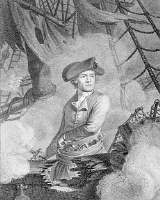
John Paul Jones ( – ) was America's
United States

The United States of America is a Federal government constitutional republic comprising U.S. state and a federal district. The country is situated mostly in central North America, where its Contiguous United States and Washington, D.C., the Capital districts and territories, lie between the Pacific Ocean and Atlantic Oceans, Borders of the U...
 first well-known naval fighter in the American Revolutionary War
American Revolutionary War

The American Revolutionary War , also known as the American War of Independence, began as a war between the Kingdom of Great Britain and Thirteen Colonies on the North America, and ended in a global war between several European great powers....
. Although he made enemies among the American ruling class, his actions in British waters during the Revolution earned him an international reputation which persists to this day.

During his engagement with Serapis
HMS Serapis (1779)

HMS Serapis was a British frigate launched by the Royal Navy in 1779. The vessel was named after the god Serapis in Greek and Ancient Egypt mythology....
, Jones uttered, according to the later recollection of his First Lieutenant, the legendary reply to a quip about surrender from the British captain: "I have not yet begun to fight!"

Paul Jones was born in 1747, on the estate of Arbigland
Arbigland

Arbigland is an estate in Dumfries and Galloway in Scotland. Arbigland lies on the Solway Firth coast to the south east of Kirkbean. The Neoclassical architecture Arbigland House was built in 1755 by improving lord and gentleman architect William Craik and a small dower house called The House on the Shore was built in 1936 by Kathleen Blacke...
 near Kirkbean
Kirkbean

Kirkbean is a small village and List_of_civil_parishes_in_Scotland#K near the Solway Firth in Dumfries and Galloway, Scotland.Arbigland, an estate in Kirkbean parish, was the birthplace of Continental Navy commander John Paul Jones....
 in the Stewartry of Kirkcudbright
Kirkcudbrightshire

The Stewartry of Kirkcudbright or Kirkcudbrightshire , was formerly a Counties of Scotland of south-western Scotland. It was also known as East Galloway, forming the larger Galloway region with Wigtownshire....
 on the southern coast of Scotland
Scotland

conventional_long_name = ScotlandAlba|common_name= Scotland|image_flag = Flag of Scotland.svg|flag_width = 130px...
.


Discussion
Ask a question about 'John Paul Jones'
Start a new discussion about 'John Paul Jones'
Answer questions from other users
Full Discussion Forum


Recent Posts


Encyclopedia


John Paul Jones ( – ) was America's
United States

The United States of America is a Federal government constitutional republic comprising U.S. state and a federal district. The country is situated mostly in central North America, where its Contiguous United States and Washington, D.C., the Capital districts and territories, lie between the Pacific Ocean and Atlantic Oceans, Borders of the U...
 first well-known naval fighter in the American Revolutionary War
American Revolutionary War

The American Revolutionary War , also known as the American War of Independence, began as a war between the Kingdom of Great Britain and Thirteen Colonies on the North America, and ended in a global war between several European great powers....
. Although he made enemies among the American ruling class, his actions in British waters during the Revolution earned him an international reputation which persists to this day.

During his engagement with Serapis
HMS Serapis (1779)

HMS Serapis was a British frigate launched by the Royal Navy in 1779. The vessel was named after the god Serapis in Greek and Ancient Egypt mythology....
, Jones uttered, according to the later recollection of his First Lieutenant, the legendary reply to a quip about surrender from the British captain: "I have not yet begun to fight!"

Early years

John Paul Jones was born in 1747, on the estate of Arbigland
Arbigland

Arbigland is an estate in Dumfries and Galloway in Scotland. Arbigland lies on the Solway Firth coast to the south east of Kirkbean. The Neoclassical architecture Arbigland House was built in 1755 by improving lord and gentleman architect William Craik and a small dower house called The House on the Shore was built in 1936 by Kathleen Blacke...
 near Kirkbean
Kirkbean

Kirkbean is a small village and List_of_civil_parishes_in_Scotland#K near the Solway Firth in Dumfries and Galloway, Scotland.Arbigland, an estate in Kirkbean parish, was the birthplace of Continental Navy commander John Paul Jones....
 in the Stewartry of Kirkcudbright
Kirkcudbrightshire

The Stewartry of Kirkcudbright or Kirkcudbrightshire , was formerly a Counties of Scotland of south-western Scotland. It was also known as East Galloway, forming the larger Galloway region with Wigtownshire....
 on the southern coast of Scotland
Scotland

conventional_long_name = ScotlandAlba|common_name= Scotland|image_flag = Flag of Scotland.svg|flag_width = 130px...
. John Paul's father, John Paul (Sr.), was a gardener at Arbigland, and his mother was Jean Duff. His parents married on 29th November 1733 in New Abbey
New Abbey

New Abbey is a village in Dumfries and Galloway, south-west Scotland. It is around south-west of Dumfries. The ruined Sweetheart Abbey is located within the village....
, Kirkcudbright
Kirkcudbright

Kirkcudbright, is a town in the south of Scotland in Dumfries and Galloway.The town lies south of Castle Douglas and Dalbeattie, in the part of Dumfries and Galloway known as the Stewartry, situated at the mouth of the River Dee, Galloway, some six miles from the sea....
. John Paul started his maritime career at the age of 13, sailing out of Whitehaven
Whitehaven

Whitehaven is a town and port on the coast of Cumbria, historically and traditionally located in the ancient county of Cumberland England. It is the administrative centre of the Copeland, Cumbria....
 in the northern English county of Cumberland
Cumberland

Cumberland is one of the 39 historic counties of England. It formed an Administrative counties of England from 1889 to 1974 and now forms part of Cumbria....
, as apprentice aboard the Friendship under Captain Benson.

Because John Paul's older brother had married and settled in Fredricksburg, Virginia this was the destination of many of John Paul's early voyages.

For several years Jones sailed aboard a number of different British merchant and slaver
Slavery

Slavery is a form of forced labor where a person is compelled to Labor for another . Slaves are held against their will from the time of their capture, purchase, or birth, and are deprived of the right to leave, to refuse to work, or to receive Remuneration in return for their labor....
 ships, including the King George in 1764 as third mate
Third Mate

A Third Mate or Third Officer is a licensed mariner of the deck department of a merchant ship. The third mate is a watchstanding and customarily the ship's occupational safety and health....
, and the Two Friends as first mate in 1766.

After a short time in this business, Jones became disgusted with the cruelty in the slave trade. During one voyage, in 1768, he abandoned his prestigious position on the profitable Two Friends while docked in Jamaica. Jones found passage back to Scotland, and eventually he obtained another position. During his next voyage aboard the brig
Brig

In Glossary of nautical terms, a brig is a vessel with two square rig masts. During the Age of Sail, brigs were seen as fast and maneuverable and were used as both naval war ships and merchant ships....
 John, which sailed from port in 1768, young John Paul’s career was quickly and unexpectedly advanced when both the captain and a ranking mate suddenly died of yellow fever
Yellow fever

Yellow fever is an acute Virus disease. It is an important cause of hemorrhage illness in many African and South American countries despite existence of an effective vaccine....
. John Paul managed to successfully navigate the ship back to a safe port and in reward for this impressive feat, the vessel’s grateful Scottish owners made him master of the ship and its crew, giving him 10 percent of the cargo. He then led two voyages to the West Indies before running into difficulty. During his second voyage in 1770, John Paul viciously flogged one of his sailors, leading to accusations of his discipline being "unnecessarily cruel." While these claims were initially dismissed, John Paul’s favorable reputation was destroyed when the disciplined sailor died a few weeks later. Sources disagree on whether he was arrested for his involvement in the man’s death, but the devastating effect on his reputation is indisputable.

Leaving Scotland, John Paul commanded a London-registered vessel, the Betsy, for about 18 months, engaging in commercial speculation in Tobago
Tobago

Tobago is the smaller of the two main islands that make up the Trinidad and Tobago. It is located in the southern Caribbean Sea, northeast of the island of Trinidad and southeast of Grenada....
. This came to an end, however, when Jones killed a member of his crew with a sword in a dispute over wages. Years later, in a letter to Benjamin Franklin describing this incident, Jones claimed it was in self-defense, but because he was not to be tried in an Admiral's Court, he felt compelled to flee to Fredericksburg
Fredericksburg, Virginia

Fredericksburg is an independent city in the Commonwealth of Virginia located 50 miles south of Washington, D.C., and 58 miles north of Richmond, Virginia....
, Province of Virginia, leaving his fortune behind.

It was in the year 1773 when he went to Fredericksburg, Virginia
Fredericksburg, Virginia

Fredericksburg is an independent city in the Commonwealth of Virginia located 50 miles south of Washington, D.C., and 58 miles north of Richmond, Virginia....
 to arrange the affairs of his brother, who had died there without leaving any family; and about this time, in addition to his original surname, he assumed the patronymic of Jones, his father’s Christian name having been John. This custom, which is of classical authority, has long been prevalent in Wales, and in various other countries, although it is not usual in that part of the island in which he was born. During this time period, John Paul, probably appended 'Jones' to his name in an attempt to escape his troubled reputation.

His prepossessions became even more in favour of America and were confirmed. From that period, as he afterwards expressed himself to Baron Van der Capellan, that became "the country of his fond election." It wasn't long afterwards that John Paul 'Jones' joined the American navy to fight against Britain. He was now safe from his past troubles and he gained a glorious reputation fighting the enemy of America through her navy, an enemy which was already a part of his own personal 'past troubles'.

America

Sources struggle with this period of Jones' life, especially the specifics of his family situation, making it difficult to historically pinpoint Jones' exact motivations for emigrating to America. Whether his plans for the plantation
Plantation

A plantation is usually a large farm or Estate , especially in a tropical or semitropical country, like Brazil or Nicaragua on which cotton, tobacco, lice coffee, sugar cane and the like are cultivated, usually by resident laborers....
 were not developing as expected, or if he was inspired by a revolutionary spirit, is unknown.

What is clearly known is that Jones left for Philadelphia
Philadelphia, Pennsylvania

Philadelphia is the largest city in Pennsylvania and the List of United States cities by population city in the United States. It is the fifth-largest metropolitan area and fourth-largest urban area by population in the United States, the nation's fourth-largest consumer media market as ranked by the Nielsen Media Research, and the 49th-most...
 shortly after settling in America to volunteer his services to the newly-founded Continental Navy
Continental Navy

The Continental Navy was formed during the American Revolution in 1775. Through the efforts of the Continental Navy's apparent patron, John Adams and vigorous Congressional support in the face of stiff opposition, the fleet cumulatively became relatively substantial when considering the limitations imposed upon the Patriot supply pool....
, which later became the United States Navy. During this time, around 1775, the Navy and Marines
Continental Marines

The Continental Marines were the Marine corps of the Thirteen Colonies during the American Revolutionary War. The corps was formed by the Continental Congress in November 10, 1775 and was disbanded in 1783....
 were being formally established, and suitable ship's officers and captains were in great demand. Were it not for the endorsement of Richard Henry Lee
Richard Henry Lee

Richard Henry Lee was an United States statesman from Virginia best known for the motion in the Second Continental Congress calling for the colonies' independence from Great Britain....
 who knew of his abilities, Jones' potential would likely have gone unrecognized. With help from influential members of the Continental Congress
Continental Congress

The Continental Congress was a convention of delegates from the Thirteen Colonies that became the governing body of the United States during the American Revolution....
, however, Jones was the first man to be assigned to the rank of 1st Lieutenant in the Continental Navy on December 22, 1775, on board the Colbert.

Revolutionary War command


Early command

Jones' first assignment was aboard the frigate USS Alfred
USS Alfred (1774)

The Alfred was a man-of-war in the Continental Navy of the United States. She was built as Black Prince, named for Edward, the Black Prince, and served as Alfred....
, sailing from the Delaware River
Delaware River

The Delaware River is a river on the Atlantic Ocean coast of the United States.The Delaware was explored by Adriaen Block as part of the New Netherlands Colony, and was named the South River to mark the southernmost reach of that colony....
 in February 1776 to attack British merchant vessels in New Providence
New Providence

New Providence is the most populous island in The Bahamas. While the first European visitors to the Bahama Islands were Bermuda salt rakers gathering sea salt in Grand Turk Island and Inagua after 1670, the first lasting occupation was on Eleuthera and then New Providence shortly thereafter....
. It was aboard this vessel that Jones took the honor of hoisting the first U.S. ensign over a naval vessel. Jones actually raised the Grand Union Flag
Grand Union Flag

File:Grand Union Flag.svgFile:Grand-Union-Flag.jpgFile:1885 History of US flags med.jpgThe Grand Union Flag, also known as the Congress flag, the First Navy Ensign, the Cambridge Flag, and the Continental Colors, is considered to be the first national flag of the United States....
, not the later and more familiar Flag of the United States
Flag of the United States

The flag of the United States consists of thirteen equal horizontal stripes of red alternating with white, with a blue rectangle in the Flag terminology bearing fifty small, white, Star s arranged in nine offset horizontal rows of six stars alternating with rows of five stars....
. After returning from this successful voyage in April 1776 aboard the Alfred, Jones was assigned command on the USS Providence
USS Providence (1775)

Originally chartered by the Rhode Island General Assembly as Katy, USS Providence was a sloop-of-war in the Continental Navy....
. Congress had recently ordered the construction of 13 frigates for the American Navy, one of which was to be commanded by Jones. In exchange for this prestigious command, Jones accepted his commission aboard the smaller Providence. During this six week voyage, Jones captured sixteen prizes and created significant damage along the coast of Nova Scotia. Jones’ next command came as a result of Commodore Hopkins' orders to liberate hundreds of American prisoners forced to labor in coal mines in Nova Scotia and also to raid British shipping. On November 1, 1776, Jones set sail in command of Alfred to carry out this mission. While the prisoners enlisted in the British service to end their imprisonment, the mission did result in the capture of the Mellish, a vessel carrying a vital supply of winter clothing intended for John Burgoyne’s troops in Canada.

Command of Ranger

Despite his successes at sea, upon arrival in Boston on December 16, 1776, Jones' disagreements with those in authority reached a very high new level. While in port, the accomplished commander began feuding with Commodore Hopkins, who Jones believed was hindering his advancement and talking down his campaign plans. As a result of this and other frustrations, Jones was assigned the smaller command, the newly constructed USS Ranger,on June 14, 1777 (the same day the new Stars and Stripes flag was adopted).

After making the necessary preparations, Jones sailed for France on November 1, 1777 with orders to assist the American cause however possible. The American commissioners in France Benjamin Franklin, John Adams, and Arthur Lee(diplomat) listened to Jones' strategic recommendations. They assured him the command of LIndien, a new vessel being constructed for America in Amsterdam. Britain, however, was able to divert the L'Indien away from American hands by exerting pressure to ensure its sale to France instead (who had not yet allied with America). Jones was again left without a command, an unpleasant reminder of his stagnation in Boston from late 1776 until early 1777. It is thought that it was during this time Jones developed his close friendship with Benjamin Franklin, whom he greatly admired. In 1778, he was accepted, together with Benjamin Franklin, into the Masonic Lodge "Les Neuf Sœurs".

On February 6, 1778, France signed their Treaty of Alliance with America, formally recognizing the independence of the new American republic. Eight days later, Captain Jones' Ranger became the first American Navy vessel to be saluted by the French, with a nine gun salute fired from Admiral Piquet's flagship. Jones wrote of the event: "I accepted his offer all the more for after all it was a recognition of our independence and in the nation."

Finally, on April 10, 1778, Jones set sail from Brest, France for the western coasts of Britain.

Ranger attacks Britain

After some early successes against British merchant shipping in the Irish Sea, on April 17, 1778, Jones convinced his crew to participate in an assault on Whitehaven
Whitehaven

Whitehaven is a town and port on the coast of Cumbria, historically and traditionally located in the ancient county of Cumberland England. It is the administrative centre of the Copeland, Cumbria....
, the same town where his maritime career began. Jones was thinking in his later memories about the reluctance of his senior officers (having tactfully avoided such matters in his official report): "Their aim, they said, was gain not honor. They were poor: instead of encouraging the morale of the crew, they excited them to disobedience; they persuaded them that they had the right to judge whether a measure that was proposed to them was good or not." As it happened, contrary winds forced the abandonment of the attempt, and drove
Ranger towards Ireland, causing more trouble for British shipping on the way.

On April 20, 1778, Jones learned from captured sailors that the Royal Navy sloop-of-war
Drake
HMS Drake (1777)

HMS Drake was a twenty-gun sloop-of-war of the Royal Navy. Originally named Resolution, she was purchased in 1777. She served in the American Revolutionary War, and on 24 April 1778, off Carrickfergus, Ireland, she fought the North Channel naval duel with the 18-gun sloop USS Ranger of the Continental Navy, commanded by Captain John...
was anchored off Carrickfergus
Carrickfergus

Carrickfergus is a large town in County Antrim, Northern Ireland. It had a population of 27,201 people recorded in the United Kingdom Census 2001....
, Ireland
Ireland

Ireland is the List of islands by area in Europe, and the twentieth-largest island in the world. It lies to the north-west of continental Europe and is surrounded by hundreds of islands and islet....
. According to the diary of
Ranger's surgeon , Jones' first intention was to attack the vessel in broad daylight, but his sailors were "unwilling to undertake it" (another incident omitted from the official report). Therefore, the attack took place just after midnight, but in the dark (or perhaps because, as Jones claimed in his memoirs, the man was drunk) the mate responsible for dropping the anchor to halt Ranger right alongside Drake misjudged the timing, so Jones had to cut his anchor cable and run.

The wind having shifted,
Ranger recrossed the Irish Sea to make another attempt at raiding Whitehaven. Jones led the assault with two boats of fifteen men on April 23 1778, just after midnight, hoping to set fire to and sink all Whitehaven’s ships anchored in harbor (numbering between 200 to 400 wooden vessels), which consisted of a full merchant fleet and many coal transporters. They also hoped to terrorize the townspeople by lighting further fires. As it happened, the journey to shore was slowed by the still-shifting wind, as well as a strong ebb tide. The spiking of the town's big defensive guns to prevent them being fired was accomplished successfully, but lighting fires proved difficult, as the lanterns in both boats had run out of fuel. To remedy this, some of the party were therefore sent to raid a public house on the quayside, but the temptation to stop for a quick drink led to a further delay. By the time they returned, and the arson attacks began, dawn was fast approaching, so efforts were concentrated on a single ship, the coal ship Thompson, in the hope that the flames would spread to adjacent vessels, all grounded by the low tide. Unfortunately, in the twilight, one of the crew slipped away and alerted residents on a harbourside street. A fire alert was sounded, and large numbers of people came running to the quay, forcing the Americans to retreat, and extinguishing the flames with the town's two fire-engines. However, hopes of sinking Jones's boats with cannon fire were dashed by the prudent spiking.

Crossing the Solway Firth
Solway Firth

The Solway Firth is a firth that forms part of the Anglo-Scottish border, between Cumbria and Dumfries and Galloway. It stretches from St Bees Head, just south of Whitehaven in Cumbria, to the Mull of Galloway, on the western end of Dumfries and Galloway....
 from Whitehaven to Scotland, Jones hoped to hold for ransom the Earl of Selkirk
Earl of Selkirk

Earl of Selkirk is a title in the Peerage of Scotland, created in 1646.William Douglas, Duke of Hamilton , younger son of the 1st Marquess of Douglas, was created Earl of Selkirk and Lord Daer and Shortcleuch in the peerage of Scotland on 4 August 1646....
, who lived on St Mary's Isle near Kirkcudbright
Kirkcudbright

Kirkcudbright, is a town in the south of Scotland in Dumfries and Galloway.The town lies south of Castle Douglas and Dalbeattie, in the part of Dumfries and Galloway known as the Stewartry, situated at the mouth of the River Dee, Galloway, some six miles from the sea....
. The Earl, Jones reasoned, could be exchanged for American sailors impressed
Impressment

Impressment is the act of compelling people to serve in the military, usually by force and without notice. Unlike "shanghaiing", impressment is carried out by law, or under color #Color of law, and forces the impressed person into military rather than commercial sea service....
 into the Royal Navy. When the Earl was discovered to be absent from his estate, Jones claims he intended to return directly to his ship and continue seeking prizes elsewhere, but his crew wished to "pillage, burn, and plunder all they could". Ultimately, Jones allowed the crew to seize a silver plate set adorned with the family’s emblem to placate their desires, but nothing else. Jones bought the plate himself when it was later sold off in France, and returned it to the Earl of Selkirk after the War.

Although their effect on British morale and allocation of defense resources was significant, the attacks on St. Mary’s Isle and Whitehaven resulted in no prizes or profits which under normal circumstances would be shared with the crew. Throughout the mission, the crew, led by Jones's second-in-command Lieutenant Thomas Simpson, acted as if they were aboard a privateer
Privateer

A privateer was a private warship authorized by a country's government by letters of marque to attack foreign shipping. Strictly, a privateer was only entitled by its state to attack and rob enemy vessels during wartime....
, not a warship.

Return to France

John Barry Stamp
Nevertheless, Jones now led
Ranger back across the Irish Sea, hoping to make another attempt at the Drake, still anchored off Carrickfergus
Carrickfergus

Carrickfergus is a large town in County Antrim, Northern Ireland. It had a population of 27,201 people recorded in the United Kingdom Census 2001....
. This time, late in the afternoon of April 24, 1778, the ships, roughly equal in firepower, engaged in combat. Earlier in the day, the Americans had captured the crew of a reconnaissance boat, and learned that
Drake had taken on dozens of soldiers, with the intention of grappling and boarding Ranger, so Jones made sure that did not happen, capturing the Drake after an hour-long gun battle
North Channel naval duel

}|-||}The North Channel naval duel was the fight between the United States Continental Navy sloop of war USS Ranger and the British Royal Navy sloop of war HMS Drake on the evening of 24 April 1778....
 which cost the British captain his life. Lieutenant Simpson was given command of
Drake for the return journey to Brest. The ships separated during the return journey as Ranger chased another prize, leading to a conflict between Simpson and Jones. Both ships arrived at port safely, but Jones filed for a court-martial
Court-martial

A court-martial is a military court. These military courts can determine punishments for members of the military subject to military law who are found guilty or may dismiss the charges based on the evidence and the case presented....
 of Simpson, keeping him detained on the ship.

Partly through the influence of John Adams
John Adams

John Adams was an Politics of the United States and the List of Presidents of the United States President of the United States , after being the List of Vice Presidents of the United States Vice President of the United States for two terms....
, who was still serving as a commissioner in France, Simpson was released from Jones' accusation. Adams implies in his memoirs that the overwhelming majority of the evidence supported Simpson’s claims. Adams seemed to believe Jones was hoping to monopolize the mission's glory, especially by detaining Simpson on board while he celebrated the capture with numerous important European dignitaries.

Even with the wealth of perspectives, including the commander's, it is difficult if not impossible to tell exactly what occurred. It is clear, however, that the crew felt alienated by their commander, who might well have been motivated by his pride. Jones believed his intentions were honorable, and his actions were strategically essential to the Revolution. Regardless of any controversy surrounding the mission,
Ranger’s capture of Drake was one of the American Navy’s few significant military victories during the Revolution, and was of immense symbolic importance, demonstrating as it did that the Royal Navy was far from invincible. By overcoming such odds, Ranger’s victory became an important symbol of the American spirit and served as an inspiration for the permanent establishment of the American Navy after the Revolution.

Bonhomme Richard

Serapis and Bonhomme Richard
In 1779, Captain Jones took command of the 42-gun
Bonhomme Richard
USS Bonhomme Richard (1765)

The first USS Bonhomme Richard, formerly Duc de Duras, was a frigate in the Continental Navy. She was originally an East Indiaman, a merchant ship built in France for the French East India Company in 1765, for service between France and the Orient....
 (or as he preferred it,
Bon Homme Richard), a merchant ship rebuilt and given to America by the French shipping magnate, Jacques-Donatien Le Ray
Jacques-Donatien Le Ray

Jacques-Donatien Le Ray was a French people "Father of the American Revolutionary War", but later an opponent of the French Revolution. His son of the same name, known also in America as James Le Ray, eventually became a United States citizen and settled in Le Ray, New York USA....
. On August 14, as a vast French and Spanish invasion fleet
Armada of 1779

The Armada of 1779 was an exceptionally large joint France in the American Revolutionary War and Spain in the American Revolutionary War fleet intended to facilitate an invasion of England, as part of the wider conflict sparked by the American Revolutionary War....
 approached England, he provided a diversion by heading for Ireland at the head of a five ship squadron including the 36-gun
Alliance
USS Alliance (1778)

The first USS Alliance of the United States Navy was a 36-gun sailing frigate of the American Revolutionary War, notable for having fired the last shot of the war....
, 32-gun
Pallas, 12-gun Vengeance, and Le Cerf, also accompanied by two privateers. Several Royal Navy warships were sent towards Ireland in pursuit, but on this occasion, he continued right around the north of Scotland into the North Sea
North Sea

The North Sea is a marginal sea, epeiric sea on the European continental shelf. The Dover Strait and the English Channel in the south and the Norwegian Sea in the north connect it to the Atlantic Ocean....
, creating near-panic all along Britain's east coast as far south as the Humber
Humber

The Humber is a large tidal estuary on the east coast of northern England.The Humber is an estuary formed at Trent Falls, Faxfleet, by the confluence of the tidal River Ouse, Yorkshire and the tidal River Trent....
 estuary. Jones's main problems, as on his previous voyage, resulted from insubordination, particularly by Pierre Landais, captain of the
Alliance. On September 23 1779, the squadron met a large merchant convoy off the coast off Flamborough Head
Flamborough Head

Flamborough Head is an eight mile long promontory on the Yorkshire coast of England, between the Filey and Bridlington bays of the North Sea....
, east Yorkshire
Yorkshire

Yorkshire is a Historic counties of England of northern England and the largest in Great Britain. Because of its great size, over time functions were increasingly undertaken by its subdivisions, which have been subject to History of local government in Yorkshire....
. The 50 gun British frigate HMS
Serapis
HMS Serapis (1779)

HMS Serapis was a British frigate launched by the Royal Navy in 1779. The vessel was named after the god Serapis in Greek and Ancient Egypt mythology....
 and the 20 gun hired escort
Countess of Scarborough placed themselves between the convoy and Jones's squadron, allowing the merchants to escape.

Shortly after 7 pm began the Battle of Flamborough Head
Battle of Flamborough Head

}|-||}The Battle of Flamborough Head was a small naval battle that took place on 23 September 1779, in the North Sea off the coast of Yorkshire between an American Continental Navy squadron led by John Paul Jones and the two British escort vessels protecting a large merchant convoy....
. The
Serapis engaged the Bonhomme Richard, and soon afterwards, the Alliance fired, from a considerable distance, at the Countess. Quickly recognising that he could not win a battle of big guns, and with the wind dying, Jones made every effort to lock Richard and Serapis together (his famous quotation was uttered in reply to a cheerful British taunt during an odd stalemate in this phase of the battle), finally succeeding after about an hour, following which his deck guns and marksmen in the rigging began clearing the British decks. Alliance sailed past and fired a broadside, doing at least as much damage to the Richard as to the Serapis. Meanwhile, the Countess of Scarborough had enticed the Pallas downwind of the main battle, beginning a separate engagement. When Alliance approached this contest, about an hour after it had begun, the badly damaged Countess surrendered.

With
Bonhomme Richard burning and sinking, it seems that her ensign
Ensign

An ensign is a distinguishing flag of a ship or a military unit; or a distinguishing token, emblem, or badge, such as a symbol of office. The word has also given rise to the military Ensign , a rank of junior officer once responsible for bearing the ensign of his unit....
 was shot away; when one of the officers, apparently believing his captain to be dead, shouted a surrender , the British commander asked, seriously this time, if they had struck their colors
Striking the colors

Striking the colors is the universally recognized indication of surrender, particularly for ships at sea. Surrender is dated from the time the ensign is struck....
. Jones later remembered saying something like "I am determined to make you strike", but the words allegedly heard by crew-members and reported in newspapers a few days later were more like: "I have just yet begun to fight!"

An attempt by the British to board
Bonhomme Richard was thwarted and a grenade caused the explosion of a large quantity of gunpowder on Serapis’ lower gun-deck. Alliance then returned to the main battle, firing two broadsides. Again, these did at least as much damage to Richard as to Serapis, but the tactic worked to the extent that, unable to move, and with Alliance keeping well out of the line of his own great guns, Captain Pearson of Serapis accepted that prolonging the battle could achieve nothing, so he surrendered. Most of Bonhomme Richard's crew immediately transferred to other vessels, and after a day and a half of frantic repair efforts, it was decided that the ship could not be saved, so it was allowed to sink, and Jones took command of Serapis for the trip to neutral (but American-sympathising) Holland.

In the following year, the King of France honoured him with the title "Chevalier
Chevalier

Chevalier is a French language word meaning, literally, "horseman," but used as a title of honor that is the equivalent of the English "knight."...
". Jones accepted the honor, and desired the title to be used thereafter: when the Continental Congress
Continental Congress

The Continental Congress was a convention of delegates from the Thirteen Colonies that became the governing body of the United States during the American Revolution....
 in 1787 resolved that a medal of gold be struck in commemoration of his "valor and brilliant services" it was to be presented to "Chevalier John Paul Jones". He also received from Louis a decoration of "Ordre du Mérite militaire
Order of Military Merit

A decoration known as the Order of Military Merit or Military Merit Order has been presented by several nations, past and present, including:...
" and a sword. By contrast, in Britain at this time, he was usually referred to as a pirate.

Russian service

In June 1782, Jones was appointed to command the 74-gun
America
USS America (1782)

The first America was the first ship of the line built for the Continental Navy, but she never saw service there, being given to France after launching....
, but his command fell through when Congress decided to give the
America to the French as replacement for the wrecked Le Magnifique. As a result, he was given assignment in Europe in 1783 to collect prize money due his former hands. At length, this too expired and Jones was left without prospects for active employment, leading him in 1788 to enter into the service of the Empress Catherine II of Russia
Catherine II of Russia

Catherine II, called Catherine the Great .The Russian empress Catherine II, known as Catherine the Great, reigned from 1762 to 1796. Under her direct auspices the Russian Empire expanded, improved in its administration, and underwent a dramatic policy of Westernization....
, who placed great confidence in Jones, saying: "He will get to Constantinople
Constantinople

Constantinople was the empire capital of the Roman Empire , the Byzantine Empire , the Latin Empire , and the Ottoman Empire . Strategically located between the Golden Horn and the Sea of Marmara at the point where Europe meets Asia, Byzantine Constantinople had been the capital of a Christendom empire, successor to ancient ancient Greece...
." He took the name Pavel Dzhones.

Jones avowed his intention, however, to preserve the condition of an American citizen and officer
Officer (armed forces)

An officer is a member of an Armed forces who holds a position of authority.Commissioned officers derive authority directly from a sovereignty power and, as such, hold a Letters patent charging them with the duties and responsibilities of a specific office or position....
. As a rear admiral
Rear Admiral

Rear Admiral is a naval commissioned officer rank above that of a Commodore and Captain , and below that of a Vice Admiral. It is the lowest form of Admiral....
 aboard the 24-gun flagship
Vladimir, he took part in the naval campaign in the Liman (an arm of the Black Sea
Black Sea

The Black Sea is an inland sea sea bounded by southeastern Europe, the Caucasus and the Anatolia and is ultimately connected to the Atlantic Ocean via the Mediterranean Sea and Aegean Seas and various straits....
, into which flow the Southern Bug
Southern Bug

The Southern Buh, Bug, or Boh River is entirely located in Ukraine. It rises in the west, in the Podolian uplands, about 145 km from the Polish border, and flows southeasterly into the Black Sea through the southern steppe....
 and Dnieper rivers) against the Turks
Ottoman Empire

The Ottoman Empire , also known by its contemporaries as the Turkish Empire or Turkey , was an empire that lasted from 1299?1923. It was Treaty of Lausanne by the Republic of Turkey, which was officially proclaimed on October 29, 1923....
. Jones successfully repulsed Ottoman forces from the area, but the jealous intrigues of Russia
Russia

Russia , or the Russian Federation , is a list of countries spanning more than one continent country extending over much of northern Eurasia....
n officer Prince Grigory Alexandrovich Potemkin and his cohort Prince of Nassau-Siegen caused him to be recalled to St. Petersburg for the pretended purpose of being transferred to a command in the North Sea
North Sea

The North Sea is a marginal sea, epeiric sea on the European continental shelf. The Dover Strait and the English Channel in the south and the Norwegian Sea in the north connect it to the Atlantic Ocean....
. Here he was compelled to remain in idleness, while rival officers plotted against him and even maliciously assailed his private character through accusations of sexual misconduct. Even so, in that period he was able to author his
Narrative of the Campaign of the Liman.

On June 8, 1788, Jones was awarded the Order of St. Anne, but he left the following month, an embittered man.

Final years and death

Johnpauljonesgrave
In May 1790, Jones arrived in Paris, where he remained in retirement during the rest of his life, although he made a number of attempts to re-enter the Russian service. In June 1792, Jones was appointed U.S. Consul
Consul

Consul was the highest elected office of the Roman Republic and an appointive office under the Roman Empire. The title was also used in other city states, and revived in modern states, notably French Republic before the Napoleon I of Franceic counter-revolution....
 to treat with the Dey of Algiers
Algiers

Algiers Nicknamed El-Bahdja or Alger la Blanche for the glistening white of its buildings as seen rising up from the sea, Algiers is situated on the west side of a bay of the Mediterranean Sea....
 for the release of American captives. Before Jones was able to fulfill his appointment, however, he died of a severe brain tumor and was found lying face-down on his bed in his third-floor Paris apartment, No. 42 Rue de Tournon, on July 18 1792. A small procession of servants, friends, and loyal soldiers walked his body the four miles (6 km) for burial. He was buried in Paris at the Saint Louis Cemetery, which belonged to the French royal family. Four years later, France's revolutionary government sold the property and the cemetery was forgotten. The area was later used as a garden, a place to dispose of dead animals, and a place where gamblers bet on animal fights.

Posthumous return to America

In 1905, Jones' remains were identified by US Ambassador to France Gen. Horace Porter
Horace Porter

Horace Porter, was an American soldier and diplomat who served as a general in the Union Army during the American Civil War.Porter was born in Huntingdon, Pennsylvania, the son of David R....
 (Goodheart 2006) who had searched for six years to track down the body using faulty copies of Jones' burial record. Thanks to the kind donation of a French admirer, Pierrot Francois Simmoneau, who donated over 460 francs for a lead coffin for Jones, Porter knew what to look for in his search. Porter's team, which included anthropologist Louis Capitan, identified an abandoned site in northeastern Paris as the former St. Louis Cemetery for Alien Protestants. Sounding probes were used to search for lead coffins, and five coffins were ultimately exhumed. The third, unearthed on April 7 1905, was later identified by a meticulous post-mortem examination by Doctors Capitan and Georges Papillault as being that of Jones, and the face was later compared to a bust by Jean-Antoine Houdon
Jean-Antoine Houdon

Jean-Antoine Houdon was a France neoclassical sculptor. Houdon is famous for his portrait busts and statues of philosophers, inventors and political figures of the Age of Enlightenment....
.

Jones' body was ceremonially removed from his interment in a Parisian charnel house
Charnel house

A charnel house is a vault or building where human skeletal remains are stored. They are often built near Church es for depositing bones that are unearthed while digging graves....
 and brought to the United States aboard the USS
Brooklyn
USS Brooklyn (CA-3)

The second USS Brooklyn was a United States Navy armored cruiser.She was launched 2 October 1895 by William Cramp and Sons Ship and Engine Building Company of Philadelphia, Pennsylvania; sponsored by Miss Ida May Schieren; and commissioned 1 December 1896, Captain F....
, escorted by three other cruisers. On approaching the American coastline, seven U.S. Navy battleships joined the procession escorting Jones' body back to America. On April 24, 1906, Jones's coffin was installed in Bancroft Hall at the United States Naval Academy
United States Naval Academy

The United States Naval Academy is an undergraduate college in Annapolis, Maryland, United States, that educates and commissions officers of the United States Navy and United States Marine Corps....
, Annapolis, Maryland
Annapolis, Maryland

Annapolis is the capital of the U.S. state of Maryland, as well as the county seat of Anne Arundel County, Maryland. It has a population of 36,408 , and is situated on the Chesapeake Bay at the mouth of the Severn River , south of Baltimore and about east of Washington D.C....
, following a ceremony in Dahlgren Hall, presided over by President Theodore Roosevelt
Theodore Roosevelt

Theodore Roosevelt , also known as T.R., and to the public as Teddy, was the List of Presidents of the United States President of the United States....
 who gave a lengthy tributary speech. On January 26, 1913, the Captain's remains were finally re-interred in a magnificent bronze and marble sarcophagus
Sarcophagus

A sarcophagus is a funeral receptacle for a corpse, most commonly carved or cut from stone. The word "sarcophagus" comes from the Greek language sa?? sarx meaning "flesh", and fa?e?? phagein meaning "to eat", hence sarkophagus means "flesh-eating"; from the phrase lithos sarkophagos the word came to refer to the limestone t...
 at the Naval Academy Chapel
Naval Academy Chapel

The United States Naval Academy Chapel in Annapolis, Maryland, is one of two houses of worship on the grounds of the Navy's service academy. The United States Naval Academy Chapel's cornerstone was laid in 1904 by George Dewey and the dedication of the Chapel was on May 28, 1908....
 in Annapolis.

External links

  • -
  • from aboard Serapis in Holland (1779)