


Jean de Joinville

Encyclopedia
Jean de Joinville was one of the great chronicle
rs of medieval
France
.
Son of Simon de Joinville and Beatrice d'Auxonne, he belonged to a noble family from Champagne. He received an education befitting a young noble at the court of Theobald IV
, count of Champagne
: reading, writing, and the rudiments of Latin
. On the death of his father, he became seneschal
of Champagne (and was therefore personally connected to Theobald IV). He was a very pious man and was concerned with the proper administration of the region.
In 1241, he accompanied Theobald to the court of the king of France, Louis IX
(the future Saint Louis). In 1244, when Louis organized the Seventh Crusade
, Joinville decided to abandon his family to join with the Christian knights just as his father had done 35 years earlier against the Albigensians. At the time of the crusade, Joinville placed himself in the service of the king and became his counsellor and confidant. In 1250, when the king and his troops were captured by the Mameluks in al-Mansourah, Joinville, among the captives, participated in the negotiations and the collection of the ransom
. Joinville probably brought himself even closer to the king in the difficult times that followed the failure of the crusade (including the death of his brother Robert, Count of Artois
). It was Joinville who advised the king to stay in the Holy Land instead of returning immediately to France as the other lords had wanted; the king followed Joinville's advice. During the following four years spent in the Holy Land Joinville was the constant advisor to the king, who knew that he could count on Joinville's frankness and absolute devotion.
In 1270, Louis IX, although very weakened physically, undertook a new crusade
with his three sons. Any enthusiasm Joinville had for the previous crusade had been knocked out of him, and he refused to follow Louis, recognizing the uselessness of the enterprise and convinced that the duty of the king was not to leave the kingdom that needed him. In fact, the expedition was a disaster and the king died outside Tunis
on August 25, 1270.
From 1271, the papacy carried out a long inquest on the subject of Louis IX, which ended with his canonization
, announced in 1297 by Pope Boniface VIII
. As Joinville had been a close friend of the king, his counselor and his confidant, his testimony was invaluable to the inquest, where he appeared as a witness in 1282.
At the request of Jeanne of Navarre
, the queen, he began work on the Histoire de Saint Louis, which he completed in 1309. Joinville died on 24 December 1317, over 93 years old, nearly fifty years after the death of Louis.
, wife of Philip IV of France
(and granddaughter of Count Theobald IV), asked Joinville to write Louis' biography. He then put himself to the task of writing livre des saintes paroles et des bons faiz de nostre saint roy Looÿs (as he himself called it), today known as the Life of Saint Louis. Jeanne of Navarre died on 2 April 1305, while the work was not yet completed. Joinville dedicated it in 1309 to her son, Louis, king of Navarre and count of Champagne, the future Louis X of France
.
ends with this note: " Ce fu escript en l'an de grace mil .CCC. et .IX. [1309], ou moys d’octovre ". This is not precisely the date of the writing of the manuscript, because it was obviously written later. Therefore it is either the date of the completion of the work by Joinville, or the date of the manuscript which served as the model to the surviving copies. The work was therefore written between 1305 and 1309. By other evidence, one can equally argue that a passage at the very end of the book, relating a dream of Joinville, could not have been written before 1308. Joinville therefore finished his work a short time before giving it to Louis.
The oldest manuscript is obviously very close to the original. It is found in the inventory of 1373 of the library of Charles V of France
. Furthermore, according to the illuminations
, it can be dated to the years 1330-1340, about 20 years after the original manuscript. This copy remained in the royal library and then passed to Philip the Good, Duke of Burgundy
, before reaching Brussels
, where it was lost. It was rediscovered only in 1746, when Brussels was taken by French troops. This Brussels manuscript is now located in the Bibliothèque nationale de France
. It is one volume of 391 pages in two columns. The first page is decorated with gold and illuminations, and with a painting representing Joinville presenting his book to Louis. The text is divided into paragraphs, each beginning with a gilded letter.
Two editions have been created from one translation of Joinville's text (which does not survive itself), created by Antoine Pierre in 1547 and by Claude Ménard in 1617 respectively. Pierre's text is corrupted from the modifications of the original text and from fanciful additions, while Ménard's is an excellent scholarly work.
Finally, a third copy of the text comes from two manuscripts which appear to date from the second quarter of the 16th century. These are modernized transcriptions with systematic renovation of the language, from one older manuscript and the Brussels manuscript.
and their stay in the Holy Land. His narrative is full of life, anecdotes and even humour. It is more of a personal testimony about the king than a history of his reign.
The freshness and precision of his memories are impressive, especially since he wrote his work some decades after the fact. Certain medievalists explain this by supposing that Joinville had often recounted his past orally or that he had previously committed it to writing before beginning his work.
Joinville speaks almost as much about himself as he does about the king, the subject of his book, but he does it in such a natural manner that he never gives the impression that he wants to place himself above the king. Thus we have an incomparable clarity about the ways of thinking of a 13th century man. For this reason, modern editors have sometimes said the work is more of a memoir than a history or a biography of Saint Louis.
Speeches are very important among Louis' court. His speech is moral and didactic, reflecting the speech of the preachers (Dominican
s and Franciscan
s) who surround him. It transmits a moral and religious teaching and often aims to strengthen the faith of the recipient. An intimacy exists between the king and his followers (his family, confidants, and counselors, among whom are Joinville and Robert de Sorbon
) who express themselves particularly in the conversation: the king invites his audience to respond to his questions, often with the aim of instructing them with moral and religious plans. This importance of the royal speech is particularly well rendered by Joinville, who often has his characters speak. He is one of the first memoirists to integrate reconstructed dialogue into a tale. He most often uses a direct style and marks the interventions of his characters with "he said" or "he did." And Joinville never has his characters speak in long monologues: the lessons are always shown from dialogue.
In addition, it is through the words of the king that his profound faith and sanctity are shown. For Joinville, Louis IX embodies the ideal prud'homme - pious, courageous, kind, intelligent and wise, a man who defends the Christian faith by his courage. And in fact, in Joinville's work he shows the king to have an ardent love of God, benevolent to his people, humble, moderate and courteous, wise and just, peaceful, loyal and generous. In some respects Joinville is sometimes not far from writing a hagiography
.
Joinville, like his king, was obviously very attached to the Christian religion, to its doctrines, its morality and its practices. For proof of this there is a small work of edification, composed in 1250, titled li romans as ymages des poinz de nostre foi, where Joinville makes a brief commentary on the Credo
. But his deep and sincere faith contrasts with the almost exalted Christian heroism of the king. The Christianity of Joinville is closer to that of the common people.
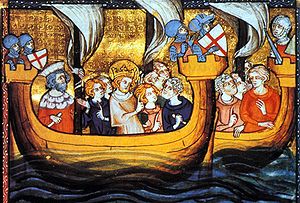 Joinville recounts equally the high deeds of Saint Louis, in particular the unfolding of the Seventh Crusade and the following stay in the Holy Land, which occupies most of the book.
Chronicle
Generally a chronicle is a historical account of facts and events ranged in chronological order, as in a time line. Typically, equal weight is given for historically important events and local events, the purpose being the recording of events that occurred, seen from the perspective of the...
rs of medieval
Middle Ages
The Middle Ages is a periodization of European history from the 5th century to the 15th century. The Middle Ages follows the fall of the Western Roman Empire in 476 and precedes the Early Modern Era. It is the middle period of a three-period division of Western history: Classic, Medieval and Modern...
France
France
The French Republic , The French Republic , The French Republic , (commonly known as France , is a unitary semi-presidential republic in Western Europe with several overseas territories and islands located on other continents and in the Indian, Pacific, and Atlantic oceans. Metropolitan France...
.
Son of Simon de Joinville and Beatrice d'Auxonne, he belonged to a noble family from Champagne. He received an education befitting a young noble at the court of Theobald IV
Theobald I of Navarre
Theobald I , called the Troubadour, the Chansonnier, and the Posthumous, was Count of Champagne from birth and King of Navarre from 1234...
, count of Champagne
Count of Champagne
The Counts of Champagne ruled the region of Champagne from 950 to 1316. Champagne evolved from the county of Troyes in the late eleventh century and Hugh I was the first to officially use the title "Count of Champagne". When Louis became King of France in 1314, upon the death of his father Philip...
: reading, writing, and the rudiments of Latin
Latin
Latin is an Italic language originally spoken in Latium and Ancient Rome. It, along with most European languages, is a descendant of the ancient Proto-Indo-European language. Although it is considered a dead language, a number of scholars and members of the Christian clergy speak it fluently, and...
. On the death of his father, he became seneschal
Seneschal
A seneschal was an officer in the houses of important nobles in the Middle Ages. In the French administrative system of the Middle Ages, the sénéchal was also a royal officer in charge of justice and control of the administration in southern provinces, equivalent to the northern French bailli...
of Champagne (and was therefore personally connected to Theobald IV). He was a very pious man and was concerned with the proper administration of the region.
In 1241, he accompanied Theobald to the court of the king of France, Louis IX
Louis IX of France
Louis IX , commonly Saint Louis, was King of France from 1226 until his death. He was also styled Louis II, Count of Artois from 1226 to 1237. Born at Poissy, near Paris, he was an eighth-generation descendant of Hugh Capet, and thus a member of the House of Capet, and the son of Louis VIII and...
(the future Saint Louis). In 1244, when Louis organized the Seventh Crusade
Seventh Crusade
The Seventh Crusade was a crusade led by Louis IX of France from 1248 to 1254. Approximately 800,000 bezants were paid in ransom for King Louis who, along with thousands of his troops, was captured and defeated by the Egyptian army led by the Ayyubid Sultan Turanshah supported by the Bahariyya...
, Joinville decided to abandon his family to join with the Christian knights just as his father had done 35 years earlier against the Albigensians. At the time of the crusade, Joinville placed himself in the service of the king and became his counsellor and confidant. In 1250, when the king and his troops were captured by the Mameluks in al-Mansourah, Joinville, among the captives, participated in the negotiations and the collection of the ransom
Ransom
Ransom is the practice of holding a prisoner or item to extort money or property to secure their release, or it can refer to the sum of money involved.In an early German law, a similar concept was called bad influence...
. Joinville probably brought himself even closer to the king in the difficult times that followed the failure of the crusade (including the death of his brother Robert, Count of Artois
Robert I of Artois
Robert I , called the Good, was the first Count of Artois, the fifth son of Louis VIII of France and Blanche of Castile.-Life:...
). It was Joinville who advised the king to stay in the Holy Land instead of returning immediately to France as the other lords had wanted; the king followed Joinville's advice. During the following four years spent in the Holy Land Joinville was the constant advisor to the king, who knew that he could count on Joinville's frankness and absolute devotion.
In 1270, Louis IX, although very weakened physically, undertook a new crusade
Eighth Crusade
The Eighth Crusade was a crusade launched by Louis IX, King of France, in 1270. The Eighth Crusade is sometimes counted as the Seventh, if the Fifth and Sixth Crusades of Frederick II are counted as a single crusade...
with his three sons. Any enthusiasm Joinville had for the previous crusade had been knocked out of him, and he refused to follow Louis, recognizing the uselessness of the enterprise and convinced that the duty of the king was not to leave the kingdom that needed him. In fact, the expedition was a disaster and the king died outside Tunis
Tunis
Tunis is the capital of both the Tunisian Republic and the Tunis Governorate. It is Tunisia's largest city, with a population of 728,453 as of 2004; the greater metropolitan area holds some 2,412,500 inhabitants....
on August 25, 1270.
From 1271, the papacy carried out a long inquest on the subject of Louis IX, which ended with his canonization
Canonization
Canonization is the act by which a Christian church declares a deceased person to be a saint, upon which declaration the person is included in the canon, or list, of recognized saints. Originally, individuals were recognized as saints without any formal process...
, announced in 1297 by Pope Boniface VIII
Pope Boniface VIII
Pope Boniface VIII , born Benedetto Gaetani, was Pope of the Catholic Church from 1294 to 1303. Today, Boniface VIII is probably best remembered for his feuds with Dante, who placed him in the Eighth circle of Hell in his Divina Commedia, among the Simonists.- Biography :Gaetani was born in 1235 in...
. As Joinville had been a close friend of the king, his counselor and his confidant, his testimony was invaluable to the inquest, where he appeared as a witness in 1282.
At the request of Jeanne of Navarre
Joan I of Navarre
Joan I , the daughter of king Henry I of Navarre and Blanche of Artois, reigned as queen regnant of Navarre and also served as queen consort of France.-Life:...
, the queen, he began work on the Histoire de Saint Louis, which he completed in 1309. Joinville died on 24 December 1317, over 93 years old, nearly fifty years after the death of Louis.
Commissioning of the work
Jeanne of NavarreJoan I of Navarre
Joan I , the daughter of king Henry I of Navarre and Blanche of Artois, reigned as queen regnant of Navarre and also served as queen consort of France.-Life:...
, wife of Philip IV of France
Philip IV of France
Philip the Fair was, as Philip IV, King of France from 1285 until his death. He was the husband of Joan I of Navarre, by virtue of which he was, as Philip I, King of Navarre and Count of Champagne from 1284 to 1305.-Youth:A member of the House of Capet, Philip was born at the Palace of...
(and granddaughter of Count Theobald IV), asked Joinville to write Louis' biography. He then put himself to the task of writing livre des saintes paroles et des bons faiz de nostre saint roy Looÿs (as he himself called it), today known as the Life of Saint Louis. Jeanne of Navarre died on 2 April 1305, while the work was not yet completed. Joinville dedicated it in 1309 to her son, Louis, king of Navarre and count of Champagne, the future Louis X of France
Louis X of France
Louis X of France, , called the Quarreler, the Headstrong, or the Stubborn was the King of Navarre from 1305 and King of France from 1314 until his death...
.
Composition and date
As noted, the book was not completed when Jeanne of Navarre died in 1305. In addition, the oldest existing manuscriptManuscript
A manuscript or handwrite is written information that has been manually created by someone or some people, such as a hand-written letter, as opposed to being printed or reproduced some other way...
ends with this note: " Ce fu escript en l'an de grace mil .CCC. et .IX. [1309], ou moys d’octovre ". This is not precisely the date of the writing of the manuscript, because it was obviously written later. Therefore it is either the date of the completion of the work by Joinville, or the date of the manuscript which served as the model to the surviving copies. The work was therefore written between 1305 and 1309. By other evidence, one can equally argue that a passage at the very end of the book, relating a dream of Joinville, could not have been written before 1308. Joinville therefore finished his work a short time before giving it to Louis.
Tradition of the text
The surviving manuscripts consist of one old copy of the text and two later copies. The manuscript that was given to Louis has not survived.The oldest manuscript is obviously very close to the original. It is found in the inventory of 1373 of the library of Charles V of France
Charles V of France
Charles V , called the Wise, was King of France from 1364 to his death in 1380 and a member of the House of Valois...
. Furthermore, according to the illuminations
Illuminated manuscript
An illuminated manuscript is a manuscript in which the text is supplemented by the addition of decoration, such as decorated initials, borders and miniature illustrations...
, it can be dated to the years 1330-1340, about 20 years after the original manuscript. This copy remained in the royal library and then passed to Philip the Good, Duke of Burgundy
Duke of Burgundy
Duke of Burgundy was a title borne by the rulers of the Duchy of Burgundy, a small portion of traditional lands of Burgundians west of river Saône which in 843 was allotted to Charles the Bald's kingdom of West Franks...
, before reaching Brussels
Brussels
Brussels , officially the Brussels Region or Brussels-Capital Region , is the capital of Belgium and the de facto capital of the European Union...
, where it was lost. It was rediscovered only in 1746, when Brussels was taken by French troops. This Brussels manuscript is now located in the Bibliothèque nationale de France
Bibliothèque nationale de France
The is the National Library of France, located in Paris. It is intended to be the repository of all that is published in France. The current president of the library is Bruno Racine.-History:...
. It is one volume of 391 pages in two columns. The first page is decorated with gold and illuminations, and with a painting representing Joinville presenting his book to Louis. The text is divided into paragraphs, each beginning with a gilded letter.
Two editions have been created from one translation of Joinville's text (which does not survive itself), created by Antoine Pierre in 1547 and by Claude Ménard in 1617 respectively. Pierre's text is corrupted from the modifications of the original text and from fanciful additions, while Ménard's is an excellent scholarly work.
Finally, a third copy of the text comes from two manuscripts which appear to date from the second quarter of the 16th century. These are modernized transcriptions with systematic renovation of the language, from one older manuscript and the Brussels manuscript.
General perspectives on the work
Joinville was a knight. He was neither a cleric skilled in composing books, nor a chronicler informed by researching written or oral information. Nevertheless, his writing is sincere and neutral. He wrote about everything he personally experienced during the reign of Saint Louis, essentially the crusade in EgyptEgypt
Egypt , officially the Arab Republic of Egypt, Arabic: , is a country mainly in North Africa, with the Sinai Peninsula forming a land bridge in Southwest Asia. Egypt is thus a transcontinental country, and a major power in Africa, the Mediterranean Basin, the Middle East and the Muslim world...
and their stay in the Holy Land. His narrative is full of life, anecdotes and even humour. It is more of a personal testimony about the king than a history of his reign.
The freshness and precision of his memories are impressive, especially since he wrote his work some decades after the fact. Certain medievalists explain this by supposing that Joinville had often recounted his past orally or that he had previously committed it to writing before beginning his work.
Joinville speaks almost as much about himself as he does about the king, the subject of his book, but he does it in such a natural manner that he never gives the impression that he wants to place himself above the king. Thus we have an incomparable clarity about the ways of thinking of a 13th century man. For this reason, modern editors have sometimes said the work is more of a memoir than a history or a biography of Saint Louis.
The holy words
The first part of Joinville's work is dedicated to the holy words of the king. Joinville writes about the edifying words of the king and his Christian virtues.Speeches are very important among Louis' court. His speech is moral and didactic, reflecting the speech of the preachers (Dominican
Dominican Order
The Order of Preachers , after the 15th century more commonly known as the Dominican Order or Dominicans, is a Catholic religious order founded by Saint Dominic and approved by Pope Honorius III on 22 December 1216 in France...
s and Franciscan
Franciscan
Most Franciscans are members of Roman Catholic religious orders founded by Saint Francis of Assisi. Besides Roman Catholic communities, there are also Old Catholic, Anglican, Lutheran, ecumenical and Non-denominational Franciscan communities....
s) who surround him. It transmits a moral and religious teaching and often aims to strengthen the faith of the recipient. An intimacy exists between the king and his followers (his family, confidants, and counselors, among whom are Joinville and Robert de Sorbon
Robert de Sorbon
Robert de Sorbon was a French theologian, the chaplain of Louis IX of France, and founder of the Sorbonne college in Paris....
) who express themselves particularly in the conversation: the king invites his audience to respond to his questions, often with the aim of instructing them with moral and religious plans. This importance of the royal speech is particularly well rendered by Joinville, who often has his characters speak. He is one of the first memoirists to integrate reconstructed dialogue into a tale. He most often uses a direct style and marks the interventions of his characters with "he said" or "he did." And Joinville never has his characters speak in long monologues: the lessons are always shown from dialogue.
In addition, it is through the words of the king that his profound faith and sanctity are shown. For Joinville, Louis IX embodies the ideal prud'homme - pious, courageous, kind, intelligent and wise, a man who defends the Christian faith by his courage. And in fact, in Joinville's work he shows the king to have an ardent love of God, benevolent to his people, humble, moderate and courteous, wise and just, peaceful, loyal and generous. In some respects Joinville is sometimes not far from writing a hagiography
Hagiography
Hagiography is the study of saints.From the Greek and , it refers literally to writings on the subject of such holy people, and specifically to the biographies of saints and ecclesiastical leaders. The term hagiology, the study of hagiography, is also current in English, though less common...
.
Joinville, like his king, was obviously very attached to the Christian religion, to its doctrines, its morality and its practices. For proof of this there is a small work of edification, composed in 1250, titled li romans as ymages des poinz de nostre foi, where Joinville makes a brief commentary on the Credo
Credo
A credo |Latin]] for "I Believe") is a statement of belief, commonly used for religious belief, such as the Apostles' Creed. The term especially refers to the use of the Nicene-Constantinopolitan Creed in the Mass, either as text, Gregorian chant, or other musical settings of the...
. But his deep and sincere faith contrasts with the almost exalted Christian heroism of the king. The Christianity of Joinville is closer to that of the common people.
The crusade