
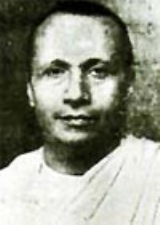
Jaishankar Prasad (January 30, 1889 January 14, 1937), one of the most famous figures in modern
Hindi literatureHindi literature , is broadly divided into four prominent forms or styles, being Bhakti ; Shringar ; Veer-Gatha ; and Adhunik...
as well as
Hindi theatreHindi theatre primarily refers to theatre performed in the Hindi language, including dialects such as Khari boli and Hindustani. Hindi theatre is produced mainly in North India, and some parts of West India and Central India, which include Mumbai and Bhopal...
.
Biography
Jaishankar Prasad was born on January 30, 1889, in an elite madheshiya vaisya family in
Varanasi-Etymology:The name Varanasi has its origin possibly from the names of the two rivers Varuna and Assi, for the old city lies in the north shores of the Ganga bounded by its two tributaries, the Varuna and the Asi, with the Ganges being to its south...
,
Uttar PradeshUttar Pradesh abbreviation U.P. , is a state located in the northern part of India. With a population of over 200 million people, it is India's most populous state, as well as the world's most populous sub-national entity...
,
IndiaIndia , officially the Republic of India , is a country in South Asia. It is the seventh-largest country by geographical area, the second-most populous country with over 1.2 billion people, and the most populous democracy in the world...
. His father
Babu Devki Prasad, also known as
Sunghani Sahu (सुंघनी साहू), was a tobacco dealer. After, he lost his father at an early age, he had to encounter some family problems at a relatively young age, and left school after class eight. However, he remained interested in literature, languages, and ancient history, and continued studying at home; thereafter he developed a special inclination towards the
VedasThe Vedas are a large body of texts originating in ancient India. Composed in Vedic Sanskrit, the texts constitute the oldest layer of Sanskrit literature and the oldest scriptures of Hinduism....
and these interests are innately reflected in the deep philosophical contender/content of his works.
Language and influence
His initial poetry (
Chitraadhar collection) was done in the
BrajBraj Bhasha , also called Brij Bhasha , Braj Bhakha , or Dehaati Zabaan , is a Central Indian language closely related to Hindi...
dialect of
HindiHindi literature , is broadly divided into four prominent forms or styles, being Bhakti ; Shringar ; Veer-Gatha ; and Adhunik...
, but later he switched to the
Khadi dialect or
SanskritSanskrit , is a historical Indo-Aryan language and the primary liturgical language of Hinduism, Jainism and Buddhism.Buddhism: besides Pali, see Buddhist Hybrid Sanskrit Today, it is listed as one of the 22 scheduled languages of India and is an official language of the state of Uttarakhand...
ized Hindi.
In his earlier days, he was influenced by
SanskritSanskrit , is a historical Indo-Aryan language and the primary liturgical language of Hinduism, Jainism and Buddhism.Buddhism: besides Pali, see Buddhist Hybrid Sanskrit Today, it is listed as one of the 22 scheduled languages of India and is an official language of the state of Uttarakhand...
dramas, but later the influence of
BengaliBengali literature is literary works written in Bengali language particularly from Bangladesh and the Indian provinces of West Bengal and Tripura. The history of Bengali literature traces back hundreds of years while it is impossible to separate the literary trends of the two Bengals during the...
and
PersianPersian literature spans two-and-a-half millennia, though much of the pre-Islamic material has been lost. Its sources have been within historical Persia including present-day Iran as well as regions of Central Asia where the Persian language has historically been the national language...
dramas is evident on his works. Prasad's most famous dramas include
Skandagupta,
Chandragupta and
Dhruvaswamini .
Poetic style
He is considered one of the Four Pillars (
Char Stambh) of
RomanticismRomanticism was an artistic, literary and intellectual movement that originated in the second half of the 18th century in Europe, and gained strength in reaction to the Industrial Revolution...
in
Hindi LiteratureHindi literature , is broadly divided into four prominent forms or styles, being Bhakti ; Shringar ; Veer-Gatha ; and Adhunik...
(Chhayavad), along with
Sumitranandan PantSumitranandan Pant was one of the most famous modern Hindi poets. He is considered one of the major poets of the Chhayavaadi school of Hindi literature. Pant mostly wrote in Sanskritized Hindi. Pant authored twenty eight published works including poetry, verse plays and essays.Pant was born at...
, Mahadevi Verma, and
Suryakant Tripathi 'Nirala'Suryakant Tripathi 'Nirala' was one of the most famous figures of the modern Hindi literature. He was a poet, novelist, essayist and story-writer...
. His style of poetry can at best be described as "touching". Art and philosophy have been exquisitely amalgamated in his writings. His vocabulary avoids the
PersianPersian is an Iranian language within the Indo-Iranian branch of the Indo-European languages. It is primarily spoken in Iran, Afghanistan, Tajikistan and countries which historically came under Persian influence...
element of
HindiStandard Hindi, or more precisely Modern Standard Hindi, also known as Manak Hindi , High Hindi, Nagari Hindi, and Literary Hindi, is a standardized and sanskritized register of the Hindustani language derived from the Khariboli dialect of Delhi...
and mainly consists of
SanskritSanskrit , is a historical Indo-Aryan language and the primary liturgical language of Hinduism, Jainism and Buddhism.Buddhism: besides Pali, see Buddhist Hybrid Sanskrit Today, it is listed as one of the 22 scheduled languages of India and is an official language of the state of Uttarakhand...
(
TatsamaTatsama are Sanskrit loanwords in modern Indic languages like Bengali, Marathi, Hindi, Gujarati, Sinhala and Central Dravidian language Telugu. They belong to a higher and more erudite register than common words. That register can be compared to the use of words of Greek origin in English Tatsama...
) words and words derived from Sanskrit (
Tadbhava' is one of three etymological classes defined by native grammarians of middle Indo-Aryan languages. A "tadbhava" is a word which had been borrowed from Sanskrit, but which had changed to fit the phonology of the Prakrit or Apabhramsa in question...
words) - some of them made really exquisitely by himself. By this means, he arrives at a sophisticated diction that was typical for Hindi Romanticism of the 1920s and 30s, and also, on the
UrduUrdu is a register of the Hindustani language that is identified with Muslims in South Asia. It belongs to the Indo-European family. Urdu is the national language and lingua franca of Pakistan. It is also widely spoken in some regions of India, where it is one of the 22 scheduled languages and an...
side, for
Muhammad IqbalSir Muhammad Iqbal , commonly referred to as Allama Iqbal , was a poet and philosopher born in Sialkot, then in the Punjab Province of British India, now in Pakistan...
.
The subject of his poetry spans the entire horizon of subjects of his era, from romantic to nationalistic. He in a way signifies the epitome of
classicalClassicism, in the arts, refers generally to a high regard for classical antiquity, as setting standards for taste which the classicists seek to emulate. The art of classicism typically seeks to be formal and restrained: of the Discobolus Sir Kenneth Clark observed, "if we object to his restraint...
HindiStandard Hindi, or more precisely Modern Standard Hindi, also known as Manak Hindi , High Hindi, Nagari Hindi, and Literary Hindi, is a standardized and sanskritized register of the Hindustani language derived from the Khariboli dialect of Delhi...
poetry. One of his patriotic poems, 'Himadri Tung Shring Se', won him many accolades in the era of
Indian independence movementThe term Indian independence movement encompasses a wide area of political organisations, philosophies, and movements which had the common aim of ending first British East India Company rule, and then British imperial authority, in parts of South Asia...
. However,
KamayaniKamayani is a Hindi epic poem by Jaishankar Prasad . It is considered one of the greatest literary works written in modern times in Hindi literature...
undoubtedly remains his best creation.
Dramas and other writings
His dramas are considered to be most pioneering ones in
HindiStandard Hindi, or more precisely Modern Standard Hindi, also known as Manak Hindi , High Hindi, Nagari Hindi, and Literary Hindi, is a standardized and sanskritized register of the Hindustani language derived from the Khariboli dialect of Delhi...
. The majority of them revolve around historical stories of
Ancient IndiaThe history of India begins with evidence of human activity of Homo sapiens as long as 75,000 years ago, or with earlier hominids including Homo erectus from about 500,000 years ago. The Indus Valley Civilization, which spread and flourished in the northwestern part of the Indian subcontinent from...
. Some of them were also based on mythological plots. In 1960s,
Shanta GandhiShanta Gandhi was an Indian theatre director, dancer and playwright. She was a founder-member of the central ballet troupe of the Indian People's Theatre Association , and toured the country widely through the 1950s...
Professor of Ancient Indian Drama at while at
National School of DramaNational School of Drama is a theatre training institute situated at New Delhi, India, established . It is an autonomous organization under Ministry of Culture, Government of India. It was set up in 1959 by the Sangeet Natak Akademi, and became an independent school in 1975...
, revived interest in Jaishankar Prasad’s plays for modern Indian theatre, by successfully staging his most important play
Skanda Gupta written in 1928, with little changes to the original script, thus quashing doubts over its "stagability".
He wrote short stories as well. The subjects were mixed - ranging from historical and mythological to contemporary and social.
Mamta (motherly love) is a famous short-story based on an incident where a
MughalThe Mughal Empire , or Mogul Empire in traditional English usage, was an imperial power from the Indian Subcontinent. The Mughal emperors were descendants of the Timurids...
Badshah gets refuge in a
HinduHindu refers to an identity associated with the philosophical, religious and cultural systems that are indigenous to the Indian subcontinent. As used in the Constitution of India, the word "Hindu" is also attributed to all persons professing any Indian religion...
widow's home whose father was killed by Badshah's army. Another one of his well-known short-stories called
chhota jadugar (little magician) portrays the life of a child who learns to earn his own living by performing small skits with his dolls on streets.
He also wrote a small number of novels.
Poetry
- Kānan kusum (The Forest Flower)
- Mahārānā kā mahatv (The Maharana’s greatness)
- Jharnā (The Waterfall)
- Ānsū (The tear)
- Lahar (The wave)
- Kāmāyanī (an epic about Manu
-Geography:*Manú Province, a province of Peru, in the Madre de Dios Region*Manú National Park, Peru*Manú River, in southeastern Peru*Manu River, Tripura, which originates in India and flows into Bangladesh...
and the flood)
- Prem pathik (The Love Wanderer)
- Ek ghūṃṭ (A sip)
- Aatmkathya(Autobiography)
| valign="top" |
Drama
- Skandagupta (On Emperor Skandagupta
Skandagupta was a Gupta Emperor of northern India. He is generally considered the last of the great Gupta Emperors.-Rule:Skandagupta's antecedents remain unclear. Later official genealogies omit his name, and even the inscriptions of his own age omit the name of his mother...
)
- Chandragupta (On Emperor Chandragupta Maurya I)
- Dhruvasvāminī
- Janmejay kā nāg yajña
- Rajyashrī (Royal Bliss)
- Kāmnā
| valign="top" |
Story collections
- Chāyā (The Shadow)
- Pratidhvani (The Echo)
- Ākāshdīp (Ethereal Lamp)
- Āṃdhī (The Storm)
- Indrajāl (Hypnosis)
| valign="top" |
Novels
- Kankāl (The Skeleton)
- Titlī (The Butterfly)
- Irāvatī (The Irravaddy)
| valign="top" |
|}
Works online
External links
- Kamayani
Kamayani is a Hindi epic poem by Jaishankar Prasad . It is considered one of the greatest literary works written in modern times in Hindi literature...
of Jai Shankar Prasad - As I saw It and Understood It by Dr.Girish Bihari
1st Edition 2006, Published by Film Institute, Lucknow (U.P.) - INDIA http://cities.expressindia.com/fullstory.php?newsid=205657