

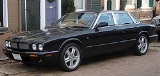
Jaguar XJ

Encyclopedia
Jaguar XJ is the designation that has been used for a series of luxury
saloon cars sold under the British Jaguar marque. The first XJ was launched in 1968 and the designation has been used for successive Jaguar flagship models since then. The original model was the last Jaguar saloon to have had the input of Sir William Lyons
, the company's founder. The current Jaguar XJ
was launched in 2009.
, replaced most of Jaguar's saloons – which, in the 1960s, had expanded to four separate ranges. Apart from the engines, the other main component carried over from previous models was the widest version of Jaguar's IRS unit
from the Mark X
.
An upmarket version was marketed under the Daimler
brand and called the Daimler Sovereign
, continuing the name from the Daimler
version of the Jaguar 420
.
The car was introduced in September 1968. Power-assisted steering and leather upholstery were standard on the 2.8 L De Luxe and 4.2 L models and air conditioning was offered as an optional extra on the 4.2 L. Daimler versions were launched in October 1969, in a series of television advertisements featuring Sir William. In these spots, he referred to the car as "the finest Jaguar ever". An unusual feature, inherited from the Jaguar Mark X
, was the provision of twin fuel tanks, positioned on each side of the boot / trunk, and filled using two separately lockable filler caps: one on the top of each wing above the rear wheel arches.
In March 1970 it was announced that the Borg-Warner Model 8 automatic transmission, which the XJ6 had featured since 1968, would be replaced on the 4.2 litre-engined XJ6 with a Borg-Warner Model 12 unit. The new transmission now had three different forward positions accessed via the selector lever, which effectively enabled performance oriented drivers to hold lower ratios at higher revs in order to achieve better acceleration. "Greatly improved shift quality" was also claimed for the new system.
In 1972 the option of a long-wheelbase version, providing a modest increase in leg room for passengers in the back, became available.
The XJ12 version was announced in July 1972, featuring simplified grille treatment, and powered by a 5.3 L V12 engine
(coupled to a Borg Warner Model 12), : The car as presented at that time was the world's only mass-produced 12-cylinder four-door car, and, with a top speed "around 140 mph" (225 km/h) as the "fastest full four-seater available in the world today". Although it had, from the car's launch, been the manufacturer's intention that the XJ would take the twelve-cylinder engine, its installation was nonetheless a tight fit, and providing adequate cooling had evidently been a challenge for the engineers designing the installation. Bonnet/hood louvres such as those fitted on the recently introduced twelve-cylinder E Type
were rejected, but the XJ12 featured a complex "cross-flow" radiator divided into two separated horizontal sections and supported with coolant feeder tanks at each end: the engine fan was geared to rotate at 1¼ times the speed of the engine rpm, subject to a limiter which cut in at a (fan) speed of 1,700 rpm. The fuel system incorporated a relief valve that returned fuel to the tank when pressure in the leads to the carburetters exceeded 1.5 psi in order to reduce the risk of vapour locks occurring at the engine's high operating temperature, while the car's battery, unusually, benefited from its own thermostatically controlled cooling fan.
3,235 of these first generation XJ12s were built. As with the six-cylinder cars, an upmarket version, this time called the Daimler Double-Six, became available later, reviving the Daimler
model name of 1926–1938.
The Series II models were known for their poor build quality, which was attributed to Jaguar being part of the British Leyland group along with massive labour union relations problems that plagued most of industrial England in the same time period, and to problems inherent in the design of certain Lucas-sourced components.
Initially the Series II was offered with two wheelbases, but at the 1974 London Motor Show Jaguar announced the withdrawal of the 'standard wheelbase' version: subsequent saloons/sedans all featured the extra 4 inches (10 cm) of passenger cabin length hitherto featured only by the 'long-wheelbase' model. By this time the first customer deliveries of the two-door coupe, which retained the shorter 'standard' wheelbase (and which had already been formally 'launched' more than a year earlier) were only months away.
Visually, Series II cars are differentiated from their predecessors by raised front bumpers to meet US crash safety regulations, which necessitated a smaller grille, complemented by a discrete additional inlet directly below the bumper. The interior received a substantial update, including simplified heating and a/c systems to address criticisms of the complex and not very effective Series I system.
In April 1975, the North American Series II got a slightly revised set of front bumpers which had rubber overriders covering the full length of the bumper with embedded turn signals at each end. In 1978 the North American cars also got the addition of electronic fuel injection in the place of Zenith-Stromberg carburettors.
In May 1977, it was announced that automatic transmission version of the twelve-cylinder cars would be fitted with a General Motors
three-speed THM 400 transmission in place of the British built Borg-Warner units used hitherto.
The 1978 UK model range included the Jaguar XJ 3.4, XJ 4.2, XJ 5.3, Daimler Sovereign 4.2, Double-Six 5.3, Daimler Vanden Plas 4.2, Double-Six Vanden Plas 5.3.
In New Zealand, knock-down kits of the Series II were assembled locally by the New Zealand Motor Corporation (NZMC) at their Nelson plant. In the last year of production in New Zealand (1978), a special 'SuperJag' model was produced which featured half leather, half dralon wide pleat seats, vinyl roof, chrome steel wheels and air conditioning as standard. New Zealand produced models featured speedometers in km/h, and the black vinyl mats sewn onto the carpets in the front footwells featured the British Leyland 'L' logo.
Though worldwide production of the Series II ended in 1979, a number were produced in Cape Town
, South Africa until 1981.
A total of 91,227 Series II models were produced, 14,226 of them with the V12 engine.
Engines
Note: HP varies depending on emission standards imposed on particular vehicles
Production count
s with a pillarless hardtop
body called the XJ-C was built between 1975 and 1978. The car was actually launched at the London Motor Show in October 1973, but it subsequently became clear that it was not ready for production, and the economic troubles
unfolding in the western world at this time seem to have reduced further any sense of urgency about producing and selling the cars: it was reported that problems with window sealing delayed production. XJ coupés finally started to emerge from Jaguar show-rooms only some two years later. The coupé was based on the short-wheelbase version of the XJ. The coupé's elongated doors were made out of a lengthened standard XJ front door (the weld seams are clearly visible under the interior panels where two front door shells were grafted together with a single outer skin). A few XJ-Cs were modified by Avon into convertible
s with a retractable canvas top, but this was not a factory product. Both six and twelve-cylinder models were offered, 6,505 of the former and 1,873 of the latter. Even with the delay, these cars suffered from water leaks and wind noise. The delayed introduction, the labour-intensive work required by the modified saloon body, the higher price than the four-door car, and the early demise promulgated by the new XJ-S
, all ensured a small production run.
All coupes came with a vinyl roof
as standard. Since the coupe lacked B-pillars, the roof flexed enough that the paint used by Jaguar at the time would develop cracks. More modern paints do not suffer such problems, so whenever a coupe is repainted it is viable to remove the vinyl. Today many XJ-Cs no longer have their vinyl roof, also removing the threat of roof rust. Some owners also modified their XJ-C by changing to Series III bumpers. This lifted the front indicators from under the bumper and provided built in rear fog lights.
A small number of Daimler
versions of the XJ-C were made. One prototype Daimler Vanden Plas version XJ-C was also made, however this version never went into production.
Production Count
Grand total = 10,426
Using the long-wheelbase version of the car, the XJ6 incorporated a subtle redesign by Pininfarina
.
Externally, the most obvious changes over the SII were the thicker and more incorporated rubber bumpers with decorative chrome only on the top edge, flush door handles for increased safety, a one-piece front door glass without a separate 1/4 light, a grille with only vertical vanes, reverse lights moved from the boot plinth to the larger rear light clusters and a revised roofline with shallower glass area.
There were three engine variants, including the 5.3 L V12
, the 4.2 L straight-six and 3.4 L straight-six. The larger six-cylinder, and V12 models incorporated Bosch
fuel injection
(made under license by Lucas) while the smaller six-cylinder was carbureted. The smaller 3.4 L six-cylinder engine was not offered in the U.S.
The short-wheelbase saloon and coupé had been dropped during the final years of the Series II XJ. The introduction of the Series III model also saw the option of a sunroof and cruise control for the first time on an XJ model.
The 1979 UK model range included the Jaguar XJ6 3.4 & 4.2, XJ12 5.3, Daimler Sovereign 4.2 & Double-Six 5.3 and Daimler Vanden Plas 4.2 & Double-Six Vanden Plas 5.3.
In 1981 the 5.3 V12 models received the new Michael May designed 'fireball' high compression cylinder head engines and were badged from this time onwards to 1985 as "HE" (High Efficiency) models.
In late 1981 Daimler Sovereign and Double Six models received a minor interior upgrade for the 1982 model year with features similar to Vanden Plas models. Also for the 1982 model year, a top sec "Jaguar" Vanden Plas model was introduced for the US market - a model designation still used today.
In late 1982 the interior of all Series III models underwent a minor update for the 1983 model year. A trip computer appeared for the first time and was fitted as standard on V12 models. A new and much sought-after alloy wheel featuring numerous distinctive circular holes was also introduced, commonly known as the "pepperpot" wheel.
In late 1983 revision and changes were made across the Series III model range for the 1984 model year, with the Sovereign name being transferred from Daimler to a new top spec Jaguar model, the "Jaguar Sovereign". A base spec Jaguar XJ12 was no longer available, with the V12 engine only being offered as a Jaguar Sovereign HE or Daimler Double Six. The Vanden Plas name was also dropped at this time in the UK market, due to Jaguar being sold by BL and the designation being used on top-of-the-range Rover-branded cars in the home UK market. Daimler models became the Daimler 4.2 and Double Six and were the most luxurious XJ Series III models, being fully optioned with Vanden Plas spec interiors.
The 1984 UK model range included the Jaguar XJ6 3.4 & 4.2, Sovereign 4.2 & 5.3, Daimler 4.2 & Double Six 5.3.
Production of the Series III XJ continued until 1992 with the V12 engine. In 1992, the last 100 cars built were numbered and sold as part of a special series commemorating the end of production for Canada. These 100 cars featured the option of having a brass plaque located in the cabin. It was the original purchaser's option to have this plaque, which also gave a number to the car (such as No. 5 of 100, etc.), fitted to the glove box, to the console woodwork or not fitted at all. This brass plaque initiative did not come from Jaguar in Coventry. It was a local effort, by Jaguar Canada staff and the brass plaques were engraved locally.
132,952 Series III cars were built, 10,500 with the V12 engine. In total between 1968 and 1992 there were around 318,000 XJ6 and XJ12 Jaguars produced.
. The XJ40 was finally introduced in 1986 at the British International Motor Show
.
With the XJ40, Jaguar began to place more emphasis on build quality as well as simplification of the XJ's build process. With 25% fewer body panel pressings required versus the Series XJ, the new process also saved weight, increased the stiffness of the chassis, and reduced cabin noise.
The new platform came with significantly different styling, which was more squared-off and angular than the outgoing Series III. Individual round headlamps were replaced with rectangular units on the higher-specification cars. The interior received several modernizations such as the switch to a digital instrument cluster (although this was eventually discontinued in favor of analog instruments.)
The six-cylinder XJ40s are powered by the AJ6 inline-six
engine, which replaced the XK6 unit used in earlier XJs. The new unit featured a four-valve, twin overhead cam design. In 1993, one year before XJ40 production ended, the V12-powered XJ12 and Daimler Double Six models were reintroduced.
Six-cylinder X300s are powered by the AJ16 inline-six engine, which is a further enhancement of the AJ6 engine that uses an electronic distributorless ignition system. The V12 remained available until the end of the X300 production in 1997 (although it ended one year earlier in the United States market due to problems meeting OBD-II-related emissions requirements.)
It was in X300 production that Jaguar introduced the supercharged XJR, which was the first supercharged road car manufactured by the company.
The exterior styling of the X308 is nearly identical to that of the X300. It features minor refinements such as a change to oval indicator lenses and round fog lights. The interior was also updated to eliminate the instrument binnacle used on the X300; instead, three large gauges were set into recesses in the walnut-faced dashboard in front of the driver.
The major mechanical change for the X308 was the discontinuation of both Jaguar's inline-six engine and V12, in favor of the new eight-cylinder AJ-V8
. Depending on the model, X308 cars were powered by either a 3.2L or 4.0L version of the V8 engine. The 4.0L was also available in supercharged form. The factory dropped the option of a manual gearbox, and all X308s were built with a five-speed automatic.
) and Mark 4 (E65
) versions of its 7 Series in 1994 and 2001 respectively – all while Jaguar was still producing the Mk 2 XJ.
In early 2003, the all-new third generation XJ (known as X350) arrived in showrooms. While the car's exterior and interior styling were traditional in appearance, the car was completely re-engineered. The new car also saw the return of the XJ6 badge, and with it six-cylinder power, albeit in a V-configuration. Although traditional in appearance, the car was actually highly technologically advanced: for example, it had an all-aluminium body that made the car very light compared to rivals, bringing improvements in performance, agility and economy.
Larger all round and higher, the new car offered much improved interior and luggage space.
The V8 engine was offered in larger 3.5 and 4.2 litre sizes as well as a supercharged 4.2 Litre. The car's lighter weight meant the 3.0 Litre V6 was also offered although with the later introduction of the 2.7 litre V6 diesel the V6 petrol version was discontinued (neither V6 petrol nor diesel were available in US markets). A new six-speed automatic gearbox was fitted which was lighter and offered better economy with lock up on all gears and a larger spread of ratios.
Air suspension was fitted all round which provided adaptive damping as well as rear self levelling. Unlike other manufacturers Jaguar did not provide any driver control of ride height or suspension mode which was fully computer controlled. Dynamic stability control as well as traction control were standard.
Two zone climate control was also standard with four zone available on long-wheelbase models. An optional touch screen interface controlled default settings, satellite navigation, the Alpine audio system, and blue tooth telephone. "Jaguar Voice" offered voice control of many functions.
in London, with Jay Leno
and Elle Macpherson
unveiling the new car. The unveiling was broadcast live on the Jaguar website.
In keeping with Ian Callum's new design direction for Jaguar, it is an all-new exterior design and a break from the XJ series mould carried over on all previous generations. It is a longer, wider car that looks much bigger than its predecessor.The front has clear links with the executive car XF, although with slimmer, sleeker lights and a larger, squarer grille and more aggressive appearance. The rear is the contentious part, like nothing Jaguar has shown before. The upright, swooping taillights, nicknamed 'cat's claws', and black roof panels each side of the rear screen, which aim to hide the XJ's width, are the most striking aspects. There is also a standard full-length sunroof, that extends all the way back with just a single body-coloured roof panel that the designer likens to bridges on yachts.
The new XJ features an innovative, all-LCD dashboard and console displays. The dashboard can be configured to display various virtual dials in addition to the obligatory speedometer. The console display presents different views to the driver and passenger, including control of a sophisticated video and audio system.
Mike Cross, one of the company's chief engineers, spoke more about the "new Jaguar XJ dynamics" in an interview with Autocar.
Like several of its predecessors, the X351 is available with both standard and long wheelbase as well as many special editions. Engines are modern units, already seen in other JLR products: the 5-litre petrol V8 either normally aspirated or supercharged, or a twin-turbo 3-litre diesel that is predicted to account for most of the sales.
Luxury vehicles
Luxury vehicle is a marketing term for a vehicle that provides luxury — pleasant or desirable features beyond strict necessity—at increased expense ....
saloon cars sold under the British Jaguar marque. The first XJ was launched in 1968 and the designation has been used for successive Jaguar flagship models since then. The original model was the last Jaguar saloon to have had the input of Sir William Lyons
William Lyons
Sir William Lyons , known as "Mr. Jaguar", was with fellow motorcycle enthusiast William Walmsley, the co-founder in 1922 of the Swallow Sidecar Company, which became Jaguar Cars Limited after the Second World War....
, the company's founder. The current Jaguar XJ
Jaguar XJ (X351)
The Jaguar XJ is the latest Jaguar XJ luxury saloon from Jaguar Cars. Completely new styling combines with underpinnings based on the previous X350 version.-Launch:...
was launched in 2009.
Series 1 (1968–1973)
The XJ6, using 2.8 litre (2790 cc) and 4.2 litre (4235 cc) straight-six cylinder versions of Jaguar's renowned XK engineJaguar XK6 engine
The renowned Jaguar XK dual overhead camshaft inline 6-cylinder engine was introduced in 1949 and continued in manufacture until 1992. It was produced in five displacements for Jaguar passenger cars, with other sizes being made by Jaguar and privateers for racing...
, replaced most of Jaguar's saloons – which, in the 1960s, had expanded to four separate ranges. Apart from the engines, the other main component carried over from previous models was the widest version of Jaguar's IRS unit
Jaguar independent rear suspension
Jaguar's independent rear suspension unit has been a common component of a number of Jaguar production cars since 1961, passing through three major changes of configuration up to 2003 and still used in the full-sized Jaguar XJ...
from the Mark X
Jaguar Mark X
The Jaguar Mark X was the top-of-the-range saloon car built by the British manufacturer Jaguar, originally aimed at the United States market. The Mark X succeeded the Mark IX as the company's large saloon model.-Body:...
.
An upmarket version was marketed under the Daimler
Daimler Motor Company
The Daimler Motor Company Limited was an independent British motor vehicle manufacturer founded in London by H J Lawson in 1896, which set up its manufacturing base in Coventry. The right to the use of the name Daimler had been purchased simultaneously from Gottlieb Daimler and Daimler Motoren...
brand and called the Daimler Sovereign
Daimler Sovereign
Daimler Sovereign was a name applied by British manufacturer Jaguar Cars to a sequence of luxury automobiles built by it but carrying the Daimler badge between 1966 and 1983....
, continuing the name from the Daimler
Jaguar 420 and Daimler Sovereign (1966–69)
The Jaguar 420 and its Daimler Sovereign equivalent were introduced at the October 1966 London Motor Show and produced for two years as the ultimate expression of a series of "compact sporting saloons" offered by Jaguar throughout that decade, all of which shared the same wheelbase...
version of the Jaguar 420
Jaguar 420 and Daimler Sovereign (1966–69)
The Jaguar 420 and its Daimler Sovereign equivalent were introduced at the October 1966 London Motor Show and produced for two years as the ultimate expression of a series of "compact sporting saloons" offered by Jaguar throughout that decade, all of which shared the same wheelbase...
.
The car was introduced in September 1968. Power-assisted steering and leather upholstery were standard on the 2.8 L De Luxe and 4.2 L models and air conditioning was offered as an optional extra on the 4.2 L. Daimler versions were launched in October 1969, in a series of television advertisements featuring Sir William. In these spots, he referred to the car as "the finest Jaguar ever". An unusual feature, inherited from the Jaguar Mark X
Jaguar Mark X
The Jaguar Mark X was the top-of-the-range saloon car built by the British manufacturer Jaguar, originally aimed at the United States market. The Mark X succeeded the Mark IX as the company's large saloon model.-Body:...
, was the provision of twin fuel tanks, positioned on each side of the boot / trunk, and filled using two separately lockable filler caps: one on the top of each wing above the rear wheel arches.
In March 1970 it was announced that the Borg-Warner Model 8 automatic transmission, which the XJ6 had featured since 1968, would be replaced on the 4.2 litre-engined XJ6 with a Borg-Warner Model 12 unit. The new transmission now had three different forward positions accessed via the selector lever, which effectively enabled performance oriented drivers to hold lower ratios at higher revs in order to achieve better acceleration. "Greatly improved shift quality" was also claimed for the new system.
In 1972 the option of a long-wheelbase version, providing a modest increase in leg room for passengers in the back, became available.
The XJ12 version was announced in July 1972, featuring simplified grille treatment, and powered by a 5.3 L V12 engine
V12 engine
A V12 engine is a V engine with 12 cylinders mounted on the crankcase in two banks of six cylinders, usually but not always at a 60° angle to each other, with all 12 pistons driving a common crankshaft....
(coupled to a Borg Warner Model 12), : The car as presented at that time was the world's only mass-produced 12-cylinder four-door car, and, with a top speed "around 140 mph" (225 km/h) as the "fastest full four-seater available in the world today". Although it had, from the car's launch, been the manufacturer's intention that the XJ would take the twelve-cylinder engine, its installation was nonetheless a tight fit, and providing adequate cooling had evidently been a challenge for the engineers designing the installation. Bonnet/hood louvres such as those fitted on the recently introduced twelve-cylinder E Type
Jaguar E-type
The Jaguar E-Type or XK-E is a British automobile, manufactured by Jaguar between 1961 and 1975. Its combination of good looks, high performance, and competitive pricing established the marque as an icon of 1960s motoring...
were rejected, but the XJ12 featured a complex "cross-flow" radiator divided into two separated horizontal sections and supported with coolant feeder tanks at each end: the engine fan was geared to rotate at 1¼ times the speed of the engine rpm, subject to a limiter which cut in at a (fan) speed of 1,700 rpm. The fuel system incorporated a relief valve that returned fuel to the tank when pressure in the leads to the carburetters exceeded 1.5 psi in order to reduce the risk of vapour locks occurring at the engine's high operating temperature, while the car's battery, unusually, benefited from its own thermostatically controlled cooling fan.
3,235 of these first generation XJ12s were built. As with the six-cylinder cars, an upmarket version, this time called the Daimler Double-Six, became available later, reviving the Daimler
Daimler Motor Company
The Daimler Motor Company Limited was an independent British motor vehicle manufacturer founded in London by H J Lawson in 1896, which set up its manufacturing base in Coventry. The right to the use of the name Daimler had been purchased simultaneously from Gottlieb Daimler and Daimler Motoren...
model name of 1926–1938.
| Model | Production |
|---|---|
| Jaguar XJ6 2.8 swb | 19,322 |
| Jaguar XJ6 4.2 swb | 59,077 |
| Jaguar XJ6 4.2 lwb | 574 |
| Jaguar XJ12 swb | 2,474 |
| Jaguar XJ12 lwb | 754 |
| Daimler Sovereign 2.8 | 3,233 |
| Daimler Sovereign 4.2 swb | 11,522 |
| Daimler Sovereign 4.2 lwb | 386 |
| Daimler Double Six swb | 534 |
| Daimler Double Six Vanden Plas | 351 |
| Total Production for Series 1 | 98,527 |
Series 2 (1973–1979)
Commonly referred to as the "Series II", the XJ line was facelifted in Autumn 1973 for the 1974 model year. The 4.2 L I-6 XJ6 (most popular in the United Kingdom) and the 5.3 L V12 XJ12 were continued with an addition of a 3.4 L (3442 cc) version of the XK engine available from 1975.The Series II models were known for their poor build quality, which was attributed to Jaguar being part of the British Leyland group along with massive labour union relations problems that plagued most of industrial England in the same time period, and to problems inherent in the design of certain Lucas-sourced components.
Initially the Series II was offered with two wheelbases, but at the 1974 London Motor Show Jaguar announced the withdrawal of the 'standard wheelbase' version: subsequent saloons/sedans all featured the extra 4 inches (10 cm) of passenger cabin length hitherto featured only by the 'long-wheelbase' model. By this time the first customer deliveries of the two-door coupe, which retained the shorter 'standard' wheelbase (and which had already been formally 'launched' more than a year earlier) were only months away.
Visually, Series II cars are differentiated from their predecessors by raised front bumpers to meet US crash safety regulations, which necessitated a smaller grille, complemented by a discrete additional inlet directly below the bumper. The interior received a substantial update, including simplified heating and a/c systems to address criticisms of the complex and not very effective Series I system.
In April 1975, the North American Series II got a slightly revised set of front bumpers which had rubber overriders covering the full length of the bumper with embedded turn signals at each end. In 1978 the North American cars also got the addition of electronic fuel injection in the place of Zenith-Stromberg carburettors.
In May 1977, it was announced that automatic transmission version of the twelve-cylinder cars would be fitted with a General Motors
General Motors
General Motors Company , commonly known as GM, formerly incorporated as General Motors Corporation, is an American multinational automotive corporation headquartered in Detroit, Michigan and the world's second-largest automaker in 2010...
three-speed THM 400 transmission in place of the British built Borg-Warner units used hitherto.
The 1978 UK model range included the Jaguar XJ 3.4, XJ 4.2, XJ 5.3, Daimler Sovereign 4.2, Double-Six 5.3, Daimler Vanden Plas 4.2, Double-Six Vanden Plas 5.3.
In New Zealand, knock-down kits of the Series II were assembled locally by the New Zealand Motor Corporation (NZMC) at their Nelson plant. In the last year of production in New Zealand (1978), a special 'SuperJag' model was produced which featured half leather, half dralon wide pleat seats, vinyl roof, chrome steel wheels and air conditioning as standard. New Zealand produced models featured speedometers in km/h, and the black vinyl mats sewn onto the carpets in the front footwells featured the British Leyland 'L' logo.
Though worldwide production of the Series II ended in 1979, a number were produced in Cape Town
Cape Town
Cape Town is the second-most populous city in South Africa, and the provincial capital and primate city of the Western Cape. As the seat of the National Parliament, it is also the legislative capital of the country. It forms part of the City of Cape Town metropolitan municipality...
, South Africa until 1981.
A total of 91,227 Series II models were produced, 14,226 of them with the V12 engine.
Engines
| Years | Type | Capacity | Horsepower |
|---|---|---|---|
| 1973–1975 | DOHC I-6 | 2,792 (171 cu. in.) | 140 |
| 1975–1979 | DOHC I-6 | 3,442 (210 cu. in.) | 161 |
| 1973–1979 | DOHC I-6 | 4,235 (258 cu. in.) | 245/162-186 See Note |
| 1973–1979 | SOHC V12 | 5,343 (326 cu. in.) | 265/244 See Note |
Note: HP varies depending on emission standards imposed on particular vehicles
Production count
| Year | XJ6 | XJ12 |
|---|---|---|
| 1973 | 1488 | 168 |
| 1974 | 13526 | 4744 |
| 1975 | 11990 | 2239 |
| 1976 | 12157 | 3283 |
| 1977 | 9043 | 1913 |
| 1978 | 12138 | 3284 |
| 1979 | 1099 | 429 |
| Total | 61,441 | 16,060 |
XJ Coupé
A 9,378-car run of two-door XJ coupéCoupé
A coupé or coupe is a closed car body style , the precise definition of which varies from manufacturer to manufacturer, and over time...
s with a pillarless hardtop
Hardtop
A hardtop is a term for a rigid, rather than canvas, automobile roof. It has been used in several contexts: detachable hardtops, retractable hardtop roofs, and the so-called pillarless hardtop body style....
body called the XJ-C was built between 1975 and 1978. The car was actually launched at the London Motor Show in October 1973, but it subsequently became clear that it was not ready for production, and the economic troubles
1973 oil crisis
The 1973 oil crisis started in October 1973, when the members of Organization of Arab Petroleum Exporting Countries or the OAPEC proclaimed an oil embargo. This was "in response to the U.S. decision to re-supply the Israeli military" during the Yom Kippur war. It lasted until March 1974. With the...
unfolding in the western world at this time seem to have reduced further any sense of urgency about producing and selling the cars: it was reported that problems with window sealing delayed production. XJ coupés finally started to emerge from Jaguar show-rooms only some two years later. The coupé was based on the short-wheelbase version of the XJ. The coupé's elongated doors were made out of a lengthened standard XJ front door (the weld seams are clearly visible under the interior panels where two front door shells were grafted together with a single outer skin). A few XJ-Cs were modified by Avon into convertible
Convertible
A convertible is a type of automobile in which the roof can retract and fold away having windows which wind-down inside the doors, converting it from an enclosed to an open-air vehicle...
s with a retractable canvas top, but this was not a factory product. Both six and twelve-cylinder models were offered, 6,505 of the former and 1,873 of the latter. Even with the delay, these cars suffered from water leaks and wind noise. The delayed introduction, the labour-intensive work required by the modified saloon body, the higher price than the four-door car, and the early demise promulgated by the new XJ-S
Jaguar XJS
The Jaguar XJ-S is a luxury grand tourer produced by the British manufacturer Jaguar from 1975 to 1996. The XJ-S replaced the E-Type in September 1975, and was based on the XJ saloon. It had been developed as the XK-F, though it was very different in character from its predecessor...
, all ensured a small production run.
All coupes came with a vinyl roof
Vinyl roof
Vinyl roof refers to a vinyl covering for an automobile's top. This covering was originally designed to give the appearance of a convertible to models with a fixed roof, but eventually it evolved into a styling statement in its own right. Vinyl roofs were most popular in the American market, and...
as standard. Since the coupe lacked B-pillars, the roof flexed enough that the paint used by Jaguar at the time would develop cracks. More modern paints do not suffer such problems, so whenever a coupe is repainted it is viable to remove the vinyl. Today many XJ-Cs no longer have their vinyl roof, also removing the threat of roof rust. Some owners also modified their XJ-C by changing to Series III bumpers. This lifted the front indicators from under the bumper and provided built in rear fog lights.
A small number of Daimler
Daimler Motor Company
The Daimler Motor Company Limited was an independent British motor vehicle manufacturer founded in London by H J Lawson in 1896, which set up its manufacturing base in Coventry. The right to the use of the name Daimler had been purchased simultaneously from Gottlieb Daimler and Daimler Motoren...
versions of the XJ-C were made. One prototype Daimler Vanden Plas version XJ-C was also made, however this version never went into production.
Production Count
| Model \ Year | 1973 | 1974 | 1975 | 1976 | 1977 | 1978 |
|---|---|---|---|---|---|---|
| 4.2l Coupe | 2 | 1 | 2925 | 1746 | 1776 | 37 |
| 5.3l Coupe | - | 11 | 821 | 663 | 329 | 31 |
| Daimler Sovereign Coupe | - | - | 471 | 587 | 613 | 6 |
| Daimler Double Six Coupe | - | 1 | 76 | 149 | 159 | 22 |
| Total | 2 | 13 | 4293 | 3145 | 2877 | 96 |
Grand total = 10,426
Series 3 (1979–1992)
In late 1979, the XJ was facelifted again, and was known as the "Series III."Using the long-wheelbase version of the car, the XJ6 incorporated a subtle redesign by Pininfarina
Pininfarina
Pininfarina S.p.A. is an Italian car design firm and coachbuilder in Cambiano, Italy.Founded as Società anonima Carrozzeria Pinin Farina in 1930 by automobile designer and builder Battista "Pinin" Farina, Pininfarina has been employed by a wide variety of high-end automobile manufacturers,...
.
Externally, the most obvious changes over the SII were the thicker and more incorporated rubber bumpers with decorative chrome only on the top edge, flush door handles for increased safety, a one-piece front door glass without a separate 1/4 light, a grille with only vertical vanes, reverse lights moved from the boot plinth to the larger rear light clusters and a revised roofline with shallower glass area.
There were three engine variants, including the 5.3 L V12
V12 engine
A V12 engine is a V engine with 12 cylinders mounted on the crankcase in two banks of six cylinders, usually but not always at a 60° angle to each other, with all 12 pistons driving a common crankshaft....
, the 4.2 L straight-six and 3.4 L straight-six. The larger six-cylinder, and V12 models incorporated Bosch
Robert Bosch GmbH
Robert Bosch GmbH is a multinational engineering and electronics company headquartered in Gerlingen, near Stuttgart, Germany. It is the world's largest supplier of automotive components...
fuel injection
Fuel injection
Fuel injection is a system for admitting fuel into an internal combustion engine. It has become the primary fuel delivery system used in automotive petrol engines, having almost completely replaced carburetors in the late 1980s....
(made under license by Lucas) while the smaller six-cylinder was carbureted. The smaller 3.4 L six-cylinder engine was not offered in the U.S.
The short-wheelbase saloon and coupé had been dropped during the final years of the Series II XJ. The introduction of the Series III model also saw the option of a sunroof and cruise control for the first time on an XJ model.
The 1979 UK model range included the Jaguar XJ6 3.4 & 4.2, XJ12 5.3, Daimler Sovereign 4.2 & Double-Six 5.3 and Daimler Vanden Plas 4.2 & Double-Six Vanden Plas 5.3.
In 1981 the 5.3 V12 models received the new Michael May designed 'fireball' high compression cylinder head engines and were badged from this time onwards to 1985 as "HE" (High Efficiency) models.
In late 1981 Daimler Sovereign and Double Six models received a minor interior upgrade for the 1982 model year with features similar to Vanden Plas models. Also for the 1982 model year, a top sec "Jaguar" Vanden Plas model was introduced for the US market - a model designation still used today.
In late 1982 the interior of all Series III models underwent a minor update for the 1983 model year. A trip computer appeared for the first time and was fitted as standard on V12 models. A new and much sought-after alloy wheel featuring numerous distinctive circular holes was also introduced, commonly known as the "pepperpot" wheel.
In late 1983 revision and changes were made across the Series III model range for the 1984 model year, with the Sovereign name being transferred from Daimler to a new top spec Jaguar model, the "Jaguar Sovereign". A base spec Jaguar XJ12 was no longer available, with the V12 engine only being offered as a Jaguar Sovereign HE or Daimler Double Six. The Vanden Plas name was also dropped at this time in the UK market, due to Jaguar being sold by BL and the designation being used on top-of-the-range Rover-branded cars in the home UK market. Daimler models became the Daimler 4.2 and Double Six and were the most luxurious XJ Series III models, being fully optioned with Vanden Plas spec interiors.
The 1984 UK model range included the Jaguar XJ6 3.4 & 4.2, Sovereign 4.2 & 5.3, Daimler 4.2 & Double Six 5.3.
Production of the Series III XJ continued until 1992 with the V12 engine. In 1992, the last 100 cars built were numbered and sold as part of a special series commemorating the end of production for Canada. These 100 cars featured the option of having a brass plaque located in the cabin. It was the original purchaser's option to have this plaque, which also gave a number to the car (such as No. 5 of 100, etc.), fitted to the glove box, to the console woodwork or not fitted at all. This brass plaque initiative did not come from Jaguar in Coventry. It was a local effort, by Jaguar Canada staff and the brass plaques were engraved locally.
132,952 Series III cars were built, 10,500 with the V12 engine. In total between 1968 and 1992 there were around 318,000 XJ6 and XJ12 Jaguars produced.
XJ40 (1986-1994)
The intended replacement for the Series XJ was code-named "XJ40", and development on the all-new car began in the early 1970s (with small scale models being built as early as 1972.) The project suffered a number of delays due to problems at parent company British Leyland and events such as the 1973 oil crisis1973 oil crisis
The 1973 oil crisis started in October 1973, when the members of Organization of Arab Petroleum Exporting Countries or the OAPEC proclaimed an oil embargo. This was "in response to the U.S. decision to re-supply the Israeli military" during the Yom Kippur war. It lasted until March 1974. With the...
. The XJ40 was finally introduced in 1986 at the British International Motor Show
British International Motor Show
The British International Motor Show is an automobile show held biennially in the United Kingdom. It is recognised as an international show by the Organisation Internationale des Constructeurs d'Automobiles. The 2008 was the last event with no news of a return of the British International Motor Show...
.
With the XJ40, Jaguar began to place more emphasis on build quality as well as simplification of the XJ's build process. With 25% fewer body panel pressings required versus the Series XJ, the new process also saved weight, increased the stiffness of the chassis, and reduced cabin noise.
The new platform came with significantly different styling, which was more squared-off and angular than the outgoing Series III. Individual round headlamps were replaced with rectangular units on the higher-specification cars. The interior received several modernizations such as the switch to a digital instrument cluster (although this was eventually discontinued in favor of analog instruments.)
The six-cylinder XJ40s are powered by the AJ6 inline-six
Jaguar AJ6 engine
The AJ6 , and the similar AJ16, was an inline-6 piston engine used by Jaguar in the 1980s and 1990s. It was designed to replace the much-loved Jaguar XK6 engine, and was introduced in 1984. The AJ6 was only the third engine ever designed by the company...
engine, which replaced the XK6 unit used in earlier XJs. The new unit featured a four-valve, twin overhead cam design. In 1993, one year before XJ40 production ended, the V12-powered XJ12 and Daimler Double Six models were reintroduced.
X300 (1994-1997)
The X300, introduced in 1994, was stylistically intended to evoke the image of the more curvaceous Series XJ. The front of the car was redesigned significantly to return to four individual round headlamps that provided definition to the sculptured hood. Mechanically, it was similar to the XJ40 that it replaced.Six-cylinder X300s are powered by the AJ16 inline-six engine, which is a further enhancement of the AJ6 engine that uses an electronic distributorless ignition system. The V12 remained available until the end of the X300 production in 1997 (although it ended one year earlier in the United States market due to problems meeting OBD-II-related emissions requirements.)
It was in X300 production that Jaguar introduced the supercharged XJR, which was the first supercharged road car manufactured by the company.
X308 (1998-2002)
With the introduction of the X308 generation in 1997 came a switch from the "XJ6" and "XJ12" nomenclature to "XJ8", reflecting the fact that the X308 cars were powered by a new V8 engine.The exterior styling of the X308 is nearly identical to that of the X300. It features minor refinements such as a change to oval indicator lenses and round fog lights. The interior was also updated to eliminate the instrument binnacle used on the X300; instead, three large gauges were set into recesses in the walnut-faced dashboard in front of the driver.
The major mechanical change for the X308 was the discontinuation of both Jaguar's inline-six engine and V12, in favor of the new eight-cylinder AJ-V8
Jaguar AJ-V8 engine
The Jaguar AJ-V8 is a compact DOHC V8 piston engine used in many Jaguar vehicles. It was the fourth new engine type in the history of the company. In 1997 it replaced both designs previously available on Jaguar cars: the straight-6 Jaguar AJ6 engine , and the Jaguar V12 engine...
. Depending on the model, X308 cars were powered by either a 3.2L or 4.0L version of the V8 engine. The 4.0L was also available in supercharged form. The factory dropped the option of a manual gearbox, and all X308s were built with a five-speed automatic.
X350 (2003-2007)
Although major revisions (through the X300 and, particularly, the X308 updates) kept the Mark 2 competitive in some areas against its rivals, the basic design dated back to 1986 which meant the car was being outclassed and losing ground to its rivals, many of which were now two generations advanced from the original competitors of the Mark 2 XJ. For example, since the model had been unveiled in 1986 (at the same time as the BMW 7 Series E32), BMW had launched Mark 3 (E38BMW E38
The BMW E38 model was the basis for the 1995 through 2001 BMW 7 Series automobiles. Developed from early 1988 to 1994, it was unveiled in the summer of 1994, replacing the BMW E32 that September and itself was replaced by the BMW E65/E66 for the 2002 model year.The E38 models were offered with...
) and Mark 4 (E65
BMW E65/E66
|name=BMW 7-Series E65/E66/E67/E68|manufacturer=BMW|assembly=Dingolfing, GermanyRayong, ThailandCairo, EgyptToluca, MexicoKaliningrad, Russia|production=2002–2008|image=|wheelbase= |length=...
) versions of its 7 Series in 1994 and 2001 respectively – all while Jaguar was still producing the Mk 2 XJ.
In early 2003, the all-new third generation XJ (known as X350) arrived in showrooms. While the car's exterior and interior styling were traditional in appearance, the car was completely re-engineered. The new car also saw the return of the XJ6 badge, and with it six-cylinder power, albeit in a V-configuration. Although traditional in appearance, the car was actually highly technologically advanced: for example, it had an all-aluminium body that made the car very light compared to rivals, bringing improvements in performance, agility and economy.
Larger all round and higher, the new car offered much improved interior and luggage space.
The V8 engine was offered in larger 3.5 and 4.2 litre sizes as well as a supercharged 4.2 Litre. The car's lighter weight meant the 3.0 Litre V6 was also offered although with the later introduction of the 2.7 litre V6 diesel the V6 petrol version was discontinued (neither V6 petrol nor diesel were available in US markets). A new six-speed automatic gearbox was fitted which was lighter and offered better economy with lock up on all gears and a larger spread of ratios.
Air suspension was fitted all round which provided adaptive damping as well as rear self levelling. Unlike other manufacturers Jaguar did not provide any driver control of ride height or suspension mode which was fully computer controlled. Dynamic stability control as well as traction control were standard.
Two zone climate control was also standard with four zone available on long-wheelbase models. An optional touch screen interface controlled default settings, satellite navigation, the Alpine audio system, and blue tooth telephone. "Jaguar Voice" offered voice control of many functions.
X358 (2007–2009)
A face-lifted version of the X350 unveiled at the end of February 2006. Aesthetically, the main changes were a new lower grille system, with a deeper, more aggressive gape, and side air vents similar to those introduced on Ian Callum's 2005 XK.X351 (2009-)
In July 2009, the newly styled XJ was unveiled at the Saatchi GallerySaatchi Gallery
The Saatchi Gallery is a London gallery for contemporary art, opened by Charles Saatchi in 1985 in order to exhibit his collection to the public. It has occupied different premises, first in North London, then the South Bank by the River Thames and currently in Chelsea. Saatchi's collection, and...
in London, with Jay Leno
Jay Leno
James Douglas Muir "Jay" Leno is an American stand-up comedian and television host.From 1992 to 2009, Leno was the host of NBC's The Tonight Show with Jay Leno. Beginning in September 2009, Leno started a primetime talk show, titled The Jay Leno Show, which aired weeknights at 10:00 p.m. ,...
and Elle Macpherson
Elle Macpherson
Elle Macpherson is an Australian model, actress, and businesswoman nicknamed "The Body". She is perhaps best known for her record five cover appearances for the Sports Illustrated Swimsuit Issue beginning in the 1980s...
unveiling the new car. The unveiling was broadcast live on the Jaguar website.
In keeping with Ian Callum's new design direction for Jaguar, it is an all-new exterior design and a break from the XJ series mould carried over on all previous generations. It is a longer, wider car that looks much bigger than its predecessor.The front has clear links with the executive car XF, although with slimmer, sleeker lights and a larger, squarer grille and more aggressive appearance. The rear is the contentious part, like nothing Jaguar has shown before. The upright, swooping taillights, nicknamed 'cat's claws', and black roof panels each side of the rear screen, which aim to hide the XJ's width, are the most striking aspects. There is also a standard full-length sunroof, that extends all the way back with just a single body-coloured roof panel that the designer likens to bridges on yachts.
The new XJ features an innovative, all-LCD dashboard and console displays. The dashboard can be configured to display various virtual dials in addition to the obligatory speedometer. The console display presents different views to the driver and passenger, including control of a sophisticated video and audio system.
Mike Cross, one of the company's chief engineers, spoke more about the "new Jaguar XJ dynamics" in an interview with Autocar.
Like several of its predecessors, the X351 is available with both standard and long wheelbase as well as many special editions. Engines are modern units, already seen in other JLR products: the 5-litre petrol V8 either normally aspirated or supercharged, or a twin-turbo 3-litre diesel that is predicted to account for most of the sales.
'XJ' Numbering
Just prior to World War II Jaguar, known then as SS Cars, started using a numbering system beginning with the letter X for internal projects. X meaning experimental, XB for military chassis projects and XF to XK for engines. This numbering system has never been consistent and there appears to be many omissions and duplications.| Number | Project |
|---|---|
| XJ3 | 3.4-litre and 3.8-litre S-Type Jaguar S-Type (1963) The Jaguar S-Type was produced from 1963–68 as a technically more sophisticated development of the Jaguar Mark 2, offering buyers a more luxurious alternative to the Mark 2 without the size and expense of the Mark X. It sold alongside the Mark 2, as well as the Jaguar 420 following its release in... saloon cars (known to the Pressed Steel Company Pressed Steel Company The Pressed Steel Company Limited was a British car body manufacturing company founded at Cowley near Oxford in 1926 as a joint venture between William Morris, the Budd Corporation and an American bank. Today at what was the company's Cowley plant, the BMW new MINI is assembled, this site is... as 'Utah') |
| XJ4 | Designation of the project which led to what was publicly announced as the XJ6 |
| XJ5 | Modifications to the Mark Ten Jaguar Mark X The Jaguar Mark X was the top-of-the-range saloon car built by the British manufacturer Jaguar, originally aimed at the United States market. The Mark X succeeded the Mark IX as the company's large saloon model.-Body:... for air-conditioning |
| XJ6 | A V12 racing engine with four-overhead-camshafts |
| XJ8 | E-type Jaguar E-type The Jaguar E-Type or XK-E is a British automobile, manufactured by Jaguar between 1961 and 1975. Its combination of good looks, high performance, and competitive pricing established the marque as an icon of 1960s motoring... 2+2 version |
| XJ13 Jaguar XJ13 The Jaguar XJ13 was a prototype racing car developed by Jaguar to challenge at Le Mans in the mid-1960s.It never raced, and only one was ever produced... |
Jaguar sport-racing mid engined prototype |
| XJ16 | Jaguar 420 saloon |
| XJ22 & XJ23 | E-type Series Two |
| XJ27 | The Jaguar XJS |
| XJ40 | Second Generation Jaguar XJ6 (1986–1994) (as opposed to Series 2 version of First Generation) |
| XJ41 | Prototype Coupé replacement for the XJ-S |
| XJ42 | Prototype Drophead replacement for the XJ-S |
| XJ50 | Jaguar XJ12 Series Three |
| XJ57 & XJ58 | Jaguar XJ-S 3.6 litre |
| XJ81 | Second Generation Jaguar XJ12 (1993–1994) |