
All Topics  
Isospin


   Email Print
   Bookmark   Link


Isospin


In physics
Physics

Physics is the natural science which examines basic concepts such as energy, force, and spacetime and all that derives from these, such as mass, charge, matter and its Motion ....
, and specifically, particle physics
Particle physics

Particle physics is a branch of physics that studies the elementary particle constituents of matter and radiation, and the interactions between them....
, isospin (isotopic spin, isobaric spin) is a quantum number
Quantum number

Quantum numbers describe values of conserved numbers in the dynamics of the quantum system. They often describe specifically the energies of electrons in atoms, but other possibilities include angular momentum, Spin etc....
 related to the strong interaction
Strong interaction

In particle physics, the strong interaction, or strong force, or color force, holds quarks and gluons together to form protons, neutrons and other particles....
. This term was derived from isotopic spin, but the term is confusing as two isotopes of a nucleus have different numbers of nucleons; in contrast, rotations of isospin maintain the number of nucleons. Nuclear physicists prefer isobaric spin, which is more precise in meaning.


Discussion
Ask a question about 'Isospin'
Start a new discussion about 'Isospin'
Answer questions from other users
Full Discussion Forum


Encyclopedia


In physics
Physics

Physics is the natural science which examines basic concepts such as energy, force, and spacetime and all that derives from these, such as mass, charge, matter and its Motion ....
, and specifically, particle physics
Particle physics

Particle physics is a branch of physics that studies the elementary particle constituents of matter and radiation, and the interactions between them....
, isospin (isotopic spin, isobaric spin) is a quantum number
Quantum number

Quantum numbers describe values of conserved numbers in the dynamics of the quantum system. They often describe specifically the energies of electrons in atoms, but other possibilities include angular momentum, Spin etc....
 related to the strong interaction
Strong interaction

In particle physics, the strong interaction, or strong force, or color force, holds quarks and gluons together to form protons, neutrons and other particles....
. This term was derived from isotopic spin, but the term is confusing as two isotopes of a nucleus have different numbers of nucleons; in contrast, rotations of isospin maintain the number of nucleons. Nuclear physicists prefer isobaric spin, which is more precise in meaning. Isospin symmetry is a subset of the flavour symmetry seen more broadly in the interactions of baryon
Baryon

Baryons are the family of composite particle subatomic particle made of three quarks, as opposed to the mesons which are the family of composite particles made of one quark and one antiquark....
s and meson
Meson

In particle physics, mesons are subatomic particles composed of one quark and one antiquark. They are part of the hadron particle family ? particles made of quarks....
s. Isospin symmetry remains an important concept in particle physics, and a close examination of this symmetry historically led directly to the discovery and understanding of quark
Quark

Quarks are a type of elementary particle and major constituents of matter. They are the only particles in the Standard Model to experience all four fundamental interaction, which are also known as fundamental interactions....
s and of the development of Yang-Mills theory.

Motivation for isospin


Isospin was introduced by Werner Heisenberg
Werner Heisenberg

Werner Heisenberg was a German Theoretical physics who made foundational contributions to quantum mechanics and is best known for asserting the uncertainty principle of quantum theory....
 in 1932 (although it was named by Eugene Wigner in 1937) to explain symmetries of the then newly discovered neutron
Neutron

The neutron is a subatomic particle with no net electric charge and a mass slightly larger than that of a proton.Neutrons are usually found in atomic nucleus....
:
  • The mass
    Mass

    In physical science, mass refers to the degree of acceleration a body acquires when subject to a force: bodies with greater mass are accelerated less by the same force....
     of the neutron and the proton are almost identical: they are nearly degenerate, and both are thus often called nucleon
    Nucleon

    In physics, a nucleon is a collective name for two baryons: the neutron and the proton. They are constituents of the atomic nucleus and until the 1960s were thought to be elementary particles....
    s. Although the proton has a positive charge, and the neutron is neutral, they are almost identical in all other respects.
  • The strength of the strong interaction between any pair of nucleons is the same, independent of whether they are interacting as protons or as neutrons.
Thus, isospin was introduced as a concept well before the development in the 1960s of the quark model
Quark model

In physics, the quark model is a classification scheme for hadrons in terms of their valence quarks, i.e., the quarks which give rise to the quantum numbers of the hadrons....
 which provides our modern understanding.

The nucleon
Nucleon

In physics, a nucleon is a collective name for two baryons: the neutron and the proton. They are constituents of the atomic nucleus and until the 1960s were thought to be elementary particles....
s, baryons of spin , were grouped together because they both have nearly the same mass and interact in nearly the same way. Thus, it was convenient to treat them as being different states of the same particle. Since a spin particle has two states, the two were said to be of isospin . The proton and neutron were then associated with different isospin projections Iz = + and - respectively. When constructing a physical theory of nuclear force
Nuclear force

The nuclear force is the force between two or more nucleons. It is responsible for binding of protons and neutrons into Atomic nucleus. To a large extent, this force can be understood in terms of the exchange of virtual light mesons, such as the pions....
s, one could then simply assume that it does not depend on isospin.

These considerations would also prove useful in the analysis of meson
Meson

In particle physics, mesons are subatomic particles composed of one quark and one antiquark. They are part of the hadron particle family ? particles made of quarks....
-nucleon interactions after the discovery of the pion
Pion

In particle physics, a pion is any of three subatomic particles: , and . Pions are the lightest mesons and play an important role in explaining low-energy properties of the strong nuclear force....
s in 1947. The three pions ( ) could be assigned to an isospin triplet with I = 1 and Iz = +1, 0 or -1. By assuming that isospin was conserved by nuclear interactions, the new mesons were more easily accommodated by nuclear theory.

As further particles were discovered, they were assigned into isospin multiplets according to the number of different charge states seen: a doublet I =  of K mesons
Kaon

In particle physics, a kaon is any one of a group of four mesons distinguished by the fact that they carry a quantum number called Strangeness ....
 (), a triplet I = 1 of Sigma baryons ( ) a singlet I = 0 Lambda baryon (a quartet I =  Delta baryons ( , ), and so on. This multiplet structure was combined with strangeness in Murray Gell-Mann
Murray Gell-Mann

Murray Gell-Mann is an United States physicist who received the 1969 Nobel Prize in physics for his work on the theory of particle physicss.Among his many accomplishments, he formulated the quark model of hadronic resonances, and identified the SU flavor symmetry of the light quarks, extending isospin to include strange quark, which he als...
's eightfold way
Eightfold way (physics)

In physics, the Eightfold Way is a term coined by United States physicist Murray Gell-Mann for a theory organizing subatomic baryons and mesons into octets ....
, ultimately leading to the quark model
Quark model

In physics, the quark model is a classification scheme for hadrons in terms of their valence quarks, i.e., the quarks which give rise to the quantum numbers of the hadrons....
 and quantum chromodynamics
Quantum chromodynamics

Quantum chromodynamics is a theory of the strong interaction , a fundamental force describing the interactions of the quarks and gluons making up hadrons ....
.

Modern understanding of isospin


Observation of the light baryon
Baryon

Baryons are the family of composite particle subatomic particle made of three quarks, as opposed to the mesons which are the family of composite particles made of one quark and one antiquark....
s (those made of up
Up quark

The up quark is a particle described by the Standard Model theory of physics. It is a first-generation quark with a charge of +elementary charge....
, down
Down quark

The down quark is a first-generation quark with a charge of - elementary charge. It is the second-lightest of all the six flavour of quarks, the lightest being the up quark....
 and strange quark
Strange quark

The strange quark is a second-generation quark with a charge of −elementary charge and a strangeness of −1. It is the third-lightest quark after the up quark and down quarks, with a mass of somewhere between 80 and 130 MeV....
s) lead us to believe that some of these particles are so similar in terms of their strong interaction
Strong interaction

In particle physics, the strong interaction, or strong force, or color force, holds quarks and gluons together to form protons, neutrons and other particles....
s that they can be treated as different states of the same particle. In the modern understanding of quantum chromodynamics
Quantum chromodynamics

Quantum chromodynamics is a theory of the strong interaction , a fundamental force describing the interactions of the quarks and gluons making up hadrons ....
, this is because up and down quarks are very similar in mass, and have the same strong interactions. Particles made of the same numbers of up and down quarks have similar masses and are grouped together. For examples, the particles known as the Delta baryon
Delta baryon

The Delta baryons are relatively light baryons made of only up and down quarks....
s — baryons of spin
Spin (physics)

In quantum mechanics, spin is a fundamental property of atomic nucleus, hadrons, and elementary particles. For particles with non-zero spin, spin direction is an important intrinsic degrees of freedom ....
  made of a mix of three up and down quarks — are grouped together because they all have nearly the same mass (approximately ), and interact in nearly the same way.

However, because the up and down quarks have different charges ( e and - e respectively), the four Deltas also have different charges ( (uuu), (uud), (udd), (ddd)). These Deltas could be treated as the same particle and the difference in charge being due to the particle being in different states. Isospin was devised as a parallel to spin to associate an isospin projection (denoted Iz) to each charged state. Since there were four Deltas, four projections were needed. Because isospin was modeled on spin, the isospin projections were made to vary in increments of 1 and to have four increments of 1, you needed an isospin value of (giving the projections Iz = , , -, -. Thus, all the Deltas were said to have isospin I =  and each individual charge had different Iz (e.g. the was associated with Iz = +). In the isospin picture, the four Deltas and the two nucleons were thought to be the different states of two particles. In the quark model, the Deltas can be thought of as the excited states of the nucleons.

After the quark model was elaborated, it was noted that the isospin projection was related to the up and down quark content of particles. The relation is

where nu and nd are the numbers of up and down quarks respectively, and n and n are the numbers of up and down antiquarks respectively.

By this, the value of Iz of the nucleons proton
Proton

The proton is a subatomic particle with an electric charge of +1 elementary charge. It is found in the nucleus of each atom but is also stable by itself and has a second identity as the hydrogen ion, H+....
 (symbol p) and neutron
Neutron

The neutron is a subatomic particle with no net electric charge and a mass slightly larger than that of a proton.Neutrons are usually found in atomic nucleus....
 (symbol n) is determined by their quark composition, uud for the proton and udd for the neutron.

Isospin symmetry


In quantum mechanics
Quantum mechanics

Quantum mechanics is a set of principles underlying the most fundamental known description of all physical systems at the microscopic scale . Notable amongst these principles are both a dual wave-like and particle-like behavior of matter and radiation, and prediction of probabilities in situations where classical physics predicts certaintie...
, when a Hamiltonian
Hamiltonian (quantum mechanics)

In quantum mechanics, the Hamiltonian H is the observable corresponding to the total energy of the system. As with all observables, the Spectrum of the Hamiltonian is the set of possible outcomes when one measures the total energy of a system....
 has a symmetry, that symmetry manifests itself through a set of states that have the same energy; that is, the states are degenerate
Degenerate energy level

In physics two or more different physical states are said to be degenerate if they are all at the same energy level. Physical states differ if and only if they are linearly independent....
. In particle physics
Particle physics

Particle physics is a branch of physics that studies the elementary particle constituents of matter and radiation, and the interactions between them....
, the near mass-degeneracy of the neutron and proton points to an approximate symmetry of the Hamiltonian describing the strong interactions. The neutron does have a slightly higher mass due to isospin breaking; this is due to the difference in the masses of the up and down quarks and the effects of the electromagnetic interaction. However, the appearance of an approximate symmetry is still useful, since the small breakings can be described by a perturbation theory
Perturbation theory

Perturbation theory comprises mathematical methods that are used to find an approximate solution to a problem which cannot be solved exactly, by starting from the exact solution of a related problem....
, which gives rise to slight differences between the near-degenerate states.

SU(2)

Heisenberg's contribution was to note that the mathematical formulation of this symmetry was in certain respects similar to the mathematical formulation of spin
Spin (physics)

In quantum mechanics, spin is a fundamental property of atomic nucleus, hadrons, and elementary particles. For particles with non-zero spin, spin direction is an important intrinsic degrees of freedom ....
, whence the name "isospin" derives. To be precise, the isospin symmetry is given by the invariance of the Hamiltonian of the strong interactions under the action of the Lie group
Lie group

In mathematics, a Lie group is a group which is also a differentiable manifold, with the property that the group operations are compatible with the Differential structure....
 SU(2). The neutron and the proton are assigned to the doublet
Doublet (physics)

In quantum mechanics, a doublet is a quantum state of a system with a spin of 1/2, such that there are two allowed values of the spin component, -1/2 and +1/2....
 (the spin-, 2, or fundamental representation
Fundamental representation

In representation theory of Lie groups and Lie algebras, a fundamental representation is an irreducible finite-dimensional representation of a semisimple Lie group...
) of SU(2). The pions are assigned to the triplet (the spin-1, 3, or adjoint representation
Adjoint representation

In mathematics, the adjoint representation of a Lie group G is the natural group representation of G on its own Lie algebra. This representation is the linearized version of the group action of G on itself by conjugation ....
) of SU(2).

Just as is the case for regular spin, isospin is described by two quantum number
Quantum number

Quantum numbers describe values of conserved numbers in the dynamics of the quantum system. They often describe specifically the energies of electrons in atoms, but other possibilities include angular momentum, Spin etc....
s, I, the total isospin, and Iz, the component of the spin vector in some direction.

Relationship to flavor

The discovery and subsequent analysis of additional particles, both meson
Meson

In particle physics, mesons are subatomic particles composed of one quark and one antiquark. They are part of the hadron particle family ? particles made of quarks....
s and baryon
Baryon

Baryons are the family of composite particle subatomic particle made of three quarks, as opposed to the mesons which are the family of composite particles made of one quark and one antiquark....
s, made it clear that the concept of isospin symmetry could be broadened to an even larger symmetry group, now called flavor symmetry. Once the kaon
Kaon

In particle physics, a kaon is any one of a group of four mesons distinguished by the fact that they carry a quantum number called Strangeness ....
s and their property of strangeness became better understood, it started to become clear that these, too, seemed to be a part of an enlarged symmetry that contained isospin as a subgroup. The larger symmetry was named the Eightfold Way
Eightfold way (physics)

In physics, the Eightfold Way is a term coined by United States physicist Murray Gell-Mann for a theory organizing subatomic baryons and mesons into octets ....
 by Murray Gell-Mann
Murray Gell-Mann

Murray Gell-Mann is an United States physicist who received the 1969 Nobel Prize in physics for his work on the theory of particle physicss.Among his many accomplishments, he formulated the quark model of hadronic resonances, and identified the SU flavor symmetry of the light quarks, extending isospin to include strange quark, which he als...
, and was promptly recognized to correspond to the adjoint representation of SU(3). To better understand the origin of this symmetry, Gell-Mann proposed the existence of up, down and strange quark
Quark

Quarks are a type of elementary particle and major constituents of matter. They are the only particles in the Standard Model to experience all four fundamental interaction, which are also known as fundamental interactions....
s which would belong to the fundamental representation of the SU(3) flavor symmetry.

Although isospin symmetry is very slightly broken, SU(3) symmetry is more badly broken, due to the much higher mass of the strange quark compared to the up and down. The discovery of charm
Charm

Charm or charms may refer to:In paranormal magic:* "Lucky charms" such as amulets, Touch Pieces and Painted pebbles* Charm bracelet, an item of jewelry worn around the wrist that carries personal charms...
, bottomness
Bottomness

In physics, bottomness also formerly called beauty, is a flavour quantum number reflecting the difference between the number of bottom quark and the number of bottom quarks that are present in a particle:...
 and topness
Topness

Topness , a flavour quantum number, is the number of top quarks minus the number of top anti-quarks that are present in a particle:Top quarks have a topness of +1 and anti-top quarks have a topness of −1....
 could lead to further expansions up to SU(6) flavour symmetry, but the very large masses of these quarks makes such symmetries almost useless. In modern applications, such as lattice QCD
Lattice QCD

In physics, lattice quantum chromodynamics is a theory of quarks and gluons formulated on a space-time lattice . That is, it is a lattice model of quantum chromodynamics, a special case of a lattice gauge theory or lattice field theory....
, isospin symmetry is often treated as exact while the heavier quarks must be treated separately.

Quark content and isospin

Up and down quarks each have isospin I = , and isospin z-components (Iz) of and − respectively. All other quarks have I = 0. In general

Hadron nomenclature

Hadron nomenclature is based on isospin.
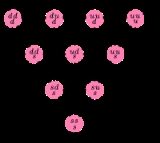
  • Particles of isospin can only be made by a mix of three u and d quarks (Delta baryons).
  • Particles of isospin 1 are made of a mix of two u quarks and d quarks (Sigma baryons, pi mesons, rho mesons, etc.).
  • Particles of isospin can be made of a mix of three u and d quarks (nucleons) or from one u or d quark (Xi baryons, K mesons, D mesons, etc.)
  • Particles of isospin 0 can be made of one u and one d quark (Lamba baryons, eta mesons, omega mesons, etc.), or from no u or d quarks at all (Omega baryons, phi mesons, etc.).


Isospin symmetry of quarks

In the framework of the Standard Model
Standard Model

The Standard Model of particle physics is a theory of three of the four known fundamental interactions and the elementary particles that take part in these interactions....
, the isospin symmetry of the proton and neutron are reinterpreted as the isospin symmetry of the up
Up quark

The up quark is a particle described by the Standard Model theory of physics. It is a first-generation quark with a charge of +elementary charge....
 and down quark
Down quark

The down quark is a first-generation quark with a charge of - elementary charge. It is the second-lightest of all the six flavour of quarks, the lightest being the up quark....
s. Technically, the nucleon doublet states are seen to be linear combinations of products of 3-particle isospin doublet states and spin doublet states. That is, the (spin-up) proton wave function, in terms of quark-flavour eigenstates, is described by

and the (spin-up) neutron by

Here, is the up quark
Up quark

The up quark is a particle described by the Standard Model theory of physics. It is a first-generation quark with a charge of +elementary charge....
 flavour eigenstate, and is the down quark
Down quark

The down quark is a first-generation quark with a charge of - elementary charge. It is the second-lightest of all the six flavour of quarks, the lightest being the up quark....
 flavour eigenstate, while and are the eigenstates of . Although these superpositions are the technically correct way of denoting a proton and neutron in terms of quark flavour and spin eigenstates, for brevity, they are often simply referred to as "uud" and "udd". Note also that the derivation above assumes exact isospin symmetry and is modified by SU(2)-breaking terms.

Similarly, the isopsin symmetry of the pions are given by:

Weak isospin

Isospin is similar to, but should not be confused with weak isospin
Weak isospin

The weak isospin in particle physics is a quantum number relating to the weak interaction, and parallels the idea of isospin under the strong interaction....
. Briefly, weak isospin is the gauge symmetry of the weak interaction
Weak interaction

The weak interaction is one of the four fundamental interactions of nature. In the Standard Model of particle physics, it is due to the exchange of the heavy W and Z bosons....
 which connects quark and lepton doublets of left-handed particles in all generations; for example, up and down quarks, top and bottom quarks, electrons and electron neutrinos. Isospin connects only up and down quarks, acts on both chiralities
Chirality

Chirality, or "handedness", is a property of asymmetry important in several branches of science.An object or a system is chiral if it cannot be wikt:superposed on its mirror image....
 (left and right) and is a global (not a gauge) symmetry.

Gauged isospin symmetry


Attempts have been made to promote isospin from a global to a local symmetry. In 1954, Chen Ning Yang
Chen Ning Yang

Chen-Ning Franklin Yang is a China-born United States physicist who worked on statistical mechanics and particle physics. He, together with Tsung-Dao Lee, received the 1957 Nobel prize in physics for their work on parity nonconservation of weak interaction....
 and Robert Mills
Robert Mills (physicist)

Robert L. Mills was a physicist, specializing in quantum field theory, the theory of alloys, and many-body theory. While sharing an office at Brookhaven National Laboratory, in 1954, Chen Ning Yang and Mills proposed a tensor equation for what are now called Yang-Mills fields....
 suggested that the notion of protons and neutrons, which are continuously rotated into each other by isospin, should be allowed to vary from point to point. To describe this, the proton and neutron direction in isospin space must be defined at every point, giving local basis for isospin. A gauge connection would then describe how to transform isospin along a path between two points.

This Yang-Mills theory describes interacting vector bosons, like the photon
Photon

In physics, the photon is an elementary particle, the quantum of the electromagnetic field and the basic unit of light and all other forms of electromagnetic radiation....
 of electromagnetism. Unlike the photon, the SU(2) gauge theory would contain self-interacting gauge bosons. The condition of gauge invariance suggests that they have zero mass, just as in electromagnetism.

Ignoring the massless problem, as Yang and Mills did, the theory makes a firm prediction: the vector particle should couple to all particles of a given isospin universally. The coupling to the nucleon would be the same as the coupling to the kaon
Kaon

In particle physics, a kaon is any one of a group of four mesons distinguished by the fact that they carry a quantum number called Strangeness ....
s. The coupling to the pion
Pion

In particle physics, a pion is any of three subatomic particles: , and . Pions are the lightest mesons and play an important role in explaining low-energy properties of the strong nuclear force....
s would be the same as the self-coupling of the vector bosons to themselves.

When Yang and Mills proposed the theory, there was no candidate vector boson. J. J. Sakurai
J. J. Sakurai

Jun John Sakurai was a Japanese-American Particle physics and theorist who authored the popular graduate text Modern Quantum Mechanics and other texts such as Invariance Principles and Elementary Particles and Advanced Quantum Mechanics ....
 in 1960 predicted that there should be a massive vector boson which is coupled to isospin, and predicted that it would show universal couplings. The rho meson
Rho meson

In particle physics, a rho meson is a short-lived hadronic particle that is an isospin Spin triplet whose three states are denoted as , and . After the pions and kaons, the rho mesons are the lightest strongly interacting particle with a mass of roughly 770 MeV for all three states....
s were discovered a short time later, and were quickly identified as Sakurai's vector bosons. The couplings of the rho to the nucleons and to each other were verified to be universal, as best as experiment could measure. The fact that the diagonal isospin current contains part of the electromagnetic current led to the prediction of rho-photon mixing and the concept of vector meson dominance
Vector meson dominance

Vector meson dominance was a model developed by J. J. Sakurai in the 1960s before the advent of QCD in order to describe interactions between photons and hadronic matter....
, ideas which led to successful theoretical pictures of GeV-scale photon-nucleus scattering.

Although the discovery of the quark
Quark

Quarks are a type of elementary particle and major constituents of matter. They are the only particles in the Standard Model to experience all four fundamental interaction, which are also known as fundamental interactions....
s led to reinterpretation of the rho meson as a vector bound state of a quark and an antiquark, it is sometimes still useful to think of it as the gauge boson of a hidden local symmetry