

Iron Ring

Encyclopedia
The Iron Ring is a ring worn by many engineer
s in Canada
as a symbol and reminder of the obligations and ethics
associated with the profession. Obtaining the ring is an optional endeavour, as it is not a prerequisite to becoming a Professional Engineer
. The ring is given in a ceremony developed with the assistance of Rudyard Kipling
and known as The Ritual of the Calling of an Engineer
, administered by a body called The Corporation of the Seven Wardens Inc./Société des Sept Gardiens inc.
or stainless steel
. The rings are given in ceremonies held at individual universities, each assigned one of 25 camps of the Corporation of the Seven Wardens. Today, ceremonies at all camps across Canada, except the Toronto
camp, have completely stopped conferring rings made of iron and have switched to stainless steel rings. At the Toronto camp, the individual ceremonies held at the University of Toronto
, Ryerson University
, York University
and the University of Ontario Institute of Technology
continue to provide recipients with a choice of rings made of wrought iron or stainless steel.
Many believe, incorrectly, that the rings are made from the steel of a beam from the first Quebec Bridge
, which collapsed during construction in 1907 killing 75 construction workers, due to poor planning and design by the overseeing engineers. This misunderstanding may have its roots in a common practice of attaching a symbol of an engineering failure, such as a bolt from that bridge, to the chain that is held by participants in the ritual. Rudyard Kipling
, who wrote the ritual obligation, indicated that the Ring as an allegory in itself be rough, not smoothed, and hammered and as a ring have no beginning or end. There is no evidence that there is any particular history in the source of "Cold Iron" (from the Calling of the Engineer ceremony) for the Ring, nor any intention that there should have been, although remnants of the Quebec Bridge "legend" still exist in Canada.
The Iron Ring is worn on the little finger
("pinky
") of the working (dominant) hand; this would be the left hand for a left-handed
person. There the facets act as a sharp reminder of obligation while the engineer works, since it would drag on the writing surface while the engineer is drawing or writing. This is particularly true of recently obligated engineers, whose rings bear sharp, unworn, facets. Protocol dictates that the rings should be returned by retired engineers or by the families of deceased engineers. Some camps offer previously obligated or "experienced" rings, but they are now rare due to medical and practical complications.
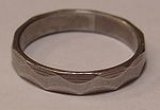
The Ring itself is small and understated, designed as a constant reminder rather than a piece of jewellery. The Rings were originally hammered manually with a rough outer surface. The modern machined ring design emulates this manual process with a unique pattern. Twelve half-circle facets are carved into the top and bottom of the outer surface, with the two halves offset by one facet radius.
is the ceremony where Iron Rings are given to graduating engineers who choose to obligate themselves to the highest professionalism and humility of their profession. It is a symbol that reflects the moral, ethical and professional commitment made by the engineer who wears the ring. The ceremonies are private affairs with no publicity. Invitations to attend are extended to local engineering alumni and professional engineers by those who are scheduled to participate. For some schools, the invitation to witness the ceremony is open to anyone in the engineering profession, and non-obligated engineers may not participate in the ritual. Some graduating engineers choose to receive a ring passed on from a relative or mentor, giving the ceremony a personal touch.
, where the Order of the Engineer
was founded in 1970, and conducts similar ring ceremonies at a number of U.S. colleges, in which the recipient signs an "Obligation of the Engineer" and receives a stainless steel Engineer's Ring
(which, unlike the Canadian Iron Ring, can be smooth and not faceted).
Engineer
An engineer is a professional practitioner of engineering, concerned with applying scientific knowledge, mathematics and ingenuity to develop solutions for technical problems. Engineers design materials, structures, machines and systems while considering the limitations imposed by practicality,...
s in Canada
Canada
Canada is a North American country consisting of ten provinces and three territories. Located in the northern part of the continent, it extends from the Atlantic Ocean in the east to the Pacific Ocean in the west, and northward into the Arctic Ocean...
as a symbol and reminder of the obligations and ethics
Engineering ethics
Engineering ethics is the field of applied ethics and system of moral principles that apply to the practice of engineering. The field examines and sets the obligations by engineers to society, to their clients, and to the profession...
associated with the profession. Obtaining the ring is an optional endeavour, as it is not a prerequisite to becoming a Professional Engineer
Professional Engineer
Regulation of the engineering profession is established by various jurisdictions of the world to protect the safety, well-being and other interests of the general public, and to define the licensure process through which an engineer becomes authorized to provide professional services to the...
. The ring is given in a ceremony developed with the assistance of Rudyard Kipling
Rudyard Kipling
Joseph Rudyard Kipling was an English poet, short-story writer, and novelist chiefly remembered for his celebration of British imperialism, tales and poems of British soldiers in India, and his tales for children. Kipling received the 1907 Nobel Prize for Literature...
and known as The Ritual of the Calling of an Engineer
The Ritual of the Calling of an Engineer
The Ritual of the Calling of an Engineer is a ritual for students about to graduate from an engineering program at a university in Canada. Participation may also be permitted for Canadian professional engineers and registered engineers-in-training who received training elsewhere. The ritual is...
, administered by a body called The Corporation of the Seven Wardens Inc./Société des Sept Gardiens inc.
Material and design
The Iron Ring may be made from either wrought ironWrought iron
thumb|The [[Eiffel tower]] is constructed from [[puddle iron]], a form of wrought ironWrought iron is an iron alloy with a very low carbon...
or stainless steel
Stainless steel
In metallurgy, stainless steel, also known as inox steel or inox from French "inoxydable", is defined as a steel alloy with a minimum of 10.5 or 11% chromium content by mass....
. The rings are given in ceremonies held at individual universities, each assigned one of 25 camps of the Corporation of the Seven Wardens. Today, ceremonies at all camps across Canada, except the Toronto
Toronto
Toronto is the provincial capital of Ontario and the largest city in Canada. It is located in Southern Ontario on the northwestern shore of Lake Ontario. A relatively modern city, Toronto's history dates back to the late-18th century, when its land was first purchased by the British monarchy from...
camp, have completely stopped conferring rings made of iron and have switched to stainless steel rings. At the Toronto camp, the individual ceremonies held at the University of Toronto
University of Toronto
The University of Toronto is a public research university in Toronto, Ontario, Canada, situated on the grounds that surround Queen's Park. It was founded by royal charter in 1827 as King's College, the first institution of higher learning in Upper Canada...
, Ryerson University
Ryerson University
Ryerson University is a public research university located in downtown Toronto, Ontario, Canada. Its urban campus is adjacent to Yonge-Dundas Square located at the busiest intersection in Downtown Toronto. The majority of its buildings are in the blocks northeast of the square in Toronto's Garden...
, York University
York University
York University is a public research university in Toronto, Ontario, Canada. It is Canada's third-largest university, Ontario's second-largest graduate school, and Canada's leading interdisciplinary university....
and the University of Ontario Institute of Technology
University of Ontario Institute of Technology
The University of Ontario Institute of Technology is located in Oshawa, Ontario, Canada. The university shares its campus with Durham College. The university was founded in 2002 and accepted its first students in 2003, making it one of Canada's newest universities...
continue to provide recipients with a choice of rings made of wrought iron or stainless steel.
Many believe, incorrectly, that the rings are made from the steel of a beam from the first Quebec Bridge
Quebec Bridge
right|thumb|Lifting the centre span in place was considered to be a major engineering achievement. Photo caption from [[Popular Mechanics]] Magazine, December 1917...
, which collapsed during construction in 1907 killing 75 construction workers, due to poor planning and design by the overseeing engineers. This misunderstanding may have its roots in a common practice of attaching a symbol of an engineering failure, such as a bolt from that bridge, to the chain that is held by participants in the ritual. Rudyard Kipling
Rudyard Kipling
Joseph Rudyard Kipling was an English poet, short-story writer, and novelist chiefly remembered for his celebration of British imperialism, tales and poems of British soldiers in India, and his tales for children. Kipling received the 1907 Nobel Prize for Literature...
, who wrote the ritual obligation, indicated that the Ring as an allegory in itself be rough, not smoothed, and hammered and as a ring have no beginning or end. There is no evidence that there is any particular history in the source of "Cold Iron" (from the Calling of the Engineer ceremony) for the Ring, nor any intention that there should have been, although remnants of the Quebec Bridge "legend" still exist in Canada.
The Iron Ring is worn on the little finger
Little finger
The little finger, often called the pinky in American English, pinkie in Scottish English , or small finger in medicine, is the most ulnar and usually smallest finger of the human hand, opposite the thumb, next to the ring finger.-Muscles:There are four muscles that...
("pinky
Pinky Ring
A pinky ring is a ring worn on the pinky finger. Pinky rings are not gender-specific, and are commonly found on both men and women. Often there is no special significance associated with wearing a pinky ring, other than the typical motivations for wearing jewellery...
") of the working (dominant) hand; this would be the left hand for a left-handed
Left-handed
Left-handedness is the preference for the left hand over the right for everyday activities such as writing. In ancient times it was seen as a sign of the devil, and was abhorred in many cultures...
person. There the facets act as a sharp reminder of obligation while the engineer works, since it would drag on the writing surface while the engineer is drawing or writing. This is particularly true of recently obligated engineers, whose rings bear sharp, unworn, facets. Protocol dictates that the rings should be returned by retired engineers or by the families of deceased engineers. Some camps offer previously obligated or "experienced" rings, but they are now rare due to medical and practical complications.
The Ring itself is small and understated, designed as a constant reminder rather than a piece of jewellery. The Rings were originally hammered manually with a rough outer surface. The modern machined ring design emulates this manual process with a unique pattern. Twelve half-circle facets are carved into the top and bottom of the outer surface, with the two halves offset by one facet radius.
The Ritual of the Calling of an Engineer
The Ritual of the Calling of an EngineerThe Ritual of the Calling of an Engineer
The Ritual of the Calling of an Engineer is a ritual for students about to graduate from an engineering program at a university in Canada. Participation may also be permitted for Canadian professional engineers and registered engineers-in-training who received training elsewhere. The ritual is...
is the ceremony where Iron Rings are given to graduating engineers who choose to obligate themselves to the highest professionalism and humility of their profession. It is a symbol that reflects the moral, ethical and professional commitment made by the engineer who wears the ring. The ceremonies are private affairs with no publicity. Invitations to attend are extended to local engineering alumni and professional engineers by those who are scheduled to participate. For some schools, the invitation to witness the ceremony is open to anyone in the engineering profession, and non-obligated engineers may not participate in the ritual. Some graduating engineers choose to receive a ring passed on from a relative or mentor, giving the ceremony a personal touch.
Adoption in other countries
Based upon the success of the Iron Ring in Canada, similar programs have started in the United StatesUnited States
The United States of America is a federal constitutional republic comprising fifty states and a federal district...
, where the Order of the Engineer
Order of the Engineer
The Order of the Engineer is an association for graduate and professional engineers in the United States that emphasizes pride and responsibility in the engineering profession. It was inspired by the success of The Ritual of the Calling of an Engineer, a similar Canadian ceremony, and is a common...
was founded in 1970, and conducts similar ring ceremonies at a number of U.S. colleges, in which the recipient signs an "Obligation of the Engineer" and receives a stainless steel Engineer's Ring
Engineer's Ring
The Engineer's Ring is a ring worn by members of the Order of the Engineer, which is an association for engineers in the USA . The ring is a plain stainless steel band worn on the little finger of the working hand...
(which, unlike the Canadian Iron Ring, can be smooth and not faceted).