
|
|
|
|
Left-handed
|
| |
|
| |
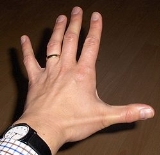
Left-handedness is the preference for the left hand over the right for everyday activities such as writing. Most left-handed people exhibit some degree of ambidexterity. Left-handedness is relatively uncommon; 90 to 93 percent of the adult population is right-handed.
998, a study suggested that approximately 7 to 10 percent of the adult population was left-handed, and that left-handedness is more common in males than females.

Discussion
Ask a question about 'Left-handed'
Start a new discussion about 'Left-handed'
Answer questions from other users
|
Encyclopedia
Left-handedness is the preference for the left hand over the right for everyday activities such as writing. Most left-handed people exhibit some degree of ambidexterity. Left-handedness is relatively uncommon; 90 to 93 percent of the adult population is right-handed.
Demographics
In 1998, a study suggested that approximately 7 to 10 percent of the adult population was left-handed, and that left-handedness is more common in males than females. Left-handedness, in comparison to the general population, also appears to occur more frequently in both identical and fraternal twins, and several groups of individuals with neurological disorders (such as people with epilepsy, Down Syndrome, autism, mental retardation and dyslexia).
Statistically, the identical twin of a left-handed person has a 76 percent chance of being left-handed, identifying the cause(s) as partly genetic and partly environmental.
Causes of left-handedness
- Hand orientation is developed in unborn children, most commonly determined by observing which hand is predominantly licked or held close to the mouth.
- In 2007, researchers discovered LRRTM1, the first gene linked to increased odds of being left-handed. The researchers also found evidence that possessing one particular form of this gene slightly raises the risk of psychotic mental illnesses such as schizophrenia.
- Long-term impairment of the right hand: People with long-term impairment of the right hand are more likely to become left-handed, even after their right hand heals. Such long-term impairment is defined as eight months or more.
- Testosterone: Exposure to higher rates of testosterone before birth can lead to a left-handed child. This is the Geschwind theory, named after the neurologist who proposed it, Norman Geschwind. It suggests that variations in levels of testosterone during pregnancy shape the development of the fetal brain. Testosterone suppresses the growth of the left cerebral hemisphere and so more neurons migrate to the right hemisphere. The highly developed right hemisphere is now better suited to function as the center of language and handedness. The fetus is more likely to become left-handed, since the right hemisphere controls the left half of the body. The theory goes on to tie the exposure to higher levels of testosterone and the resultant right-hemisphere dominance to auto-immune disorders, learning disorders, dyslexia, and stuttering, as well as increased spatial ability.
- Mirror twins
Social stigma and repression of left-handedness
Negative associations of left-handedness in language
There are many colloquial terms used to refer to a left-handed person, e.g. "southpaw." Some are just slang or jargon words, while others may be offensive or demeaning, either in context or in origin. In more technical contexts, 'sinistral' may be used in place of 'left-handed' and 'sinistrality' in place of 'left-handedness'. Both of these technical terms derive from sinestra, a Latin word meaning 'left'.
In Hebrew, as well as in other ancient Semitic and Mesopotamian languages, the term "hand" was a symbol of power or custody. The left hand symbolized the power to shame society, and was used as a metaphor for misfortune, natural evil, or punishment from the gods. This metaphor survived ancient culture and was integrated into mainstream Christianity by early Catholic theologians as Ambrose of Milan to modern Protestant theologians such as Karl Barth to attribute natural evil to God in explaining God's omnipotence over the universe.
Meanings evolved from use of these terms in the ancient languages. In many European languages, "right" is not only a synonym for correctness, but also stands for authority and justice: German and Dutch recht, French droit, Spanish derecho, Portuguese direito; in most Slavic languages the root prav is used in words carrying meanings of correctness or justice. Being right-handed has also historically been thought of as being skillful: the Latin word for right-handed is dexter, as in dexterity; indeed, the Spanish term diestro and the Italian's destro, mean both "right-handed" and "skilful". In Irish, "deas" means "right side" and "nice". "Ciotóg" is the left hand and is related to "ciotach" meaning "awkward"; in French, "gauche" means "left" and is also a synonym of "maladroit", meaning "clumsy". Same for the Italian "maldestro" and the Dutch word "links".
Meanwhile, the English word sinister comes from the Latin word sinestra, which originally meant "left" but took on meanings of "evil" or "unlucky" by the Classical Latin era. Alternatively, sinister comes from the Latin word sinus meaning "pocket": a traditional Roman toga had only one pocket, located on the left side for the convenience of a right-handed wearer. The contemporary Italian word sinistra has both meanings of sinister and left. The Spanish siniestra has both, too, although the 'left' meaning is less common and is usually expressed by izquierda, a Basque word that made its way into Portuguese too. In Portuguese, the most common word for left-handed person, canhoto, was once used to identify the devil, and canhestro, a related word, means "clumsy" (sinistro means only "sinister"). Furthermore, in English, the expression "To have two left feet" refers to clumsiness in the domains of football or dancing.
The left side is often associated with awkwardness and clumsiness. The English expression "having two left feet", the Dutch expression "twee linkerhanden hebben", the German expression "zwei linke Hände haben", the Bulgarian expression "dve levi ratse" and the Czech expression "Mít obe ruce levé" ("to have two left hands") all mean being clumsy.
In ancient China, the left has been the "bad" side. The adjective "left" (Chinese character: , Mandarin: zuo) means "improper" or "out of accord". For instance, the phrase "left path" (Mandarin: zuodao) stands for illegal or immoral means. The pictograph for "left," depicts a left hand attending to work. In contrast, the pictograph for "right," (Mandarin: yòu) depicts a right hand in relation to the mouth, suggesting the act of eating. Contrast this pattern with the Muslim example below.
In Welsh, the word chwith means left, but can also mean strange, awkward, or wrong. The phrase o'r chwith refers to an object being inside-out.
In Vietnamese, the word trái means left. Trái also means wrong in Vietnamese.
In some Spanish-speaking countries, to do something por izquierda means to engage in corrupt conduct or employ illegitimate means; whereas por derecha or a derechas means to do it the right (legitimate) way.
In Norwegian, the expression venstrehåndsarbeid (left-hand work) means "something that is done in a sloppy or unsatisfactory way". Additionally, one of the Norwegian words for left-handed, "keivhendt", comes from Norwegian words meaning wrong handed or not straight handed.
In Ireland left handedness is called a "ciotógach" (kitt-oog) which is Irish for left-handed. It is frequently used amongst native Irish people, e.g. "she gave him a slap of the ciotógach after he insulted her at the bar" the word ciotógach is not derogatory and is held with affection amongst left-handed people.
The Scots term for left-handedness is corrie fistit. The term can be used to convey clumsiness. Another term for left-handedness is Heilan meaning Highland. The term refers to the one-time perception of Highlanders but came to be used to refer to awkward, backward and left-handedness.
In some parts of the English-speaking world 'cack-handed' is slang for left-handed (it is also used to mean clumsy). The origin of this term is disputed, but some suggest it is derived from the Latin cacare, in reference to the habit of performing ablutions with the left hand, leaving the right hand 'clean'. However, other source suggest that it is derived from the Old Norse word keikr, meaning "bent backwards" Australians frequently use "cacky-handed". A less common Australian slang word for a left-handed individual is the term Molly-Dooker, whose origins cannot be ascertained for certain.
Amongst Muslims, and in some societies including India, it is customary to use the left hand for cleaning oneself with water after defecating. The right hand is commonly known in contradistinction from the left, as the hand used for eating.
Even the word "ambidexterity" reflects the bias. Its intended meaning is, "skillful on both sides". However, since it keeps the Latin root "dexter", which means "right", it ends up conveying the idea of being "right-handed at both sides". This bias is also apparent in the lesser-known antonym "ambisinistrous", which means "clumsy on both sides" and derives from the Latin root "sinister," which means "left."
Southpaw A left-handed individual may be known as a southpaw, particularly in a sports context. It is widely accepted that the term originated in the United States, in the game of baseball. Ballparks are often designed so that batters are facing east, so that the afternoon or evening sun does not shine in their eyes. This means that left-handed pitchers are throwing with their south-side arm. However, the Oxford English Dictionary lists a non-baseball citation for "south paw", meaning a punch with the left hand, as early as 1848, just three years after the first organized baseball game.
In boxing, someone who boxes left-handed is frequently referred to as southpaw. The term is also used to refer to a stance in which the boxer places the right foot in front of the left, so it is possible for a right-handed boxer to box with a southpaw stance. Most boxers, southpaw or otherwise, tend to train with sparring partners who adopt an orthodox stance which gives southpaws an advantage.
In tennis, a southpaw holds the racket in their left hand. Because of this their grip of the handle is supposedly adjusted in a slightly different style from right-handed players.
In Major League Gaming or MLG, southpaw controls are just reversed.
Accessibility of implements and skills
Left-handed people are sometimes placed at a disadvantage by the prevalence of right-handed tools in society. Many tools and devices are designed to be comfortably used with the right hand. For example, (right-handed) scissors, a very common tool, are arranged so that the line being cut along can be seen by a right-handed user, but is obscured to a left-handed user. Furthermore, the handles are often molded in a way that is difficult for a left-hander to hold, and extensive use in such cases can lead to varying levels of discomfort. Most importantly, the scissoring or shearing action - how the blades work together (how they are attached at the pivot) - operates correctly for a right-hander, but a left-hander will tend to force the blades apart rather than shearing the target substance.
The computer mouse is sometimes made to fit the right hand better. Many computer installations have the mouse placed on the right side, making it awkward for left-handers to use without moving the mouse to the other side of the keyboard. Some mouse drivers and operating systems allow the user to reconfigure the mouse buttons to reverse their functions. However, being left-handed does not always mean the person uses the mouse on a computer with the left hand; many left-handers can use the mouse right-handed because they learned it that way from the start. It can be said that this is an advantage as one can use the mouse with their non-dominant hand, leaving their dominant hand available to simultaneously complete other tasks.
While European-style kitchen knives are symmetrical, Japanese kitchen knives have the cutting edge ground asymmetrically, with ratios ranging from 70-30 for the average chef's knife, to 90-10 for professional sushi chef knives; left-handed models are rare, and usually must be specially ordered or custom made.
The lack of left-handed tools and machines in many workplaces is not only a nuisance to many left-handers, but has actually placed them at peril. In fact, some factories have installed left-handed equipment after successful class-action lawsuits on behalf of left-handed employees.
Many well-intentioned companies have manufactured products with left-handers in mind, but have still failed to meet left-handers' needs. For instance, many companies have produced "left-handed scissors" by simply inverting the scissors' handles, making the grip work for the left-hander. Unfortunately, for scissors to function in a truly left-handed manner, their blades must also be mirror-inverted, without which the left-hander is forced to make a "blind cut" because the blade obscures the paper from view. Mundial and Fiskars are companies that have produced truly left-handed scissors, inverting both the blades and the handles.
Left-handed adaptations have even bridged the world of music; guitars are often made especially for left-handers, though generally at a higher cost, and with greatly reduced availability. There have even been inverted pianos where the deepest notes correspond to the rightmost keys instead of the leftmost. Inverted trumpets are made, too, but at a considerably higher cost. Although the trumpet's valves are normally designed to be operated with the right hand, the prevailing belief is that left-handed trumpeters aren't at a significant disadvantage. The horn, for example, is played with the left hand, yet most horn players are right-handed.
Left-handed golf clubs were one of the earlier, and well-accepted, manifestations of a special version of an implement; the most notable left-handed-playing participant being Phil Mickelson (he is naturally right-handed).
Other items which are inconvenient for left-handers include tin-openers, potato peelers, corkscrews, rulers, number keys on keyboards, watches, chequebooks, boomerangs, and pencil sharpeners.
The sextant is a rare example of a device that is more convenient for a left-hander to use. The grip on almost all sextants is for the right hand, meaning a right-handed user has to put down the instrument in order to write down the measurement after taking a sighting.
Handwriting
It can be difficult for left-handed children to learn to write if the teacher does not take the student's left-handedness into account. In fact, even in the later 20th century, some UK schools were discouraging children from writing with their left hand, often seriously affecting the child's development (). When properly done, left-handed writing is a mirror image to that of the right-hander, making the teaching process confusing for the right-handed teacher of a left-handed student. The result is that many left-handed children learn to write with their hand curled around the pen so that it can meet the paper at the same angle as the right-hander and also to account for the front page of notebooks and binders, as the books open so you write on the right side, which puts the binding on the left side, inhibiting the left hand from writing freely. Once this habit is formed, it is difficult to break. This curling of the hand results in the heel of the palm being placed behind the writing, forcing the writer to lift it off the paper and making the grip even more awkward. In addition, constantly lifting and replacing the hand over fresh ink often causes smudging, causing problems for many left-handed students, especially in exam situations. When the left hand is held correctly, it is below the writing, as is typical for right-handers.
However, left-handed people who speak Arabic, Persian, Urdu, Hebrew, and Japanese or any other right-to-left language do not have the same difficulties with writing. The right-to-left nature of these languages prevents left-handers from running their hand on the ink as happens with left to right languages. Still, due to these alphabets being developed for right-handed people, the characters are still often more easily matched to a right-handed profile.
Firearms
The vast majority of firearms are designed for right-handed shooters, with the operating handle, magazine release, and/or safety mechanisms set up for manipulation by the right hand, and fired cartridge cases ejected to the right. Also, scopes and sights may be mounted in such a way as to require the shooter to place the rifle against his or her right shoulder. A left-handed shooter must either purchase a left-handed firearm (which are manufactured in smaller numbers and are generally more expensive and/or harder to obtain), shoot a right-handed gun left-handed (which presents certain difficulties, such as the controls being improperly located for them or hot shell cases being ejected towards their body, especially their eyes), or learn to shoot right-handed (which may pose additional problems, primarily that of ocular dominance). Fortunately for left-handed people, modern guns feature more ambidextrous or right/left-handed reversible operating parts than their predecessors(such as the H&K G36). Bullpup rifles are particularly problematic for left-handers unless they can be reconfigured, since empty shells would be ejected fast and straight into the shooter's face and cheek potentially causing injury. Lever action and pump action firearms present fewer difficulties for left-handers than bolt action weapons do. Many weapons with adjustable sights allow for left handed use, but a right eye dominant shooter is necessary to adjust. In fact, most weapons adjust well enough that a weapon will not eject shells into a left hander's eye.
Cameras
The only camera ever produced for left-handers was the half-frame Yashica Samurai. Cameras predominantly have the hand grip, shutter release, film wind lever and commonly used selection buttons, switches and dials controlled by the right hand, lens controls (where present) tend to be accessible by either hand. When a left handed person uses a right handed camera the hand control can be less steady and hence produce camera shake leading to poorer pictures at low shutter speeds. When cameras were predominantly mechanical, or later electro mechanical, it would be difficult and hence expensive to produce a left handed version of a right handed camera.
Video-cameras also tend to have the handstrap on the rightside of the camera. Thus the camera must be held using the right hand, which often leads to a more shakey video being captured.
Accessories
Something also common in between left-handers is the usage of wrist, fist, finger, ear, hair accessories. Most commonly, a left-hander would prefer to wear their wrist-watch on the right wrist so it doesn't interfere (excessive weight, agility downgrade) with the daily activities of the left hand (such as writing) when right-handers most commonly wear their wrist-watches on the left wrist for the same purpose. The same might work for earrings, hairbands, rings etc.
Left-handedness and intelligence In his book Right-Hand, Left-Hand, Chris McManus of University College London argues that the proportion of left-handers is rising and left-handed people as a group have historically produced an above-average quota of high achievers. He says that left-handers' brains are structured differently in a way that widens their range of abilities, and the genes that determine left-handedness also govern development of the language centres of the brain.
McManus also says that the increase in the 20th century of people identifying as left-handed could produce a corresponding intellectual advance and a leap in the number of mathematical, sporting, or artistic geniuses.
In 2006, researchers at Lafayette College and Johns Hopkins University in a study found that left-handed men are 15 percent richer than right-handed men for those who attended college, and 26 percent richer if they graduated. The wage difference is still unexplainable and does not appear to apply to women.
Left-handedness and politics
See: Handedness of Presidents of the United States
Prevalence with age In Britain, a study in the 1970s found that around 11 percent of men and women aged 15-24 were left-handed, compared to just 3 percent in the 55-64 age category. The study suggests that 'cultural pressures' for right-hand use were prevalent in the industrial societies in the 18th and 19th centuries (with the advancement of mass literacy), and that those pressures were only significantly relaxed in the 'later decades' of the 20th century. The study also refers to tests on medieval skeletons that show evidence of hand-usage similar to today's, which suggests that hand-prejudice was not always part of UK society.
Right-Hand, Left-Hand author Chris McManus also suggests a number of factors that may have led to the modern increase in left-hand usage:
- Left-handers suffered severe prejudice during the 18th and 19th centuries and it was often "beaten out" of people
- In adulthood, left-handers were often shunned by society, resulting in fewer marrying and reproducing
- As prejudice declined in the 20th century, the number of natural left-handers who stayed left-handed increased
- The rising age of motherhood contributed as, statistically, older mothers are more likely to give birth to left-handed children.
Statistics show that older people are less likely to be left-handed than their younger counterparts — the percentages of left-handed people sharply drop off with increased age. In the U.S., 12 percent of 20 year olds are left-handed, while only 5 percent of 50 year olds and less than 1 percent of people over 80 are.
A study published in 1991 claimed that these statistics indicate that left-handed people's lifespans are shorter than those of their right-handed counterparts by as much as 9 years. The authors suggested that this may be the result of left-handed people being more likely to die in accidents as a result of their "affliction", which renders them clumsier and ill-equipped to survive in a right-handed world. Many subsequent studies have shown no evidence that left-handed people have reduced longevity compared to right-handed people
According to The Left-Hander Syndrome, most people were only forced to write with their right hand and allowed to continue being left-handed in most other respects indicating that the decline in older left-handers is not from being forced or switching in later life.
Dory Previn wrote a song in which she explains that she was born left-handed but nuns in her school "broke her out of it"; later in life, she went back to using her left hand she said "I went back to using my left, my natural hand," and discovered her musical talent, among other things.
Historically, the justification of forcing use of the right-hand was in part due to the difficulty left-handers had writing with liquid ink or fountain pens. When writing with these pens, the side of the left-hander's hand would smear the writing as it passed over the still-wet ink. While not as prone to this, modern ballpoint pens do not entirely eliminate this smudging. Writing in pencil also smudges the graphite as the hand passes over what has just been written.
Left-sidedness
Studies show that left-handedness does not necessarily correspond with "left-sidedness" (such as using your left foot to kick with), though most left-handed people tend to have "left-sidedness". The same effect holds with ocular dominance. It has also been found that people have dominant sides of the body, such as the eye, foot, and ear.
Possible effects in humans on thinking
There are many theories on how being left-handed affects the way a person thinks. One theory divides left- and right-handed thinkers into two camps: visual simultaneous vs. linear sequential.
According to this theory, right-handed people are thought to process information using a "linear sequential" method in which one thread must complete its processing before the next thread can be started.
Left-handed persons are thought to process information using a "visual simultaneous" method in which several threads can be processed simultaneously. Another way to view this is such: Suppose there were one thousand pieces of popcorn and one of them was colored blue. Right-handed people—using the linear sequential processing style—would look at the popcorn one at a time until they encountered the blue one. The left-handed person would spread out the pieces of popcorn and look at all of them to find the one that was blue. A side effect of these differing styles of processing is that right-handers need to complete one task before they can start the next. Left-handers, by contrast, are capable and comfortable switching between tasks. This seems to suggest that left-handed people have an excellent ability to multi-task, and anecdotal evidence that they are more creative may stem from this ability to multi-task.
Right-handed people process information using "analysis", which is the method of solving a problem by breaking it down to its pieces and analyzing the pieces one at a time. By contrast, left-handed people process information using "synthesis", which is the method of solving a problem by looking at the whole and trying to use pattern-matching to solve the problem.
The hypothesis that left-handed people are predisposed to visual-based thought has been validated by a variety of evidence. In the 2004 book Brains That Work a Little Bit Differently, researchers Allen D. Bragdon and David Gamon, Ph.D., briefly described some of the current research on handedness and its significance. "Handedness researchers Coren and Clare Porac have shown that left-handed university students are more likely to major in visually-based, as opposed to language-based subjects. Another sample of 103 art students found an astounding 47 percent were left- or mixed-handed." [page 76]
Ultimately, being left-handed is not an all-or-nothing situation. The processing styles operate on a continum where some people are more visual-simultaneous and others are more linear-sequential.
See also
External links
- , ScienceDaily, April 14, 2006.
- (CBC radio documentary on left-handedness including interviews with four scientists holding different views on the determinants of handedness)
- (Audio slideshow)
- Schwartz, Alyssa (2005). C-Health News, 30 September.
- , BBC News.
- Hansard (1998) ‘’, Debate contribution by the Rt Hon. Mr. Peter Luff (MP for Mid-Worcestershire), House of Commons, 22 July.
- A 1918 Popular Science Monthly article on left-handedness -- Is your Child Left-Handed? Why, according to psychological tests, left-handed people ought to remain so, Popular Science monthly, December 1918, page 22, Scanned by Google Books: http://books.google.com/books?id=EikDAAAAMBAJ&pg=PA22
|
| |
|
|