
All Topics  
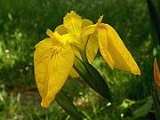
Iris pseudacorus

 
Iris Pseudacorus

   Email Print
   Bookmark   Link


Iris pseudacorus


Iris pseudacorus is a species of Iris
Iris (plant)

Iris is a genus of between 200-300 species of flowering plants with showy flowers. It takes its name from the Greek word for a rainbow, referring to the wide variety of flower colors found among the many species....
, native to Europe
Europe

Europe is, conventionally, one of the world's seven continents. Comprising the westernmost peninsula of Eurasia, Europe is generally divided from Asia to its east by the water divide of the Ural Mountains, the Ural , the Caspian Sea, and by the Caucasus Mountains to the southeast....
, western Asia
Asia

Asia is the world's largest and most populous continent. It covers 8.6% of the Earth's total surface area and, with over 4 billion people, it contains more than 60% of the world's current human population....
 and northwest Africa
Africa

Africa is the world's second-largest and second most-populous continent, after Asia. At about 30.2 million km? including adjacent islands, it covers 6% of the Earth's total surface area and 20.4% of the total land area....
. Common names include yellow iris and yellow flag. Its specific epithet, meaning "false acorus," refers to the similarity of its leaves to those of Acorus calamus, as they have a prominently veined mid-rib and sword-like shape.

s a herbaceous
Herbaceous

A herbaceous plant is a plant that has leaf and stem that die down at the end of the growing season to the soil level. A herbaceous plant may be Annual plant, Biennial plant or Perennial plant....
 perennial plant
Perennial plant

A perennial plant or perennial is a plant that lives for more than two years. When used by gardeners or horticulturalists, this term applies specifically to perennial herbaceous plants....
 growing to 1-1.5 m (or a rare 2 m) tall, with erect leaves
Leaf

In botany, a leaf is an above-ground plant Organ specialized for photosynthesis. For this purpose, a leaf is typically flat and thin, to expose the cells containing chloroplast to light over a broad area, and to allow light to penetrate fully into the tissues....
 up to 90 cm long and 3 cm broad.


Discussion
Ask a question about 'Iris pseudacorus'
Start a new discussion about 'Iris pseudacorus'
Answer questions from other users
Full Discussion Forum


Encyclopedia


Iris pseudacorus is a species of Iris
Iris (plant)

Iris is a genus of between 200-300 species of flowering plants with showy flowers. It takes its name from the Greek word for a rainbow, referring to the wide variety of flower colors found among the many species....
, native to Europe
Europe

Europe is, conventionally, one of the world's seven continents. Comprising the westernmost peninsula of Eurasia, Europe is generally divided from Asia to its east by the water divide of the Ural Mountains, the Ural , the Caspian Sea, and by the Caucasus Mountains to the southeast....
, western Asia
Asia

Asia is the world's largest and most populous continent. It covers 8.6% of the Earth's total surface area and, with over 4 billion people, it contains more than 60% of the world's current human population....
 and northwest Africa
Africa

Africa is the world's second-largest and second most-populous continent, after Asia. At about 30.2 million km? including adjacent islands, it covers 6% of the Earth's total surface area and 20.4% of the total land area....
. Common names include yellow iris and yellow flag. Its specific epithet, meaning "false acorus," refers to the similarity of its leaves to those of Acorus calamus, as they have a prominently veined mid-rib and sword-like shape.

Growth

Iris Pseudacorus From Sweden
It is a herbaceous
Herbaceous

A herbaceous plant is a plant that has leaf and stem that die down at the end of the growing season to the soil level. A herbaceous plant may be Annual plant, Biennial plant or Perennial plant....
 perennial plant
Perennial plant

A perennial plant or perennial is a plant that lives for more than two years. When used by gardeners or horticulturalists, this term applies specifically to perennial herbaceous plants....
 growing to 1-1.5 m (or a rare 2 m) tall, with erect leaves
Leaf

In botany, a leaf is an above-ground plant Organ specialized for photosynthesis. For this purpose, a leaf is typically flat and thin, to expose the cells containing chloroplast to light over a broad area, and to allow light to penetrate fully into the tissues....
 up to 90 cm long and 3 cm broad. The flower
Flower

A flower, sometimes known as a bloom or blossom, is the reproduction structure found in flowering plants . The biological function of a flower is to mediate the union of male sperm with female ovum in order to produce seeds....
s are bright yellow, 7-10 cm across, with the typical iris form. The fruit
Fruit

The term fruit has different meanings dependent on context, and the term is not synonymous in food preparation and biology. In botany, which is the scientific study of plants, fruits are the ripened Ovary of flowering plants....
 is a dry capsule
Capsule (fruit)

In botany a capsule is a type of simple, dry fruit produced by many species of flowering plants. A capsule is a dehiscent structure composed of two or more carpels, that, at maturity, split apart to release the seeds within....
 4-7 cm long, containing numerous pale brown seeds.

Iris pseudacorus grows best in very wet conditions, and is often common in wetland
Wetland

File:Mangrove trees in Everglades.JPGA wetland is an area of land whose soil is saturated with moisture either permanently or seasonally. Such areas may also be covered partially or completely by shallow pools of water....
s, where it tolerates submersion, low pH
PH

pH is a measure of the Acid or Base of a solution. It is defined as the cologarithm of the Activity of dissolved hydrogen ions . Hydrogen ion activity coefficients cannot be measured experimentally, so they are based on theoretical calculations....
, and anoxic soils. The plant spreads quickly, by both rhizome
Rhizome

In botany, a rhizome is a characteristically horizontal plant stem of a plant that is usually found underground, often sending out roots and shoots from its nodes....
 and water-dispersed seed. It fills a similar niche
Niche

Niche may refer to:*Niche , an ecedra or an apse that has been reduced in size*Ecological niche, a term describing the relational position of an organism's species...
 to that of Typha
Typha

Typha is a genus of about eleven species of monocotyledonous flowering plants in the monogeneric family, Typhaceae. The genus has a largely Northern Hemisphere distribution, but is essentially cosmopolitan distribution, being found in a variety of wetland habitats....
 and often grows with it, though usually in less deep water. While it is primarily an aquatic plant, the rhizomes can survive prolonged dry conditions. Yellow iris has been used as a form of water treatment since it has the ability to take up heavy metals
Heavy metals

A heavy metal is a member of an ill-defined subset of elements that exhibit metallic properties, which would mainly include the transition metals, some metalloids, lanthanides, and actinides....
 through its roots.

Large iris stands in western Scotland
Scotland

conventional_long_name = ScotlandAlba|common_name= Scotland|image_flag = Flag of Scotland.svg|flag_width = 130px...
 form a very important feeding and breeding habitat for the endangered Corn Crake
Corn Crake

The Corn Crake , or landrail is a small bird in the family Rallidae.Its breeding habitat is not marshes as with most rallidae, but, as the name implies, meadows and arable land....
.

I. pseudacorus is one of two Iris species native to Britain
Great Britain

Great Britain is an island lying to the northwest of Continental Europe. It is the List of islands by area, and the largest in Europe. With a population of 58.9 million people it is List of islands by population....
, the other being Stinking Iris
Iris foetidissima

Iris foetidissima , is a species of iris found in open woodland, hedgebanks and sea-cliffs. Its natural range is Western Europe, including England south of Durham and also Ireland, and from France south and east to N....
 (Iris foetidissima).

Cultivation and uses

The rhizome has historically been used as a herbal remedy
Herbalism

Herbalism is a traditional medicinal or folk medicine practice based on the use of plants and plant extracts. Herbalism is also known as botanical medicine, medical herbalism, herbal medicine, herbology, and phytotherapy....
, most often as an emetic. When applied to the skin or inhaled, the tannin
Tannin

Tannins are astringent, bitter plant polyphenols that either bind and Precipitation or shrink proteins. The astringency from the tannins is what causes the dry and puckery feeling in the mouth following the consumption of red wine or an unripened fruit....
-rich juices can be acrid and irritating.

It has been planted nearly worldwide as an ornamental plant
Ornamental plant

Ornamental plants are typically grown in the flower garden or as house plants. Most commonly they are grown for the display of their flowers. Other common ornamental features include leaves, scent, fruit, Plant stem and bark....
, with several cultivar
Cultivar

A cultivar is a cultivated plant that has been selected and given a unique name because of its decorative or useful characteristics; it is usually distinct from similar plants and when Plant propagation it retains those characteristics....
s selected for bog garden planting.

In some regions it has escaped from cultivation to establish itself as an invasive
Invasive species

Invasive species is a phrase with several definitions. The first definition expresses the phrase in terms of non-indigenous species that adversely affect the habitats they invade economically, environmentally or ecologically....
 aquatic plant
Aquatic plant

Aquatic plants — also called hydrophytic plants or hydrophytes — are plants that have adapted to living in or on aquatic environments....
 which can create dense, monotypic stands that outcompete other plants in the ecosystem. Where it is invasive, it is tough to remove on a large scale. Even ploughing the rhizomes is often ineffective, and its eradication is highly unlikely. It has been banned in some areas but is still widely sold in others for use in gardens, and it will continue to be planted by gardeners unaware of or unconcerned with its invasive potential.

Gallery

Image:Yellow Iris Iris pseudacorus Flower 1469px.jpg|Closeup Image:Iris_pseudacorus_01.jpg|Iris pseudacorus Image:Iris_Pseudacorus.jpg|Iris pseudacorus Image:Illustration_Iris_pseudacorus0.jpg|Iris pseudacorus Image:Iris pseudacorus fruit.JPG|Fruit

See also

  • Fleur-de-lis
    Fleur-de-lis

    The fleur-de-lis is a stylized design of either an Iris or a Lilium that is now used purely decoratively as well as symbolically, or it may be "at one and the same time political, dynasty, artistic, emblematic and symbolic", especially in heraldry....
  • Flag of the Brussels-Capital Region
    Flag of the Brussels-Capital Region

    The Flag of the Brussels consists of a yellow Iris with a white outline upon a blue background. It was adopted by the Capital Region in 1991....