


Iridium satellite constellation

Encyclopedia
Satellite phone
A satellite telephone, satellite phone, or satphone is a type of mobile phone that connects to orbiting satellites instead of terrestrial cell sites...
s, pagers and integrated transceivers over Earth's entire surface. Iridium Communications Inc. owns and operates the constellation and sells equipment and access to its services.
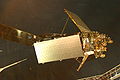
The constellation operates 66 active satellites in orbit to complete its constellation and additional spare satellites are kept in-orbit to serve in case of failure. Satellites are in low Earth orbit
Low Earth orbit
A low Earth orbit is generally defined as an orbit within the locus extending from the Earth’s surface up to an altitude of 2,000 km...
at a height of approximately 485 mi (780.5 km) and inclination of 86.4°. Orbital velocity of the satellites is approximately 17000 mph (7,599.7 m/s). Satellites communicate with neighboring satellites via inter-satellite links. Each satellite can have four inter-satellite links: two to neighbors fore and aft in the same orbital plane, and two to satellites in neighboring planes to either side. The satellites orbit from pole to pole with an orbit of roughly 100 minutes. This design means that there is excellent satellite visibility and service coverage at the North and South poles, where there are few customers. The over-the-pole orbital design produces "seams" where satellites in counter-rotating planes next to one another are traveling in opposite directions. Cross-seam inter-satellite link hand-offs would have to happen very rapidly and cope with large Doppler shifts
Doppler effect
The Doppler effect , named after Austrian physicist Christian Doppler who proposed it in 1842 in Prague, is the change in frequency of a wave for an observer moving relative to the source of the wave. It is commonly heard when a vehicle sounding a siren or horn approaches, passes, and recedes from...
; therefore, Iridium supports inter-satellite links only between satellites orbiting in the same direction.
Satellites
The satellites each contain seven Motorola/Freescale PowerPCPowerPC
PowerPC is a RISC architecture created by the 1991 Apple–IBM–Motorola alliance, known as AIM...
603E processors running at roughly 200 MHz, connected by a custom backplane network. One processor is dedicated to each cross-link antenna ("HVARC"), and two processors ("SVARC"s) are dedicated to satellite control, one being a spare. Late in the project an extra processor ("SAC") was added to perform resource management and phone call processing.
The cellular look down antenna has 48 spot beams arranged as 16 beams in three sectors. The four inter-satellite cross links on each satellite operate at 10 Mbit/s. The inventors of the system had previously worked on a government study in the late 1980s that showed that microwave cross links were simpler and had fewer risks than optical cross links. Although optical links could have supported a much greater bandwidth and a more aggressive growth path, microwave cross links were favored because the bandwidth was more than sufficient for the desired system. Nevertheless, a parallel optical cross link option was carried through a critical design review, and ended when the microwave cross links were shown to support the size, weight and power requirements allocated within the individual satellite's budget. In recent press releases, Iridium Satellite LLC has stated that their second generation satellites would also use microwave, not optical, inter-satellite communications links. Such cross-links are unique in the satellite telephone industry, as other providers do not relay data between satellites.
The original design envisioned a completely static 1960s "dumb satellite" with a set of control messages and time-triggers for an entire orbit that would be uploaded as the satellite passed over the poles. It was found that this design did not have enough bandwidth in the space-based backhaul
Backhaul (telecommunications)
In a hierarchical telecommunications network the backhaul portion of the network comprises the intermediate links between the core network, or backbone, of the network and the small subnetworks at the "edge" of the entire hierarchical network...
to upload each satellite quickly and reliably over the poles. Therefore, the design was scrapped in favor of a design that performed dynamic control of routing and channel selection late in the project, resulting in a one year delay in system delivery.
Each satellite can support up to 1100 concurrent phone calls and weighs about 1500 lb (680.4 kg).
Owing to the highly reflective antennas, Iridium satellites cause a phenomenon known as Iridium flares, watched by enthusiasts and sometimes visible in daylight.
In-orbit spares
Spare satellites are usually held in a 414 mi (666.3 km) storage orbit. These will be boosted to the correct altitude and put into service in case of a satellite failure. After the Iridium company emerged from bankruptcy the new owners decided to launch seven new spares, which would have ensured two spare satellites were available in each plane. not every plane has a spare satellite; however, the satellites can be moved to a different plane if required. A move can take several weeks and consumes fuel which will shorten the satellite's expected service life.Significant orbital plane changes are normally very fuel-intensive, but orbital perturbations aid the process. The Earth's equatorial bulge causes the orbital right ascension of the ascending node (RAAN) to precess at a rate that depends mainly on the period and inclination. Iridium satellites have an inclination of 86.4°, so like every satellite in a prograde
Prograde
Prograde can refer to:*Prograde or direct motion, in astronomy, a type of motion of astronomical bodies* Prograde metamorphism, in geology, describes mineral changes in rocks under increasing pressure and/or temperature conditions...
(inclination < 90°) orbit, their equator crossings steadily precess westward.
A spare Iridium satellite in the lower storage orbit has a shorter period so its RAAN moves westward more quickly than the satellites in the standard orbit. Iridium simply waits until the desired RAAN (i.e., the desired orbital plane) is reached and then raises the spare satellite to the standard altitude, fixing its orbital plane with respect to the constellation. Although this saves substantial amounts of fuel, this can be a time-consuming process.
Next-generation constellation
Iridium is currently developing, and is expected to launch beginning in 2015, Iridium NEXT a second-generation worldwide network of telecommunications satellites, consisting of 66 satellites and six in-orbit and nine ground spares. These satellites will incorporate features such as data transmission which were not emphasized in the original design. The original plan was to begin launching new satellites in 2014. Satellites will incorporate additional payload such as cameras and sensors in collaboration with some customers and partners. Iridium can also be used to provide a data link to other satellites in space, enabling command and control of other space assets regardless of the position of ground stations and gateways. The constellation will provide L-band data speeds of up to 1.5 Mbps and High-speed Ka-Band service of up to 8 Mbps.The existing constellation of satellites is expected to remain operational until Iridium NEXT is fully operational, with many satellites expected to remain in service until the 2020s. Iridium is planning for the next-generation of satellites to have improved bandwidth. This system will be backward compatible with the current system. In August 2008, Iridium selected two companies — Lockheed Martin
Lockheed Martin
Lockheed Martin is an American global aerospace, defense, security, and advanced technology company with worldwide interests. It was formed by the merger of Lockheed Corporation with Martin Marietta in March 1995. It is headquartered in Bethesda, Maryland, in the Washington Metropolitan Area....
and Thales Alenia Space
Thales Alenia Space
Thales Alenia Space is an aerospace company born after the Thales Group bought the participation of Alcatel in the two joint-ventures between Alcatel and Finmeccanica, Alcatel Alenia Space and Telespazio.-History:...
— to participate in the final phase of the procurement of the next generation satellite constellation. On June 2, 2010 the winner of the contract was announced as Thales Alenia Space, in a $2.9 billion deal underwritten by Compagnie Française d'Assurance pour le Commerce Extérieur
Compagnie française d'assurance pour le commerce extérieur
The Compagnie Française d'Assurance pour le Commerce Extérieur was founded in 1946 as the French export credit agency. It was subsequently privatized by the government and continued as a commercial enterprise...
.
In June 2010, Iridium signed the largest commercial rocket launch deal ever, a US$492 million contract with SpaceX
SpaceX
Space Exploration Technologies Corporation, or more popularly and informally known as SpaceX, is an American space transport company that operates out of Hawthorne, California...
to launch tens of Iridium NEXT satellites on multiple Falcon 9
Falcon 9
Falcon 9 is a rocket-powered spaceflight launch system designed and manufactured by SpaceX. Both stages of its two-stage-to-orbit vehicle use liquid oxygen and rocket-grade kerosene propellants...
launchers in 2015-2017 from Vandenberg AFB Space Launch Complex 3
Vandenberg AFB Space Launch Complex 3
Space Launch Complex 3 is a launch site at Vandenberg Air Force Base that has been used by Atlas and Thor rockets. It was built in the early 1960s and consists of two pads, SLC-3E and SLC-3W . The East-West coastline at Vandenberg allows SLC-3 to launch over-ocean polar trajectories that avoid...
.
Patents and manufacturing
The main patents on the Iridium system, U.S. Patents 5,410,728 and 5,604,920, are in the field of satellite communications, and the manufacturer generated several hundred patents protecting the technology in the system. Satellite manufacturing initiatives were also instrumental in the technical success of the system. Motorola made a key hire of the engineer who set up the automated factory for Apple's Macintosh. He created the technology necessary to mass-produce satellites on a gimbalGimbal
A gimbal is a pivoted support that allows the rotation of an object about a single axis. A set of two gimbals, one mounted on the other with pivot axes orthogonal, may be used to allow an object mounted on the innermost gimbal to remain immobile regardless of the motion of its support...
, taking weeks instead of months or years and at a record low construction cost of only US$5 million per satellite. At its peak during the launch campaign in 1997 and 1998, Motorola produced a new satellite every 4.3 days, with the lead-time of a single satellite being 21 days.
Launch campaign
Motorola used launch vehicles from three companies from three different countries — the Delta IIDelta II
Delta II was an American space launch system, originally designed and built by McDonnell Douglas. Delta II is part of the Delta rocket family and was in service from 1989 until November 1, 2011...
from McDonnell Douglas
McDonnell Douglas
McDonnell Douglas was a major American aerospace manufacturer and defense contractor, producing a number of famous commercial and military aircraft. It formed from a merger of McDonnell Aircraft and Douglas Aircraft in 1967. McDonnell Douglas was based at Lambert-St. Louis International Airport...
; the Proton K from Krunichev in Russia; and the Long March IIC from China Aerospace Science and Technology Corporation
China Aerospace Science and Technology Corporation
The China Aerospace Science and Technology Corporation is the main contractor for the Chinese space program. It is state-owned and has a number of subordinate entities which design, develop and manufacture a range of spacecraft, launch vehicles, strategic and tactical missile systems, and ground...
. The original constellation of 66 satellites, plus six spares, was launched in 12 months and 12 days, between May 5, 1997, and May 17, 1998, with an astounding success rate of 15 out of 15 successful launches and all 72 satellites put into the intended orbits. In one 13-day period (late-March to early-April 1998) they successfully put 14 satellites into orbit.
The most recent launches took place in 2002 when a total of seven spare satellites were launched.
Defunct satellites
Over the years several Iridium satellites have ceased to work and tumbled out of control, some have reentered the atmosphere while other partially functional satellites have remained in orbit. However these satellites are not in active service.Iridium 28
Iridium 28 failed in July 2008 and was replaced with the in-orbit spare Iridium 95.Iridium 33
At 16:56 UTC on February 10, 2009 Iridium 33
Iridium 33
Iridium 33 was a U.S. Iridium communications satellite. It was launched into low Earth orbit from Site 81/23 at the Baikonur Cosmodrome at 01:36 GMT on 14 September 1997, by a Proton-K carrier rocket with a Block DM2 upper stage...
collided with the defunct Russian satellite Kosmos 2251. This was the first time two intact satellites collided. Iridium 33 was in active service when the accident took place but was one of the oldest satellites in the constellation, having been launched in 1997.
Iridium moved one of its in-orbit spares to replace the destroyed satellite, completing the move on March 4, 2009.
A video has been produced to show the relationship of the two satellites as they collided. The satellites collided at roughly 22,000 miles per hour; roughly 32 times faster than a speeding bullet.