


SpaceX

Encyclopedia
Space Exploration Technologies Corporation, or more popularly and informally known as SpaceX, is an American space transport company that operates out of Hawthorne
, California
. It was founded in 2002 by former PayPal entrepreneur lon Musk]. It has developed the Falcon 1
and Falcon 9
space boosters, both of which are built with a goal of becoming reusable launch vehicles
. SpaceX is also developing the Dragon spacecraft
to be flown into orbit by Falcon 9 launch vehicles.
SpaceX designs, tests and fabricates the majority of their components in-house, including the Merlin
, Kestrel
, and Draco
rocket engines. In 2006, NASA
awarded the company a Commercial Orbital Transportation Services
(COTS) contract to design and demonstrate a launch system to resupply cargo to the International Space Station
(ISS) On 9 December 2010, the launch of the COTS Demo Flight 1 mission, SpaceX became the first privately funded company to successfully launch, orbit and recover a spacecraft
.
NASA has also awarded SpaceX a contract to develop and demonstrate a human-rated Dragon as part of its Commercial Crew Development
(CCDev) program to replace the Space Shuttle
as a crew transporter to the ISS. SpaceX is planning its first crewed Dragon/Falcon9 flight in 2015, when it expects to have a fully certified, human-rated launch escape system incorporated into the spacecraft.
Besides NASA contracts, SpaceX has signed contracts with private sector companies, non-American government agencies and the American military for its launch services. It has already launched, for a paying customer, a low earth orbiting satellite with its Falcon 1 booster in 2009. The company plans to launch its first commercial geostationary satellite in 2013 from a Falcon 9.
Future projects that are in the planning stages or in development include the Falcon Heavy
Super Heavy Lift
-class booster, and a NASA robotic mission to Mars in 2018. The Heavy, is based on Falcon 9 technology, and will be the most powerful rocket in the American arsenal since the Apollo-era Saturn V
. Heavy can be used to send a crewed Dragon spacecraft on lunar orbiting missions – such as the Apollo 8
mission; or be used to send an unpiloted Dragon on a Mars landing mission. Musk has stated that his intention for the company is to help in the creation of a permanent human presence on Mars.
co-founder Elon Musk
who had invested US$
100 million of his own money by March 2006.In January 2005, SpaceX bought a 10% stake in Surrey Satellite Technology Ltd
. On August 4, 2008, SpaceX accepted a further $20 million USD investment from the Founders Fund
. The company has grown rapidly since it was founded in 2002, growing from 160 employees in November 2005 to more than 500 by July 2008, to over 1,100 in 2010.
Musk believes the high prices of other space-launch services are driven in part by unnecessary bureaucracy. He has stated that one of his goals is to improve the cost and reliability of access to space
, ultimately by a factor of ten. SpaceX became the first private company to successfully launch and return a spacecraft from orbit on December 8, 2010, after its Dragon capsule returned from a two-orbit flight. Space Foundation
recognized SpaceX for its successful Dragon launch and recovery with the Space Achievement Award in 2011.
All Falcon 1 launches have taken place at Omelek Island. Falcon 9 launches on the SpaceX manifest are planned for Cape Canaveral SLC-40 and Vandenberg AFB SLC-4E (Polar Launches); both the Falcon 9 maiden flight on June 4, 2010, and the December 8, 2010 flight also took place at Cape Canaveral SLC-40.
SpaceX announced on March 15, 2010 that it would launch SES-8, a medium-sized communications satellite for SES, on a Falcon 9
vehicle in 2013, which marked the first launch contract for a geostationary communications satellite for SpaceX. In June 2010, SpaceX was awarded the largest ever commercial space launch contract (US$492 million) to launch Iridium satellites using Falcon 9 rockets.
On May 2, 2005, SpaceX announced that it had been awarded an Indefinite Delivery/Indefinite Quantity
(IDIQ) contract for Responsive Small Spacelift (RSS) launch services by the United States Air Force
, which could allow the Air Force to purchase up to US$
100 Million worth of launches from the company. On April 22, 2008, NASA
announced that it had awarded an IDIQ Launch Services contract to SpaceX for Falcon 1 and Falcon 9
launches. The contract will be worth up to $1 billion, depending on the number of missions awarded. The contract covers launch services ordered by June 30, 2010, for launches through December 2012. Elon Musk stated in the same April 22 announcement that SpaceX has sold 14 contracts for flights on the various Falcon vehicles. On August 18, 2006, NASA announced that SpaceX had won a NASA Commercial Orbital Transportation Services
(COTS) contract to demonstrate cargo delivery to the International Space Station
with a possible option for crew transport. This contract, designed by NASA to provide "seed money" for development of new boosters, paid SpaceX US$278 million to develop the Falcon 9 launch vehicle, with incentive payments paid at milestones culminating in three demonstration launches. On December 23, 2008, SpaceX announced that it had won a Commercial Resupply Services (CRS) contract, for at least 12 missions for US$1.6 billion to carry supplies and cargo to and from the International Space Station
, after the Space Shuttle
retires.
SpaceX broke ground on their own launch site, located at Vandenberg Air Force Base
, on July 13, 2011. The launch site is intended for use by the Falcon Heavy
launch vehicle, which is scheduled to be brought on site in 2012 with a test flight to follow soon after. The project is expected to cost US$20 to US$30 million for the first 24 months of construction and operation, with US$5–10 million in operational costs per year afterwards. The site is said to be a natural fit for SpaceX, who had attempted to launch the Falcon 1 from there previously and plans to launch up to 16 flights per year by 2015.
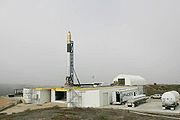 SpaceX is manufacturing two main space launch vehicles: the Falcon 1
, which made its first successful flight on 28 September 2008, and the large EELV
class Falcon 9
, which flew successfully to orbit on its first launch on June 4, 2010. A Falcon 5
launcher was also planned, but its development was stopped in favor of the Falcon 9. SpaceX also developed the SpaceX Dragon, a pressurized orbital vehicle that is launched on top of a Falcon 9 rocket, that can carry cargo, and is in the process of being human-rated.
On June 16, 2009, SpaceX announced the opening of its Astronaut Safety and Mission Assurance Department. It hired former NASA
astronaut Ken Bowersox
to oversee the department as a vice president of the company.
in the Pacific Ocean, and represented the first attempt to fly a ground-launched rocket to orbit from that site. On 26 March 2006, the Falcon 1's maiden flight failed only seconds after leaving the pad due to a fuel line rupture. After almost a full-year, the second flight was launched on 22 March 2007 and also ended in failure, due to spin stablization problem that automatically caused sensors to turn off the Merlin first stage engine. The third Falcon 1 flight used a new regenerative cooling system for the first stage Merlin engine, and its development was responsible the almost 17-month flight delay. The new cooling system turned out to be the major reason the mission failed; because the first stage rammed into the second stage engine bell at staging, due to excess fuel, left over from the cooling system, powering the engine a few seconds longer than it was supposed to. On 28 September 2008, the Falcon 1 succeeded in reaching orbit on its fourth attempt, becoming the first privately funded, liquid-fueled rocket to do so. The Falcon 1 carried its first successful commercial payload into orbit on July 13, 2009, on its fifth launch.
rocket, which has nine Merlin
engines in its first stage. The design is an EELV
-class vehicle, intended to compete with the Delta IV
and the Atlas V rockets. Both stages were designed for reuse. A similarly designed Falcon 5
rocket was also envisioned to fit between the Falcon 1 and Falcon 9, but development was dropped to concentrate on the Falcon 9.
The company purchased the McGregor, Texas
, testing facilities of defunct Beal Aerospace
, where it refitted the largest test stand at the facilities for Falcon 9 testing. On 22 November 2008, the stand tested the nine Merlin 1C engines of the Falcon 9, which deliver 350 metric-tons-force
(3.4-meganewtons) of thrust, well under the stand's capacity of 1,500 metric-tons-force (15 meganewtons).
The first Falcon 9 vehicle was integrated at Cape Canaveral
on 30 December 2008. NASA was planning for a flight to take place in January 2010; however the maiden flight was postponed several times and took place on 4 June 2010. At 2:50pm EST the Falcon 9 rocket successfully reached orbit.
The second flight for the Falcon 9 vehicle was the COTS Demo Flight 1, the first launch under the NASA Commercial Orbital Transportation Services
(COTS) contract designed to provide "seed money" for development of new boosters. The original NASA contract called for the COTS Demo Flight 1 to occur the second quarter of 2008; this flight was delayed several times, occurring at 1543 GMT on 8 December 2010. The rocket successfully deployed an operational Dragon spacecraft at 1553 GMT. Dragon orbited the Earth twice, and then made a controlled reentry burn that put it on target for a splashdown in the Pacific Ocean off the coast of Mexico. With Dragon's safe recovery, SpaceX become the first private company to launch, orbit, and recover a spacecraft; prior to this mission, only government agencies had been able to recover orbital spacecraft.
According to the original schedule, in the third flight
the Falcon 9 would help the Dragon perform a flyby past the ISS. The fourth flight would include a complete docking with the ISS. However, after the success of the first mission, NASA agreed on 15 July 2011 that the two flights would be combined. The next Dragon mission will now see a docking with the ISS. It is tentatively planned for 7 January 2012; though NASA officials involved with the planning believe this is an optimistic date, stating that late January or early February is more likely.
configuration, using a cluster of three Falcon 9 first stages with 27 uprated Merlin 1D engines and propellant cross-feed. SpaceX is aiming for the first demo flight of the Falcon Heavy in 2013.
is intended to carry up to seven Astronauts into orbit and beyond.
On August 18, 2006, NASA
announced that the company was one of two selected to provide crew and cargo resupply demonstration contracts to the International Space Station
(ISS) under the Commercial Orbital Transportation Services
(COTS) program. SpaceX will demonstrate crew and cargo resupply using the SpaceX Dragon, a conventional blunt-cone ballistic capsule, which is capable of carrying 7 people or a mixture of personnel and cargo to and from low Earth orbit. It will be launched atop a Falcon 9 vehicle. The nose cone of the vehicle has a hinged cap, which opens to reveal a standard ISS Common Berthing Mechanism
, which allows the Dragon to dock to the U.S. segment of the ISS. NASA's plan calls for SpaceX demonstration flights between 2008 and 2010. SpaceX may receive up to $278 million if it meets all NASA milestones.
First flight of a structural test article of the Dragon took place June 4, 2010, from Launch Complex 40 at Cape Canaveral Air Force Station
during the maiden flight of the Falcon 9. Though the mock-up Dragon lacked avionics, heat shield, and other key elements, an operational Dragon spacecraft was launched on December 8, 2010 aboard the second flight of the Falcon 9, and returned to Earth after two orbits.
In 2009 and 2010, Musk suggested on several occasions that plans for a human-rated variant of Dragon were proceeding and had a 2- to 3-year time line to completion.
, NASA Ames Research Center is developing a concept for a low-cost Mars mission that would utilize Falcon Heavy
as the launch vehicle and trans-Martian injection vehicle, and the Dragon capsule
to enter the Martian atmosphere. The concept, called 'Red Dragon', would be proposed for funding in 2012/2013 as a NASA Discovery mission
, for launch in 2018 and arrival at Mars several months later. The science objectives of the mission would be to look for evidence of life — detecting "molecules that are proof of life, like DNA
or perchlorate reductase
... proof of life through biomolecules. ... Red Dragon would drill 3.3 feet (1 m) or so underground, in an effort to sample reservoirs of water ice known to lurk under the red dirt." The mission cost is projected to be less than , not including the launch cost.
The Grasshopper reusable
launch vehicle (RLV) is a vertical takeoff, vertical landing
(VTVL) rocket
being built in 2011 for low-altitude testing scheduled to begin in 2012.
The rocket "consists of a Falcon 9 first stage tank, a single Merlin-1D engine, four steel landing legs and a support structure, plus other pressurization tanks attached to the support structure" and will stand at 106 feet (32.3 m) tall.
Flight tests will occur in three phases, at maximum flight altitudes of 670 to 11500 ft (204.2 to 3,505.2 ), for durations of 45 s Testing is expected to take up to three years and the FAA permit allows up to 70 suborbital launches per year.
project to create a higher performance LOX
/liquid hydrogen
second stage for Falcon 9.
In a presentation to the Joint Propulsion Conference in July 2010, SpaceX revealed preliminary, but unfunded, design concepts for a larger Merlin 2 engine to replace the nine engine cluster used on the Falcon 9. The Merlin 2 would also be used on conceptual heavy-lift launch vehicles Falcon X, Falcon X Heavy, and Falcon XX.
By mid-August, the SpaceX CEO Elon Musk
clarified that while the Merlin 2 engine architecture was a key element of any effort SpaceX would make toward their objective of "super-heavy lift" launch vehicles—and that SpaceX indeed did want to "move toward super heavy lift"—the specific potential design configurations of the particular launch vehicles shown by Markusic at the propulsion conference were merely conceptual "brainstorming ideas", just a "bunch of ideas for discussion."
Elon Musk has stated the personal goal of eventually enabling human exploration and settlement of Mars
. He stated in a 2011 interview that he hopes to send humans to Mars
' surface within 10–20 years.
Hawthorne, California
Hawthorne is a city in southwestern Los Angeles County, California. The city at the 2010 census had a population of 84,293, up from 84,112 at the 2000 census.-Geography:...
, California
California
California is a state located on the West Coast of the United States. It is by far the most populous U.S. state, and the third-largest by land area...
. It was founded in 2002 by former PayPal entrepreneur lon Musk]. It has developed the Falcon 1
Falcon 1
The Falcon 1 is a partially reusable launch system designed and manufactured by SpaceX, a space transportation company in Hawthorne, California. The two-stage-to-orbit rocket uses LOX/RP-1 for both stages, the first powered by a single Merlin engine and the second powered by a single Kestrel engine...
and Falcon 9
Falcon 9
Falcon 9 is a rocket-powered spaceflight launch system designed and manufactured by SpaceX. Both stages of its two-stage-to-orbit vehicle use liquid oxygen and rocket-grade kerosene propellants...
space boosters, both of which are built with a goal of becoming reusable launch vehicles
Rocket launch
A rocket launch is the takeoff phase of the flight of a rocket. Launches for orbital spaceflights, or launches into interplanetary space, are usually from a fixed location on the ground, but may also be from a floating platform such as the San Marco platform, or the Sea Launch launch...
. SpaceX is also developing the Dragon spacecraft
Dragon (spacecraft)
The Dragon is a reusable spacecraft developed by SpaceX, a private space transportation company based in Hawthorne, California. During its unmanned maiden flight in December 2010, it became the first commercially-built and -operated spacecraft to ever be successfully recovered from orbit.The Dragon...
to be flown into orbit by Falcon 9 launch vehicles.
SpaceX designs, tests and fabricates the majority of their components in-house, including the Merlin
Merlin (rocket engine)
Merlin is a rocket engine developed by SpaceX for use on its Falcon 1 and Falcon 9 rockets. Merlin uses RP-1 and liquid oxygen as propellants in a gas-generator power cycle...
, Kestrel
Kestrel (rocket engine)
The Kestrel engine is an LOX/RP-1 pressure-fed rocket engine. The Kestrel engine was developed by SpaceX for upper stage use on the Falcon 1 rocket....
, and Draco
Draco (rocket engine)
Draco is a small hypergolic rocket engine designed by SpaceX for use on their Dragon spacecraftand the upper stage of their Falcon 9 rocket.-Performance and use:...
rocket engines. In 2006, NASA
NASA
The National Aeronautics and Space Administration is the agency of the United States government that is responsible for the nation's civilian space program and for aeronautics and aerospace research...
awarded the company a Commercial Orbital Transportation Services
Commercial Orbital Transportation Services
Commercial Orbital Transportation Services is a NASA program to coordinate the delivery of crew and cargo to the International Space Station by private companies. The program was announced on January 18, 2006...
(COTS) contract to design and demonstrate a launch system to resupply cargo to the International Space Station
International Space Station
The International Space Station is a habitable, artificial satellite in low Earth orbit. The ISS follows the Salyut, Almaz, Cosmos, Skylab, and Mir space stations, as the 11th space station launched, not including the Genesis I and II prototypes...
(ISS) On 9 December 2010, the launch of the COTS Demo Flight 1 mission, SpaceX became the first privately funded company to successfully launch, orbit and recover a spacecraft
Spacecraft
A spacecraft or spaceship is a craft or machine designed for spaceflight. Spacecraft are used for a variety of purposes, including communications, earth observation, meteorology, navigation, planetary exploration and transportation of humans and cargo....
.
NASA has also awarded SpaceX a contract to develop and demonstrate a human-rated Dragon as part of its Commercial Crew Development
Commercial Crew Development
Commercial Crew Development is a multiphase space technology development program, funded by the U.S. government, and administered by NASA. The program is intended to stimulate development of privately operated crew vehicles to low Earth orbit. It is run by the Commercial Crew and Cargo Program...
(CCDev) program to replace the Space Shuttle
Space Shuttle
The Space Shuttle was a manned orbital rocket and spacecraft system operated by NASA on 135 missions from 1981 to 2011. The system combined rocket launch, orbital spacecraft, and re-entry spaceplane with modular add-ons...
as a crew transporter to the ISS. SpaceX is planning its first crewed Dragon/Falcon9 flight in 2015, when it expects to have a fully certified, human-rated launch escape system incorporated into the spacecraft.
Besides NASA contracts, SpaceX has signed contracts with private sector companies, non-American government agencies and the American military for its launch services. It has already launched, for a paying customer, a low earth orbiting satellite with its Falcon 1 booster in 2009. The company plans to launch its first commercial geostationary satellite in 2013 from a Falcon 9.
Future projects that are in the planning stages or in development include the Falcon Heavy
Falcon Heavy
Falcon Heavy, previously known as the Falcon 9 Heavy, is a spaceflight launch system that uses rocket engines currently being designed and manufactured by SpaceX. Both stages of the two-stage-to-orbit vehicles use liquid oxygen and rocket-grade kerosene propellants...
Super Heavy Lift
Comparison of orbital launch systems
This page exposes the full list of orbital launch systems. For the short simple list of launchers families, see Comparison of orbital launchers families....
-class booster, and a NASA robotic mission to Mars in 2018. The Heavy, is based on Falcon 9 technology, and will be the most powerful rocket in the American arsenal since the Apollo-era Saturn V
Saturn V
The Saturn V was an American human-rated expendable rocket used by NASA's Apollo and Skylab programs from 1967 until 1973. A multistage liquid-fueled launch vehicle, NASA launched 13 Saturn Vs from the Kennedy Space Center, Florida with no loss of crew or payload...
. Heavy can be used to send a crewed Dragon spacecraft on lunar orbiting missions – such as the Apollo 8
Apollo 8
Apollo 8, the second manned mission in the American Apollo space program, was the first human spaceflight to leave Earth orbit; the first to be captured by and escape from the gravitational field of another celestial body; and the first crewed voyage to return to Earth from another celestial...
mission; or be used to send an unpiloted Dragon on a Mars landing mission. Musk has stated that his intention for the company is to help in the creation of a permanent human presence on Mars.
Background
SpaceX was founded in June 2002 by PayPalPayPal
PayPal is an American-based global e-commerce business allowing payments and money transfers to be made through the Internet. Online money transfers serve as electronic alternatives to paying with traditional paper methods, such as checks and money orders....
co-founder Elon Musk
Elon Musk
Elon Musk is an American engineer and entrepreneur heritage best known for co-founding PayPal, SpaceX and Tesla Motors. He is currently the CEO and CTO of SpaceX, CEO and Product Architect of Tesla Motors and Chairman of SolarCity...
who had invested US$
United States dollar
The United States dollar , also referred to as the American dollar, is the official currency of the United States of America. It is divided into 100 smaller units called cents or pennies....
100 million of his own money by March 2006.In January 2005, SpaceX bought a 10% stake in Surrey Satellite Technology Ltd
Surrey Satellite Technology Ltd
Surrey Satellite Technology Ltd, or SSTL, is a spin-off company of the University of Surrey, now fully owned by EADS Astrium, that builds and operates small satellites. Its satellites began as amateur radio satellites known by the UoSAT name or by an OSCAR designation...
. On August 4, 2008, SpaceX accepted a further $20 million USD investment from the Founders Fund
The Founders Fund
Founders Fund is a San Francisco based venture capital firm which invests at all stages in companies with revolutionary technologies. The firm’s six partners, Peter Thiel, Sean Parker, Ken Howery, Luke Nosek, Bruce Gibney, and Brian Singerman have been founders of or early investors in numerous...
. The company has grown rapidly since it was founded in 2002, growing from 160 employees in November 2005 to more than 500 by July 2008, to over 1,100 in 2010.
Musk believes the high prices of other space-launch services are driven in part by unnecessary bureaucracy. He has stated that one of his goals is to improve the cost and reliability of access to space
Outer space
Outer space is the void that exists between celestial bodies, including the Earth. It is not completely empty, but consists of a hard vacuum containing a low density of particles: predominantly a plasma of hydrogen and helium, as well as electromagnetic radiation, magnetic fields, and neutrinos....
, ultimately by a factor of ten. SpaceX became the first private company to successfully launch and return a spacecraft from orbit on December 8, 2010, after its Dragon capsule returned from a two-orbit flight. Space Foundation
Space Foundation
The Space Foundation is a nonprofit organization that supports the global space industry through information and education programs. It is a resource for the entire space community - industry, national security organizations, civil space agencies, private space companies and the military around the...
recognized SpaceX for its successful Dragon launch and recovery with the Space Achievement Award in 2011.
Flight operations and contracts
SpaceX has utilized a number of launch sites, including:- Ronald Reagan Ballistic Missile Defense Test SiteRonald Reagan Ballistic Missile Defense Test SiteThe Ronald Reagan Ballistic Missile Defense Test Site, commonly referred to as the Reagan Test Site , is a missile test range in the Pacific Ocean. It covers about and includes rocket launch sites at the Kwajalein Atoll , Wake Island, and Aur Atoll. It primarily functions as a test facility for U.S...
, Omelek IslandOmelek IslandOmelek Island is part of the Kwajalein Atoll in the Republic of the Marshall Islands. It is controlled by the United States military under a long-term lease and is part of the Ronald Reagan Ballistic Missile Defense Test Site.-Geography:The Island is about in size...
, Kwajalein Atoll, Marshall Islands - Cape Canaveral Air Force Station Space Launch Complex 40
- Vandenberg Air Force BaseVandenberg Air Force BaseVandenberg Air Force Base is a United States Air Force Base, located approximately northwest of Lompoc, California. It is under the jurisdiction of the 30th Space Wing, Air Force Space Command ....
, Space Launch Complex 4Vandenberg AFB Space Launch Complex 4Space Launch Complex 4 , was a launch site at Vandenberg Air Force Base, used by Atlas and Titan rockets between 1963 and 2005. It consisted of two separate launch pads, SLC-4W and SLC-4E, which were formerly designated PALC2-3 and PALC2-4 respectively. Both pads were originally built for use by...
All Falcon 1 launches have taken place at Omelek Island. Falcon 9 launches on the SpaceX manifest are planned for Cape Canaveral SLC-40 and Vandenberg AFB SLC-4E (Polar Launches); both the Falcon 9 maiden flight on June 4, 2010, and the December 8, 2010 flight also took place at Cape Canaveral SLC-40.
SpaceX announced on March 15, 2010 that it would launch SES-8, a medium-sized communications satellite for SES, on a Falcon 9
Falcon 9
Falcon 9 is a rocket-powered spaceflight launch system designed and manufactured by SpaceX. Both stages of its two-stage-to-orbit vehicle use liquid oxygen and rocket-grade kerosene propellants...
vehicle in 2013, which marked the first launch contract for a geostationary communications satellite for SpaceX. In June 2010, SpaceX was awarded the largest ever commercial space launch contract (US$492 million) to launch Iridium satellites using Falcon 9 rockets.
On May 2, 2005, SpaceX announced that it had been awarded an Indefinite Delivery/Indefinite Quantity
IDIQ
IDIQ is a contracting acronym meaning Indefinite delivery/indefinite quantity. This is a type of contract that provides for an indefinite quantity of supplies or services during a fixed period of time...
(IDIQ) contract for Responsive Small Spacelift (RSS) launch services by the United States Air Force
United States Air Force
The United States Air Force is the aerial warfare service branch of the United States Armed Forces and one of the American uniformed services. Initially part of the United States Army, the USAF was formed as a separate branch of the military on September 18, 1947 under the National Security Act of...
, which could allow the Air Force to purchase up to US$
United States dollar
The United States dollar , also referred to as the American dollar, is the official currency of the United States of America. It is divided into 100 smaller units called cents or pennies....
100 Million worth of launches from the company. On April 22, 2008, NASA
NASA
The National Aeronautics and Space Administration is the agency of the United States government that is responsible for the nation's civilian space program and for aeronautics and aerospace research...
announced that it had awarded an IDIQ Launch Services contract to SpaceX for Falcon 1 and Falcon 9
Falcon 9
Falcon 9 is a rocket-powered spaceflight launch system designed and manufactured by SpaceX. Both stages of its two-stage-to-orbit vehicle use liquid oxygen and rocket-grade kerosene propellants...
launches. The contract will be worth up to $1 billion, depending on the number of missions awarded. The contract covers launch services ordered by June 30, 2010, for launches through December 2012. Elon Musk stated in the same April 22 announcement that SpaceX has sold 14 contracts for flights on the various Falcon vehicles. On August 18, 2006, NASA announced that SpaceX had won a NASA Commercial Orbital Transportation Services
Commercial Orbital Transportation Services
Commercial Orbital Transportation Services is a NASA program to coordinate the delivery of crew and cargo to the International Space Station by private companies. The program was announced on January 18, 2006...
(COTS) contract to demonstrate cargo delivery to the International Space Station
International Space Station
The International Space Station is a habitable, artificial satellite in low Earth orbit. The ISS follows the Salyut, Almaz, Cosmos, Skylab, and Mir space stations, as the 11th space station launched, not including the Genesis I and II prototypes...
with a possible option for crew transport. This contract, designed by NASA to provide "seed money" for development of new boosters, paid SpaceX US$278 million to develop the Falcon 9 launch vehicle, with incentive payments paid at milestones culminating in three demonstration launches. On December 23, 2008, SpaceX announced that it had won a Commercial Resupply Services (CRS) contract, for at least 12 missions for US$1.6 billion to carry supplies and cargo to and from the International Space Station
International Space Station
The International Space Station is a habitable, artificial satellite in low Earth orbit. The ISS follows the Salyut, Almaz, Cosmos, Skylab, and Mir space stations, as the 11th space station launched, not including the Genesis I and II prototypes...
, after the Space Shuttle
Space Shuttle
The Space Shuttle was a manned orbital rocket and spacecraft system operated by NASA on 135 missions from 1981 to 2011. The system combined rocket launch, orbital spacecraft, and re-entry spaceplane with modular add-ons...
retires.
SpaceX broke ground on their own launch site, located at Vandenberg Air Force Base
Vandenberg Air Force Base
Vandenberg Air Force Base is a United States Air Force Base, located approximately northwest of Lompoc, California. It is under the jurisdiction of the 30th Space Wing, Air Force Space Command ....
, on July 13, 2011. The launch site is intended for use by the Falcon Heavy
Falcon Heavy
Falcon Heavy, previously known as the Falcon 9 Heavy, is a spaceflight launch system that uses rocket engines currently being designed and manufactured by SpaceX. Both stages of the two-stage-to-orbit vehicles use liquid oxygen and rocket-grade kerosene propellants...
launch vehicle, which is scheduled to be brought on site in 2012 with a test flight to follow soon after. The project is expected to cost US$20 to US$30 million for the first 24 months of construction and operation, with US$5–10 million in operational costs per year afterwards. The site is said to be a natural fit for SpaceX, who had attempted to launch the Falcon 1 from there previously and plans to launch up to 16 flights per year by 2015.
Space vehicles
Falcon 1
The Falcon 1 is a partially reusable launch system designed and manufactured by SpaceX, a space transportation company in Hawthorne, California. The two-stage-to-orbit rocket uses LOX/RP-1 for both stages, the first powered by a single Merlin engine and the second powered by a single Kestrel engine...
, which made its first successful flight on 28 September 2008, and the large EELV
EELV
Evolved Expendable Launch Vehicle is an expendable launch system program of the United States Air Force , intended to assure access to space for Department of Defense and other United States government payloads...
class Falcon 9
Falcon 9
Falcon 9 is a rocket-powered spaceflight launch system designed and manufactured by SpaceX. Both stages of its two-stage-to-orbit vehicle use liquid oxygen and rocket-grade kerosene propellants...
, which flew successfully to orbit on its first launch on June 4, 2010. A Falcon 5
Falcon 5
The Falcon 5 was a proposed two-stage-to-orbit partially reusable launch vehicle designed by SpaceX, since canceledand replaced by the larger, more powerful Falcon 9.-Overview:...
launcher was also planned, but its development was stopped in favor of the Falcon 9. SpaceX also developed the SpaceX Dragon, a pressurized orbital vehicle that is launched on top of a Falcon 9 rocket, that can carry cargo, and is in the process of being human-rated.
On June 16, 2009, SpaceX announced the opening of its Astronaut Safety and Mission Assurance Department. It hired former NASA
NASA
The National Aeronautics and Space Administration is the agency of the United States government that is responsible for the nation's civilian space program and for aeronautics and aerospace research...
astronaut Ken Bowersox
Ken Bowersox
Kenneth Dwane "Sox" Bowersox is an engineer, United States Naval officer, and a former NASA astronaut. He is a veteran of five Space Shuttle missions and an extended stay aboard the International Space Station....
to oversee the department as a vice president of the company.
Falcon 1
The Falcon 1 is a small, partially reusable rocket capable of placing several hundred kilograms into low earth orbit. It also functions as a testbed for developing concepts and components for the larger Falcon 9. Initial Falcon 1 flights were launched from the US government's Reagan Test Center on the island atoll of KwajaleinKwajalein
Kwajalein Atoll , is part of the Republic of the Marshall Islands . The southernmost and largest island in the atoll is named Kwajalein Island. English-speaking residents of the U.S...
in the Pacific Ocean, and represented the first attempt to fly a ground-launched rocket to orbit from that site. On 26 March 2006, the Falcon 1's maiden flight failed only seconds after leaving the pad due to a fuel line rupture. After almost a full-year, the second flight was launched on 22 March 2007 and also ended in failure, due to spin stablization problem that automatically caused sensors to turn off the Merlin first stage engine. The third Falcon 1 flight used a new regenerative cooling system for the first stage Merlin engine, and its development was responsible the almost 17-month flight delay. The new cooling system turned out to be the major reason the mission failed; because the first stage rammed into the second stage engine bell at staging, due to excess fuel, left over from the cooling system, powering the engine a few seconds longer than it was supposed to. On 28 September 2008, the Falcon 1 succeeded in reaching orbit on its fourth attempt, becoming the first privately funded, liquid-fueled rocket to do so. The Falcon 1 carried its first successful commercial payload into orbit on July 13, 2009, on its fifth launch.
Falcon 9
On 8 September 2005, SpaceX announced the development of the Falcon 9Falcon 9
Falcon 9 is a rocket-powered spaceflight launch system designed and manufactured by SpaceX. Both stages of its two-stage-to-orbit vehicle use liquid oxygen and rocket-grade kerosene propellants...
rocket, which has nine Merlin
Merlin (rocket engine)
Merlin is a rocket engine developed by SpaceX for use on its Falcon 1 and Falcon 9 rockets. Merlin uses RP-1 and liquid oxygen as propellants in a gas-generator power cycle...
engines in its first stage. The design is an EELV
EELV
Evolved Expendable Launch Vehicle is an expendable launch system program of the United States Air Force , intended to assure access to space for Department of Defense and other United States government payloads...
-class vehicle, intended to compete with the Delta IV
Delta IV rocket
Delta IV is an active expendable launch system in the Delta rocket family. Delta IV uses rockets designed by Boeing's Integrated Defense Systems division and built in the United Launch Alliance facility in Decatur, Alabama. Final assembly is completed at the launch site by ULA...
and the Atlas V rockets. Both stages were designed for reuse. A similarly designed Falcon 5
Falcon 5
The Falcon 5 was a proposed two-stage-to-orbit partially reusable launch vehicle designed by SpaceX, since canceledand replaced by the larger, more powerful Falcon 9.-Overview:...
rocket was also envisioned to fit between the Falcon 1 and Falcon 9, but development was dropped to concentrate on the Falcon 9.
The company purchased the McGregor, Texas
McGregor, Texas
McGregor is a city in Coryell and McLennan Counties in the U.S. state of Texas. The population was 4,727 at the 2000 census.McGregor lies in two counties as well as two metropolitan areas...
, testing facilities of defunct Beal Aerospace
Beal Aerospace
Beal Aerospace was a launch vehicle development company, founded in February 1997 by Andrew Beal, president of Beal Bank in Dallas, Texas. The goal of the company was to build and operate a privately developed heavy lift orbital launch vehicle...
, where it refitted the largest test stand at the facilities for Falcon 9 testing. On 22 November 2008, the stand tested the nine Merlin 1C engines of the Falcon 9, which deliver 350 metric-tons-force
Kilogram-force
A kilogram-force , or kilopond , is a gravitational metric unit of force. It is equal to the magnitude of the force exerted by one kilogram of mass in a gravitational field...
(3.4-meganewtons) of thrust, well under the stand's capacity of 1,500 metric-tons-force (15 meganewtons).
The first Falcon 9 vehicle was integrated at Cape Canaveral
Cape Canaveral
Cape Canaveral, from the Spanish Cabo Cañaveral, is a headland in Brevard County, Florida, United States, near the center of the state's Atlantic coast. Known as Cape Kennedy from 1963 to 1973, it lies east of Merritt Island, separated from it by the Banana River.It is part of a region known as the...
on 30 December 2008. NASA was planning for a flight to take place in January 2010; however the maiden flight was postponed several times and took place on 4 June 2010. At 2:50pm EST the Falcon 9 rocket successfully reached orbit.
The second flight for the Falcon 9 vehicle was the COTS Demo Flight 1, the first launch under the NASA Commercial Orbital Transportation Services
Commercial Orbital Transportation Services
Commercial Orbital Transportation Services is a NASA program to coordinate the delivery of crew and cargo to the International Space Station by private companies. The program was announced on January 18, 2006...
(COTS) contract designed to provide "seed money" for development of new boosters. The original NASA contract called for the COTS Demo Flight 1 to occur the second quarter of 2008; this flight was delayed several times, occurring at 1543 GMT on 8 December 2010. The rocket successfully deployed an operational Dragon spacecraft at 1553 GMT. Dragon orbited the Earth twice, and then made a controlled reentry burn that put it on target for a splashdown in the Pacific Ocean off the coast of Mexico. With Dragon's safe recovery, SpaceX become the first private company to launch, orbit, and recover a spacecraft; prior to this mission, only government agencies had been able to recover orbital spacecraft.
According to the original schedule, in the third flight
COTS Demo Flight 2
Dragon C2, also known as COTS Demo Flight 2, is a planned second test-flight for SpaceX's unpiloted Dragon cargo spacecraft, and the third overall flight for the company's two-stage Falcon 9 launch vehicle....
the Falcon 9 would help the Dragon perform a flyby past the ISS. The fourth flight would include a complete docking with the ISS. However, after the success of the first mission, NASA agreed on 15 July 2011 that the two flights would be combined. The next Dragon mission will now see a docking with the ISS. It is tentatively planned for 7 January 2012; though NASA officials involved with the planning believe this is an optimistic date, stating that late January or early February is more likely.
Falcon Heavy
SpaceX also plans to develop a HeavyFalcon Heavy
Falcon Heavy, previously known as the Falcon 9 Heavy, is a spaceflight launch system that uses rocket engines currently being designed and manufactured by SpaceX. Both stages of the two-stage-to-orbit vehicles use liquid oxygen and rocket-grade kerosene propellants...
configuration, using a cluster of three Falcon 9 first stages with 27 uprated Merlin 1D engines and propellant cross-feed. SpaceX is aiming for the first demo flight of the Falcon Heavy in 2013.
Dragon
In 2005, SpaceX announced plans to pursue a manned commercial space program through the end of the decade. The Dragon space capsuleSpace capsule
A space capsule is an often manned spacecraft which has a simple shape for the main section, without any wings or other features to create lift during atmospheric reentry....
is intended to carry up to seven Astronauts into orbit and beyond.
On August 18, 2006, NASA
NASA
The National Aeronautics and Space Administration is the agency of the United States government that is responsible for the nation's civilian space program and for aeronautics and aerospace research...
announced that the company was one of two selected to provide crew and cargo resupply demonstration contracts to the International Space Station
International Space Station
The International Space Station is a habitable, artificial satellite in low Earth orbit. The ISS follows the Salyut, Almaz, Cosmos, Skylab, and Mir space stations, as the 11th space station launched, not including the Genesis I and II prototypes...
(ISS) under the Commercial Orbital Transportation Services
Commercial Orbital Transportation Services
Commercial Orbital Transportation Services is a NASA program to coordinate the delivery of crew and cargo to the International Space Station by private companies. The program was announced on January 18, 2006...
(COTS) program. SpaceX will demonstrate crew and cargo resupply using the SpaceX Dragon, a conventional blunt-cone ballistic capsule, which is capable of carrying 7 people or a mixture of personnel and cargo to and from low Earth orbit. It will be launched atop a Falcon 9 vehicle. The nose cone of the vehicle has a hinged cap, which opens to reveal a standard ISS Common Berthing Mechanism
Common Berthing Mechanism
The common berthing mechanism is a berthing mechanism used to connect all non-Russian pressurized modules of the International Space Station....
, which allows the Dragon to dock to the U.S. segment of the ISS. NASA's plan calls for SpaceX demonstration flights between 2008 and 2010. SpaceX may receive up to $278 million if it meets all NASA milestones.
First flight of a structural test article of the Dragon took place June 4, 2010, from Launch Complex 40 at Cape Canaveral Air Force Station
Cape Canaveral Air Force Station
Cape Canaveral Air Force Station is an installation of the United States Air Force Space Command's 45th Space Wing, headquartered at nearby Patrick Air Force Base. Located on Cape Canaveral in the state of Florida, CCAFS is the primary launch head of America's Eastern Range with four launch pads...
during the maiden flight of the Falcon 9. Though the mock-up Dragon lacked avionics, heat shield, and other key elements, an operational Dragon spacecraft was launched on December 8, 2010 aboard the second flight of the Falcon 9, and returned to Earth after two orbits.
In 2009 and 2010, Musk suggested on several occasions that plans for a human-rated variant of Dragon were proceeding and had a 2- to 3-year time line to completion.
NASA-funded Mars mission concept
In addition to SpaceX' privately funded plans for an eventual Mars missionExploration of Mars
The exploration of Mars has been an important part of the space exploration programs of the Soviet Union, the United States, Europe, and Japan. Dozens of robotic spacecraft, including orbiters, landers, and rovers, have been launched toward Mars since the 1960s...
, NASA Ames Research Center is developing a concept for a low-cost Mars mission that would utilize Falcon Heavy
Falcon Heavy
Falcon Heavy, previously known as the Falcon 9 Heavy, is a spaceflight launch system that uses rocket engines currently being designed and manufactured by SpaceX. Both stages of the two-stage-to-orbit vehicles use liquid oxygen and rocket-grade kerosene propellants...
as the launch vehicle and trans-Martian injection vehicle, and the Dragon capsule
Dragon (spacecraft)
The Dragon is a reusable spacecraft developed by SpaceX, a private space transportation company based in Hawthorne, California. During its unmanned maiden flight in December 2010, it became the first commercially-built and -operated spacecraft to ever be successfully recovered from orbit.The Dragon...
to enter the Martian atmosphere. The concept, called 'Red Dragon', would be proposed for funding in 2012/2013 as a NASA Discovery mission
Discovery Program
NASA's Discovery Program is a series of lower-cost, highly-focused American scientific space missions that are exploring the Solar System. It was founded in 1992 to implement then-NASA Administrator Daniel S. Goldin's vision of "faster, better, cheaper" planetary missions...
, for launch in 2018 and arrival at Mars several months later. The science objectives of the mission would be to look for evidence of life — detecting "molecules that are proof of life, like DNA
DNA
Deoxyribonucleic acid is a nucleic acid that contains the genetic instructions used in the development and functioning of all known living organisms . The DNA segments that carry this genetic information are called genes, but other DNA sequences have structural purposes, or are involved in...
or perchlorate reductase
Perchlorate
Perchlorates are the salts derived from perchloric acid . They occur both naturally and through manufacturing. They have been used as a medicine for more than 50 years to treat thyroid gland disorders. They are used extensively within the pyrotechnics industry, and ammonium perchlorate is also a...
... proof of life through biomolecules. ... Red Dragon would drill 3.3 feet (1 m) or so underground, in an effort to sample reservoirs of water ice known to lurk under the red dirt." The mission cost is projected to be less than , not including the launch cost.
Launcher versions
| Launcher Versions | Falcon 1 Falcon 1 The Falcon 1 is a partially reusable launch system designed and manufactured by SpaceX, a space transportation company in Hawthorne, California. The two-stage-to-orbit rocket uses LOX/RP-1 for both stages, the first powered by a single Merlin engine and the second powered by a single Kestrel engine... |
Falcon 1e Falcon 1e The Falcon 1e is an American small partially reusable launch system which is being developed by SpaceX. It will replace the Falcon 1, which was retired in 2009 following five launches, two of which were successful. The Falcon 1e consists of a new first stage, the same second stage used on the... |
Falcon 9 Falcon 9 Falcon 9 is a rocket-powered spaceflight launch system designed and manufactured by SpaceX. Both stages of its two-stage-to-orbit vehicle use liquid oxygen and rocket-grade kerosene propellants... |
Falcon Heavy Falcon Heavy Falcon Heavy, previously known as the Falcon 9 Heavy, is a spaceflight launch system that uses rocket engines currently being designed and manufactured by SpaceX. Both stages of the two-stage-to-orbit vehicles use liquid oxygen and rocket-grade kerosene propellants... |
|---|---|---|---|---|
| Stage 0 | — | — | — | 2 boosters with 9 × Merlin 1D each; Cross-feeding |
| Stage 1 | 1 × Merlin 1A (2006–2007); 1 x Merlin 1C (2008 ff) |
1 x Merlin 1C | 9 × Merlin 1C | 9 × Merlin 1D |
| Stage 2 | 1 × Kestrel Kestrel (rocket engine) The Kestrel engine is an LOX/RP-1 pressure-fed rocket engine. The Kestrel engine was developed by SpaceX for upper stage use on the Falcon 1 rocket.... |
1 x Kestrel | 1 × Merlin 1C Vacuum | 1 × Merlin 1C Vacuum |
| Height (max; m) |
21.3 | 26.83 | 50 or 54 | 69.2 |
| Diameter (m) |
1.7 | 1.7 | 3.6 | 3.6 |
| Initial thrust (kN) |
318 | 454 | 3,400 | 17,000 |
| Takeoff weight (tonne Tonne The tonne, known as the metric ton in the US , often put pleonastically as "metric tonne" to avoid confusion with ton, is a metric system unit of mass equal to 1000 kilograms. The tonne is not an International System of Units unit, but is accepted for use with the SI... s) |
27.2 | 38.56 | 325 | 1,400 |
| Fairing diameter (Inner; m) |
1.5 | 1.71 | 3.6 or 5.2 | 5.2 |
| Payload (LEO Low Earth orbit A low Earth orbit is generally defined as an orbit within the locus extending from the Earth’s surface up to an altitude of 2,000 km... ; kg Kilogram The kilogram or kilogramme , also known as the kilo, is the base unit of mass in the International System of Units and is defined as being equal to the mass of the International Prototype Kilogram , which is almost exactly equal to the mass of one liter of water... ) |
570 | 1010 (430 to SSO Sun-synchronous orbit A Sun-synchronous orbit is a geocentric orbit which combines altitude and inclination in such a way that an object on that orbit ascends or descends over any given point of the Earth's surface at the same local mean solar time. The surface illumination angle will be nearly the same every time... ) |
9,900 | 53,000 |
| Payload (GTO Geostationary transfer orbit A geosynchronous transfer orbit or geostationary transfer orbit is a Hohmann transfer orbit used to reach geosynchronous or geostationary orbit.... ; kg Kilogram The kilogram or kilogramme , also known as the kilo, is the base unit of mass in the International System of Units and is defined as being equal to the mass of the International Prototype Kilogram , which is almost exactly equal to the mass of one liter of water... ) |
— | — | 4,900 | 19,500 |
| Price (Mil. USD United States dollar The United States dollar , also referred to as the American dollar, is the official currency of the United States of America. It is divided into 100 smaller units called cents or pennies.... ) |
6.7 | 9.1 | In 2005 announced as 27 with 12 ft (3.7 m) payload fairing; 35 with 17 ft (5.2 m) fairing to LEO Low Earth orbit A low Earth orbit is generally defined as an orbit within the locus extending from the Earth’s surface up to an altitude of 2,000 km... .In 2009: 44 or 49.5 to LEO Low Earth orbit A low Earth orbit is generally defined as an orbit within the locus extending from the Earth’s surface up to an altitude of 2,000 km... or GTO Geostationary transfer orbit A geosynchronous transfer orbit or geostationary transfer orbit is a Hohmann transfer orbit used to reach geosynchronous or geostationary orbit.... with 5.2 m (17.1 ft) fairing |
95 to LEO Low Earth orbit A low Earth orbit is generally defined as an orbit within the locus extending from the Earth’s surface up to an altitude of 2,000 km... or between 55 and 95 (according to Satellite Mass) to GTO Geostationary transfer orbit A geosynchronous transfer orbit or geostationary transfer orbit is a Hohmann transfer orbit used to reach geosynchronous or geostationary orbit.... |
| minimal Price/kg (LEO Low Earth orbit A low Earth orbit is generally defined as an orbit within the locus extending from the Earth’s surface up to an altitude of 2,000 km... ; USD United States dollar The United States dollar , also referred to as the American dollar, is the official currency of the United States of America. It is divided into 100 smaller units called cents or pennies.... ) |
11,754 | 9,010 (21,163 to SSO Sun-synchronous orbit A Sun-synchronous orbit is a geocentric orbit which combines altitude and inclination in such a way that an object on that orbit ascends or descends over any given point of the Earth's surface at the same local mean solar time. The surface illumination angle will be nearly the same every time... ) |
4,737 | 1792 |
| minimal Price/kg (GTO Geostationary transfer orbit A geosynchronous transfer orbit or geostationary transfer orbit is a Hohmann transfer orbit used to reach geosynchronous or geostationary orbit.... ; USD United States dollar The United States dollar , also referred to as the American dollar, is the official currency of the United States of America. It is divided into 100 smaller units called cents or pennies.... ) |
— | — | 10,903 | 6,000 |
| Success ratio (successful/total) |
2/5 | — | 2/2 | — |
Test vehicles
GrasshopperThe Grasshopper reusable
Reusable launch system
A reusable launch system is a launch system which is capable of launching a launch vehicle into space more than once. This contrasts with expendable launch systems, where each launch vehicle is launched once and then discarded.No true orbital reusable launch system is currently in use. The...
launch vehicle (RLV) is a vertical takeoff, vertical landing
VTVL
Vertical takeoff, vertical landing is a form of takeoff and landing using rockets . Multiple VTVL craft have flown. , at least five VTVL rocket vehicles are currently under development at four different aerospace companies...
(VTVL) rocket
being built in 2011 for low-altitude testing scheduled to begin in 2012.
The rocket "consists of a Falcon 9 first stage tank, a single Merlin-1D engine, four steel landing legs and a support structure, plus other pressurization tanks attached to the support structure" and will stand at 106 feet (32.3 m) tall.
Flight tests will occur in three phases, at maximum flight altitudes of 670 to 11500 ft (204.2 to 3,505.2 ), for durations of 45 s Testing is expected to take up to three years and the FAA permit allows up to 70 suborbital launches per year.
Concept vehicles
At various conferences, SpaceX has revealed concept slides for future engine, stage, and launch vehicle designs. Development of these designs would be predicated on demand for increased performance. Company plans in 2004 called for "development of a heavy lift product and even a super-heavy, if there is customer demand" with each size increase resulting in a significant decrease in cost per pound to orbit. Projected dollar cost per pound to orbit could drop from $4,000 to $1,300 ($8,800/kg to $2,900/kg) between Falcon 1 and the five-engine concept vehicle, Falcon 5. CEO Elon Musk said: "I believe $500 per pound ($1,100/kg) or less is very achievable." SpaceX revealed in a June 2009 AIAA presentation a plan for the RaptorRaptor (rocket stage)
,Raptor is a rocket engine design concept by SpaceX for a higher performance upper stage for the Falcon 9 launch vehicle. The engine would be powered by liquid hydrogen and liquid oxygen,...
project to create a higher performance LOX
Lox
Lox is salmon fillet that has been cured. In its most popular form, it is thinly sliced—less than in thickness—and, typically, served on a bagel, often with cream cheese, onion, tomato, cucumber and capers...
/liquid hydrogen
Liquid hydrogen
Liquid hydrogen is the liquid state of the element hydrogen. Hydrogen is found naturally in the molecular H2 form.To exist as a liquid, H2 must be pressurized above and cooled below hydrogen's Critical point. However, for hydrogen to be in a full liquid state without boiling off, it needs to be...
second stage for Falcon 9.
In a presentation to the Joint Propulsion Conference in July 2010, SpaceX revealed preliminary, but unfunded, design concepts for a larger Merlin 2 engine to replace the nine engine cluster used on the Falcon 9. The Merlin 2 would also be used on conceptual heavy-lift launch vehicles Falcon X, Falcon X Heavy, and Falcon XX.
By mid-August, the SpaceX CEO Elon Musk
Elon Musk
Elon Musk is an American engineer and entrepreneur heritage best known for co-founding PayPal, SpaceX and Tesla Motors. He is currently the CEO and CTO of SpaceX, CEO and Product Architect of Tesla Motors and Chairman of SolarCity...
clarified that while the Merlin 2 engine architecture was a key element of any effort SpaceX would make toward their objective of "super-heavy lift" launch vehicles—and that SpaceX indeed did want to "move toward super heavy lift"—the specific potential design configurations of the particular launch vehicles shown by Markusic at the propulsion conference were merely conceptual "brainstorming ideas", just a "bunch of ideas for discussion."
Elon Musk has stated the personal goal of eventually enabling human exploration and settlement of Mars
Mars
Mars is the fourth planet from the Sun in the Solar System. The planet is named after the Roman god of war, Mars. It is often described as the "Red Planet", as the iron oxide prevalent on its surface gives it a reddish appearance...
. He stated in a 2011 interview that he hopes to send humans to Mars
Mars
Mars is the fourth planet from the Sun in the Solar System. The planet is named after the Roman god of war, Mars. It is often described as the "Red Planet", as the iron oxide prevalent on its surface gives it a reddish appearance...
' surface within 10–20 years.
See also
- Orbital Sciences CorporationOrbital Sciences CorporationOrbital Sciences Corporation is an American company which specializes in the manufacturing and launch of satellites. Its Launch Systems Group is heavily involved with missile defense launch systems...
- Space explorationSpace explorationSpace exploration is the use of space technology to explore outer space. Physical exploration of space is conducted both by human spaceflights and by robotic spacecraft....
- Private spaceflightPrivate spaceflightPrivate spaceflight is flight above Earth altitude conducted by and paid for by an entity other than a government. In the early decades of the Space Age, the government space agencies of the Soviet Union and United States pioneered space technology augmented by collaboration with affiliated design...
External links
- Michael Belfiore's notes from SpaceX pre-launch conference in 2005
- Kwajalein Atoll and Rockets (Candid and highly unofficial blog by Elon Musk's brother KimbalKimbal MuskKimbal Musk is an entrepreneur who has helped found, advise and invest in several software and technology companies. He is the owner of The Kitchen restaurant in Boulder, Colorado...
, with on-site pictures and reporting.)