
The
invasion of IcelandIceland , described as the Republic of Iceland, is a Nordic and European island country in the North Atlantic Ocean, on the Mid-Atlantic Ridge. Iceland also refers to the main island of the country, which contains almost all the population and almost all the land area. The country has a population...
, codenamed
Operation Fork, was a
BritishThe military history of the United Kingdom covers the period from the creation of the united Kingdom of Great Britain in 1707, with the political union of England and Scotland, to the present day....
military operationMilitary operation is the coordinated military actions of a state in response to a developing situation. These actions are designed as a military plan to resolve the situation in the state's favor. Operations may be of combat or non-combat types, and are referred to by a code name for the purpose...
conducted by the
Royal NavyThe Royal Navy is the naval warfare service branch of the British Armed Forces. Founded in the 16th century, it is the oldest service branch and is known as the Senior Service...
, the
Royal MarinesThe Corps of Her Majesty's Royal Marines, commonly just referred to as the Royal Marines , are the marine corps and amphibious infantry of the United Kingdom and, along with the Royal Navy and Royal Fleet Auxiliary, form the Naval Service...
and a small
CanadianThe Canadian Forces , officially the Canadian Armed Forces , are the unified armed forces of Canada, as constituted by the National Defence Act, which states: "The Canadian Forces are the armed forces of Her Majesty raised by Canada and consist of one Service called the Canadian Armed Forces."...
task force during
World War IIWorld War II, or the Second World War , was a global conflict lasting from 1939 to 1945, involving most of the world's nations—including all of the great powers—eventually forming two opposing military alliances: the Allies and the Axis...
.
The
invasionAn invasion is a military offensive consisting of all, or large parts of the armed forces of one geopolitical entity aggressively entering territory controlled by another such entity, generally with the objective of either conquering, liberating or re-establishing control or authority over a...
began in the early morning of 10 May 1940 with British troops disembarking in
ReykjavíkReykjavík is the capital and largest city in Iceland.Its latitude at 64°08' N makes it the world's northernmost capital of a sovereign state. It is located in southwestern Iceland, on the southern shore of Faxaflói Bay...
, capital of
neutralA neutral power in a particular war is a sovereign state which declares itself to be neutral towards the belligerents. A non-belligerent state does not need to be neutral. The rights and duties of a neutral power are defined in Sections 5 and 13 of the Hague Convention of 1907...
IcelandThe Kingdom of Iceland was a constitutional monarchy lasting from 1 December 1918 until 17 June 1944, when the republic was proclaimed.- Origins in Danish rule :...
. Meeting no resistance, the troops moved quickly to disable communication networks, secure strategic locations and arrest German citizens. Requisitioning local means of transportation, the troops moved to
HvalfjörðurHvalfjörður is situated in the west of Iceland between Mosfellsbær and Akranes. The fjord is approximately 30 km long and 5 km wide....
, Kaldaðarnes, Sandskeiði and
AkranesAkranes is a port town and municipality located on the west coast of Iceland.It is the ninth most populous town in Iceland after Mosfellsbær and Árborg with a population of 6,623 people...
to secure landing areas against the possibility of a
GermanNazi Germany , also known as the Third Reich , but officially called German Reich from 1933 to 1943 and Greater German Reich from 26 June 1943 onward, is the name commonly used to refer to the state of Germany from 1933 to 1945, when it was a totalitarian dictatorship ruled by...
counterattack. In the following days air defence equipment was deployed in Reykjavík and a detachment of troops was sent to
AkureyriAkureyri is a town in northern Iceland. It is Iceland's second largest urban area and fourth largest municipality ....
.
In the evening of 10 May, the government of Iceland issued a protest, charging that the neutrality of Iceland had been "flagrantly violated" and "its independence infringed" and noting that compensation would be expected for all damage done. The British promised compensation, favourable business agreements, non-interference in Icelandic affairs and the withdrawal of all forces at the end of the war. Resigning themselves to the situation, the Icelandic authorities provided the invasion force with
de factoDe facto is a Latin expression that means "concerning fact." In law, it often means "in practice but not necessarily ordained by law" or "in practice or actuality, but not officially established." It is commonly used in contrast to de jure when referring to matters of law, governance, or...
cooperation, though formally maintaining a policy of neutrality.
The invasion force consisted of 746 marines, ill-equipped and only partially trained. Although it succeeded in its mission, it was manifestly insufficient to defend an island of 103000 square kilometres (39,768.5 sq mi). On 17 May, 4,000 troops of the
British ArmyThe British Army is the land warfare branch of Her Majesty's Armed Forces in the United Kingdom. It came into being with the unification of the Kingdom of England and Scotland into the Kingdom of Great Britain in 1707. The new British Army incorporated Regiments that had already existed in England...
arrived to relieve the marines. This force was subsequently augmented, to a final force strength of 25,000. American forces relieved the British a year later, although their country was still officially a non-belligerent. They remained there for the duration of the war.
Background
In 1918, after a long period of
DanishDenmark is a Scandinavian country in Northern Europe. The countries of Denmark and Greenland, as well as the Faroe Islands, constitute the Kingdom of Denmark . It is the southernmost of the Nordic countries, southwest of Sweden and south of Norway, and bordered to the south by Germany. Denmark...
rule, Iceland had become an independent state in
personal unionA personal union is the combination by which two or more different states have the same monarch while their boundaries, their laws and their interests remain distinct. It should not be confused with a federation which is internationally considered a single state...
with Denmark and with common handling of foreign affairs. The newly born
Kingdom of IcelandThe Kingdom of Iceland was a constitutional monarchy lasting from 1 December 1918 until 17 June 1944, when the republic was proclaimed.- Origins in Danish rule :...
declared itself a
neutral countryA neutral power in a particular war is a sovereign state which declares itself to be neutral towards the belligerents. A non-belligerent state does not need to be neutral. The rights and duties of a neutral power are defined in Sections 5 and 13 of the Hague Convention of 1907...
without a defence force. The treaty of union allowed for a revision to begin in 1941 and for unilateral termination three years after that, if no agreement was reached. By 1928, all Icelandic political parties were in agreement that the union treaty would be terminated as soon as possible.
On 9 April 1940,
GermanNazi Germany , also known as the Third Reich , but officially called German Reich from 1933 to 1943 and Greater German Reich from 26 June 1943 onward, is the name commonly used to refer to the state of Germany from 1933 to 1945, when it was a totalitarian dictatorship ruled by...
forces launched
Operation WeserübungOperation Weserübung was the code name for Germany's assault on Denmark and Norway during the Second World War and the opening operation of the Norwegian Campaign...
, invading both
NorwayNorway , officially the Kingdom of Norway, is a Nordic unitary constitutional monarchy whose territory comprises the western portion of the Scandinavian Peninsula, Jan Mayen, and the Arctic archipelago of Svalbard and Bouvet Island. Norway has a total area of and a population of about 4.9 million...
and Denmark. Denmark was subdued within a day and
occupiedNazi Germany's occupation of Denmark began with Operation Weserübung on 9 April 1940, and lasted until German forces withdrew at the end of World War II following their surrender to the Allies on 5 May 1945. Contrary to the situation in other countries under German occupation, most Danish...
. On the same day, the British government sent a message to the Icelandic government, stating that Britain was willing to assist Iceland in maintaining her independence but would require facilities in Iceland to do so. Iceland was invited to join Britain in the war "as a belligerent and an ally." The Icelandic government rejected the offer.
On the next day, 10 April, the Icelandic parliament, the Alþingi, declared Danish King Christian X unable to perform his constitutional duties and assigned them to the government of Iceland, along with all other responsibilities previously carried out by Denmark on behalf of Iceland. Iceland was now entirely on its own.
On 12 April, in
Operation ValentineThe British occupation of the Faroe Islands in World War II, also known as "Operation Valentine," was implemented immediately following the German invasion of Denmark and Norway....
, the British took over the
Faroe IslandsThe Faroe Islands are an island group situated between the Norwegian Sea and the North Atlantic Ocean, approximately halfway between Scotland and Iceland. The Faroe Islands are a self-governing territory within the Kingdom of Denmark, along with Denmark proper and Greenland...
.
Following the German invasion of Denmark and Norway, the British government became increasingly concerned that Germany would soon try to establish a military presence in Iceland. They felt that this would constitute an intolerable threat to British control of the North Atlantic. Just as importantly, the British were eager to obtain bases in Iceland for themselves to strengthen their
Northern PatrolThe Northern Patrol was a Royal Navy operation of the First World War operating around Scotland and the North Sea.The Patrol existed to form part of the British "distant" blockade of Germany...
.
Planning
As the military situation in Norway deteriorated, the
AdmiraltyThe Admiralty was formerly the authority in the Kingdom of England, and later in the United Kingdom, responsible for the command of the Royal Navy...
came to the conclusion that Britain could no longer do without bases in Iceland. On 6 May,
Winston ChurchillSir Winston Leonard Spencer-Churchill, was a predominantly Conservative British politician and statesman known for his leadership of the United Kingdom during the Second World War. He is widely regarded as one of the greatest wartime leaders of the century and served as Prime Minister twice...
presented the case to the War Cabinet. Churchill maintained that if further negotiations with the Icelandic government were attempted, the Germans might learn of them and act first. A surer and more effective solution was to land troops unannounced and present the Icelandic government with a
fait accompliFait accompli is a French phrase which means literally "an accomplished deed". It is commonly used to describe an action which is completed before those affected by it are in a position to query or reverse it...
. The War Cabinet approved the plan.
The expedition was organized hastily and haphazardly. Much of the operational planning was conducted
en route. The force was supplied with few maps, most of poor quality, with one of them having been drawn from memory. No one in the expedition was fully fluent in the
Icelandic languageIcelandic is a North Germanic language, the main language of Iceland. Its closest relative is Faroese.Icelandic is an Indo-European language belonging to the North Germanic or Nordic branch of the Germanic languages. Historically, it was the westernmost of the Indo-European languages prior to the...
.
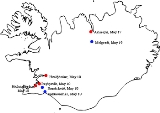
The British planned to land all of their forces at Reykjavík. There, they would overcome any resistance and take care of local Germans. To guard against a German counterattack by sea, they would secure the harbour and send troops by land to nearby
HvalfjörðurHvalfjörður is situated in the west of Iceland between Mosfellsbær and Akranes. The fjord is approximately 30 km long and 5 km wide....
. The British were also worried that the Germans might airlift troops, as they had done with great success in their
Norwegian CampaignThe Norwegian Campaign was a military campaign that was fought in Norway during the Second World War between the Allies and Germany, after the latter's invasion of the country. In April 1940, the United Kingdom and France came to Norway's aid with an expeditionary force...
. To guard against this, troops would drive east to the landing grounds at Sandskeið and Kaldaðarnes. Lastly, troops would be sent by land to the harbour at
AkureyriAkureyri is a town in northern Iceland. It is Iceland's second largest urban area and fourth largest municipality ....
and the landing ground at Melgerði in the north of the country.
The
Naval Intelligence DivisionThe Naval Intelligence Division was the intelligence arm of the British Admiralty before the establishment of a unified Defence Staff in 1965. It dealt with matters concerning British naval plans, with the collection of naval intelligence...
(NID) expected resistance from three possible sources. Local Germans, who were thought to have some arms, could be expected to resist or even attempt some sort of coup. In addition, a German invasion force might already be under way or launched immediately following the British landings. The NID also expected resistance from the Reykjavík police, consisting of some 70 men under arms. If by chance a Danish patrol vessel were present in Reykjavík, the Danish sailors might assist the defenders.
Force Sturges
On 3 May 1940, the
2nd Royal Marine BattalionNo. 43 Commando or 43 Commando was a unit of Royal Marines trained as Commandos during the Second World War. They served in the 2nd Special Service Brigade in the Mediterranean, Italy and the Adriatic....
in
Bisley, SurreyBisley is a large village in Surrey, England, which is notable for rifle shooting. Bisley's immediate neighbours are West End, Chobham and Knaphill.- History :...
, received orders from London to be ready to move on two hours notice for an unknown destination. The battalion had only been activated the month before. Though there was a nucleus of active service officers, the troops were new recruits and only partially trained. There was a shortage of weapons, consisting only of rifles, pistols and bayonets, while 50 of the Marines had only just received their rifles and had not had a chance to fire them. On 4 May, the battalion received some modest additional equipment in the form of Bren light machine guns, anti-tank guns and 2-inch mortars. With no time to spare, zeroing of the weapons and initial familiarization firing would have to be conducted at sea.
Supporting arms provided to the force consisted of two
3.7 inch Mountain HowitzerThe Ordnance QF 3.7 Inch Mountain Howitzer was an artillery weapon, used by British and Commonwealth armies in World War I and World War II, and between the wars.-History:...
s, four
QF 2 pounder naval gunThe 2-pounder gun, officially designated the QF 2-pounder and universally known as the pom-pom, was a 1.575 inch British autocannon, used famously as an anti-aircraft gun by the Royal Navy. The name came from the sound that the original models make when firing...
s and two 4 inch coastal defence guns. The guns were manned by troops from the artillery divisions of the Navy and the Marines, none of whom had ever fired them. They lacked searchlights, communication equipment and gun directors.
Colonel
Robert SturgesLieutenant General Sir Robert Grice Sturges KBE, CB, DSO was an officer in the Royal Marines.In World War I, Sturges fought in the Gallipoli Campaign and the Battle of Jutland....
was assigned to command the force. Aged 49, he was a highly regarded veteran of
World War IWorld War I , which was predominantly called the World War or the Great War from its occurrence until 1939, and the First World War or World War I thereafter, was a major war centred in Europe that began on 28 July 1914 and lasted until 11 November 1918...
, having fought in the
Battle of GallipoliThe Gallipoli Campaign, also known as the Dardanelles Campaign or the Battle of Gallipoli, took place at the peninsula of Gallipoli in the Ottoman Empire between 25 April 1915 and 9 January 1916, during the First World War...
and the
Battle of JutlandThe Battle of Jutland was a naval battle between the British Royal Navy's Grand Fleet and the Imperial German Navy's High Seas Fleet during the First World War. The battle was fought on 31 May and 1 June 1916 in the North Sea near Jutland, Denmark. It was the largest naval battle and the only...
. He was accompanied by a small intelligence detachment under Major Humphrey Quill and a diplomatic mission headed by Charles Howard Smith. Excluding those, the invasion force consisted of 746 troops.
Journey to Iceland
On 6 May, Force Sturges boarded trains for
GreenockGreenock is a town and administrative centre in the Inverclyde council area in United Kingdom, and a former burgh within the historic county of Renfrewshire, located in the west central Lowlands of Scotland...
on the
ClydeThe Firth of Clyde forms a large area of coastal water, sheltered from the Atlantic Ocean by the Kintyre peninsula which encloses the outer firth in Argyll and Ayrshire, Scotland. The Kilbrannan Sound is a large arm of the Firth of Clyde, separating the Kintyre Peninsula from the Isle of Arran.At...
. In order to avoid drawing attention to itself, the force was divided into two different trains for the journey, but due to delays in rail travel, the troops arrived at the rail station in Greenock around the same time, losing the small degree of anonymity desired. Additionally, security had been compromised by a dispatch in the clear and by the time the troops arrived in Greenock, everyone knew that the destination was Iceland.
In the morning of 7 May, the force headed to the harbour in Greenock where they found the cruisers and , intended to take them to Iceland. Boarding commenced, but was fraught with problems and delays. The departure date was moved to 8 May and even then, a large amount of equipment and supplies had to be left on the piers.
At 04:00 on 8 May, the cruisers departed for Iceland. They were accompanied by an anti-submarine escort consisting of the destroyers and . The cruisers were not designed to transport a force of the size assigned to them and conditions were cramped. Despite reasonably good weather, many of the marines developed severe seasickness. The voyage was used as planned for calibration and familiarization with the newly acquired weapons.
One of the newly recruited marines committed suicide
en route. The voyage was otherwise uneventful.
Surprise is lost
At 01:47, Icelandic time, on 10 May, HMS
Berwick used its
catapultAn aircraft catapult is a device used to launch aircraft from ships—in particular aircraft carriers—as a form of assisted take off. It consists of a track built into the flight deck, below which is a large piston or shuttle that is attached through the track to the nose gear of the aircraft, or in...
to launch a
Supermarine WalrusThe Supermarine Walrus was a British single-engine amphibious biplane reconnaissance aircraft designed by R. J. Mitchell and operated by the Fleet Air Arm . It also served with the Royal Air Force , Royal Australian Air Force , Royal Canadian Air Force , Royal New Zealand Navy and Royal New...
reconnaissance plane. The principal aim of the was to scout the vicinity of Reykjavík for enemy submarines, which the Naval Intelligence Division had convinced itself were operating out of Icelandic harbours. The Walrus was given orders not to fly over Reykjavík but — either accidentally or as the result of a miscommunication — it flew several circles over the town, making considerable noise. At this time, Iceland possessed no airplanes of its own, so this unusual event woke up and alerted a number of people.
Icelandic Prime MinisterThe Prime Minister of Iceland is Iceland's head of government. The prime minister is appointed formally by the President and exercises executive authority along with the cabinet subject to parliamentary support....
Hermann Jónasson was alerted to the plane, as were the
Icelandic PoliceThe Icelandic National Police is the main police force of Iceland. It is responsible for law enforcement on all Icelandic territories except at sea where the Icelandic Coast Guard enforces the law. The two services assist each other as needed.- History :...
. The acting chief of police, Einar Arnalds, surmised that it most likely originated from a British warship bringing the expected new ambassador. This was correct, though it was not the whole story.
Werner Gerlach, the German
consulConsul was the highest elected office of the Roman Republic and an appointive office under the Empire. The title was also used in other city states and also revived in modern states, notably in the First French Republic...
, was also alerted to the plane. Suspecting what was about to happen, he drove down to the harbour with a German associate. With the use of binoculars, he confirmed his fears and then hurried back. At home, he arranged for the burning of his documents and tried unsuccessfully to reach the
Icelandic foreign ministerThe Icelandic Ministry for Foreign Affairs or the Icelandic Ministry for Foreign Affairs and External Trade is a cabinet-level ministry responsible for the country's foreign relations and defence...
by telephone.
Down at the harbour
At 03:40, an Icelandic policeman saw a small fleet of warships approaching the harbour, but could not discern their nationality. He notified his superior, who notified Einar Arnalds, the acting chief of police. The laws of neutrality to which Iceland had committed forbade more than three warships from a belligerent nation from making use of a neutral harbour at the same time. Any aeroplanes from such ships were forbidden from flying over neutral territorial waters. Seeing that the approaching fleet was about to violate Icelandic neutrality in two ways, Arnalds set out to investigate. Down at the harbour, he viewed the ships for himself and decided they were probably British. He contacted the foreign ministry, which confirmed that he should go out to the fleet and announce to its commander that he was in violation of Icelandic neutrality. Customs officers were ordered to prepare a boat.
Meanwhile, Marines on
Berwick were being ordered aboard
Fearless, which would take them to the harbour. The seasickness and inexperience of the troops were causing delays and the officers were becoming frustrated. Just before five o'clock in the morning,
Fearless, loaded with around 400 marines, set out for the harbour. A small crowd had assembled, including several policemen still waiting for the customs boat. The British consul had received advance notice of the invasion and was waiting with his associates to assist the troops when they arrived. Uncomfortable with the crowd, Consul Shepherd turned to the Icelandic police. "Would you mind ... getting the crowd to stand back a bit, so that the soldiers can get off the destroyer?" he asked. "Certainly," came the reply.
The
Fearless started disembarking immediately once it docked. Arnalds asked to speak with the captain of the destroyer, but was refused. He then hastened to report to the Prime Minister. Jónasson gave him orders not to interfere with the British troops and to try to prevent conflicts between them and Icelanders.
Down at the harbour, some of the locals protested against the arrival of the British. One Icelander snatched a rifle from a marine and stuffed a cigarette in it. He then threw it back to the marine and told him to be careful with it. An officer arrived to scold the marine.
Operations in Reykjavík
The British forces began their operations in Reykjavík by posting a guard at the Post Office and attaching a flier to the door. The flier explained in broken
IcelandicIcelandic is a North Germanic language, the main language of Iceland. Its closest relative is Faroese.Icelandic is an Indo-European language belonging to the North Germanic or Nordic branch of the Germanic languages. Historically, it was the westernmost of the Indo-European languages prior to the...
that British forces were occupying the city and asked for cooperation in dealing with local Germans. The offices of the
SíminnSíminn, previously named Landssíminn, is an Icelandic telecommunications company. It was acquired by Exista in 2008.-History:Telecommunications play a vital role in Iceland. Although the country's population is relatively small , its penetration rates for network-related products and services are...
(telecommunication service), the
RÚVRíkisútvarpið is Iceland's national public-service broadcasting organization.Operating from studios in the country's capital, Reykjavík, as well as regional centres around the country, the service broadcasts a variety of general programming to a wide audience across the whole country via radio...
(broadcasting service) and the Meteorological Office were quickly put under British control to prevent news of the invasion from reaching Berlin.
Meanwhile, high priority was assigned to the capture of the German consulate. Arriving at the consulate, the British troops were relieved to find no sign of resistance and simply knocked on the door. Consul Gerlach opened, protested against the invasion and reminded the British that Iceland was a neutral country. He was reminded, in turn, that Denmark had also been a neutral country. The British discovered a fire upstairs in the building and found a pile of documents burning in the consul's bathtub. They extinguished the fire and salvaged a substantial number of records.
The British had also expected resistance from the crew of
Bahia Blanca, a German freighter which had hit an iceberg in the
Denmark StraitThe Denmark Strait or Greenland Strait |Sound]]) is an oceanic strait between Greenland and Iceland...
and whose 62-man crew had been rescued by an Icelandic trawler. The Naval Intelligence Division believed the Germans were actually reserve crews for the German submarines they thought were operating out of Iceland. In reality, the unarmed Germans were captured without incident.
United States occupation force
Britain needed her troops elsewhere, and in July 1941, passed responsibility for Iceland to the United States under a U.S.-Icelandic defence agreement.
PresidentThe President of the United States of America is the head of state and head of government of the United States. The president leads the executive branch of the federal government and is the commander-in-chief of the United States Armed Forces....
Franklin Roosevelt ordered United States occupation of Iceland on 16 June 1941. The
1st Provisional Marine BrigadeThe 1st Provisional Marine Brigade was a Marine infantry brigade of the United States Marine Corps that existed periodically from 1912 to 1950. It was an ad hoc unit formed for specific operations and therefore not considered a "permanent" USMC unit....
of 194 officers and 3714 men from
San Diego, CaliforniaSan Diego is the eighth-largest city in the United States and second-largest city in California. The city is located on the coast of the Pacific Ocean in Southern California, immediately adjacent to the Mexican border. The birthplace of California, San Diego is known for its mild year-round...
under the command of Brigadier General John Marston sailed from
Charleston, South CarolinaCharleston is the second largest city in the U.S. state of South Carolina. It was made the county seat of Charleston County in 1901 when Charleston County was founded. The city's original name was Charles Towne in 1670, and it moved to its present location from a location on the west bank of the...
on 22 June to assemble as Task Force 19 (TF 19) at Argentia, Newfoundland:
Task Force 19
Task Force 19 (TF 19) sailed from Argentia on 1 July. On 7 July, Britain persuaded the
AlthingThe Alþingi, anglicised variously as Althing or Althingi, is the national parliament of Iceland. The Althingi is the oldest parliamentary institution in the world still extant...
to approve an American occupation force, and TF 19 anchored off Reykjavík that evening.
U.S. MarinesThe United States Marine Corps is a branch of the United States Armed Forces responsible for providing power projection from the sea, using the mobility of the United States Navy to deliver combined-arms task forces rapidly. It is one of seven uniformed services of the United States...
commenced landing on 8 July, and disembarkation was completed on 12 July. On 6 August, the
U.S. NavyThe United States Navy is the naval warfare service branch of the United States Armed Forces and one of the seven uniformed services of the United States. The U.S. Navy is the largest in the world; its battle fleet tonnage is greater than that of the next 13 largest navies combined. The U.S...
established an air base at Reykjavík with the arrival of Patrol Squadron VP-73
PBY CatalinaThe Consolidated PBY Catalina was an American flying boat of the 1930s and 1940s produced by Consolidated Aircraft. It was one of the most widely used multi-role aircraft of World War II. PBYs served with every branch of the United States Armed Forces and in the air forces and navies of many other...
s and VP-74
PBM MarinerThe Martin PBM Mariner was a patrol bomber flying boat of World War II and the early Cold War period. It was designed to complement the PBY Catalina in service. A total of 1,366 were built, with the first example flying on 18 February 1939 and the type entering service in September 1940.-Design and...
s.
U.S. ArmyThe United States Army is the main branch of the United States Armed Forces responsible for land-based military operations. It is the largest and oldest established branch of the U.S. military, and is one of seven U.S. uniformed services...
personnel began arriving in Iceland in August, and the Marines had been transferred to the Pacific by March, 1942. Up to 40,000 U.S. military personnel were stationed on the island, outnumbering adult Icelandic men (at the time, Iceland had a population of about 120,000.) The U.S. Navy remained at
Naval Air Station KeflavikUnited States Naval Air Station Keflavik is a former NATO facility at Keflavík International Airport, Iceland. It is located on the Reykjanes peninsula on the south-west portion of the island...
until 2006.
Outcome
Although the British action was to forestall any
risk of a German invasion, none had been planned. However, after the British invasion, the Germans prepared a plan to intervene,
Operation IkarusOperation Ikarus was a World War II German plan to invade Iceland, which had been occupied by British forces during Operation Fork in 1940. The German plan was never realized....
, but this was abandoned, possibly due to logistical problems.
One reminder of the occupation was the many semi-circular British
Nissen hutA Nissen hut is a prefabricated steel structure made from a half-cylindrical skin of corrugated steel, a variant of which was used extensively during World War II.-Description:...
s left behind, which with the postwar shortage of housing were adapted for civilian housing.
See also
- British occupation of the Faroe Islands
- Expansion operations and planning of the Axis Powers
Planning for global territorial expansion of the Axis Powers; Germany, Italy and Japan, progressed before and during the Second World War. This included some special strike plans against the Allied nations .-1939-1940:*Fall Grün Planning for global territorial expansion of the Axis Powers; Germany,...
- Battle of the Atlantic
- History of Iceland
-Early history:In geological terms, Iceland is a young island. It started to form about 20 million years ago from a series of volcanic eruptions on the Mid-Atlantic Ridge...
External links