

Indricotheriinae

Encyclopedia
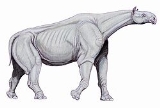
Indricotheriinae is a subfamily of Hyracodontidae
, a group of long-limbed, hornless rhinoceros
es that evolved in the Eocene
epoch and continued through to the early Miocene
. The earlier hyracodontid species, such as Hyracodon
were modest-sized, fast-running, lightly built animals with little similarity to modern rhinos. However, during the late Eocene and early Oligocene
, the indricotherines evolved, and quickly grew to huge sizes. They flourished in the rainforest
s of a coastal region that became Kazakhstan
, Pakistan
, and southwest China
, and lived further inland throughout central Asia as well.
The indricotherines reached the peak of their evolution from the middle Oligocene through to the early Miocene, where they had become truly gigantic animals, represented by the specialized genera Indricotherium and Paraceratherium
(these genera may be synonymous, but several distinct species probably remain valid). These were the largest land mammal
s that ever lived, equaling the medium-sized sauropod dinosaurs in size. However, they remained confined to central Asia, which at the time was part of a large, lush lowland region. The collision with the India
n subcontinent and the Himalayan uplift
led to global cooling
, desertification
, and the disappearance of forest habitats, which resulted in the extinction of these giant ungulates. Certain unidentified species may have lived in Mongolia, and many other places in Russia.
Hyracodontidae
Hyracodontidae is an extinct family of rhinoceroses endemic to North America, Europe, and Asia during the Eocene through early Miocene living from 55.8—20 mya, existing for approximately .They are typified as having long limbs and having no horns...
, a group of long-limbed, hornless rhinoceros
Rhinoceros
Rhinoceros , also known as rhino, is a group of five extant species of odd-toed ungulates in the family Rhinocerotidae. Two of these species are native to Africa and three to southern Asia....
es that evolved in the Eocene
Eocene
The Eocene Epoch, lasting from about 56 to 34 million years ago , is a major division of the geologic timescale and the second epoch of the Paleogene Period in the Cenozoic Era. The Eocene spans the time from the end of the Palaeocene Epoch to the beginning of the Oligocene Epoch. The start of the...
epoch and continued through to the early Miocene
Miocene
The Miocene is a geological epoch of the Neogene Period and extends from about . The Miocene was named by Sir Charles Lyell. Its name comes from the Greek words and and means "less recent" because it has 18% fewer modern sea invertebrates than the Pliocene. The Miocene follows the Oligocene...
. The earlier hyracodontid species, such as Hyracodon
Hyracodon
Hyracodon is an extinct genus of mammal.It was a lightly built, pony-like mammal of about 1.5 m long. Hyracodons skull was large in comparison to the rest of the body...
were modest-sized, fast-running, lightly built animals with little similarity to modern rhinos. However, during the late Eocene and early Oligocene
Oligocene
The Oligocene is a geologic epoch of the Paleogene Period and extends from about 34 million to 23 million years before the present . As with other older geologic periods, the rock beds that define the period are well identified but the exact dates of the start and end of the period are slightly...
, the indricotherines evolved, and quickly grew to huge sizes. They flourished in the rainforest
Rainforest
Rainforests are forests characterized by high rainfall, with definitions based on a minimum normal annual rainfall of 1750-2000 mm...
s of a coastal region that became Kazakhstan
Kazakhstan
Kazakhstan , officially the Republic of Kazakhstan, is a transcontinental country in Central Asia and Eastern Europe. Ranked as the ninth largest country in the world, it is also the world's largest landlocked country; its territory of is greater than Western Europe...
, Pakistan
Pakistan
Pakistan , officially the Islamic Republic of Pakistan is a sovereign state in South Asia. It has a coastline along the Arabian Sea and the Gulf of Oman in the south and is bordered by Afghanistan and Iran in the west, India in the east and China in the far northeast. In the north, Tajikistan...
, and southwest China
China
Chinese civilization may refer to:* China for more general discussion of the country.* Chinese culture* Greater China, the transnational community of ethnic Chinese.* History of China* Sinosphere, the area historically affected by Chinese culture...
, and lived further inland throughout central Asia as well.
The indricotherines reached the peak of their evolution from the middle Oligocene through to the early Miocene, where they had become truly gigantic animals, represented by the specialized genera Indricotherium and Paraceratherium
Paraceratherium
Paraceratherium, also commonly known as Indricotherium or Baluchitherium , is an extinct genus of gigantic hornless rhinoceros-like mammals of the family Hyracodontidae, endemic to Eurasia and Asia during the Eocene to Oligocene 37.2—23.030 Mya, existing for approximately...
(these genera may be synonymous, but several distinct species probably remain valid). These were the largest land mammal
Mammal
Mammals are members of a class of air-breathing vertebrate animals characterised by the possession of endothermy, hair, three middle ear bones, and mammary glands functional in mothers with young...
s that ever lived, equaling the medium-sized sauropod dinosaurs in size. However, they remained confined to central Asia, which at the time was part of a large, lush lowland region. The collision with the India
India
India , officially the Republic of India , is a country in South Asia. It is the seventh-largest country by geographical area, the second-most populous country with over 1.2 billion people, and the most populous democracy in the world...
n subcontinent and the Himalayan uplift
Tectonic uplift
Tectonic uplift is a geological process most often caused by plate tectonics which increases elevation. The opposite of uplift is subsidence, which results in a decrease in elevation. Uplift may be orogenic or isostatic.-Orogenic uplift:...
led to global cooling
Global cooling
Global cooling was a conjecture during the 1970s of imminent cooling of the Earth's surface and atmosphere along with a posited commencement of glaciation...
, desertification
Desertification
Desertification is the degradation of land in drylands. Caused by a variety of factors, such as climate change and human activities, desertification is one of the most significant global environmental problems.-Definitions:...
, and the disappearance of forest habitats, which resulted in the extinction of these giant ungulates. Certain unidentified species may have lived in Mongolia, and many other places in Russia.