

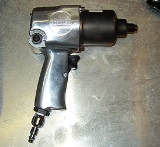
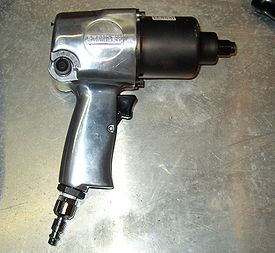
Impact wrench

Encyclopedia
Socket wrench
A socket wrench is a wrench with interchangeable heads called sockets that attach to a fitting on the wrench, allowing it to turn different sized bolts and other fasteners. The most common form is a hand tool popularly called a ratchet consisting of a handle with a ratcheting mechanism built in,...
power tool
Power tool
A power tool is a tool that is actuated by an additional power source and mechanism other than the solely manual labour used with hand tools. The most common types of power tools use electric motors. Internal combustion engines and compressed air are also commonly used...
designed to deliver high torque
Torque
Torque, moment or moment of force , is the tendency of a force to rotate an object about an axis, fulcrum, or pivot. Just as a force is a push or a pull, a torque can be thought of as a twist....
output with minimal exertion by the user, by storing energy in a rotating mass, then delivering it suddenly to the output shaft.
Compressed air
Compressed air
Compressed air is air which is kept under a certain pressure, usually greater than that of the atmosphere. In Europe, 10 percent of all electricity used by industry is used to produce compressed air, amounting to 80 terawatt hours consumption per year....
is the most common power source, although electric or hydraulic power is also used, with cordless electric
Cordless
The term cordless literally means without a cord and is generally used to refer to electrical or electronic devices that are powered by a battery or battery pack and can operate without a power cord or cable attached to a fixed electricity supply such as an outlet, generator, or other centralized...
devices becoming increasingly popular in recent times.
Impact wrenches are widely used in many industries, such as automotive repair, heavy equipment maintenance, product assembly (often called "pulse tools" and designed for precise torque output), major construction
Construction
In the fields of architecture and civil engineering, construction is a process that consists of the building or assembling of infrastructure. Far from being a single activity, large scale construction is a feat of human multitasking...
projects, and any other instance where a high torque output is needed.
Impact wrenches are available in every standard socket wrench drive size, from small 1/4" drive tools for small assembly and disassembly, up to 3.5" and larger square drives for major construction. Impact wrenches are one of the most commonly used air tools, and are found in virtually every mechanic
Mechanic
A mechanic is a craftsman or technician who uses tools to build or repair machinery.Many mechanics are specialized in a particular field such as auto mechanics, bicycle mechanics, motorcycle mechanics, boiler mechanics, general mechanics, industrial maintenance mechanics , air conditioning and...
's shop.
In operation, a rotating mass (the hammer
Hammer
A hammer is a tool meant to deliver an impact to an object. The most common uses are for driving nails, fitting parts, forging metal and breaking up objects. Hammers are often designed for a specific purpose, and vary widely in their shape and structure. The usual features are a handle and a head,...
) is accelerated by the motor, storing energy, then suddenly connected to the output shaft (the anvil
Anvil
An anvil is a basic tool, a block with a hard surface on which another object is struck. The inertia of the anvil allows the energy of the striking tool to be transferred to the work piece. In most cases the anvil is used as a forging tool...
), creating a high-torque impact. The hammer mechanism is designed such that after delivering the impact, the hammer is again allowed to spin freely, and does not stay locked. With this design, the only reaction force applied to the body of the tool is the motor accelerating the hammer, and thus the operator feels very little torque, even though a very high peak torque is delivered to the socket. This is similar to a conventional hammer, where the user applies a small, constant force to swing the hammer, which generates a very large impulse when the hammer strikes an object. Energy is stored over time, allowing a very strong, but short output impulse to be generated from a relatively weak, but constant input force. The hammer design requires a certain minimum torque before the hammer is allowed to spin separately from the anvil, causing the tool to stop hammering and instead smoothly drive the fastener if only low torque is needed, rapidly installing/removing the fastener.
Power source
Compressed air is the most common power source for impact wrenches, providing a low-cost design with the best power-to-weight ratioPower-to-weight ratio
Power-to-weight ratio is a calculation commonly applied to engines and mobile power sources to enable the comparison of one unit or design to another. Power-to-weight ratio is a measurement of actual performance of any engine or power sources...
. A simple vane motor is almost always used, usually with four to seven vanes, and various lubrication
Lubrication
Lubrication is the process, or technique employed to reduce wear of one or both surfaces in close proximity, and moving relative to each another, by interposing a substance called lubricant between the surfaces to carry or to help carry the load between the opposing surfaces. The interposed...
systems, the most common of which uses oiled air, while others may include special oil passages routed to the parts that need it and a separate, sealed oil system for the hammer assembly. Most impact wrenches drive the hammer directly from the motor, giving it fast action when the fastener requires only low torque. Other designs use a gear reduction system before the hammer mechanism, most often a single-stage planetary gearset usually with a heavier hammer, delivering a more constant speed and higher "spin" torque. Electric impact wrenches are available, either mains
Mains
Mains may refer to:* Mains electricity * Mains power around the world* Electricity transmission* Public utility, "mains services", including electricity, natural gas, water, and sewage disposal...
powered, or for automotive use, 12-volt or 24-volt DC-powered. Recently, cordless electric impact wrenches have become common, although typically their power outputs are significantly lower than corded electric or air-powered equivalents. Some industrial tools are hydraulically powered, using high-speed hydraulic motor
Hydraulic motor
A hydraulic motor is a mechanical actuator that converts hydraulic pressure and flow into torque and angular displacement . The hydraulic motor is the rotary counterpart of the hydraulic cylinder....
s, and are used in some heavy equipment repair shops, large construction sites, and other areas where a suitable hydraulic supply is available. Hydraulically powered impact wrench has the advantage of high power-to-weight ratio and are able to deliver more power in smaller size.
Sizes and styles
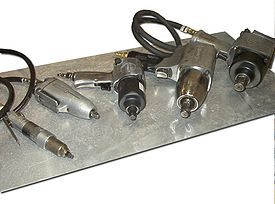
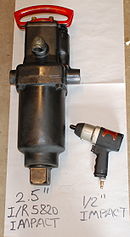
Screwdriver
A screwdriver is a tool for driving screws and often rotating other machine elements with the mating drive system. The screwdriver is made up of a head or tip, which engages with a screw, a mechanism to apply torque by rotating the tip, and some way to position and support the screwdriver...
, with the output on the end) and pistol grip
Pistol grip
On a firearm or other tool, the pistol grip is that portion of the mechanism that is held by the hand and orients the hand in a forward, vertical orientation, similar to the position one would take with a conventional pistol such as the M1911....
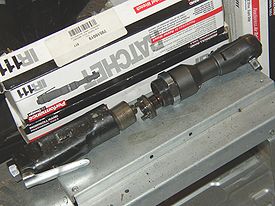
(the user holds a handle which is at right angles to the output) forms, and less commonly in an angle drive, which is similar to an inline tool but with a set of bevel gears to rotate the output 90 degrees. 3/8" impacts are most commonly available in pistol grip form and a special inline form known as a "butterfly" wrench, which has a large, flat throttle paddle on the side of the tool which may be tilted to one side or the other to control the direction of rotation, rather than using a separate reversing control, and shaped to allow access into tight areas. Regular inline and angle 3/8" drive impact wrenches are uncommon, but available. 1/2" drive units are virtually only available in pistol grip form, with any inline type being virtually impossible to obtain, due to the increased torque transmitted back to the user and the greater weight of the tool requiring the larger handle. 3/4" drive impact wrenches are again essentially only available in pistol grip form. 1" drive tools are available in both pistol grip and "D handle" inline, where the back of the tool has an enclosed handle for the user to hold. Both forms often also incorporate a side handle, allowing both hands to hold the tool at once. 1.25" and larger wrenches are usually available in "T handle" form, with two large handles on either side of the tool body, allowing for maximum torque to be applied to the user, and giving the best control of the tool. Very large impact wrenches (up to several hundred thousand foot-pounds of torque) usually incorporate eyelets in their design, allowing them to be suspended from a crane, lift, or other device, since their weight is often more than a person can move. A recent design combines an impact wrench and an air ratchet, often called a "reactionless air ratchet" by the manufacturers, incorporating an impact assembly before the ratchet assembly. Such a design allows very high output torques with minimal effort on the operator, and prevents the common injury of slamming one's knuckles into some part of the equipment when the fastener tightens down and the torque suddenly increases. Specialty designs are available for certain applications, such as removing crankshaft
Crankshaft
The crankshaft, sometimes casually abbreviated to crank, is the part of an engine which translates reciprocating linear piston motion into rotation...
pulley
Pulley
A pulley, also called a sheave or a drum, is a mechanism composed of a wheel on an axle or shaft that may have a groove between two flanges around its circumference. A rope, cable, belt, or chain usually runs over the wheel and inside the groove, if present...
s without removing the radiator
Radiator
Radiators are heat exchangers used to transfer thermal energy from one medium to another for the purpose of cooling and heating. The majority of radiators are constructed to function in automobiles, buildings, and electronics...
in a vehicle.
Various methods are used to attach the socket or accessory to the anvil, such as a spring-loaded pin that snaps into a matching hole in the socket, preventing the socket being removed until an object is used to depress the pin, a hog ring which holds the socket by friction or by snapping into indents machined into the socket, and a through-hole, where a pin is inserted completely through the socket and anvil, locking the socket on. Hog rings are used on most smaller tools, with though-hole used only on larger impact wrenches, typically 3/4" drive or greater. Pin retainers used to be more common, but seem to be being replaced by hog rings on most tools, despite the lack of a positive lock. 1/4" female hex drive is becoming increasingly popular for small impact wrenches, especially cordless electric versions, allowing them to fit standard screwdriver tips rather than sockets.
Many users choose to equip their air-powered impact wrenches with a short length of air hose rather than attaching an air fitting directly to the tool. Such a hose greatly aids in fitting the wrench into tight areas, by not having the complete coupler assembly sticking out the back of the tool, as well as making it easier for the user to position the tool. An additional benefit is greatly reduced wear on the coupler, by isolating it from the vibration of the tool. A short length of hose also prevents the air fitting from being broken off in the base of the tool if the user loses their grip and the tool is allowed to spin.
Effects of impact drive
As the output of an impact wrench, when hammering, is a very short impact forceImpact force
In mechanics, an impact is a high force or shock applied over a short time period when two or more bodies collide. Such a force or acceleration usually has a greater effect than a lower force applied over a proportionally longer time period of time...
, the actual effective torque is difficult to measure, with several different ratings in use. As the tool delivers a fixed amount of energy with each blow, rather than a fixed torque, the actual output torque changes with the duration of the output pulse. If the output is springy
Spring (device)
A spring is an elastic object used to store mechanical energy. Springs are usually made out of spring steel. Small springs can be wound from pre-hardened stock, while larger ones are made from annealed steel and hardened after fabrication...
or capable of absorbing energy, the impulse will simply be absorbed, and virtually no torque will ever be applied, and somewhat counter-intuitively, if the object is very springy, the wrench may actually turn backwards as the energy is delivered back to the anvil, while it is not connected to the hammer and able to spin freely. A wrench that is capable of freeing a rusted nut on a very large bolt may be incapable of turning a small screw mounted on a spring. "Maximum torque" is the number most often given by manufacturers, which is the instantaneous peak torque delivered if the anvil is locked into a perfectly solid object. "Working torque" is a more realistic number for continually driving a very stiff fastener. "Nut
Nut (hardware)
A nut is a type of hardware fastener with a threaded hole. Nuts are almost always used opposite a mating bolt to fasten a stack of parts together. The two partners are kept together by a combination of their threads' friction, a slight stretch of the bolt, and compression of the parts...
-busting torque" is often quoted, with the usual definition being that the wrench can loosen a nut tightened with the specified amount of torque in some specified time period. Accurately controlling the output torque of an impact wrench is very difficult, and even an experienced operator will have a hard time making sure a fastener is not undertightened or overtightened using an impact wrench. Special socket extensions are available, which take advantage of the inability of an impact wrench to work against a spring, to precisely limit the output torque. Designed with spring steel
Spring steel
Spring steel is a low alloy, medium carbon steel or high carbon steel with a very high yield strength. This allows objects made of spring steel to return to their original shape despite significant bending or twisting.-Grades:...
, they act as large torsion spring
Torsion spring
A torsion spring is a spring that works by torsion or twisting; that is, a flexible elastic object that stores mechanical energy when it is twisted. The amount of force it exerts is proportional to the amount it is twisted. There are two types...
s, flexing at their torque rating, and preventing any further torque from being applied to the fastener. Some impact wrenches designed for product assembly have a built-in torque control system, such as a built-in torsion spring and a mechanism that shuts the tool down when the given torque is exceeded. When very precise torque is required, an impact wrench is only used to snug down the fastener, with a torque wrench
Torque wrench
A torque wrench is a tool used to precisely apply a specific torque to a fastener such as a nut or bolt. It is usually in the form of a socket wrench with special internal mechanisms. It was invented by Conrad Bahr in 1918 while working for the New York City Water Department...
used for the final tightening. Due to the lack of standards when measuring the maximum torque, some manufacturers are believed to inflate their ratings
False advertising
False advertising or deceptive advertising is the use of false or misleading statements in advertising. As advertising has the potential to persuade people into commercial transactions that they might otherwise avoid, many governments around the world use regulations to control false, deceptive or...
, or to use measurements with little bearing on how the tool will perform in actual use. Many air impact wrenches incorporate a flow regulator into their design, either as a separate control or part of the reversing valve, allowing torque to be roughly limited in one or both directions, while electric tools may use a variable speed trigger for the same effect.
Hammer mechanisms
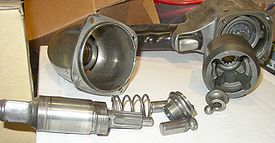
A common hammer design has the hammer able to slide and rotate on a shaft, with a spring holding it in the downwards position. Between the hammer and the driving shaft is a steel ball on a ramp, such that if the input shaft rotates ahead of the hammer with enough torque, the spring is compressed and the hammer is slid backwards. On the bottom of the hammer, and the top of the anvil, are dog teeth, designed for high impacts. When the tool is used, the hammer rotates until its dog teeth contact the teeth on the anvil, stopping the hammer from rotating. The input shaft continues to turn, causing the ramp to lift the steel ball, lifting the hammer assembly until the dog teeth no longer engage the anvil, and the hammer is free to spin again. The hammer then springs forward to the bottom of the ball ramp, and is accelerated by the input shaft, until the dog teeth contact the anvil again, delivering the impact. The process then repeats, delivering blows every time the teeth meet, almost always twice per revolution. If the output has little load on it, such as when spinning a loose nut on a bolt, the torque will never be high enough to cause the ball to compress the spring, and the input will smoothly drive the output. This design has the advantage of small size and simplicity, but energy is wasted moving the entire hammer back and forth, and delivering multiple blows per revolution gives less time for the hammer to accelerate. This design is often seen after a gear reduction, compensating for the lack of acceleration time by delivering more torque at a lower speed.
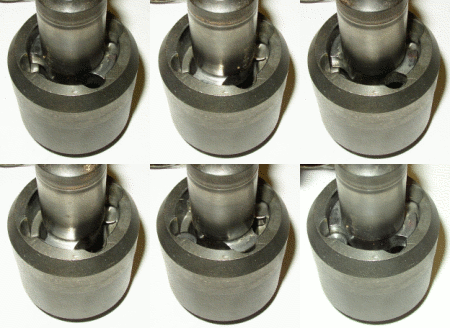
Clutch
A clutch is a mechanical device which provides for the transmission of power from one component to another...
es. When the hammer rotates past the anvil, a ball ramp pushes the pins outwards against a spring, extending them to where they will hit the anvil and deliver the impact, then release and spring back into the hammer, usually by having the balls "fall off" the other side of the ramp at the instant the hammer hits. Since the ramp need only have one peak around the shaft, and the engagement of the hammer with the anvil is not based on a number of teeth between them, this design allows the hammer to accelerate for a full revolution before contacting the anvil, giving it more time to accelerate and delivering a stronger impact. The disadvantages are that the sliding pins must handle very high impacts, and often cause the early failure of tool.
Yet another design uses a rocking weight inside the hammer, and a single, long protrusion on the side of the anvil's shaft. When the hammer spins, the rocking weight first contacts the anvil on the opposite side than used to drive the anvil, nudging the weight into position for the impact. As the hammer spins further, the weight hits the side of the anvil, transferring the hammer's and its own energy to the output, then rocks back to the other side. This design also has the advantage of hammering only once per revolution, as well as its simplicity, but has the disadvantage of making the tool vibrate as the rocking weight acts as an eccentric, and can be less tolerant of running the tool with low input power. To help combat the vibration and uneven drive, sometimes two of these hammers are placed in line with each other, at 180 degree offsets, both striking at the same time.
Many other designs are used, but all of them accomplish the same goal of allowing the hammer to spin freely of the anvil, allowing it to be accelerated and store energy, then delivering that energy suddenly to the anvil, before allowing the process to repeat.
Sockets and accessories
Sockets and extensions for impact wrenches are made of high tensile metal, as any spring effect will greatly reduce the torque available at the fastener. Even so, the use of multiple extensions, universal jointUniversal joint
A universal joint, universal coupling, U joint, Cardan joint, Hardy-Spicer joint, or Hooke's joint is a joint or coupling in a rigid rod that allows the rod to 'bend' in any direction, and is commonly used in shafts that transmit rotary motion...
s, and so forth will weaken the impacts, and the operator needs to minimize their use. Using non-impact sockets or accessories with an impact wrench will often result in bending, fracturing, or otherwise damaging the accessory, as most are not capable of withstanding the sudden high torque of an impact tool, and can result in stripping the head on the fastener. Non-impact sockets and accessories are made of a harder more brittle metal. Safety glasses should always be worn when working with impact tools, as the strong impacts will generate high-speed shrapnel if a socket, accessory, or fastener fails, unlike the steady torque of a hand ratchet where a broken accessory usually does nothing worse than cause bruised knuckles.