
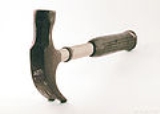
A
hammer is a tool meant to deliver an impact to an object. The most common uses are for driving nails, fitting parts, forging metal and breaking up objects. Hammers are often designed for a specific purpose, and vary widely in their shape and structure. The usual features are a handle and a head, with most of the weight in the head. The basic design is hand-operated, but there are also many mechanically operated models for heavier uses.
The hammer is a basic tool of many professions, and can also be used as a
weaponA war hammer is a late medieval weapon of war intended for close combat action, the design of which resembles the hammer.The war hammer consists of a handle and a head...
.
By analogy, the name
hammer has also been used for devices that are designed to deliver blows, e.g. in the
caplock mechanismThe caplock mechanism or "percussion" lock was the successor of the flintlock mechanism in firearm technology, and used a percussion cap struck by the hammer to set off the main charge, rather than using a piece of flint to strike a steel frizzen....
of
firearmA firearm is a device which projects either single or multiple projectiles at high velocity through a controlled explosion. The firing is achieved by the gases produced through rapid, confined burning of a propellant. This process of rapid burning is technically known as deflagration...
s.
History
The use of simple tools dates to about 2,400,000 BCE when various shaped stones were used to strike
woodWood is an organic material; in the strict sense wood is produced as secondary xylem in the stems of trees . In a living tree it transfers water and nutrients to the leaves and other growing tissues, and has a support function, enabling woody plants to reach large sizes or to stand up for themselves...
,
boneBones are rigid organs that form part of the endoskeleton of vertebrates. They function to move, support, and protect the various organs of the body, produce red and white blood cells and store minerals. Bone tissue is a type of dense connective tissue...
, or other stones to break them apart and shape them. Stones attached to sticks with strips of leather or animal sinew were being used as hammers by about 30,000 BCE during the middle of the
Paleolithic Stone AgeThe Paleolithic or Palaeolithic Age, Era, or Period, or Old Stone Age, is a prehistoric era distinguished by the development of the first stone tools, and covers roughly 99% of human technological history...
. Its archeological record means it is perhaps the oldest human tool known.
Designs and variations
The essential part of a hammer is the head, a compact solid mass that is able to deliver the blow to the intended target without itself deforming.
The opposite side may have a ball, as in the
ball-peen hammerA ball-peen hammer is a type of peening hammer used in metalworking. It is distinguished from a point-peen hammer or chisel-peen hammer by having a hemispherical head...
and the cow hammer. Some upholstery hammers have a magnetized appendage, to pick up tacks. In the
hatchetA hatchet is a single-handed striking tool with a sharp blade used to cut and split wood...
the hammer head is secondary to the cutting edge of the tool.
As the impact between steel hammer heads and the objects being hit can, and does, create sparks, which in some industries such as underground coal mining with methane gas, or in other hazardous environments containing flammable gases and vapours, can be dangerous and risk igniting the gases. In these environments, a variety of non-sparking metal tools are used, being principallly aluminium or beryllium copper-headed hammers.
In recent years the handles have been made of durable plastic or rubber. The hammer varies at the top; some are larger than others giving a larger surface area to hit different sized nails and such.
Popular hand-powered variations include:
- carpenter's hammers (used for nailing), such as the framing hammer
Framing hammers, used for framing wooden houses, are heavy duty rip hammers with a straight claw. The hammer heads typically weigh from 20 to 32 ounces for steel heads, and 12 to 16 ounces for titanium heads...
and the claw hammerA claw hammer is a tool primarily used for pounding nails into, or extricating nails from, some other object. Generally, a claw hammer is associated with woodworking but is not limited to use with wood products...
- upholstery hammer
An upholstery hammer is a lightweight hammer used for securing upholstery fabric to furniture frames using tacks or small nails....
- construction hammers, including the sledgehammer
A sledgehammer is a tool consisting of a large, flat head attached to a lever . The head is typically made of metal. The sledgehammer can apply more impulse than other hammers, due to its large size. Along with the mallet, it shares the ability to distribute force over a wide area...
- drilling hammer - a lightweight, short handled sledgehammer
- Ball-peen hammer
A ball-peen hammer is a type of peening hammer used in metalworking. It is distinguished from a point-peen hammer or chisel-peen hammer by having a hemispherical head...
, or mechanic's hammer
- Soft-faced hammer
- cross-peen hammer, or Warrington hammer
- mallet
A mallet is a kind of hammer, usually of wood, smaller than a maul or beetle and usually with a relatively large head.-Tools:Tool mallets come in different types, the most common of which are:...
s, including the rubber hammer and dead blow hammerA dead blow hammer is a specialized mallet helpful in minimizing damage to the struck surface and in controlling striking force with minimal rebound from the striking surface...
.
- Splitting maul
- stonemason's hammer
A Stonemason's hammer has one flat traditional face and a short or long chisel-shaped blade. It can thus be used to chip off edges or small pieces of stone without using a separate chisel...
- Geologist's hammer
A geologist's hammer is a hammer used for geological purposes. In field geology, they are used to obtain a fresh surface of a rock in order to determine its composition, nature, mineralogy and history...
or rock pick
- lump hammer
A lump hammer or club hammer is a heavy one-handed hammer with a double-faced head. It is useful for light demolition work, driving masonry nails, and for use with a steel chisel when cutting stone or metal. In this last application, its weight drives the chisel more deeply into the material being...
, or club hammer
- gavel
A gavel is a small ceremonial mallet commonly made of hardwood, typically fashioned with a handle and often struck against a sound block to enhance its sounding qualities. It is a symbol of the authority and right to act officially in the capacity of a chair or presiding officer. It is used to call...
, used by judges and presiding authorities in general
- Tinner's Hammer

Mechanically-powered hammers often look quite different from the hand tools, but nevertheless most of them work on the same principle. They include:
- jackhammer
A pneumatic drill or jackhammer is a portable percussive drill powered by compressed air . It is used to drill rock and break up pavement, among other applications...
- steam hammer
A steam hammer is a power-driven hammer used to shape forgings. It consists of a hammer-like piston located within a cylinder. The hammer is raised by the pressure of steam injected into the lower part of a cylinder and falls down with a force by removing the steam. Usually, the hammer is made to...
- trip hammer
A trip hammer, also known as a helve hammer, is a massive powered hammer used in:* agriculture to facilitate the labor of pounding, decorticating and polishing of grain;...
- hammer drill
A hammer drill, also known as a "rotary hammer" or "roto-hammer", is a rotary drill with a hammering action. The hammering action provides a short, rapid hammer thrust to pulverize relatively brittle material and provide quicker drilling with less effort...
, that combines a jackhammer-like mechanism with a drillA drill is a tool with a rotating drill bit used for drilling holes in various materials. The drill bit is gripped by a chuck at one end of the drill and rotated while pressed against the target material...
In professional
framingFraming, in construction known as light frame construction, is a building technique based around structural members, usually called studs, which provide a stable frame to which interior and exterior wall coverings are attached, and covered by a roof comprising horizontal ceiling joists and sloping...
carpentryA carpenter is a skilled craftsperson who performs carpentry. Carpenters work with wood to construct, install and maintain buildings, furniture, and other objects. The work may involve manual labor and work outdoors....
, the hammer has almost been completely replaced by the
nail gunA nail gun, nailgun or nailer is a type of tool used to drive nails into wood or some other kind of material. It is usually driven by electromagnetism, compressed air , highly flammable gases such as butane or propane, or, for powder-actuated tools, a small explosive charge...
. In professional
upholsteryUpholstery is the work of providing furniture, especially seats, with padding, springs, webbing, and fabric or leather covers. The word upholstery comes from the Middle English words up and holden, meaning to hold up. The term is applied to domestic furniture and also to in automobiles and boats...
, its chief competitor is the
staple gunA staple gun or powered stapler is a hand-held machine used to drive heavy metal staples into wood or masonry. Staple guns are used for many different applications and to affix a variety of materials, including insulation, house wrap, roofing, wiring, carpeting, upholstery, and hobby and craft...
.
Tools used in conjunction with hammers
- Woodsplitting wedge - hit with a sledgehammer for splitting wood.
- Woodsplitting maul - can be hit with a sledgehammer for splitting wood.
- Masonry star drill
- Chisel
A chisel is a tool with a characteristically shaped cutting edge of blade on its end, for carving or cutting a hard material such as wood, stone, or metal...
- Punch
A punch is a hard metal rod with a shaped tip at one end and a blunt butt end at the other that is usually struck by a hammer. A variety of punches are used in engineering, but often the purpose is to form an impression of the tip on a workpiece.- Center :...
- Anvil
An anvil is a basic tool. In the simplest terms it is a block with a hard surface on which another object is struck. The inertia of the anvil allows the energy of the striking tool to be transferred to the work piece. In most cases the anvil is used as a forging tool. Before the advent of modern...
Hammer as a force amplifier
A hammer is basically a
forceIn physics, a force is any agent that causes a change in the motion of a free body, or that causes stress in a fixed body. It can also be described by intuitive concepts such as a push or pull that can cause an object with mass to change its velocity , i.e., to accelerate, or which can cause a...
amplifierGenerally, an amplifier or simply amp, is any device that changes, usually increases, the amplitude of a signal. The relationship of the input to the output of an amplifier—usually expressed as a function of the input frequency—is called the transfer function of the amplifier, and the magnitude of...
that works by converting
mechanical workIn physics, mechanical work is the amount of energy transferred by a force acting through a distance. Like energy, it is a scalar quantity, with SI units of joules...
into
kinetic energyThe kinetic energy of an object is the extra energy which it possesses due to its motion. It is defined as the work needed to accelerate a body of a given mass from rest to its current velocity. Having gained this energy during its acceleration, the body maintains this kinetic energy unless its...
and back.
In the swing that precedes each blow, a certain amount of kinetic energy gets stored in the hammer's head, equal to the length
D of the swing times the force
f produced by the
muscleMuscle is the contractile tissue of the body and is derived from the mesodermal layer of embryonic germ cells. Muscle cells contain contractile filaments that move past each other and change the size of the cell. They are classified as skeletal, cardiac, or smooth muscles. Their function is to...
s of the arm and by gravity. When the hammer strikes, the head gets stopped by an opposite force coming from the target; which is equal and opposite to the force applied by the head to the target. If the target is a hard and heavy object, or if it is resting on some sort of
anvilAn anvil is a basic tool. In the simplest terms it is a block with a hard surface on which another object is struck. The inertia of the anvil allows the energy of the striking tool to be transferred to the work piece. In most cases the anvil is used as a forging tool. Before the advent of modern...
, the head can travel only a very short distance
d before stopping. Since the stopping force
F times that distance must be equal to the head's kinetic energy, it follows that
F will be much greater than the original driving force
f — roughly, by a factor
D/
d. In this way, great strength is not needed to produce a force strong enough to bend steel, or crack the hardest stone.
Effect of the head's mass
The amount of energy delivered to the target by the hammer-blow is equivalent to one half the mass of the head times the square of the head's speed at the time of impact . While the energy delivered to the target increases linearly with mass, it increases geometrically with the
speedSpeed is the rate of motion, or equivalently the rate of change of distance.Speed is a scalar quantity with dimensions length/time; the equivalent vector quantity to speed is velocity. Speed is measured in the same physical units of measurement as velocity, but does not contain the element of...
(see the effect of the handle, below). High tech
titaniumTitanium is a chemical element with the symbol Ti and atomic number 22. Sometimes called the “space age metal”, it has a low density and is a strong, lustrous, corrosion-resistant transition metal with a silver color.Titanium can be alloyed with iron, aluminium, vanadium, molybdenum, among other...
heads are lighter and allow for longer handles, thus increasing velocity and delivering more energy with less arm fatigue than that of a steel head hammer of the same weight. As hammers must be used in many circumstances, where the position of the person using them cannot be taken for granted, trade-offs are made for the sake of practicality. In areas where one has plenty of room, a long handle with a heavy head (like a sledge hammer) can deliver the maximum amount of energy to the target. It is not practical to use such a large hammer for all tasks, however, and thus the overall design has been modified repeatedly to achieve the optimum utility in a wide variety of situations.
Effect of the handle
The handle of the hammer helps in several ways. It keeps the user's hands away from the point of impact. It provides a broad area that is better-suited for gripping by the hand. Most importantly, it allows the user to maximize the speed of the head on each blow. The primary constraint on additional handle length is the lack of space in which to swing the hammer. This is why sledge hammers, largely used in open spaces, can have handles that are much longer than a standard carpenter's hammer. The second most important constraint is more subtle. Even without considering the effects of fatigue, the longer the handle, the harder it is to guide the head of the hammer to its target at full speed. Most designs are a compromise between practicality and energy efficiency. Too long a handle: the hammer is inefficient because it delivers force to the wrong place, off-target. Too short a handle: the hammer is inefficient because it doesn't deliver enough force, requiring more blows to complete a given task. Recently, modifications have also been made with respect to the effect of the hammer on the user. A titanium head has about 3% recoil and can result in greater efficiency and less fatigue when compared to a steel head with about 27% recoil. Handles made of shock-absorbing materials or varying angles attempt to make it easier for the user to continue to wield this age-old device, even as nail guns and other powered drivers encroach on its traditional field of use.
War hammers
The concept of putting a handle on a weight to make it more convenient to use may well have led to the very first weapons ever invented. The
clubA club is among the simplest of all weapons. A club is essentially a short staff, or stick, usually made of wood, and wielded as a weapon....
is basically a variant of a hammer. In the
Middle AgesThe Middle Ages of European history is a period of European history covering roughly a millennium in the 5th century through 16th centuries. More specific starting and ending points are sometimes adopted by scholars to suit their respective specializations or current focus...
, the
war hammerA war hammer is a late medieval weapon of war intended for close combat action, the design of which resembles the hammer.The war hammer consists of a handle and a head...
became popular when edged weapons could no longer easily penetrate some forms of armour.
Symbolic hammers
The hammer, being one of the most used tools by
Homo sapiens, has been used very much in symbols and arms. In the Middle Ages it was used often in blacksmith guild logos, as well as in many family symbols. The most recognised symbol with a hammer in it is the
Hammer and SickleThe hammer and sickle is a part of communist symbolism and its usage indicates an association with Communism, a Communist party, or a Communist state. It features a hammer and a sickle overlapping each other. The two tools are symbols of the industrial proletariat and the peasantry; placing them...
, which was the symbol of the former
Soviet UnionThe Union of Soviet Socialist Republics was a constitutionally socialist state that existed in Eurasia from 1922 to 1991. The name is a translation of the , tr. Soyuz Sovetskikh Sotsialisticheskikh Respublik, abbreviated СССР, SSSR. The common short name is Soviet Union, from , Sovetskiy Soyuz...
and is very interlinked with Communism/Socialism. The hammer in this symbol represents the industrial working class (and the sickle the agricultural working class). The hammer is used in some coat of arms in (former) socialist countries like East Germany.
In
Norse MythologyNorse, North Germanic, or Scandinavian mythology comprises the myths of North Germanic pre-Christian religion.Most of the written sources for Norse mythology were assembled in medieval Iceland in Old Norse, notably as the Edda....
,
ThorThor is the red-haired and bearded god of thunder in Germanic mythology and Germanic paganism, and its subsets: Norse paganism, Anglo-Saxon paganism and Continental Germanic paganism....
, the god of thunder and lightning, wields a hammer named
MjolnirIn Norse mythology, Mjǫllnir is the hammer of Thor, a major god associated with thunder in Norse mythology. Distinctively shaped, Mjöllnir is depicted in Norse mythology as one of the most fearsome weapons, capable of leveling mountains...
. Many artifacts of decorative hammers have been found, leading modern practitioners of this religion to often wear reproductions as a sign of their faith.
External links