
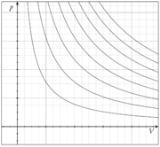
The
ideal gas law is the
equation of stateIn physics and thermodynamics, an equation of state is a relation between state variables. More specifically, an equation of state is a thermodynamic equation describing the state of matter under a given set of physical conditions...
of a hypothetical
ideal gasAn ideal gas is a theoretical gas composed of a set of randomly-moving, non-interacting point particles. The ideal gas concept is useful because it obeys the ideal gas law, a simplified equation of state, and is amenable to analysis under statistical mechanics.At normal conditions such as...
. It is a good approximation to the behavior of many
gasGas is one of the three classical states of matter . Near absolute zero, a substance exists as a solid. As heat is added to this substance it melts into a liquid at its melting point , boils into a gas at its boiling point, and if heated high enough would enter a plasma state in which the electrons...
es under many conditions, although it has several limitations. It was first stated by
Émile ClapeyronBenoît Paul Émile Clapeyron was a French engineer and physicist, one of the founders of thermodynamics.-Life:...
in 1834 as a combination of
Boyle's lawBoyle's law is one of many gas laws and a special case of the ideal gas law. Boyle's law describes the inversely proportional relationship between the absolute pressure and volume of a gas, if the temperature is kept constant within a closed system...
and
Charles's lawCharles' law is an experimental gas law which describes how gases tend to expand when heated. It was first published by French natural philosopher Joseph Louis Gay-Lussac in 1802, although he credited the discovery to unpublished work from the 1780s by Jacques Charles...
. It can also be derived from
kinetic theoryThe kinetic theory of gases describes a gas as a large number of small particles , all of which are in constant, random motion. The rapidly moving particles constantly collide with each other and with the walls of the container...
, as was achieved (apparently independently) by
August KrönigAugust Karl Krönig was a German chemist and physicist who published an account of the kinetic theory of gases in 1856, probably after reading a paper by John James Waterston....
in 1856 and
Rudolf ClausiusRudolf Julius Emanuel Clausius , was a German physicist and mathematician and is considered one of the central founders of the science of thermodynamics. By his restatement of Sadi Carnot's principle known as the Carnot cycle, he put the theory of heat on a truer and sounder basis...
in 1857.
The
stateIn thermodynamics, a state function, function of state, state quantity, or state variable is a property of a system that depends only on the current state of the system, not on the way in which the system acquired that state . A state function describes the equilibrium state of a system...
of an amount of
gasGas is one of the three classical states of matter . Near absolute zero, a substance exists as a solid. As heat is added to this substance it melts into a liquid at its melting point , boils into a gas at its boiling point, and if heated high enough would enter a plasma state in which the electrons...
is determined by its pressure, volume, and temperature. The modern form of the equation is:

where
P is the absolute
pressurePressure is the force per unit area applied in a direction perpendicular to the surface of an object. Gauge pressure is the pressure relative to the local atmospheric or ambient pressure.- Definition :...
of the gas measured in
atmospheresThe standard atmosphere is an international reference pressure defined as 101325 Pa and formerly used as unit of pressure. For practical purposes it has been replaced by the bar which is 105 Pa...
;
V is the volume (in this equation the volume is expressed in liters);
N is the number of particles in the gas;
k is Boltzmann's constant relating temperature and energy; and
T is the absolute temperature.
In SI units,
P is measured in
pascalsThe pascal is the SI derived unit of pressure, internal pressure, stress, Young's modulus and tensile strength, named after the French mathematician, physicist, inventor, writer, and philosopher Blaise Pascal. It is a measure of force per unit area, defined as one newton per square metre...
;
V in cubic metres;
N is a dimensionless number; and
T in kelvin.
k has the value 1.38·10
−23 JThe joule ; symbol J) is a derived unit of energy or work in the International System of Units. It is equal to the energy expended in applying a force of one newton through a distance of one metre , or in passing an electric current of one ampere through a resistance of one ohm for one second...
·
KThe kelvin is a unit of measurement for temperature. It is one of the seven base units in the International System of Units and is assigned the unit symbol K. The Kelvin scale is an absolute, thermodynamic temperature scale using as its null point absolute zero, the temperature at which all...
−1 in SI units.
Sometimes this is expressed as

where
n is the
amount of substanceAmount of substance is a standards-defined quantity that measures the size of an ensemble of elementary entities, such as atoms, molecules, electrons, and other particles. It is sometimes referred to as chemical amount. The International System of Units defines the amount of substance to be...
of gas (also known as number of moles) and
R is the ideal, or universal, gas constant, equal to the product of Boltzmann's constant and Avogadro's constant. In SI units,
n is measured in
molesThe mole is a unit of measurement used in chemistry to express amounts of a chemical substance, defined as an amount of a substance that contains as many elementary entities as there are atoms in 12 grams of pure carbon-12 , the isotope of carbon with atomic weight 12. This corresponds to a value...
, and
T in kelvin.
R has the value 8.314
JThe joule ; symbol J) is a derived unit of energy or work in the International System of Units. It is equal to the energy expended in applying a force of one newton through a distance of one metre , or in passing an electric current of one ampere through a resistance of one ohm for one second...
·
KThe kelvin is a unit of measurement for temperature. It is one of the seven base units in the International System of Units and is assigned the unit symbol K. The Kelvin scale is an absolute, thermodynamic temperature scale using as its null point absolute zero, the temperature at which all...
−1·
molThe mole is a unit of measurement used in chemistry to express amounts of a chemical substance, defined as an amount of a substance that contains as many elementary entities as there are atoms in 12 grams of pure carbon-12 , the isotope of carbon with atomic weight 12. This corresponds to a value...
−1.
The temperature used in the equation of state is an absolute temperature: in the SI system of units,
kelvinThe kelvin is a unit of measurement for temperature. It is one of the seven base units in the International System of Units and is assigned the unit symbol K. The Kelvin scale is an absolute, thermodynamic temperature scale using as its null point absolute zero, the temperature at which all...
s; in the Imperial system, degrees Rankine.
Deviations from real gases
The equation of state given here applies only to an ideal gas, or as an approximation to a real gas that behaves sufficiently like an ideal gas. There are in fact many different forms of the equation of state for different gases. Since it neglects both molecular size and intermolecular attractions, the ideal gas law is most accurate for monatomic gases at high temperatures and low pressures. The neglect of molecular size becomes less important for lower densities, i.e. for larger volumes at lower pressures, because the average distance between adjacent molecules becomes much larger than the molecular size. The relative importance of intermolecular attractions diminishes with increasing
thermal kinetic energyThermal energy is the part of the total internal energy of a thermodynamic system or sample of matter that results in the system's temperature....
, i.e., with increasing temperatures. More detailed
equations of stateIn physics and thermodynamics, an equation of state is a relation between state variables. More specifically, an equation of state is a thermodynamic equation describing the state of matter under a given set of physical conditions...
, such as the
van der Waals equationThe van der Waals equation is an equation of state for a fluid composed of particles that have a non-zero volume and a pairwise attractive inter-particle force It was derived by Johannes Diderik van der Waals in 1873, who received the Nobel prize in 1910 for "his work on the equation of state for...
, allow deviations from ideality caused by molecular size and intermolecular forces to be taken into account.
A
residual propertyIn thermodynamics a residual property is defined as the difference between a real gas property and an ideal gas property, both considered at the same pressure, temperature, and composition.-References:...
is defined as the difference between a
real gasReal gases – as opposed to a perfect or ideal gas – exhibit properties that cannot be explained entirely using the ideal gas law. To understand the behaviour of real gases, the following must be taken into account:* compressibility effects;...
property and an ideal gas property, both considered at the same pressure, temperature, and composition.
Molar form
As the amount of substance could be given in mass instead of moles, sometimes an alternative form of the ideal gas law is useful. The number of moles (
n) is equal to the mass (
m) divided by the
molar massMolar mass, symbol M, is a physical property of a given substance , namely its mass per amount of substance. The base SI unit for mass is the kilogram and that for amount of substance is the mole. Thus, the derived unit for molar mass is kg/mol...
(
M):
-

By replacing
n, and with
densityThe mass density or density of a material is defined as its mass per unit volume. The symbol most often used for density is ρ . In some cases , density is also defined as its weight per unit volume; although, this quantity is more properly called specific weight...
ρ =
m/
V, we get:
-

-

Defining the specific gas constant
Rspecific as the ratio
R/
M,
-

This form of the ideal gas law is very useful because it links pressure, density, and temperature in a unique formula independent of the quantity of the considered gas. Alternatively, the law may be written in terms of the
specific volumeIn thermodynamics, the specific volume of a substance is the ratio of the substance's volume to its mass. It is the reciprocal of density:In thermodynamics, the specific volume of a substance is the ratio of the substance's volume to its mass...
v, the reciprocal of density, as
-

It is common, especially in engineering applications, to represent the
specific gas constant by the symbol
R. In such cases, the
universal gas constant is usually given a different symbol such as
R to distinguish it. In any case, the context and/or units of the gas constant should make it clear as to whether the universal or specific gas constant is being referred to.
Statistical mechanics
In
statistical mechanicsStatistical mechanics or statistical thermodynamicsThe terms statistical mechanics and statistical thermodynamics are used interchangeably...
the following molecular equation is derived from first principles:
-

Here
k is the
Boltzmann constant, and
N is the
actual number of molecules, in contrast to the other formulation, which uses
n, the number of moles. This relation implies that
Nk =
nR, and the consistency of this result with experiment is a good check on the principles of statistical mechanics.
From here we can notice that for an average particle mass of
μ times the
atomic mass constantIn physics and chemistry, the atomic mass constant, mu, is one twelfth of the mass of an unbound atom of carbon-12 at rest and in its ground state. It serves to define the atomic mass unit and is, by definition, equal to 1 u...
mu (i.e., the mass is
μ uThe unified atomic mass unit or dalton is a unit that is used for indicating mass on an atomic or molecular scale. It is defined as one twelfth of the rest mass of an unbound neutral atom of carbon-12 in its nuclear and electronic ground state, and has a value of...
)

and since
ρ =
m/
V, we find that the ideal gas law can be rewritten as:
Applications to thermodynamic processes
The table below essentially simplifies the ideal gas equation for a particular processes, thus making this equation easier to solve using numerical methods.
A thermodynamic process is defined as a system that moves from state 1 to state 2, where the state number is denoted by subscript. As shown in the first column of the table, basic thermodynamic processes are defined such that one of the gas properties (
P,
V,
T, or
S) is constant throughout the process.
For a given thermodynamics process, in order to specify the extent of a particular process, one of the properties ratios (listed under the column labeled "known ratio") must be specified (either directly or indirectly). Also, the property for which the ratio is known must be distinct from the property held constant in the previous column (otherwise the ratio would be unity, and not enough information would be available to simplify the gas law equation).
In the final three columns, the properties (
P,
V, or
T) at state 2 can be calculated from the properties at state 1 using the equations listed.
| Process |
Constant |
Known ratio |
P2 |
V2 |
T2 |
Isobaric processAn isobaric process is a thermodynamic process in which the pressure stays constant. The term derives from the Greek isos, , and barus,...
|
Pressure |
V2/V1 |
P2 = P1 |
V2 = V1(V2/V1) |
T2 = T1(V2/V1) |
| T2/T1 |
P2 = P1 |
V2 = V1(T2/T1) |
T2 = T1(T2/T1) |
| Isochoric process An isochoric process, also called a constant-volume process, an isovolumetric process, or an isometric process, is a thermodynamic process during which the volume of the closed system undergoing such a process remains constant...
|
Volume |
P2/P1 |
P2 = P1(P2/P1) |
V2 = V1 |
T2 = T1(P2/P1) |
| T2/T1 |
P2 = P1(T2/T1) |
V2 = V1 |
T2 = T1(T2/T1) |
Isothermal processAn isothermal process is a change of a system, in which the temperature remains constant: ΔT = 0. This typically occurs when a system is in contact with an outside thermal reservoir , and the change occurs slowly enough to allow the system to continually adjust to the temperature of the reservoir...
|
Temperature |
P2/P1 |
P2 = P1(P2/P1) |
V2 = V1/(P2/P1) |
T2 = T1 |
| V2/V1 |
P2 = P1/(V2/V1) |
V2 = V1(V2/V1) |
T2 = T1 |
| Isentropic process In thermodynamics, an isentropic process or isoentropic process is one in which for purposes of engineering analysis and calculation, one may assume that the process takes place from initiation to completion without an increase or decrease in the entropy of the system, i.e., the entropy of the...
(Reversible adiabatic processIn thermodynamics, an adiabatic process or an isocaloric process is a thermodynamic process in which the net heat transfer to or from the working fluid is zero. Such a process can occur if the container of the system has thermally-insulated walls or the process happens in an extremely short time,... ) |
EntropyEntropy is a thermodynamic property that can be used to determine the energy available for useful work in a thermodynamic process, such as in energy conversion devices, engines, or machines. Such devices can only be driven by convertible energy, and have a theoretical maximum efficiency when...
|
P2/P1 |
P2 = P1(P2/P1) |
V2 = V1(P2/P1)(−1/γ) |
T2 = T1(P2/P1)(1 − 1/γ) |
| V2/V1 |
P2 = P1(V2/V1)−γ |
V2 = V1(V2/V1) |
T2 = T1(V2/V1)(1 − γ) |
| T2/T1 |
P2 = P1(T2/T1)γ/(γ − 1) |
V2 = V1(T2/T1)1/(1 − γ) |
T2 = T1(T2/T1) |
Polytropic process
|
P Vn |
P2/P1 |
P2 = P1(P2/P1) |
V2 = V1(P2/P1)(-1/n) |
T2 = T1(P2/P1)(1 - 1/n) |
| V2/V1 |
P2 = P1(V2/V1)−n |
V2 = V1(V2/V1) |
T2 = T1(V2/V1)(1−n) |
| T2/T1 |
P2 = P1(T2/T1)n/(n − 1) |
V2 = V1(T2/T1)1/(1 − n) |
T2 = T1(T2/T1) |
a. In an isentropic process, system entropy (
S) is constant. Under these conditions,
P1 V1γ =
P2 V2γ, where
γ is defined as the
heat capacity ratioThe heat capacity ratio or adiabatic index or ratio of specific heats, is the ratio of the heat capacity at constant pressure to heat capacity at constant volume . It is sometimes also known as the isentropic expansion factor and is denoted by \gamma or \kappa . The latter symbol kappa is...
, which is constant for an ideal gas. The value used for
γ is typically 1.4 for diatomic gases like
nitrogenNitrogen is a chemical element that has the symbol N, atomic number of 7 and atomic mass 14.00674 u. Elemental nitrogen is a colorless, odorless, tasteless, and mostly inert diatomic gas at standard conditions, constituting 78.08% by volume of Earth's atmosphere...
(N
2) and
oxygenOxygen is the element with atomic number 8 and represented by the symbol O. Its name derives from the Greek roots ὀξύς and -γενής , because at the time of naming, it was mistakenly thought that all acids required oxygen in their composition...
(O
2), (and air, which is 99% diatomic). Also
γ is typically 1.6 for monatomic gases like the
noble gasThe noble gases are a group of chemical elements with very similar properties: under standard conditions, they are all odorless, colorless, monatomic gases, with very low chemical reactivity...
es
heliumHelium is the chemical element with atomic number 2 and an atomic weight of 4.002602, which is represented by the symbol He. It is a colorless, odorless, tasteless, non-toxic, inert, monatomic gas that heads the noble gas group in the periodic table...
(He), and
argonArgon is a chemical element represented by the symbol Ar. Argon has atomic number 18 and is the third element in group 18 of the periodic table . Argon is the third most common gas in the Earth's atmosphere, at 0.93%, making it more common than carbon dioxide...
(Ar). In internal combustion engines
γ varies between 1.35 and 1.15, depending on constitution gases and temperature.
Empirical
The ideal gas law can be derived from combining two empirical
gas lawsThe early gas laws were developed at the end of the 18th century, when scientists began to realize that relationships between the pressure, volume and temperature of a sample of gas could be obtained which would hold for all gases...
: the
combined gas lawThe combined gas law is a gas law which combines Charles's law, Boyle's law, and Gay-Lussac's law. These laws each relate one thermodynamic variable to another mathematically while holding everything else constant. Charles's law states that volume and temperature are directly proportional to each...
and
Avogadro's lawAvogadro's law is a gas law named after Amedeo Avogadro who, in 1811, hypothesized that two given samples of an ideal gas, at the same temperature, pressure and volume, contain the same number of molecules...
. The combined gas law states that
where
C is a constant which is directly proportional to the amount of gas,
n (
Avogadro's lawAvogadro's law is a gas law named after Amedeo Avogadro who, in 1811, hypothesized that two given samples of an ideal gas, at the same temperature, pressure and volume, contain the same number of molecules...
). The proportionality factor is the universal gas constant,
R, i.e.
C =
nR.
Hence the ideal gas law
Theoretical
The ideal gas law can also be derived from
first principlesIn philosophy, a first principle is a basic, foundational proposition or assumption that cannot be deduced from any other proposition or assumption. In mathematics, first principles are referred to as axioms or postulates...
using the kinetic theory of gases, in which several simplifying assumptions are made, chief among which are that the molecules, or atoms, of the gas are point masses, possessing mass but no significant volume, and undergo only elastic collisions with each other and the sides of the container in which both linear momentum and kinetic energy are conserved.
From statistical mechanics
Let
q = (
qx,
qy,
qz) and
p = (
px,
py,
pz) denote the position vector and momentum vector of a particle of an ideal gas, respectively. Let
F denote the net force on that particle. Then the time average momentum of the particle is:

where the first equality is Newton's second law, and the second line uses Hamilton's equations and the
equipartition theoremIn classical statistical mechanics, the equipartition theorem is a general formula that relates the temperature of a system with its average energies. The equipartition theorem is also known as the law of equipartition, equipartition of energy, or simply equipartition...
. Summing over a system of
N particles yields
By Newton's third law and the ideal gas assumption, the net force on the system is the force applied by the walls of their container, and this force is given by the pressure
P of the gas. Hence
where d
S is the infinitesimal area element along the walls of the container. Since the
divergenceIn vector calculus, divergence is a vector operator that measures the magnitude of a vector field's source or sink at a given point, in terms of a signed scalar. More technically, the divergence represents the volume density of the outward flux of a vector field from an infinitesimal volume around...
of the position vector
q is
the
divergence theoremIn vector calculus, the divergence theorem, also known as Gauss' theorem , Ostrogradsky's theorem , or Gauss–Ostrogradsky theorem is a result that relates the flow of a vector field through a surface to the behavior of the vector field inside the surface.More precisely, the divergence theorem...
implies that
where
dV is an infinitesimal volume within the container and
V is the total volume of the container.
Putting these equalities together yields
which immediately implies the ideal gas law for
N particles:
where
n =
N/
NA is the number of
molesThe mole is a unit of measurement used in chemistry to express amounts of a chemical substance, defined as an amount of a substance that contains as many elementary entities as there are atoms in 12 grams of pure carbon-12 , the isotope of carbon with atomic weight 12. This corresponds to a value...
of gas and
R =
NAkB is the
gas constantThe gas constant is a physical constant which is featured in many fundamental equations in the physical sciences, such as the ideal gas law and the Nernst equation. It is equivalent to the Boltzmann constant, but expressed in units of energy The gas constant (also known as the molar, universal,...
.
The readers are referred to the comprehensive article
Configuration integral (statistical mechanics) where an alternative statistical mechanics derivation of the ideal-gas law, using the relationship between the
Helmholtz free energyIn thermodynamics, the Helmholtz free energy is a thermodynamic potential that measures the “useful” work obtainable from a closed thermodynamic system at a constant temperature and volume...
and the
partition functionPartition functions describe the statistical properties of a system in thermodynamic equilibrium. It is a function of temperature and other parameters, such as the volume enclosing a gas...
, but without using the equipartition theorem, is provided.
See also
- Combined gas law
The combined gas law is a gas law which combines Charles's law, Boyle's law, and Gay-Lussac's law. These laws each relate one thermodynamic variable to another mathematically while holding everything else constant. Charles's law states that volume and temperature are directly proportional to each...
- Van der Waals equation
The van der Waals equation is an equation of state for a fluid composed of particles that have a non-zero volume and a pairwise attractive inter-particle force It was derived by Johannes Diderik van der Waals in 1873, who received the Nobel prize in 1910 for "his work on the equation of state for...
- Boltzmann's constant
- Configuration integral
- Dynamic pressure
Further reading
External links