

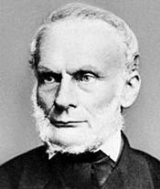
Rudolf Clausius

Encyclopedia
Rudolf Julius Emanuel Clausius (Born Rudolf Gottlieb, 2 January 1822 – 24 August 1888), was a German
physicist
and mathematician
and is considered one of the central founders of the science of thermodynamics
. By his restatement of Sadi Carnot
's principle known as the Carnot cycle
, he put the theory of heat
on a truer and sounder basis. His most important paper, On the mechanical theory of heat, published in 1850, first stated the basic ideas of the second law of thermodynamics
. In 1865 he introduced the concept of entropy.
(now Koszalin) in the Province of Pomerania. He started his education at the school of his father. After a few years, he went to the Gymnasium
in Stettin (now Szczecin). Clausius graduated from the University of Berlin in 1844 where he studied mathematics and physics with, among others, Gustav Magnus, Johann Dirichlet and Jakob Steiner
. He also studied history with Leopold von Ranke
. During 1847, he got his doctorate from the University of Halle on optical effects in the Earth's atmosphere. He then became professor of physics at the Royal Artillery and Engineering School in Berlin and Privatdozent at the Berlin University. In 1855 he became professor at the ETH Zürich
, the Swiss Federal Institute of Technology in Zürich
, where he stayed until 1867. During that year, he moved to Würzburg
and two years later, in 1869 to Bonn
.
In 1870 Clausius organized an ambulance corps in the Franco-Prussian War
. He was wounded in battle, leaving him with a lasting disability. He was awarded the Iron Cross
for his services.
His wife, Adelheid Rimpham, died in childbirth in 1875, leaving him to raise their six children. He continued to teach, but had less time for research thereafter.
In 1886 he remarried Sophie Sack, and then had another child.
Two years later, on 24 August 1888, he died in Bonn
, Germany.
His most famous paper, "Über die bewegende Kraft der Wärme" ("On the Moving Force of Heat and the Laws of Heat which may be Deduced Therefrom")
was published in 1850, and dealt with the mechanical theory of heat. In this paper, he showed that there was a contradiction between Carnot
's principle and the concept of conservation of energy
. Clausius restated the two laws of thermodynamics
to overcome this contradiction (the third law
was developed by Walther Nernst
, during the years 1906–1912). This paper made him famous among scientists.
During 1857, Clausius contributed to the field of kinetic theory
after refining August Krönig
's very simple gas-kinetic model to include translational, rotational and vibrational molecular motions. In this same work he introduced the concept of 'Mean free path
' of a particle.
Clausius deduced the Clausius–Clapeyron relation from thermodynamics
. This relation, which is a way of characterizing the phase transition
between two states of matter such as solid
and liquid
, had originally been developed in 1834 by Émile Clapeyron.
, and also gave it its name. He used the now abandoned unit 'Clausius' (symbol: Cl) for entropy. Clausius chose the word "entropy" because the meaning, from Greek, en+tropein, is "content transformative" or "transformation content" ("Verwandlungsinhalt").
Germany
Germany , officially the Federal Republic of Germany , is a federal parliamentary republic in Europe. The country consists of 16 states while the capital and largest city is Berlin. Germany covers an area of 357,021 km2 and has a largely temperate seasonal climate...
physicist
Physicist
A physicist is a scientist who studies or practices physics. Physicists study a wide range of physical phenomena in many branches of physics spanning all length scales: from sub-atomic particles of which all ordinary matter is made to the behavior of the material Universe as a whole...
and mathematician
Mathematician
A mathematician is a person whose primary area of study is the field of mathematics. Mathematicians are concerned with quantity, structure, space, and change....
and is considered one of the central founders of the science of thermodynamics
Thermodynamics
Thermodynamics is a physical science that studies the effects on material bodies, and on radiation in regions of space, of transfer of heat and of work done on or by the bodies or radiation...
. By his restatement of Sadi Carnot
Nicolas Léonard Sadi Carnot
Nicolas Léonard Sadi Carnot was a French military engineer who, in his 1824 Reflections on the Motive Power of Fire, gave the first successful theoretical account of heat engines, now known as the Carnot cycle, thereby laying the foundations of the second law of thermodynamics...
's principle known as the Carnot cycle
Carnot cycle
The Carnot cycle is a theoretical thermodynamic cycle proposed by Nicolas Léonard Sadi Carnot in 1824 and expanded by Benoit Paul Émile Clapeyron in the 1830s and 40s. It can be shown that it is the most efficient cycle for converting a given amount of thermal energy into work, or conversely,...
, he put the theory of heat
Theory of heat
In the history of science, the theory of heat or mechanical theory of heat was a theory, introduced predominantly in 1824 by the French physicist Sadi Carnot, that heat and mechanical work are equivalent. It is related to the mechanical equivalent of heat...
on a truer and sounder basis. His most important paper, On the mechanical theory of heat, published in 1850, first stated the basic ideas of the second law of thermodynamics
Second law of thermodynamics
The second law of thermodynamics is an expression of the tendency that over time, differences in temperature, pressure, and chemical potential equilibrate in an isolated physical system. From the state of thermodynamic equilibrium, the law deduced the principle of the increase of entropy and...
. In 1865 he introduced the concept of entropy.
Life
Clausius was born in KöslinKoszalin
Koszalin ; is the largest city of Middle Pomerania in north-western Poland. It is located 12 km south of the Baltic Sea coast. Koszalin is also a county-status city and capital of Koszalin County of West Pomeranian Voivodeship since 1999...
(now Koszalin) in the Province of Pomerania. He started his education at the school of his father. After a few years, he went to the Gymnasium
Gymnasium (school)
A gymnasium is a type of school providing secondary education in some parts of Europe, comparable to English grammar schools or sixth form colleges and U.S. college preparatory high schools. The word γυμνάσιον was used in Ancient Greece, meaning a locality for both physical and intellectual...
in Stettin (now Szczecin). Clausius graduated from the University of Berlin in 1844 where he studied mathematics and physics with, among others, Gustav Magnus, Johann Dirichlet and Jakob Steiner
Jakob Steiner
Jakob Steiner was a Swiss mathematician who worked primarily in geometry.-Personal and professional life:...
. He also studied history with Leopold von Ranke
Leopold von Ranke
Leopold von Ranke was a German historian, considered one of the founders of modern source-based history. Ranke set the standards for much of later historical writing, introducing such ideas as reliance on primary sources , an emphasis on narrative history and especially international politics .-...
. During 1847, he got his doctorate from the University of Halle on optical effects in the Earth's atmosphere. He then became professor of physics at the Royal Artillery and Engineering School in Berlin and Privatdozent at the Berlin University. In 1855 he became professor at the ETH Zürich
ETH Zurich
The Swiss Federal Institute of Technology Zurich or ETH Zürich is an engineering, science, technology, mathematics and management university in the City of Zurich, Switzerland....
, the Swiss Federal Institute of Technology in Zürich
Zürich
Zurich is the largest city in Switzerland and the capital of the canton of Zurich. It is located in central Switzerland at the northwestern tip of Lake Zurich...
, where he stayed until 1867. During that year, he moved to Würzburg
University of Würzburg
The University of Würzburg is a university in Würzburg, Germany, founded in 1402. The university is a member of the distinguished Coimbra Group.-Name:...
and two years later, in 1869 to Bonn
University of Bonn
The University of Bonn is a public research university located in Bonn, Germany. Founded in its present form in 1818, as the linear successor of earlier academic institutions, the University of Bonn is today one of the leading universities in Germany. The University of Bonn offers a large number...
.
In 1870 Clausius organized an ambulance corps in the Franco-Prussian War
Franco-Prussian War
The Franco-Prussian War or Franco-German War, often referred to in France as the 1870 War was a conflict between the Second French Empire and the Kingdom of Prussia. Prussia was aided by the North German Confederation, of which it was a member, and the South German states of Baden, Württemberg and...
. He was wounded in battle, leaving him with a lasting disability. He was awarded the Iron Cross
Iron Cross
The Iron Cross is a cross symbol typically in black with a white or silver outline that originated after 1219 when the Kingdom of Jerusalem granted the Teutonic Order the right to combine the Teutonic Black Cross placed above a silver Cross of Jerusalem....
for his services.
His wife, Adelheid Rimpham, died in childbirth in 1875, leaving him to raise their six children. He continued to teach, but had less time for research thereafter.
In 1886 he remarried Sophie Sack, and then had another child.
Two years later, on 24 August 1888, he died in Bonn
Bonn
Bonn is the 19th largest city in Germany. Located in the Cologne/Bonn Region, about 25 kilometres south of Cologne on the river Rhine in the State of North Rhine-Westphalia, it was the capital of West Germany from 1949 to 1990 and the official seat of government of united Germany from 1990 to 1999....
, Germany.
Work
Clausius' PhD thesis concerning the refraction of light proposed that we see a blue sky during the day, and various shades of red at sunrise and sunset (among other phenomena) due to reflection and refraction of light. Later, Lord Rayleigh would show that it was in fact due to the scattering of light, but regardless, Clausius used a far more mathematical approach than some have used.His most famous paper, "Über die bewegende Kraft der Wärme" ("On the Moving Force of Heat and the Laws of Heat which may be Deduced Therefrom")
was published in 1850, and dealt with the mechanical theory of heat. In this paper, he showed that there was a contradiction between Carnot
Nicolas Léonard Sadi Carnot
Nicolas Léonard Sadi Carnot was a French military engineer who, in his 1824 Reflections on the Motive Power of Fire, gave the first successful theoretical account of heat engines, now known as the Carnot cycle, thereby laying the foundations of the second law of thermodynamics...
's principle and the concept of conservation of energy
Conservation of energy
The nineteenth century law of conservation of energy is a law of physics. It states that the total amount of energy in an isolated system remains constant over time. The total energy is said to be conserved over time...
. Clausius restated the two laws of thermodynamics
Laws of thermodynamics
The four laws of thermodynamics summarize its most important facts. They define fundamental physical quantities, such as temperature, energy, and entropy, in order to describe thermodynamic systems. They also describe the transfer of energy as heat and work in thermodynamic processes...
to overcome this contradiction (the third law
Third law of thermodynamics
The third law of thermodynamics is a statistical law of nature regarding entropy:For other materials, the residual entropy is not necessarily zero, although it is always zero for a perfect crystal in which there is only one possible ground state.-History:...
was developed by Walther Nernst
Walther Nernst
Walther Hermann Nernst FRS was a German physical chemist and physicist who is known for his theories behind the calculation of chemical affinity as embodied in the third law of thermodynamics, for which he won the 1920 Nobel Prize in chemistry...
, during the years 1906–1912). This paper made him famous among scientists.
During 1857, Clausius contributed to the field of kinetic theory
Kinetic theory
The kinetic theory of gases describes a gas as a large number of small particles , all of which are in constant, random motion. The rapidly moving particles constantly collide with each other and with the walls of the container...
after refining August Krönig
August Krönig
August Karl Krönig was a German chemist and physicist who published an account of the kinetic theory of gases in 1856, probably after reading a paper by John James Waterston....
's very simple gas-kinetic model to include translational, rotational and vibrational molecular motions. In this same work he introduced the concept of 'Mean free path
Mean free path
In physics, the mean free path is the average distance covered by a moving particle between successive impacts which modify its direction or energy or other particle properties.-Derivation:...
' of a particle.
Clausius deduced the Clausius–Clapeyron relation from thermodynamics
Thermodynamics
Thermodynamics is a physical science that studies the effects on material bodies, and on radiation in regions of space, of transfer of heat and of work done on or by the bodies or radiation...
. This relation, which is a way of characterizing the phase transition
Phase transition
A phase transition is the transformation of a thermodynamic system from one phase or state of matter to another.A phase of a thermodynamic system and the states of matter have uniform physical properties....
between two states of matter such as solid
Solid
Solid is one of the three classical states of matter . It is characterized by structural rigidity and resistance to changes of shape or volume. Unlike a liquid, a solid object does not flow to take on the shape of its container, nor does it expand to fill the entire volume available to it like a...
and liquid
Liquid
Liquid is one of the three classical states of matter . Like a gas, a liquid is able to flow and take the shape of a container. Some liquids resist compression, while others can be compressed. Unlike a gas, a liquid does not disperse to fill every space of a container, and maintains a fairly...
, had originally been developed in 1834 by Émile Clapeyron.
Entropy
In 1865, Clausius gave the first mathematical version of the concept of entropyEntropy
Entropy is a thermodynamic property that can be used to determine the energy available for useful work in a thermodynamic process, such as in energy conversion devices, engines, or machines. Such devices can only be driven by convertible energy, and have a theoretical maximum efficiency when...
, and also gave it its name. He used the now abandoned unit 'Clausius' (symbol: Cl) for entropy. Clausius chose the word "entropy" because the meaning, from Greek, en+tropein, is "content transformative" or "transformation content" ("Verwandlungsinhalt").
- 1 Cl = 1 calCalorieThe calorie is a pre-SI metric unit of energy. It was first defined by Nicolas Clément in 1824 as a unit of heat, entering French and English dictionaries between 1841 and 1867. In most fields its use is archaic, having been replaced by the SI unit of energy, the joule...
/°C = 4.1868 jouleJouleThe joule ; symbol J) is a derived unit of energy or work in the International System of Units. It is equal to the energy expended in applying a force of one newton through a distance of one metre , or in passing an electric current of one ampere through a resistance of one ohm for one second...
s per kelvinKelvinThe kelvin is a unit of measurement for temperature. It is one of the seven base units in the International System of Units and is assigned the unit symbol K. The Kelvin scale is an absolute, thermodynamic temperature scale using as its null point absolute zero, the temperature at which all...
(J/K)
Tributes
- He was elected a Fellow of the Royal Society of London in 1868 and received its Copley MedalCopley MedalThe Copley Medal is an award given by the Royal Society of London for "outstanding achievements in research in any branch of science, and alternates between the physical sciences and the biological sciences"...
in 1879. - He was elected a member of the Royal Swedish Academy of SciencesRoyal Swedish Academy of SciencesThe Royal Swedish Academy of Sciences or Kungliga Vetenskapsakademien is one of the Royal Academies of Sweden. The Academy is an independent, non-governmental scientific organization which acts to promote the sciences, primarily the natural sciences and mathematics.The Academy was founded on 2...
in 1878. - He received the HuygensHuygensHuygens is a Dutch patronymic surname, meaning "son of Hugo". People with the name Huygens include:People* Constantijn Huygens , Dutch poet and composer...
Medal in 1870. - He received the Poncelet PrizePoncelet PrizeThe Poncelet Prize is awarded by the French Academy of Sciences. The prize was established in 1868 by the widow of General Jean-Victor Poncelet for the advancement of the sciences. It was in the amount of 2,000 francs , mostly for the work in applied mathematics...
in 1883. - He received an honorary doctorate from the University of WürzburgWürzburgWürzburg is a city in the region of Franconia which lies in the northern tip of Bavaria, Germany. Located at the Main River, it is the capital of the Regierungsbezirk Lower Franconia. The regional dialect is Franconian....
in 1882. - The crater ClausiusClausius (crater)Clausius is a lunar crater that is located in the southwest part of the Moon, in the small lunar mare designated Lacus Excellentiae. It is completely enclosed by mare material, although the tiny satellite crater Clausius A lies just to the north. The rim of Clausius is low and sharp, with a...
on the MoonMoonThe Moon is Earth's only known natural satellite,There are a number of near-Earth asteroids including 3753 Cruithne that are co-orbital with Earth: their orbits bring them close to Earth for periods of time but then alter in the long term . These are quasi-satellites and not true moons. For more...
is named in his honor.
Quotes
The following are two famous quotes made by Clausius in 1865:The energyEnergyIn physics, energy is an indirectly observed quantity. It is often understood as the ability a physical system has to do work on other physical systems...
of the universeUniverseThe Universe is commonly defined as the totality of everything that exists, including all matter and energy, the planets, stars, galaxies, and the contents of intergalactic space. Definitions and usage vary and similar terms include the cosmos, the world and nature...
is constant.
The entropyEntropyEntropy is a thermodynamic property that can be used to determine the energy available for useful work in a thermodynamic process, such as in energy conversion devices, engines, or machines. Such devices can only be driven by convertible energy, and have a theoretical maximum efficiency when...
of the universe tends to a maximum.
External links
- Revival of Kinetic Theory by Clausius
- Clausius biography in The MacTutor History of Mathematics archive