

Exocytosis

Encyclopedia
Greek language
Greek is an independent branch of the Indo-European family of languages. Native to the southern Balkans, it has the longest documented history of any Indo-European language, spanning 34 centuries of written records. Its writing system has been the Greek alphabet for the majority of its history;...
ἔξω "out" and English cyto- "cell" from Gk. κύτος "receptacle"), also known as 'The peni-cytosis', is the durable process by which a cell directs the contents of secretory vesicles
Vesicle (biology)
A vesicle is a bubble of liquid within another liquid, a supramolecular assembly made up of many different molecules. More technically, a vesicle is a small membrane-enclosed sack that can store or transport substances. Vesicles can form naturally because of the properties of lipid membranes , or...
out of the cell membrane
Cell membrane
The cell membrane or plasma membrane is a biological membrane that separates the interior of all cells from the outside environment. The cell membrane is selectively permeable to ions and organic molecules and controls the movement of substances in and out of cells. It basically protects the cell...
. These membrane-bound vesicles contain soluble proteins to be secreted to the extracellular environment, as well as membrane proteins and lipids that are sent to become components of the cell membrane.
Types
In multicellular organisms there are two types of exocytosis:1) Ca2+ triggered non-constitutive and
2) non Ca2+ triggered constitutive.
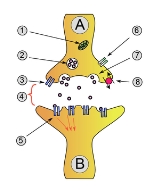
Exocytosis in neuronal chemical synapses is Ca2+ triggered and serves interneuronal signalling. Constitutive exocytosis is performed by all cells and serves the release of components of the extracellular matrix
Extracellular matrix
In biology, the extracellular matrix is the extracellular part of animal tissue that usually provides structural support to the animal cells in addition to performing various other important functions. The extracellular matrix is the defining feature of connective tissue in animals.Extracellular...
, or just delivery of newly-synthesized membrane proteins that are incorporated in the plasma membrane
Cell membrane
The cell membrane or plasma membrane is a biological membrane that separates the interior of all cells from the outside environment. The cell membrane is selectively permeable to ions and organic molecules and controls the movement of substances in and out of cells. It basically protects the cell...
after the fusion of the transport vesicle
Vesicle (biology)
A vesicle is a bubble of liquid within another liquid, a supramolecular assembly made up of many different molecules. More technically, a vesicle is a small membrane-enclosed sack that can store or transport substances. Vesicles can form naturally because of the properties of lipid membranes , or...
. Regulated exocytosis, on the other hand, requires an external signal, a specific sorting signal on the vesicles, a clathrin
Clathrin
Clathrin is a protein that plays a major role in the formation of coated vesicles. Clathrin was first isolated and named by Barbara Pearse in 1975. It forms a triskelion shape composed of three clathrin heavy chains and three light chains. When the triskelia interact they form a polyhedral lattice...
coat, as well as an increase in intracellular calcium. Exocytosis is the opposite of endocytosis
Endocytosis
Endocytosis is a process by which cells absorb molecules by engulfing them. It is used by all cells of the body because most substances important to them are large polar molecules that cannot pass through the hydrophobic plasma or cell membrane...
.
Vesicle trafficking
Certain vesicle-trafficking steps require the translation of a vesicle over a moderately small distance. For example, vesicles that have the duty to transport the proteins from the Golgi apparatusGolgi apparatus
The Golgi apparatus is an organelle found in most eukaryotic cells. It was identified in 1898 by the Italian physician Camillo Golgi, after whom the Golgi apparatus is named....
to the cell surface area, will be likely to use motor proteins and a cytoskeletal track to get closer than previously stated to their target. Before tethering would have been appropriate, many of the proteins used for the active transport would have been instead set for passive transport, due to the fact that the Golgi apparatus does not require ATP to transport proteins. Both the actin- and the microtubule-base are implicated in these processes, along with several motor proteins
Molecular motors
Molecular motors are biological molecular machines that are the essential agents of movement in living organisms. Generally speaking, a motor may be defined as a device that consumes energy in one form and converts it into motion or mechanical work; for example, many protein-based molecular motors...
. Once the vesicles reach their targets, they come into contact with tethering factors that can restrain them.
Vesicle tethering
It is useful to distinguish between the initial, loose tethering of vesicles with their objective from the more stable, packing interactions. Tethering involves links over distances of more than about half the diameter of a vesicle from a given membrane surface (>25 nm). Tethering interactions are likely to be involved in concentrating synaptic vesicles at the synapse.The vesicles are also involved in regular cell's transcription processes.
Vesicle docking
The term docking refers to the holding of two membranes within a bilayer's distance of one another (<5-10 nm). Stable docking probably represents several distinct, molecular states: the molecular interactions underlying the close and tight association of a vesicle with its target may include the molecular rearrangements needed to trigger bilayer fusion. A common feature of many proteins that function in vesicle tethering and docking is their propensity to form highly extended, coiled-coil structures. Tethering and docking of a transport vesicle at the target membrane precedes the formation of a tight core SNARE complexSnare
Snare may refer to:* Snare trap, a kind of trap used for capturing animals* Snare drum* SNARE , a family of proteins involved in vesicle fusion* The Snares, a group of islands approximately 200 kilometres south of New Zealand...
.
Vesicle priming
In neuronal exocytosis, the term priming has been used to include all of the molecular rearrangements and ATP-dependent protein and lipid modifications that take place after initial docking of a synaptic vesicle but before exocytosis, such that the influx of calcium ions is all that is needed to trigger nearly instantaneous neurotransmitterNeurotransmitter
Neurotransmitters are endogenous chemicals that transmit signals from a neuron to a target cell across a synapse. Neurotransmitters are packaged into synaptic vesicles clustered beneath the membrane on the presynaptic side of a synapse, and are released into the synaptic cleft, where they bind to...
release. In other cell types, whose secretion is constitutive (i.e. continuous, calcium ion independent, non-triggered) there is no priming.
Vesicle fusion
The vesicle fusion is driven by SNARESnare
Snare may refer to:* Snare trap, a kind of trap used for capturing animals* Snare drum* SNARE , a family of proteins involved in vesicle fusion* The Snares, a group of islands approximately 200 kilometres south of New Zealand...
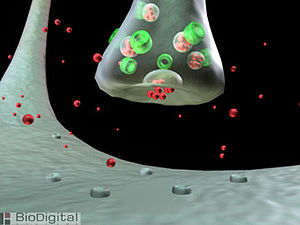
proteins process of merging the vesicle membrane with the target one resulting in release of large biomolecules in the extracellular space (or in case of neurons in the synaptic cleft).
The merging of the donor and the acceptor membranes accomplishes three tasks:
- The surface of the plasma membrane increases (by the surface of the fused vesicle). This is important for the regulation of cell size, e.g., during cell growth.
- The substances within the vesicle are released into the exterior. These might be waste products or toxinToxinA toxin is a poisonous substance produced within living cells or organisms; man-made substances created by artificial processes are thus excluded...
s, or signaling molecules like hormoneHormoneA hormone is a chemical released by a cell or a gland in one part of the body that sends out messages that affect cells in other parts of the organism. Only a small amount of hormone is required to alter cell metabolism. In essence, it is a chemical messenger that transports a signal from one...
s or neurotransmitterNeurotransmitterNeurotransmitters are endogenous chemicals that transmit signals from a neuron to a target cell across a synapse. Neurotransmitters are packaged into synaptic vesicles clustered beneath the membrane on the presynaptic side of a synapse, and are released into the synaptic cleft, where they bind to...
s during synaptic transmissionSynapseIn the nervous system, a synapse is a structure that permits a neuron to pass an electrical or chemical signal to another cell...
. - ProteinProteinProteins are biochemical compounds consisting of one or more polypeptides typically folded into a globular or fibrous form, facilitating a biological function. A polypeptide is a single linear polymer chain of amino acids bonded together by peptide bonds between the carboxyl and amino groups of...
s embedded in the vesicle membrane are now part of the plasma membrane. The side of the protein that was facing the inside of the vesicle now faces the outside of the cell. This mechanism is important for the regulation of transmembrane and transporters.
See also
- Secretory pathwaySecretory pathwayThe secretory pathway is a series of steps a cell uses to move proteins out of the cell; a process known as secretion. The path of a protein destined for secretion has its origins in the rough endoplasmic reticulum, a membrane-bound compartment in the cell...
- SynapseSynapseIn the nervous system, a synapse is a structure that permits a neuron to pass an electrical or chemical signal to another cell...
- EndocytosisEndocytosisEndocytosis is a process by which cells absorb molecules by engulfing them. It is used by all cells of the body because most substances important to them are large polar molecules that cannot pass through the hydrophobic plasma or cell membrane...
- Phagocytosis
- Endocytic cycleEndocytic cycleMost animal cells take up portions of their surface plasma membranes in a process called endocytosis. The main route of endocytosis is the coated pit, which buds into a cell to form a cytoplasmic vesicle — a clathrin-coated vesicle. The membrane so internalised is processed in a series of...
- Membrane nanotubeMembrane nanotubeMembrane nanotubes, membrane nanotubules or cytonemes are long and thin tubes formed from the plasma membrane that connect different animal cells over long distances. Two types of nanotubes have been observed. The first type are less than 0.7 micrometres in diameter, contain actin and carry...
- Active TransportActive transportActive transport is the movement of a substance against its concentration gradient . In all cells, this is usually concerned with accumulating high concentrations of molecules that the cell needs, such as ions, glucose, and amino acids. If the process uses chemical energy, such as from adenosine...
- Viral sheddingViral sheddingViral shedding refers to the successful reproduction, expulsion, and host-cell infection caused by virus progeny. Once replication has been completed and the host cell is exhausted of all resources in making viral progeny, the viruses may begin to leave the cell by several methods.The term is used...
- Presynaptic active zoneActive zoneThe active zone is a term first used by Couteaux and Pecot-Dechavassinein in 1970 and is defined in the neuron as the site of neurotransmitter release. Neurons contain structures called synapses that allow for the communication from one neuron to another...