
All Topics  
Hydroponics

 
Hydroponics

   Email Print
   Bookmark   Link


Hydroponics


Hydroponics (from the Greek words hydro water and ponos labour) is a method of growing plant
Plant

Plants are Life organisms belonging to the Kingdom Plantae. They include familiar organisms such as trees, herbs, bushes, grasses, vines, ferns, mosses, and green algae....
s using mineral nutrient
Nutrient

A nutrient is a chemical that an organism needs to live and grow or a substance used in an organism's metabolism which must be taken in from its environment....
 solutions, without soil
Soil

Soil is the naturally occurring, unconsolidated or loose covering on the Earth's surface. Soil is composed of particles of broken rock that have been altered by chemical and environmental processes including weathering and erosion....
. Terrestrial plants may be grown with their root
Root

In vascular plants, the root is the organ of a plant body that typically lies below the surface of the soil. This is not always the case, however, since a root can also be aerial root or aerating ....
s in the mineral nutrient solution only or in an inert medium, such as perlite
Perlite

Perlite is an amorphous volcanic glass that has a relatively high water content, typically formed by the hydration of obsidian. It occurs naturally and has the unusual property of greatly expanding when heated sufficiently....
, gravel
Gravel

Gravel is rock that is of a specific particle size range. Specifically, it is is any loose rock that is larger than two millimeters in its largest dimension and no more than 64 millimeters ....
, or mineral wool
Mineral wool

Mineral wool, also known as mineral fibers or man-made mineral fibers are fibers made from natural or synthetic minerals or metal oxides....
.

Plant physiology
Plant physiology

Plant physiology is a subdiscipline of botany concerned with the function, or physiology, of plants. Closely related fields include plant morphology , plant ecology , phytochemistry , cell biology, and molecular biology....
 researchers discovered in the 19th century that plants absorb essential mineral nutrients as inorganic ions in water.


Discussion
Ask a question about 'Hydroponics'
Start a new discussion about 'Hydroponics'
Answer questions from other users
Full Discussion Forum


Encyclopedia


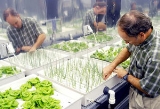
Hydroponic Onions Nasa
Hydroponics (from the Greek words hydro water and ponos labour) is a method of growing plant
Plant

Plants are Life organisms belonging to the Kingdom Plantae. They include familiar organisms such as trees, herbs, bushes, grasses, vines, ferns, mosses, and green algae....
s using mineral nutrient
Nutrient

A nutrient is a chemical that an organism needs to live and grow or a substance used in an organism's metabolism which must be taken in from its environment....
 solutions, without soil
Soil

Soil is the naturally occurring, unconsolidated or loose covering on the Earth's surface. Soil is composed of particles of broken rock that have been altered by chemical and environmental processes including weathering and erosion....
. Terrestrial plants may be grown with their root
Root

In vascular plants, the root is the organ of a plant body that typically lies below the surface of the soil. This is not always the case, however, since a root can also be aerial root or aerating ....
s in the mineral nutrient solution only or in an inert medium, such as perlite
Perlite

Perlite is an amorphous volcanic glass that has a relatively high water content, typically formed by the hydration of obsidian. It occurs naturally and has the unusual property of greatly expanding when heated sufficiently....
, gravel
Gravel

Gravel is rock that is of a specific particle size range. Specifically, it is is any loose rock that is larger than two millimeters in its largest dimension and no more than 64 millimeters ....
, or mineral wool
Mineral wool

Mineral wool, also known as mineral fibers or man-made mineral fibers are fibers made from natural or synthetic minerals or metal oxides....
.

Plant physiology
Plant physiology

Plant physiology is a subdiscipline of botany concerned with the function, or physiology, of plants. Closely related fields include plant morphology , plant ecology , phytochemistry , cell biology, and molecular biology....
 researchers discovered in the 19th century that plants absorb essential mineral nutrients as inorganic ions in water. In natural conditions, soil acts as a mineral nutrient reservoir but the soil itself is not essential to plant growth. When the mineral nutrients in the soil dissolve in water, plant roots are able to absorb them. When the required mineral nutrients are introduced into a plant's water supply artificially, soil is no longer required for the plant to thrive. Almost any terrestrial plant will grow with hydroponics. Hydroponics is also a standard technique in biology research and teaching.

History

The study of crop nutrition began thousands of years ago. Ancient history tells us that various experiments were undertaken by Theophrastus
Theophrastus

Theophrastus , a Greek native of Eressos in Lesbos Island, was the successor of Aristotle in the Peripatetic school. His interests were wide-ranging, extending from biology and physics to ethics and metaphysics....
 (372-287 B.C.), while several writings of Dioscorides on botany dating from the first century A.D., are still in existence.

The earliest published work on growing terrestrial plants without soil was the 1627 book, Sylva Sylvarum by Sir Francis Bacon
Francis Bacon

Francis Bacon, 1st Viscount St Alban King's Counsel , son of Nicholas Bacon by his second wife Anne Bacon, was an English philosopher, statesman, scientist, lawyer, jurist, and author....
, printed a year after his death. Water culture became a popular research technique after that. In 1699, John Woodward
John Woodward (naturalist)

John Woodward was an England natural history, antiquarian and geologist....
 published his water culture experiments with spearmint
Spearmint

Mentha spicata is a species of Mentha native to much of Europe and southwest Asia, though its exact natural range is uncertain due to extensive early cultivation....
. He found that plants in less pure water sources grew better than plants in distilled water. By 1842 a list of nine elements believed to be essential to plant growth had been made out, and the discoveries of the German botanists, Julius von Sachs
Julius von Sachs

Julius von Sachs was a Germany botanist from Wroclaw, Prussian Silesia.At an early age he showed a taste for natural history, becoming acquainted with the Breslau physiologist Jan Evangelista Purkyne....
 and Wilhelm Knop, in the years 1859-65, resulted in a development of the technique of soilless cultivation. Growth of terrestrial plants without soil in mineral nutrient solutions was called solution culture. It quickly became a standard research and teaching technique and is still widely used today. Solution culture is now considered a type of hydroponics where there is no inert medium.

In 1929, Professor William Frederick Gericke of the University of California at Berkeley began publicly promoting that solution culture be used for agricultural crop production. He first termed it aquaculture but later found that aquaculture
Aquaculture

Aquaculture is the farming of freshwater and saltwater organisms including molluscs, crustaceans and aquatic plants. Unlike fishing, aquaculture, also known as aquafarming, implies the cultivation of aquatic populations under controlled conditions....
 was already applied to culture of aquatic organisms. Gericke created a sensation by growing tomato vines twenty-five feet high in his back yard in mineral nutrient solutions rather than soil. By analogy with the ancient Greek
Ancient Greek

Ancient Greek is the historical stage in the development of the Greek language spanning across the Archaic Greece , Classical Greece , and Hellenistic civilization periods of ancient Greece and the classical antiquity....
 term for agriculture, geoponics, the science of cultivating the earth, Gericke introduced the term hydroponics in 1937 (although he asserts that the term was suggested by Dr. W. A. Setchell, of the University of California) for the culture of plants in water (from the Greek hydros, "water", and ponos, "labor").

Reports of Gericke's work and his claims that hydroponics would revolutionize plant agriculture prompted a huge number of requests for further information. Gericke refused to reveal his secrets claiming he had done the work at home on his own time. This refusal eventually resulted in his leaving the University of California. In 1940, he wrote the book, Complete Guide to Soilless Gardening.

Two other plant nutritionists at the University of California were asked to research Gericke's claims. and wrote a classic 1938 agricultural bulletin, The Water Culture Method for Growing Plants Without Soil, debunking the exaggerated claims made about hydroponics. Hoagland and Arnon found that hydroponic crop yields were no better than crop yields with good quality soils. Crop yields were ultimately limited by factors other than mineral nutrients, especially light. This research, however, overlooked the fact that hydroponics has other advantages including the fact that the roots of the plant have constant access to oxygen and that the plants have access to as much or as little water as they need. This is important as one of the most common errors when growing is over- and under- watering; and hydroponics prevents this from occurring as large amounts of water can be made available to the plant and any water not used, drained away, recirculated, or actively aerated, eliminating anoxic conditions which drown root systems in soil. In soil, a grower needs to be very experienced to know exactly how much water to feed the plant. Too much and the plant will not be able to access oxygen; too little and the plant will lose the ability to transport nutrients, which are typically moved into the roots while in solution.

These two researchers developed several formulas for mineral nutrient solutions, known as Hoagland solutions
Hoagland

Hoagland is a surname and a first name, and may refer to:* Edward Hoagland, non-fiction writer* Jim Hoagland, Pulitzer Prize-winning journalist...
. Modified Hoagland solutions are still used today.

One of the early successes of hydroponics occurred on Wake Island
Wake Island

Wake Island is a coral atoll having a coastline of 12 miles in the North Pacific Ocean, located about two-thirds of the way from Honolulu to Guam ....
, a rocky atoll in the Pacific Ocean used as a refueling stop for Pan American Airlines. Hydroponics was used there in the 1930s to grow vegetables for the passengers. Hydroponics was a necessity on Wake Island because there was no soil, and it was prohibitively expensive to airlift in fresh vegetables.

In the 1960s, Allen Cooper of England developed the Nutrient Film Technique. The Land Pavilion
The Land (Disney)

The Land is the name of a Pavilion that sits on the western side of "Future World", one of two themed areas of Epcot, a theme park at the Walt Disney World Resort in Lake Buena Vista, Florida USA....
 at Walt Disney World's EPCOT Center opened in 1982 and prominently features a variety of hydroponic techniques. In recent decades, NASA
NASA

The National Aeronautics and Space Administration is an agency of the Federal government of the United States, responsible for the nation's public list of space agencies....
 has done extensive hydroponic research for their Controlled Ecological Life Support System
Controlled Ecological Life Support System

Controlled Ecological Life Support Systems are a type of scientific endeavor to create a self-supporting life support system for space stations and colonies typically through controlled closed ecological systems, such as the BioHome, BIOS-3 and Biosphere 2....
 or CELSS. Hydroponics intended to take place on Mars are using LED lighting to grow in different color spectrum with much less heat.

Origin


Soilless culture

Gericke originally defined hydroponics as crop growth in mineral nutrient solutions, with no solid medium for the roots. He objected in print to people who applied the term hydroponics to other types of soilless culture such as sand culture and gravel culture. The distinction between hydroponics and soilless culture of plants has often been blurred. Soilless culture is a broader term than hydroponics; it only requires that no soils with clay or silt are used. Note that sand
Sand

Sand is a naturally occurring granular material composed of finely divided rock and mineral particles.As the term is used by geologists, sand particles range in diameter from 0.0625 to 2 millimeters....
 is a type of soil yet sand culture is considered a type of soilless culture. Hydroponics is a subset of soilless culture. Many types of soilless culture do not use the mineral nutrient solutions required for hydroponics.

Billions of container plants are produced annually, including fruit, shade and ornamental trees, shrubs, forest seedlings, vegetable seedlings, bedding plants, herbaceous perennials and vines. Most container plants are produced in soilless media, representing soilless culture. However, most are not hydroponics because the soilless medium often provides some of the mineral nutrients via slow release fertilizers, cation exchange and decomposition of the organic medium itself. Most soilless media for container plants also contain organic materials such as peat
Peat

Peat is an accumulation of partially decayed vegetation biological tissue. Peat forms in wetlands or peatlands, variously called bogs, Moorland, muskegs, pocosins, mires, and peat swamp forests....
 or composted bark, which provide some nitrogen to the plant. Greenhouse growth of plants in peat bags is often termed hydroponics, but technically it is not because the medium provides some of the mineral nutrients.

Advantages

Today, hydroponics is an established branch of agronomical science. Progress has been rapid, and results obtained in various countries have proved it to be thoroughly practical and to have very definite advantages over conventional methods of horticulture
Horticulture

'Horticulture' is the industry and science of plant cultivation. Horticulturists work and conduct research in the disciplines of plant propagation and cultivation, Crop , plant breeding and genetic engineering, plant biochemistry, and plant physiology....
. The two chief merits of the soilless cultivation of plants are, first, much higher crop yields, and secondly, the fact that hydroponics can be used in places where ordinary agriculture or gardening is impossible. Thus not only is it a profitable undertaking, but one which has proved of great benefit to humanity. People living in crowded city streets, without gardens, can grow fresh vegetables and fruits in window-boxes or on house tops. By means of hydroponics all such places can be made to yield a regular and abundant supply of clean, health-giving greenstuff. Not only town dwellers, but also country residents have cause to be thankful to soiless culture. Deserts, rocky and stony land in mountainous districts or barren and sterile areas can be made productive at relatively low cost. It is difficult to exaggerate the importance of hydroponics for it has given a new lease of life to the landless worker.

Other advantages include faster growth combined with relative freedom from soil diseases, and very consistent crops, the quality of produce being excellent. There is also a considerable reduction in growing area, weeds are practically non-existant, while standard methods and automatic operations mean less labor, less cost, and no hard manual work. Some plants can be raised, out of season, better control of crops naturally results in addition to no dirt and no smells. Waterlogging never occurs now. Chemically grown plants are not inferior to naturally reared ones in point of flavor, nor have analyses shown any deficiency in vitamin content.

Higher Yields

Hydroponic averages compared with ordinary soil yields
Bengal United States West Indies
Name of crop Hydroponic equivalent per acre Agricultural average per acre Hydroponic equivalent per acre Agricultural average per acre Hydroponic equivalent per acre Agricultural average per acre
Wheat8,000 lb.5,600 lb.    
Oats3,000 lb.1,850 lb.    
Rice12,000 lb.750-900 lb.    
Maize (Corn)8,000 lb.1,500 lb.    
Soya beans1,500 lb.600 lb.    
Potatoes70 tons8 tons62.5 tons6-10 tons  
Beetroot20,000 lb.9,500 lb.    
Cabbage18,000 lb.13,000 lb.    
Peas140,000 lb.25,000 lb.    
Tomatoes180 tons5-10 tons300 tons in Florida5-10 tons for unstaked field plants; 50 tons for greenhouse cultured crops178 tons per annum on a commercial field scale 
Cauliflowers30,000 lb.15-35,000 lb.    
French beans42,000 lb. of pods for eating     
Lettuce21,000 lb.9,000 lb.    
Lady's finger19,000 lb.5-10,000 lb.    
Cucumber28,000 lb.7,000 lb.    
Note: with controlled cropping, increase in area brings no comparative decrease in yield. No matter how many times a hydroponic plot is multiplied in size, output will remain relatively constant.

Disadvantages

The hydroponic conditions (presence of fertilizer and high humidity) create an environment that stimulates salmonella
Salmonella

Salmonella is a genus of rod-shaped Gram-negative enterobacteriaceae that causes typhoid fever, paratyphoid fever, and the foodborne illness salmonellosis....
 growth.

Techniques

The two main types of hydroponics are solution culture and medium culture. Solution culture does not use a solid medium for the roots, just the nutrient solution. The three main types of solution culture are static solution culture, continuous flow solution culture and aeroponics. The medium culture method has a solid medium for the roots and is named for the type of medium, e.g. sand culture, gravel culture or rockwool culture. There are two main variations for each medium, subirrigation and top irrigation
Irrigation

Irrigation is an artificial application of water to the soil usually for assisting in growing crops. In crop production it is mainly used in dry areas and in periods of rainfall shortfalls, but also to protect plants against frost....
. For all techniques, most hydroponic reservoirs are now built of plastic but other materials have been used including concrete, glass, metal, vegetable solids and wood. The containers should exclude light to prevent algae growth in the nutrient solution.

Static solution culture

In static solution culture, plants are grown in containers of nutrient solution, such as glass Mason jars (typically in-home applications), plastic buckets, tubs or tanks. The solution is usually gently aerated but may be unaerated. If unaerated, the solution level is kept low enough that enough roots are above the solution so they get adequate oxygen. A hole is cut in the lid of the reservoir for each plant. There can be one to many plants per reservoir. Reservoir size can be increased as plant size increases. A homemade system can be constructed from plastic food containers or glass canning jars with aeration
Aeration

Aeration is the process by which air is circulated through, mixed with or solvation in a liquid or substance....
 provided by an aquarium pump, aquarium airline tubing and aquarium valves. Clear containers are covered with aluminium foil, butcher paper, black plastic or other material to exclude light, thus helping to eliminate the formation of algae. The nutrient solution is either changed on a schedule, such as once per week, or when the concentration drops below a certain level as determined with an electrical conductivity meter
EC meter

An electrical conductivity meter measures the electrical conductivity in a solution. Commonly used in hydroponics, aquaculture and freshwater systems to monitor the amount of nutrients, salts or impurities in the water....
. Whenever the solution is depleted below a certain level, either water or fresh nutrient solution is added. A Mariotte's bottle
Mariotte's bottle

Mariotte?s bottle is a device that provides a constant pressure that will deliver a constant rate of flow from closed bottles or tanks. It is named after French physicist Edme Mariotte ....
 can be used to automatically maintain the solution level. In raft solution culture, plants are placed in a sheet of buoyant plastic that is floated on the surface of the nutrient solution. That way, the solution level never drops below the roots.

Continuous flow solution culture

In continuous flow solution culture the nutrient solution constantly flows past the roots. It is much easier to automate than the static solution culture because sampling and adjustments to the temperature and nutrient concentrations can be made in a large storage tank that serves potentially thousands of plants. A popular variation is the nutrient film technique
Nutrient film technique

Nutrient Film Technique or NFT is a hydroponic technique whereby a very shallow stream of water containing all the dissolved nutrients required for plant growth is recirculated past the bare roots of plants in a watertight gully, also known as channels....
 or NFT whereby a very shallow stream of water containing all the dissolved nutrients required for plant growth is recirculated past the bare roots of plants in a watertight gully, also known as channels. Ideally, the depth of the recirculating stream should be very shallow, little more than a film of water, hence the name 'nutrient film'. This ensures that the thick root mat, which develops in the bottom of the channel, has an upper surface which, although moist, is in the air. Subsequently, there is an abundant supply of oxygen to the roots of the plants. A properly designed NFT system is based on using the right channel slope, the right flow rate and the right channel length. The main advantage of the NFT system over other forms of hydroponics is that the plant roots are exposed to adequate supplies of water, oxygen and nutrients. In all other forms of production there is a conflict between the supply of these requirements, since excessive or deficient amounts of one results in an imbalance of one or both of the others. NFT, because of its design, provides a system where all three requirements for healthy plant growth can be met at the same time, providing the simple concept of NFT is always remembered and practised. The result of these advantages is that higher yields of high quality produce are obtained over an extended period of cropping. A downside of NFT is that it has very little buffering against interruptions in the flow e.g. power outages, but overall, it is probably one of the more productive techniques.

The same design characteristics apply to all conventional NFT systems. While slopes along channels of 1:100 have been recommended, in practice it is difficult to build a base for channels that is sufficiently true to enable nutrient films to flow without ponding in locally depressed areas. Consequently, it is recommended that slopes of 1:30 to 1:40 are used. This allows for minor irregularities in the surface but, even with these slopes, ponding and waterlogging may occur. The slope may be provided by the floor, or benches or racks may hold the channels and provide the required slope. Both methods are used and depend on local requirements, often determined by the site and crop requirements.

As a general guide, flow rates for each gully should be 1 liter per minute. At planting, rates may be half this and the upper limit of 2L/min appears about the maximum. Flow rates beyond these extremes are often associated with nutritional problems. Depressed growth rates of many crops have been observed when channels exceed 12 metres in length. On rapidly growing crops, tests have indicated that, while oxygen levels remain adequate, nitrogen may be depleted over the length of the gully. Consequently, channel length should not exceed 10-15 metres. In situations where this is not possible, the reductions in growth can be eliminated by placing another nutrient feed half way along the gully and reducing flow rates to 1L/min through each outlet.

Aeroponics

Aeroponics is a system where roots are continuously or discontinuously in an environment saturated with fine drops (a mist or aerosol) of nutrient solution. The method requires no substrate and entails growing plants with their roots suspended in a deep air or growth chamber with the roots periodically wetted with a fine mist of atomized nutrients. Excellent aeration is the main advantage of aeroponics.

Aeroponic techniques have proved very successful for propagation, but have yet to prove themselves on a commercial scale. Aeroponics is also widely used in laboratory studies of plant physiology. Aeroponic techniques have been given special attention from NASA
NASA

The National Aeronautics and Space Administration is an agency of the Federal government of the United States, responsible for the nation's public list of space agencies....
 since a mist is easier to handle than a liquid in a zero gravity environment.

Passive subirrigation

Passive subirrigation, also known as passive hydroponics or semi-hydroponics, is a method where plants are grown in an inert
Inert

In English, to be inert is to be in a state of doing little or nothing....
 porous medium that transports water and fertilizer to the roots by capillary action
Capillary action

Capillary action, capillarity, capillary motion, or wicking refers to two phenomena:# The movement of liquids in thin tubes...
 from a separate reservoir as necessary, reducing labor and providing a constant supply of water to the roots. In the simplest method, the pot sits in a shallow solution of fertilizer and water or on a capillary mat saturated with nutrient solution. The various hydroponic media available, such as expanded clay and coconut husk, contain more air space than more traditional potting mixes, delivering increased oxygen to the roots, which is important in epiphytic
Epiphyte

File:Cadzow oak epiphyte 2.JPGAn epiphyte is an organism that grows upon or attaches to a living plant. Epiphyte is one of the subdivisions of the Raunki?r plant life-form....
 plants such as orchids
Orchidaceae

Orchidaceae is the largest Family of the flowering plants . Its name is derived from the genus Orchis.The Royal Botanic Gardens, Kew list 880 genus and nearly 22,000 accepted species, but the exact number is unknown because of taxonomic disputes....
 and bromeliads
Bromeliaceae

Bromeliaceae is a Family of monocot flowering plants of around 2,400 species native mainly to the Tropics Americas, with a few species found in the American subtropics and one in tropical west Africa....
, whose roots are exposed to the air in nature. Additional advantages of passive hydroponics are the reduction of root rot and the additional ambient humidity provided through evaporation.

Ebb and flow / Flood and drain subirrigation

In its simplest form, there is a tray above a reservoir of nutrient solution. The tray is either filled with growing medium (clay granules being the most common) and planted directly, or pots of medium stand in the tray. At regular intervals, a simple timer causes a pump to fill the upper tray with nutrient solution, after which the solution drains back down into the reservoir. This keeps the medium regularly flushed with nutrients and air.

Top irrigation

In Top irrigation, nutrient solution is periodically applied to the medium surface. This may be done manually once per day in large containers of some media, such as sand. Usually, it is automated with a pump, timer and drip irrigation tubing to deliver nutrient solution as frequently as 5 to 10 minutes every hour.

Deep water culture

The hydroponic method of plant production by means of suspending the plant roots in a solution of nutrient rich, oxygenated water. Traditional methods favor the use of plastic buckets and large containers with the plant contained in a net pot suspended from the centre of the lid and the roots suspended in the nutrient solution.

Media

One of the most obvious decisions hydroponic farmers have to make is which medium they should use. Different media are appropriate for different growing techniques.

Diahydro


Diahydro is a natural sedimentary rock medium that consists of the fossilized remains of diatoms. Diahydro is extremely high in Silica (87-94%), an essential component for the growth of plants and strengthening of cell walls.

Expanded clay

Baked clay pellets, also known under the trademark
TradeMark

TradeMark is a tall, primarily residential, skyscraper in Charlotte, North Carolina. It was completed in 2007 and has 28 floors. There are 200 hundred residential units....
s 'Hydroton' or LECA
LECA

Expanded clay pellets, most commonly known under the brand name LECA , also known as Hydroton and under the non-proprietary terms fired clay pebble, grow rocks, expanded clay or hydrocorns, are small globes of burnt and puffed clay, used in construction and farming, and especially in hydroponics....
 (light expanded clay
Clay

Clay is a naturally occurring material composed primarily of fine-grained minerals, which show plasticity through a variable range of water content, and which can be hardened when dried and/or fired....
 aggregate), are suitable for hydroponic systems in which all nutrients are carefully controlled in water solution. The clay pellets are inert, pH
PH

pH is a measure of the Acid or Base of a solution. It is defined as the cologarithm of the Activity of dissolved hydrogen ions . Hydrogen ion activity coefficients cannot be measured experimentally, so they are based on theoretical calculations....
 neutral and do not contain any nutrient value.

The clay is formed into round pellets and fired in rotary kiln
Kiln

Kilns are thermally insulated chambers, or ovens, in which controlled temperature regimes are produced. They are used to harden, burn or dry materials....
s at 1200 °C. This causes the clay to expand, like popcorn, and become porous. It is light in weight, and does not compact over time. Shape of individual pellet can be irregular or uniform depending on brand and manufacturing process. The manufacturers consider expanded clay to be an ecologically sustainable and re-usable growing medium because of its ability to be cleaned and sterilized, typically by washing in solutions of white vinegar, chlorine
Chlorine

Chlorine...
 bleach
Bleach

A bleach is a chemical that removes colors or whitens, often via oxidation. Common chemical bleaches include household "chlorine bleach", a solution of approximately 3?6% sodium hypochlorite , and "oxygen bleach", which contains hydrogen peroxide or a peroxide-releasing compound such as sodium perborate, sodium percarbonate, sodium persulfat...
 or hydrogen peroxide
Hydrogen peroxide

Hydrogen peroxide is a very pale blue liquid which appears colorless in a dilute solution, slightly more viscous than water. It is a weak acid....
 (H2O2), and rinsing completely.

A less popular view is that clay pebbles are best not re-used even when they are cleaned, due to root growth which may enter the medium. Breaking open a clay pebble after a crop has been grown will reveal this growth.

Rock wool

Rock wool (mineral wool) is probably the most widely used medium in hydroponics. Rock Wool is an inert substrate for both 'free drainage' and recirculating systems. It is produced by aerosolization of molten mineral compounds, resulting in a fibrous medium accessible to capillary action that is not degraded by microbiological activity.

Coir

Coco Peat
Coco Peat

Coco Peat , also known as coir pith or coir dust, is a byproduct of extracting fibres from the husk of a coconut. Coco peat is the binding material that comes from the fibre portion of the coconut husk....
, also known as coir
Coir

Coir is a coarse fibre extracted from the fibrous outer shell of a coconut....
 or coco, is the leftover material after the fibres have been removed from the outermost shell (bolster) of the coconut. Coir is a 100% natural grow and flowering medium.

Perlite

Perlite
Perlite

Perlite is an amorphous volcanic glass that has a relatively high water content, typically formed by the hydration of obsidian. It occurs naturally and has the unusual property of greatly expanding when heated sufficiently....
 is a volcanic rock that has been superheated into very lightweight expanded glass pebbles. It is used loose or in plastic sleeves immersed in the water. It is also used in potting soil mixes to decrease soil density. Perlite has similar properties and uses to vermiculite
Vermiculite

Vermiculite is a natural mineral that expands with the application of heat. The expansion process is called exfoliation and it is routinely accomplished in purpose-designed commercial furnaces....
 but generally holds more air and less water. If not contained, it can float if flood and drain feeding is used. It is a fusion of granite, obsidian, pumice and basalt. This volcanic rock is naturally fused at high temperatures undergoing what is called "Fusionic Metamorphosis".

Vermiculite

Like perlite, vermiculite
Vermiculite

Vermiculite is a natural mineral that expands with the application of heat. The expansion process is called exfoliation and it is routinely accomplished in purpose-designed commercial furnaces....
 is another mineral that has been superheated until it has expanded into light pebbles. Vermiculite holds more water than perlite and has a natural "wicking" property that can draw water and nutrients in a passive hydroponic system. If too much water and not enough air surrounds the plants roots, it's possible to gradually lower the medium's water-retention capability by mixing in increasing quantities of perlite.

Sand

Sand is cheap and easily available. However, it is heavy, it does not always drain well, and it must be sterilized between use.

Gravel

The same type that is used in aquariums, though any small gravel can be used, provided it is washed first. Indeed, plants growing in a typical traditional gravel filter bed, with water circulated using electric powerhead pumps, are in effect being grown using gravel hydroponics. Gravel is inexpensive, easy to keep clean, drains well and won't become waterlogged. However, it is also heavy, and if the system doesn't provide continuous water, the plant roots may dry out.

Brick shards

Brick shards have similar properties to gravel. They have the added disadvantages of possibly altering the pH and requiring extra cleaning before reuse.

Polystyrene packing peanuts

Polystyrene packing peanuts are inexpensive, readily available, and have excellent drainage. However, they can be too lightweight for some uses. They are mainly used in closed tube systems. Note that polystyrene
Polystyrene

Polystyrene , sometimes abbreviated PS, is an Aromaticity polymer made from the aromatic monomer styrene, a liquid hydrocarbon that is commercially manufactured from petroleum by the chemical industry....
 peanuts must be used; biodegradable packing peanuts will decompose into a sludge. Plants may absorb styrene
Styrene

Styrene, also known as vinyl benzene as well as many other names , is an organic compound with the chemical formula C6H5CH=CH2....
 and pass it to their consumers; this is a possible health risk.

Nutrient solutions

Plant nutrient
Nutrient

A nutrient is a chemical that an organism needs to live and grow or a substance used in an organism's metabolism which must be taken in from its environment....
s are dissolved in the water used in hydroponics and are mostly in inorganic and ion
Ion

An ion is an atom or molecule which has lost or gained one or more electrons, giving it a positive or negative electrical charge. According to the Bohr_model this will be from or in the outer shield 'n'....
ic form. Primary among the dissolved cations (positively-charged ions) are Ca2+ (calcium
Calcium

Calcium is the chemical element with the symbol Ca and atomic number 20. It has an atomic mass of 40.078 amu. Calcium is a soft grey alkaline earth metal, and is the fifth most abundant element by mass in the earth's Crust ....
), Mg2+ (magnesium
Magnesium

Magnesium is a chemical element with the symbol Mg, atomic number 12, atomic weight 24.3050 and common oxidation number +2.Magnesium, an alkaline earth metal, is the ninth most abundance of the chemical elements in the universe by mass....
), and K+ (potassium
Potassium

Potassium is a chemical element. It has the symbol K , atomic number 19, and atomic mass 39.0983. Potassium was first isolated from potash, hence the name....
); the major nutrient anions in nutrient solutions are NO3 (nitrate
Nitrate

In inorganic chemistry, a nitrate is a salt of nitric acid with an ion composed of one nitrogen and three oxygen atoms . In organic chemistry the esters of nitric acid and various alcohols are called nitrates....
), SO42− (sulfate
Sulfate

In inorganic chemistry, a sulfate is a salt of sulfuric acid....
), and H2PO4 (dihydrogen phosphate).

Numerous 'recipes' for hydroponic solutions are available. Many use different combinations of chemicals to reach similar total final compositions. Commonly-used chemicals for the macronutrients include potassium nitrate
Potassium nitrate

Potassium nitrate is a chemical compound with the chemical formula PotassiumNitrogenOxygen3. A naturally occurring mineral source of nitrogen, KNO3 constitutes a critical oxidation component of black powder/gunpowder....
, calcium nitrate
Calcium nitrate

Calcium nitrate, also called Norgessalpeter is the inorganic compound with the formula Ca2. This colourless Salt absorbs moisture from the air and is commonly found as a water of crystallization....
, potassium phosphate, and magnesium sulfate
Magnesium sulfate

Magnesium sulfate is a chemical compound containing magnesium and sulfate, with the formula MgSO4. In its hydrated form the pH is 6.0 ....
. Various micronutrients are typically added to hydroponic solutions to supply essential elements; among them are Fe (iron
Iron

Iron is a chemical element with the symbol Fe and atomic number 26. Iron is a Group 8 element and period 4 element. Iron is lustrous and silvery in color....
), Mn (manganese
Manganese

Manganese is a chemical element, designated by the symbol Mn. It has the atomic number 25. It is found as a Oxidation state in nature , and in many minerals....
), Cu (copper
Copper

Copper is a chemical element with the symbol Cu and atomic number 29.It is a ductile metal with very high thermal and electrical conductivity....
), Zn (zinc
Zinc

Zinc is a metallic chemical element with the symbol Zn and atomic number 30. It is a first-row transition metal of the group 12 element of the periodic table....
), B (boron
Boron

Boron is a chemical element with atomic number 5 and the chemical symbol B. Boron is a trivalent metalloid element which occurs abundantly in the evaporite ores borax and ulexite....
), Cl (chlorine
Chlorine

Chlorine...
), and Ni (nickel
Nickel

Nickel is a chemical element, with the chemical symbol Ni and atomic number 28. It is a silvery-white lustrous metal with a slight golden tinge....
). Chelating agents are sometimes used to keep Fe soluble. Many variations of the nutrient solutions used by Arnon and Hoagland (see above) have been styled 'modified Hoagland solutions' and are widely used. Variation of different mixes throughout the plant life cycle, further optimizes its nutritional value.

Plants will change the composition of the nutrient solutions upon contact by depleting specific nutrients more rapidly than others, removing water from the solution, and altering the pH
PH

pH is a measure of the Acid or Base of a solution. It is defined as the cologarithm of the Activity of dissolved hydrogen ions . Hydrogen ion activity coefficients cannot be measured experimentally, so they are based on theoretical calculations....
 by excretion of either acidity or alkalinity. Care is required not to allow salt concentrations to become too high, nutrients to become too depleted, or pH to wander far from the desired value.

Commercial

The largest commercial hydroponics facility in the world is Eurofresh Farms in Willcox, Arizona
Willcox, Arizona

Willcox is a city in Cochise County, Arizona, Arizona, United States. According to 2006 Census Bureau estimates, the population of the city is 3,769....
, which sold 125 million pounds of tomatoes in 2005. Eurofresh has under glass and represents about a third of the commercial hydroponic greenhouse area in the U.S. Eurofresh does not consider its tomatoes organic, but they are pesticide-free. They are grown in rockwool with top irrigation.

Some commercial installations use no pesticide
Pesticide

A pesticide is a substance or mixture of substances used to kill a pest .A pesticide may be a chemical substance, biological agent , antimicrobial, disinfectant or device used against any pest ....
s or herbicide
Herbicide

A herbicide is used to kill unwanted plants. Selective herbicides kill specific targets while leaving the desired crop relatively unharmed. Some of these act by interfering with the growth of the weed and are often synthetic "imitations" of plant hormones....
s, preferring integrated pest management
Integrated Pest Management

In agriculture, Integrated Pest Management is a Pest control strategy that uses an variety of complementary strategies including: mechanical devices, physical devices, genetic, biological, cultural management, and chemical management....
 techniques. There is often a price premium willingly paid by consumers for produce which is labeled "organic
Organic farming

Organic farming is a form of agriculture that relies on crop rotation, green manure, compost, biological pest control, and mechanical cultivation to maintain soil productivity and control pest s, excluding or strictly limiting the use of synthetic fertilizers and synthetic pesticides, plant growth regulators, livestock feed additives, and gen...
". Some states in the USA require soil as an essential to obtain organic certification
Organic certification

Organic certification is a product certification process for producers of organic food and other organic agriculture products. In general, any business directly involved in food production can be certified, including seed suppliers, farmers, food processors, retailers and restaurants....
. There are also overlapping and somewhat contradictory rules established by the US Federal Government, so some food grown with hydroponics can be certified organic
Organic farming

Organic farming is a form of agriculture that relies on crop rotation, green manure, compost, biological pest control, and mechanical cultivation to maintain soil productivity and control pest s, excluding or strictly limiting the use of synthetic fertilizers and synthetic pesticides, plant growth regulators, livestock feed additives, and gen...
.

Hydroponics also saves an incredible amount of water; it uses as little as 1/20 the amount as a regular farm to produce the same amount of food. The water table
Water table

The water table is the level at which the ground water pressure is equal to atmospheric pressure. It may be conveniently visualized as the 'surface' of the Groundwater in a given vicinity....
 can be impacted by the water use and run-off of chemicals from farms, but hydroponics may minimize impact as well as having the advantage that water use and water returns are easier to measure. This can save the farmer money by allowing reduced water use and the ability to measure consequences to the land around a farm.

To increase plant growth, lighting systems such as metal halide or high pressure sodium are used to lengthen the day or to supplement natural sunshine if it is scarce. Metal halide emits more light in the blue spectrum, making it ideal for plant growth. High pressure sodium emits more light in the red spectrum, meaning that it is best suited for supplementing natural sunshine. However, these lighting systems require large amounts of electricity (and hence high electrical expenses) to operate.

The environment in a hydroponics greenhouse
Greenhouse

A greenhouse is a building where plants are cultivated.A greenhouse is a structure with a glass or plastic roof and frequently glass or plastic walls; it heats up because incoming solar radiation from the sun warms plants, soil, and other things inside the building....
 is tightly controlled for maximum efficiency and this new mindset is called Soil-less/Controlled Environment Agriculture (S/CEA
Controlled Environment Agriculture

Controlled Environment Agriculture is any agricultural technology that enables the grower to manipulate a crop's environment to the desired conditions....
). With this growers can make ultra-premium foods anywhere in the world, regardless of temperature and growing seasons. Growers monitor the temperature, humidity, and pH
PH

pH is a measure of the Acid or Base of a solution. It is defined as the cologarithm of the Activity of dissolved hydrogen ions . Hydrogen ion activity coefficients cannot be measured experimentally, so they are based on theoretical calculations....
 level constantly.

Hydroponics have been used to enhance vegetables to provide more nutritional value. A hydroponic farmer in Virginia
Virginia

The Commonwealth of Virginia is an United States U.S. state on the East Coast of the United States of the Southern United States. The state is known as the "Old Dominion" and sometimes as "Mother of Presidents", because it is the birthplace of Lists of United States Presidents by place of birth#By state....
 has developed a calcium
Calcium

Calcium is the chemical element with the symbol Ca and atomic number 20. It has an atomic mass of 40.078 amu. Calcium is a soft grey alkaline earth metal, and is the fifth most abundant element by mass in the earth's Crust ....
 and potassium
Potassium

Potassium is a chemical element. It has the symbol K , atomic number 19, and atomic mass 39.0983. Potassium was first isolated from potash, hence the name....
 enriched head of lettuce, scheduled to be widely available in April 2007. Grocers in test markets have said that the lettuce sells "very well", and the farmers claim that their hydroponic lettuce uses 90% less water than traditional soil farming.

Advancements

With pest problems reduced, and nutrients constantly fed to the roots, productivity in hydroponics is high, plant growth being limited by the low levels of carbon dioxide
Carbon dioxide

Carbon dioxide is a chemical compound composed of two oxygen atoms covalent bond to a single carbon atom. It is a gas at standard temperature and pressure and exists in Earth's atmosphere in this state....
 in the atmosphere, or limited light. To increase yield further, some sealed greenhouses inject carbon dioxide into their environment to help growth (CO2 enrichment), or add lights to lengthen the day, control vegetative growth etc.

Future

This technology allows for growing where no one has grown before, be it underground, or above, in space or under the oceans this technology will allow humanity to live where humanity chooses. If used for our own survival or our colonization, hydroponics is and will be a major part of our collective future.

See also

  • Aeroponics
    Aeroponics

    Aeroponics is the process of growing plants in an air or mist environment without the use of soil or an Construction aggregate medium. Aeroponic culture differs from both hydroponics and in-vitro growing....
  • Aquaponics
    Aquaponics

    Aquaponics is the symbiosis cultivation of plants and aquatic animals in a recirculating environment. Alternate definition: An integrated hydroponics and aquaculture system....
  • Folkewall
    Folkewall

    Inspired by Dr G?sta Nilsson's "Sanitas wall" at the Sanitas farm in Botswana, this technique makes an efficient use of space by fulfilling on its own two essential functions: a mutually beneficial system allies vertical plant growing and the Water purification of greywater....
  • Grow box
    Grow box

    A hydroponics grow box is a device for growing any kind of plant in a self contained environment. These automated growing systems are typically totally enclosed, and contain a built in light, intake and exhaust fan system for ventilation, hydroponics system for growing, and odor control system for removing strong smells and odors....
  • Growroom
    Growroom

    A 'growroom', or grow room, is a room of any size where plants are grown under controlled conditions. The reasons for utilizing a growroom are countless....
  • Organoponics
    Organopónicos

    Organop?nicos are a system of urban organic gardens in Cuba. They often consist of low-level concrete walls filled with organic matter and soil, with lines of drip irrigation laid on the surface of the growing media....
  • Passive hydroponics
  • Vertical Farming
    Vertical farming

    Vertical farming is a proposal to conduct large-scale agriculture in Urban area high-rises or "farmscrapers". Using recycled resources and greenhouse methods such as hydroponics, these buildings would produce fruit, vegetables, edible mushrooms and algae year-round....
  • Xeriscaping
    Xeriscaping

    Xeriscaping and xerogardening refers to Landscape architecture and gardening in ways that reduce or eliminate the need for supplemental irrigation....


External links


  • Hershey, D.R. 1994. Solution culture hydroponics: history and inexpensive equipment. American Biology Teacher 56:111-118.
  • , (Popsci).