

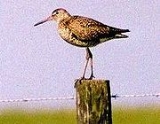
Hudsonian Godwit

Encyclopedia
The Hudsonian Godwit, Limosa haemastica, is a large shorebird.
and Alaska
, also on the shores of Hudson Bay
. They nest on the ground, in a well-concealed location in a marsh
y area. The female usually lays 4 eggs. Both parents look after the young birds, who find their own food and are able to fly within a month of birth.
to South America
. These birds gather at James Bay
before fall migration. In good weather, many birds make the trip south without stopping.
They can perhaps be most easily seen in migration on the east coast of North America at a place called South Beach in Chatham, MA where they can be plentiful in migration. Late July through early August appears to be the most plentiful time for the bird there and can be seen in the tens (usually a few individuals) to a hundred (rare) at a time.
Identification
Adults have long dark legs and a long pink bill with a slight upward curve and dark at the tip. The upper parts are mottled brown and the underparts are chestnut. The tail is black and the rump is white. They show black wing linings in flight.Breeding and Nesting
Their breeding habitat is the far north near the tree line in northwestern CanadaCanada
Canada is a North American country consisting of ten provinces and three territories. Located in the northern part of the continent, it extends from the Atlantic Ocean in the east to the Pacific Ocean in the west, and northward into the Arctic Ocean...
and Alaska
Alaska
Alaska is the largest state in the United States by area. It is situated in the northwest extremity of the North American continent, with Canada to the east, the Arctic Ocean to the north, and the Pacific Ocean to the west and south, with Russia further west across the Bering Strait...
, also on the shores of Hudson Bay
Hudson Bay
Hudson Bay , sometimes called Hudson's Bay, is a large body of saltwater in northeastern Canada. It drains a very large area, about , that includes parts of Ontario, Quebec, Saskatchewan, Alberta, most of Manitoba, southeastern Nunavut, as well as parts of North Dakota, South Dakota, Minnesota,...
. They nest on the ground, in a well-concealed location in a marsh
Marsh
In geography, a marsh, or morass, is a type of wetland that is subject to frequent or continuous flood. Typically the water is shallow and features grasses, rushes, reeds, typhas, sedges, other herbaceous plants, and moss....
y area. The female usually lays 4 eggs. Both parents look after the young birds, who find their own food and are able to fly within a month of birth.
Migration
They migrateBird migration
Bird migration is the regular seasonal journey undertaken by many species of birds. Bird movements include those made in response to changes in food availability, habitat or weather. Sometimes, journeys are not termed "true migration" because they are irregular or in only one direction...
to South America
South America
South America is a continent situated in the Western Hemisphere, mostly in the Southern Hemisphere, with a relatively small portion in the Northern Hemisphere. The continent is also considered a subcontinent of the Americas. It is bordered on the west by the Pacific Ocean and on the north and east...
. These birds gather at James Bay
James Bay
James Bay is a large body of water on the southern end of Hudson Bay in Canada. Both bodies of water extend from the Arctic Ocean. James Bay borders the provinces of Quebec and Ontario; islands within the bay are part of Nunavut...
before fall migration. In good weather, many birds make the trip south without stopping.
They can perhaps be most easily seen in migration on the east coast of North America at a place called South Beach in Chatham, MA where they can be plentiful in migration. Late July through early August appears to be the most plentiful time for the bird there and can be seen in the tens (usually a few individuals) to a hundred (rare) at a time.
External links
- Hudsonian Godwit - Limosa haemastica - USGS Patuxent Bird Identification InfoCenter
- Hudsonian Godwit Species Account - Cornell Lab of Ornithology
- Hudsonian Godwit Information and Photos - South Dakota Birds and Birding