

House Bunting

Encyclopedia
The House Bunting, Emberiza sahari, is a passerine
bird
in the bunting
family Emberizidae.
 It is a resident breeder of dry country from northwestern Africa
from Morocco
south to Mali
and east to Chad
. The House Bunting breeds around human habitation, laying 2–4 eggs in a nest in a hole in a wall or building. Its natural food consists of insects when feeding young, and otherwise seeds.
It is 14cm long, similar in size to the Striolated Bunting
and smaller than the Rock Bunting
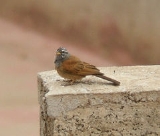
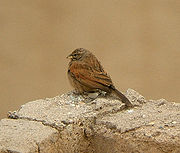
. The breeding male has a sandy orange-brown body and a grey head slightly dark-streaked but without the white supercilium that the Striolated Bunting has. The female's head has a brown tint to the grey, and more diffused streaking.
The House Bunting has recently been split from the closely related Striolated Bunting, of which it used to be treated as a subspecies, Emberiza striolata sahari. The Striolated Bunting has stronger facial striping and a paler belly than the House Bunting.
The incubation period of the clutch of 3 eggs is noted as 12–14 days.
The song, given from a perch, is similar to, but weaker than, that of the Chaffinch
.
In Morocco, the species is traditionally regarded as sacred, and has become very tame, freely entering and feeding inside houses, shops and mosques.
Passerine
A passerine is a bird of the order Passeriformes, which includes more than half of all bird species. Sometimes known as perching birds or, less accurately, as songbirds, the passerines form one of the most diverse terrestrial vertebrate orders: with over 5,000 identified species, it has roughly...
bird
Bird
Birds are feathered, winged, bipedal, endothermic , egg-laying, vertebrate animals. Around 10,000 living species and 188 families makes them the most speciose class of tetrapod vertebrates. They inhabit ecosystems across the globe, from the Arctic to the Antarctic. Extant birds range in size from...
in the bunting
Bunting (bird)
Buntings are a group of Eurasian and African passerine birds of the family Emberizidae.They are seed-eating birds with stubby, conical bills, and are the Old World equivalents of the species known in North America as sparrows...
family Emberizidae.
Africa
Africa is the world's second largest and second most populous continent, after Asia. At about 30.2 million km² including adjacent islands, it covers 6% of the Earth's total surface area and 20.4% of the total land area...
from Morocco
Morocco
Morocco , officially the Kingdom of Morocco , is a country located in North Africa. It has a population of more than 32 million and an area of 710,850 km², and also primarily administers the disputed region of the Western Sahara...
south to Mali
Mali
Mali , officially the Republic of Mali , is a landlocked country in Western Africa. Mali borders Algeria on the north, Niger on the east, Burkina Faso and the Côte d'Ivoire on the south, Guinea on the south-west, and Senegal and Mauritania on the west. Its size is just over 1,240,000 km² with...
and east to Chad
Chad
Chad , officially known as the Republic of Chad, is a landlocked country in Central Africa. It is bordered by Libya to the north, Sudan to the east, the Central African Republic to the south, Cameroon and Nigeria to the southwest, and Niger to the west...
. The House Bunting breeds around human habitation, laying 2–4 eggs in a nest in a hole in a wall or building. Its natural food consists of insects when feeding young, and otherwise seeds.
It is 14cm long, similar in size to the Striolated Bunting
Striolated Bunting
The Striolated Bunting is a passerine bird in the bunting family Emberizidae, a group now separated by most modern authors from the finches, Fringillidae.- Distribution and habitat :...
and smaller than the Rock Bunting
Rock Bunting
The Rock Bunting, Emberiza cia, is a passerine bird in the bunting family Emberizidae, a group now separated by most modern authors from the finches, Fringillidae.- Range :...
. The breeding male has a sandy orange-brown body and a grey head slightly dark-streaked but without the white supercilium that the Striolated Bunting has. The female's head has a brown tint to the grey, and more diffused streaking.
The House Bunting has recently been split from the closely related Striolated Bunting, of which it used to be treated as a subspecies, Emberiza striolata sahari. The Striolated Bunting has stronger facial striping and a paler belly than the House Bunting.
The incubation period of the clutch of 3 eggs is noted as 12–14 days.
The song, given from a perch, is similar to, but weaker than, that of the Chaffinch
Chaffinch
The Chaffinch , also called by a wide variety of other names, is a small passerine bird in the finch family Fringillidae.- Description :...
.
In Morocco, the species is traditionally regarded as sacred, and has become very tame, freely entering and feeding inside houses, shops and mosques.