
All Topics  
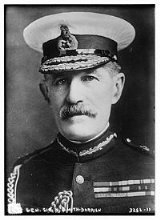
Horace Smith-Dorrien

 
Horace Smith Dorrien

   Email Print
   Bookmark   Link


Horace Smith-Dorrien


General
General

A General officer is an Officer of high military rank. The term or equivalent is used by nearly every country in the world. General can be used as a generic term for all grades of general officer, or it can specifically refer to a single rank that is just called general....
 Sir Horace Lockwood Smith-Dorrien GCB
Order of the Bath

The Most Honourable Order of the Bath is a United Kingdom order of chivalry founded by George I of Great Britain on 18 May 1725. The name derives from the medieval ceremony for creating a knight, which involved bathing as one of its elements....
, GCMG
Order of St Michael and St George

The Most Distinguished Order of Saint Michael and Saint George is a British order of chivalry founded on 28 April 1818 by George IV of the United Kingdom whilst he was acting as Prince Regent for his father, George III of the United Kingdom....
, DSO
Distinguished Service Order

The Distinguished Service Order is a military decoration of the United Kingdom, and formerly of other Commonwealth of Nations countries, awarded for meritorious or distinguished service by officers of the armed forces during wartime, typically in actual combat....
, ADC (26 May 1858 – 12 August 1930) was a British
United Kingdom

The United Kingdom of Great Britain and Northern Ireland, commonly known as the United Kingdom , the UK or Britain,is a sovereign state located off the northwestern coast of continental Europe....
 soldier and commander of the British II Corps
British II Corps

The British II Corps was formed in both World War I and World War II.During the Great War it was part of the original British Expeditionary Force , under the command of Sir Horace Smith-Dorrien, and remained on the Western Front throughout the war....
 and Second Army of the BEF
BEF

BEF can mean:*British Expeditionary Force or British Expeditionary Force *Brazilian Expeditionary Force*Bonus Army*Belgian franc, ISO 4217 currency code for the former currency of Belgium...
 during the Great War.

ce Smith-Dorrien was born at Haresfoot, Berkhamsted
Berkhamsted

Berkhamsted is a historic town which is situated in the west of Hertfordshire, between the towns of Tring and Hemel Hempstead. It is in the administrative district of Dacorum....
, the 11th child of 15. He was educated at Harrow
Harrow School

Harrow School, commonly known as "Harrow", is a world-famous boys' independent school in United Kingdom. Harrow has educated boys since 1243 but was officially founded by John Lyon under a Royal Charter of Elizabeth I in 1572....
, and on 26 February 1876 entered the Royal Military Academy Sandhurst
Royal Military Academy Sandhurst

The Royal Military Academy Sandhurst , commonly known simply as Sandhurst, is the British Army Commissioned officer initial training centre....
, passing out with a commission as a subaltern to the 95th (Derbyshire) Regiment of Foot
95th (Derbyshire) Regiment of Foot

The 95th Regiment of Foot was formed when the 95th Rifles were redesignated as The Rifle Brigade . In 1881, during the Childers Reforms, it was united with the 45th Regiment of Foot to form the Sherwood Foresters ....
.


Discussion
Ask a question about 'Horace Smith-Dorrien'
Start a new discussion about 'Horace Smith-Dorrien'
Answer questions from other users
Full Discussion Forum


Recent Posts


Encyclopedia


General
General

A General officer is an Officer of high military rank. The term or equivalent is used by nearly every country in the world. General can be used as a generic term for all grades of general officer, or it can specifically refer to a single rank that is just called general....
 Sir Horace Lockwood Smith-Dorrien GCB
Order of the Bath

The Most Honourable Order of the Bath is a United Kingdom order of chivalry founded by George I of Great Britain on 18 May 1725. The name derives from the medieval ceremony for creating a knight, which involved bathing as one of its elements....
, GCMG
Order of St Michael and St George

The Most Distinguished Order of Saint Michael and Saint George is a British order of chivalry founded on 28 April 1818 by George IV of the United Kingdom whilst he was acting as Prince Regent for his father, George III of the United Kingdom....
, DSO
Distinguished Service Order

The Distinguished Service Order is a military decoration of the United Kingdom, and formerly of other Commonwealth of Nations countries, awarded for meritorious or distinguished service by officers of the armed forces during wartime, typically in actual combat....
, ADC (26 May 1858 – 12 August 1930) was a British
United Kingdom

The United Kingdom of Great Britain and Northern Ireland, commonly known as the United Kingdom , the UK or Britain,is a sovereign state located off the northwestern coast of continental Europe....
 soldier and commander of the British II Corps
British II Corps

The British II Corps was formed in both World War I and World War II.During the Great War it was part of the original British Expeditionary Force , under the command of Sir Horace Smith-Dorrien, and remained on the Western Front throughout the war....
 and Second Army of the BEF
BEF

BEF can mean:*British Expeditionary Force or British Expeditionary Force *Brazilian Expeditionary Force*Bonus Army*Belgian franc, ISO 4217 currency code for the former currency of Belgium...
 during the Great War.

Early life and career

Horace Smith-Dorrien was born at Haresfoot, Berkhamsted
Berkhamsted

Berkhamsted is a historic town which is situated in the west of Hertfordshire, between the towns of Tring and Hemel Hempstead. It is in the administrative district of Dacorum....
, the 11th child of 15. He was educated at Harrow
Harrow School

Harrow School, commonly known as "Harrow", is a world-famous boys' independent school in United Kingdom. Harrow has educated boys since 1243 but was officially founded by John Lyon under a Royal Charter of Elizabeth I in 1572....
, and on 26 February 1876 entered the Royal Military Academy Sandhurst
Royal Military Academy Sandhurst

The Royal Military Academy Sandhurst , commonly known simply as Sandhurst, is the British Army Commissioned officer initial training centre....
, passing out with a commission as a subaltern to the 95th (Derbyshire) Regiment of Foot
95th (Derbyshire) Regiment of Foot

The 95th Regiment of Foot was formed when the 95th Rifles were redesignated as The Rifle Brigade . In 1881, during the Childers Reforms, it was united with the 45th Regiment of Foot to form the Sherwood Foresters ....
. On 1 November 1878, he was posted to South Africa where he worked as a transport officer. In this role he encountered, and fought against, corruption in the army.

Zulu Wars
Anglo-Zulu War

The Anglo-Zulu War was fought in 1879 between the British Empire and the Zulu Empire. From complex beginnings, the war is notable for several particularly bloody battles, as well as for being a landmark in the timeline of colonialism in the region....
: Smith-Dorrien was present at the Battle of Isandlwana
Battle of Isandlwana

The Battle of Isandlwana on 22 January 1879 was the opening, major encounter in the Anglo-Zulu War between the British Empire and the Zulu Kingdom....
 on 22 January 1879, serving with the British invasion force as a transport officer for the army's Royal Artillery
Royal Artillery

The Royal Artillery, is the common name for the Royal Regiment of Artillery, is an Arm of the British Army. Despite its name, it is made up of a number of regiments....
 detachment. As Zulu forces overran the British forces, Smith-Dorrien narrowly escaped on his transport pony. As such, Smith-Dorrien was one of fewer than fifty white survivors of the battle. His observations on the difficulty of opening ammunition boxes led to changes in British practice for the rest of the war, though modern commentators argue that this was not as an important factor in the defeat as was thought at the time. Because of his conduct in trying to help other soldiers during his dramatic escape from the battlefield, he was nominated for a Victoria Cross
Victoria Cross

The Victoria Cross is the highest military decoration which is, or has been, awarded for valour "in the face of the enemy" to members of the armed forces of various Commonwealth of Nations countries, and previous British Empire territories....
, but, as the nomination did not go through the proper channels, he never received it. He took part in the rest of that war.

Egypt
Egypt

Egypt is a country mainly in North Africa, with the Sinai Peninsula forming a land bridge in Western Asia. Covering an area of about , Egypt borders the Mediterranean Sea to the north, the Gaza Strip and Israel to the northeast, the Red Sea to the east, Sudan to the south and Libya to the west....
 1882–7
: He later served in Egypt
Egypt

Egypt is a country mainly in North Africa, with the Sinai Peninsula forming a land bridge in Western Asia. Covering an area of about , Egypt borders the Mediterranean Sea to the north, the Gaza Strip and Israel to the northeast, the Red Sea to the east, Sudan to the south and Libya to the west....
 on police duties, being appointed assistant chief of police in Alexandria on 22 August 1882. During this time, he forged a life-long friendship with Lord Kitchener. On 30 December 1885, he witnessed the Battle of Gennis, where the British Army fought in red coats for the last time. The next day he was given an independent command and, following a bold military action where he went beyond his orders, he was awarded the Distinguished Service Order
Distinguished Service Order

The Distinguished Service Order is a military decoration of the United Kingdom, and formerly of other Commonwealth of Nations countries, awarded for meritorious or distinguished service by officers of the armed forces during wartime, typically in actual combat....
.

From 1887–9, Smith-Dorrien then left active command to go to the Staff College, Camberley
Staff College, Camberley

Staff College, Camberley, Surrey, was a staff college for the British Army....
.

India
India

India, officially the Republic of India , is a country in South Asia. It is the List of countries and outlying territories by total area country by geographical area, the List of countries by population country, and the most populous liberal democracy in the world....
: He returned to his regiment
Regiment

A regiment is a military unit, composed of variable numbers of battalions, commanded by a Colonel. Depending on the nation, military branch, mission, and organization, a modern regiment resembles a brigade, in that both range in size from a few hundred to 5,000 soldiers ....
 where he commanded troops during the Tirah campaign
Tirah Campaign

The Tirah Campaign was an Indian frontier war in 1897-98. The Afridis had for sixteen years received a subsidy from the government of British India for the safeguarding of the Khyber Pass, in addition to which the government had maintained for this purpose a local regiment entirely composed of Afridis, who were stationed in the pass....
 of 1897–98.

Egypt
Egypt

Egypt is a country mainly in North Africa, with the Sinai Peninsula forming a land bridge in Western Asia. Covering an area of about , Egypt borders the Mediterranean Sea to the north, the Gaza Strip and Israel to the northeast, the Red Sea to the east, Sudan to the south and Libya to the west....
 and Sudan
Sudan

Sudan is a country in northeastern Africa. It is the largest in the African continent and the Arab World, and List of countries and outlying territories by total area by area....
: In 1898, he transferred back to Egypt and fought at the Battle of Omdurman
Battle of Omdurman

At the Battle of Omdurman , an army commanded by the United Kingdom General Sir Herbert Kitchener, 1st Earl Kitchener defeated the army of Abdullah al-Taashi, the successor to the self-proclaimed Mahdi Muhammad Ahmad....
 and commanded the British troops during the Fashoda incident
Fashoda Incident

The Fashoda Incident was the climax of empire territorial disputes between the United Kingdom of Great Britain and Ireland and French Third Republic in East Africa....
. During this time, he was promoted to the rank of Colonel
Colonel

Colonel is a military rank of a commissioned officer, with corresponding ranks existing in almost every country in the world. It is also used in some police forces and other paramilitary rank structures....
.

Second Boer War
Second Boer War

The Second Boer War , commonly referred to as The Boer War and also known as the South African War , the Anglo-Boer War and in Afrikaans as the Boereoorlog or Tweede Vryheidsoorlog , was fought from 11 October 1899 until 31 May 1902, between the British Empire and the two independent Boer republics of the Orange Fre...
: On 31 October 1899, he shipped to South Africa
South Africa

The Republic of South Africa, also known by Official names of South Africa, is a country located at the southern tip of the continent of Africa....
, arriving on 13 December. On 2 February 1900, Lord Roberts
Lord Roberts

Lord Roberts may refer to:*Frederick Roberts, 1st Earl Roberts, Anglo-Irish soldier of the British Army in the Victorian Era.*Roger Roberts, Baron Roberts of Llandudno, Welsh Liberal Democrat peer...
 put him in command of 19 Brigade and, on 11 February, he was promoted to Major-General. He played an important role at the Battle of Paardeberg
Battle of Paardeberg

The Battle of Paardeberg was a major battle during the Second Anglo-Boer War. It was fought near Paardeberg Drift on the banks of the Modder River in the Orange Free State near Kimberley, Northern Cape....
 (18 February to 27 February 1900), steering Lord Kitchener and Henry Colville away from tactics of attacking an entrenched enemy over open ground. At Sanna's Post
Sanna's Post

Sanna?s Post was an engagement fought during the Second Boer War between the British Empire and the Boers of the two independent republics of Orange Free State and South African Republic at ....
 (31 March 1900), Smith-Dorrien ignored inept orders from Colville to leave wounded largely unprotected and managed an orderly retreat without further casualties. He took part in the Battle of Leliefontein
Battle of Leliefontein

The Battle of Leliefontein was an engagement between Canadian and Boer forces during the Second Boer War on 7 November 1900, at the Komati River 30 km south of Belfast, Mpumalanga at the present day Maguga Dam....
 (7 November 1900). On 6 February 1901, Smith-Dorrien's troops were attacked in the Battle of Chrissiesmeer
Chrissiesmeer

Chrissiesmeer is a small town situated in a wetland area of Mpumalanga province in South Africa. The San inhabited this area along with the Tlou-tle people who lived on rafts in the larger lakes....
. Smith-Dorrien's qualities as a commander meant he was one of a very few British commanders to enhance his reputation during this war.

India
India

India, officially the Republic of India , is a country in South Asia. It is the List of countries and outlying territories by total area country by geographical area, the List of countries by population country, and the most populous liberal democracy in the world....
: On 22 April 1901, he received orders to return to India where he was made Adjutant General (6 November 1901) under Kitchener. He was placed in command of the 4th Division in Baluchistan, a post he held until 1907. In the dispute between Kitchener and Lord Curzon over the role of the Military Member, Smith-Dorrien stayed neutral, torn between his relations with Kitchener and with the Military Member himself, Sir Arthur Power Palmer.

Aldershot and other home postings

He returned to England to become GOC of the Aldershot
Aldershot

Aldershot is a town in the England county of Hampshire, located on heathland about 60 km southwest of London. The town is administered by Rushmoor Borough Council....
 training base. During this time, he instituted a number of reforms designed to improve the lot of the ordinary soldier. One was to abandon the practice of posting pickets to police the soldiers when they were outside the base. Another was to improve sports facilities. His reforms earned many plaudits (but were treated as an implied criticism by his predecessor, Sir John French
John French, 1st Earl of Ypres

Field Marshal John Denton Pinkstone French, 1st Earl of Ypres Order of St Patrick, Order of the Bath, Order of Merit, Royal Victorian Order, Order of St Michael and St George, Aide de Camp, Privy Council of the United Kingdom...
).

He improved the frequency and methods of training in marksmanship of all soldiers. During this period, the higher ranks of the army were divided on the best use of cavalry. Smith-Dorrien, along with Lord Roberts
Frederick Roberts, 1st Earl Roberts

Field Marshal Frederick Sleigh Roberts, 1st Earl Roberts, Victoria Cross, Order of the Garter, Order of St Patrick, Order of the Bath, Order of Merit , Order of the Star of India, Order of the Indian Empire, Privy Council of the United Kingdom was a distinguished Anglo-Irish soldier and one of the most successful commanders of the Victorian...
 and Sir Ian Hamilton
Ian Standish Monteith Hamilton

General Sir Ian Standish Monteith Hamilton Order of the Bath Order of St Michael and St George Distinguished Service Order Territorial Decoration was a general in the British Army and is most notably known for commanding the ill-fated Mediterranean Expeditionary Force during the Battle of Gallipoli....
 and others, doubted that cavalry could often be used as cavalry, thinking they would be more often deployed as mounted infantry. To this end, he took steps to improve the marksmanship of the cavalry. This did not endear him to the 'pro-cavalry' faction, which included French and Douglas Haig
Douglas Haig

Douglas Haig may refer to:*Douglas Haig, 1st Earl Haig, British Earl and a Field Marshall during the First World War*Club Atl?tico Douglas Haig, a football club from Argentina...
.

He also tried to get the army to purchase better machine-guns.

Although Smith-Dorrien was perfectly urbane and, by the standards of the day, kind-hearted towards his troops, he was notorious for furious outbursts of bad temper, which could last for hours before his equilibrium was restored. It has been suggested that the pain from a knee injury was one cause his ill temper.

In 1911, he was made Aide-de-Camp to King George V
George V of the United Kingdom

George V was the first British monarch belonging to the House of Windsor, which he created from the British branch of the German House of Saxe-Coburg and Gotha....
. He was part of the king's hunt in the Chitwan
Chitwan District

Chitwan District is one of the seventy-five Districts of Nepal of Nepal, a landlocked country of South Asia. The district is in the western part of Narayani Zone, Bharatpur, Nepal is its district headquarters....
 area of Nepal
Nepal

Nepal , officially the Federal Democratic Republic of Nepal, is a landlocked country in South Asia and is the world's youngest republic. It is bordered to the north by the People's Republic of China, and to the south, east, and west by India....
; on 19 December 1911, Smith-Dorrien killed a rhino and on the following day shot a bear.

On 1 March 1912, he was appointed GOC Southern Command and on 10 August 1912 he was promoted to full General
General

A General officer is an Officer of high military rank. The term or equivalent is used by nearly every country in the world. General can be used as a generic term for all grades of general officer, or it can specifically refer to a single rank that is just called general....
.

Unlike French, he was politically astute enough to avoid becoming entangled in the Curragh Incident
Curragh Incident

The Curragh Incident of 20 March 1914, also known as the Curragh Mutiny, occurred in the Curragh, County Kildare, Ireland. The Curragh Camp was then the main base for the British army in Ireland....
 of 1914.

World War I

With the outbreak of the Great War
World War I

World War I, or the First World War , was a global military conflict which involved the Great powers, organized into two opposing military alliances: the Allies of World War I and the Central Powers....
, he was given command of the Home Defence Army; however, following the sudden death of Sir James Grierson
James Grierson

File:British generals Sir John French, Grierson and Henderson with the French Minister of War, General le Brun.jpgLieutenant General Sir James Moncrieff Grierson Order of the Bath, Order of Saint Michael and Saint George, Royal Victorian Order, Aide de Camp was a British soldier....
, he was placed in charge of the British Expeditionary Force II Corps, by Lord Kitchener, the new Secretary of State for War
Secretary of State for War

The position of Secretary of State for War, commonly called War Secretary, was a United Kingdom Cabinet -level position, first applied to Henry Dundas ....
. Field Marshal Sir John French
John French, 1st Earl of Ypres

Field Marshal John Denton Pinkstone French, 1st Earl of Ypres Order of St Patrick, Order of the Bath, Order of Merit, Royal Victorian Order, Order of St Michael and St George, Aide de Camp, Privy Council of the United Kingdom...
 had wanted Sir Herbert Plumer
Herbert Plumer, 1st Viscount Plumer

Field Marshal Herbert Charles Onslow Plumer, 1st Viscount Plumer, Order of the Bath, Order of St Michael and St George, Royal Victorian Order, Order of the British Empire was a United Kingdom colony official and soldier born in Torquay....
 but Kitchener chose Smith-Dorrien as he knew he could stand up to French.

Smith-Dorrien's II Corps took the brunt of a heavy assault by the German forces at Mons
Battle of Mons

The Battle of Mons was the first major action of the British Expeditionary Force in World War I....
, with the Germans under von Kluck
Alexander von Kluck

Alexander Heinrich Rudolph von Kluck was a Germany general during World War I.Kluck was born in M?nster, Province of Westphalia. He saw service during the Austro-Prussian War of 1866 and the Franco-Prussian War....
 attempting a flanking manoeuvre. French ordered a general retreat, during which I Corps (under General Douglas Haig
Douglas Haig

Douglas Haig may refer to:*Douglas Haig, 1st Earl Haig, British Earl and a Field Marshall during the First World War*Club Atl?tico Douglas Haig, a football club from Argentina...
) and II Corps became separated. Haig's I Corps did not reach its intended position to the immediate east of Le Cateau.

Le Cateau
Battle of Le Cateau

The Battle of Le Cateau occurred on 26 August 1914, after the United Kingdom of Great Britain and Ireland, France and Belgium retreated from the Battle of Mons and set up defensive positions in a fighting withdrawal against the German advance at Le Cateau-Cambr?sis on 26 August....
 (26 August 1914)

Smith-Dorrien, now at Le Cateau
Battle of Le Cateau

The Battle of Le Cateau occurred on 26 August 1914, after the United Kingdom of Great Britain and Ireland, France and Belgium retreated from the Battle of Mons and set up defensive positions in a fighting withdrawal against the German advance at Le Cateau-Cambr?sis on 26 August....
, saw that his isolated forces were in danger of being overwhelmed in a piecemeal fashion. He decided instead to concentrate his corps, supplemented by Allenby's cavalry
Cavalry

The Cavalry is the second oldest of the Combat Arms, and as soldiers or warriors who fought mounted on horseback in combat, it represents the mobility and offensive power of the armed forces....
 and the 4th Division of Thomas D'Oyly Snow
Thomas D'Oyly Snow

Lieutenant-General Sir Thomas D?Oyly Snow Order of the Bath, Order of St Michael and St George was a United Kingdom General in the First World War who commanded during some of the major battles of the Western Front ....
. On 26 August 1914, he mounted a vigorous defensive action, a "stopping blow", which despite heavy casualties, halted the German advance. With the BEF saved, he resumed an orderly retreat.

His decision to stand and fight enraged French who accused Smith-Dorrien of jeopardising the whole BEF, an accusation which did not amuse Smith-Dorrien's fellow corps commander, Haig, who already believed French to be incompetent.

Smith-Dorrien's II Corps took part in the First Battle of the Marne
First Battle of the Marne

The First Battle of the Marne was a World War I battle fought between the 5th and 12th of September 1914. It resulted in a France-United Kingdom victory against the German Empire Wehrmacht under Chief of Staff Helmuth von Moltke the Younger....
 and the First Battle of the Aisne
First Battle of the Aisne

The First Battle of the Aisne was the Allies follow-up offensive against the right wing of the German First Army & German Second Army as they retreated after the First Battle of the Marne earlier in September 1914....
 before the British were moved north to be closer to their supply lines.

First Battle of Ypres

}|-||}The First Battle of Ypres, also called the Battle of Flanders, was the last major battle of the first year of World War I ; actually a series of battles, starting on 19 October and ending, according to the various histories, on 13 November , 22 November or 30 November ....

The battle for Hill 60
Battle of Hill 60 (Western Front)

The Battle of Hill 60 was a United Kingdom assault that was subsidiary to the Battle of Neuve Chapelle. Hill 60 was a low rise on the southern flank of the Ypres Salient and was named for the 60 metre contour which marked its bounds....
 was a notable struggle here. A defensive line at Neuve Chapelle
Battle of Neuve Chapelle

The Battles of Neuve Chapelle and Artois was a battle in the First World War. It was a British offensive in the Artois region and broke through at Neuve-Chapelle but they were unable to exploit the advantage....
 became known as the Smith-Dorrien Trench (or, sometimes, the Smith-Dorrien Line). On 26 December 1914, Smith-Dorrien took command of the Second Army
British Second Army

The British Second Army existed in both the First World War and Second World Wars....
.

Second Battle of Ypres

The Second Battle of Ypres was the first time Germany used chemical weapons on a large scale on the Western Front in World War I and the first time a former colonial force pushed back a major European power on European soil, which occurred in the battle of St....

In this battle, the British were defending an untenable salient. On 22 April 1915, the Germans used poison gas on the Western Front
Western Front

Western Front was a term used during the World War I and World War II world war to describe the "contested armed frontier" between lands controlled by Germany to the East and the Allies to the West....
 for the first time and heavy casualties were sustained. On 27 April, Smith-Dorrien recommended withdrawal to a more defensible front line. On 30 April, Haig wrote in his diary
Sir John also told me Smith-Dorrien had caused him much trouble. 'He was quite unfit [(he said)] to hold the Command of an Army' so Sir J. had withdrawn all troops from him control except the II Corps. Yet Smith-D. stayed on! [He would not resign!] French is to ask Lord Kitchener to find something to do at home. … He also alluded to Smith-Dorrien's conduct on the retreat, and said he ought to have tried him by Court Martial, because (on the day of Le Cateau) he 'had ordered him to retire at 8 am and he did not attempt to do so [but insisted on fighting in spite of his orders to retire]'.


French used the 'pessimism' of the withdrawal recommendation as an excuse to sack Smith-Dorrien on 6 May. His replacement, Herbert Plumer
Herbert Plumer, 1st Viscount Plumer

Field Marshal Herbert Charles Onslow Plumer, 1st Viscount Plumer, Order of the Bath, Order of St Michael and St George, Royal Victorian Order, Order of the British Empire was a United Kingdom colony official and soldier born in Torquay....
, then recommended a withdrawal almost identical to that proposed by Smith-Dorrien, which French accepted. In December 1915, French himself was removed by Kitchener; Douglas Haig then replaced French as commander of the BEF.

French later wrote a partial and inaccurate account of the opening of the war in his book 1914, which attacked Smith-Dorrien. Smith-Dorrien, as a serving officer, was denied permission to reply in public.

Remainder of the war

After a period in Britain, Smith-Dorrien was assigned a command to fight the Germans in German East Africa
German East Africa

German East Africa was a German Empire colony in East Africa, including what is now Burundi, Rwanda and Tanganyika . It measured 994,996 km? in size or nearly three times the size of re-united Germany today....
 (present day Tanzania
Tanzania

Tanzania , officially the United Republic of Tanzania , is a country in East Africa that is bordered by Kenya and Uganda on the north, Rwanda, Burundi and the Democratic Republic of the Congo on the west, and Zambia, Malawi and Mozambique on the south....
, Rwanda
Rwanda

The Republic of Rwanda is a small landlocked country in the Great Lakes region of east-central Africa, bordered by Uganda, Burundi, the Democratic Republic of the Congo and Tanzania....
, and Burundi
Burundi

Burundi , officially the Republic of Burundi, is a small country in the Great Lakes region of Eastern Africa bordered by Rwanda to the north, Tanzania to the south and east, and the Democratic Republic of the Congo to the west....
) but pneumonia contracted during the voyage to South Africa prevented him from taking command. His former adversary, Jan Smuts
Jan Smuts

Field Marshal Jan Christiaan Smuts, Order of Merit, Companion of Honour, Privy Counsellor, Efficiency Decoration, King's Counsel, Royal Society, Order of the Tower and Sword was a prominent South African and British Commonwealth of Nations statesman, military leader and philosopher....
, took on this command. Smith-Dorrien took no significant military part in the rest of the war. On 29 January 1917, Smith-Dorrien was appointed lieutenant of the Tower of London
Tower of London

Her Majesty's Royal Palace and Fortress, more commonly known as the Tower of London , is a historic monument in central London, England, on the north bank of the River Thames....
.

Final years

His next position was as Governor of Gibraltar
Governor of Gibraltar

The Governor and Commander-in-Chief of Gibraltar is the representative of the British monarch in the British overseas territories of Gibraltar. The Governor is appointed by the Monarchy of the United Kingdom on the advice of the Her Majesty's Government....
 from 9 July 1918 – 26 May 1923, where he introduced an element of democracy and closed some brothels. According to Wyndham Childs
Wyndham Childs

Major-General Sir Borlase Elward Wyndham Childs Order of St Michael and St George Order of the British Empire Order of the Bath was a British Army officer who also served as Assistant Commissioner of Police of the Metropolis from 1921 to 1928....
 in the summer of 1918, Horace tried, and nearly succeeded, in uniting the Comrades of the Great War
Comrades of the Great War

The Comrades of The Great War were formed in 1917 as a non-political association to represent the rights of ex-service men and women who had served or had been discharged from service during The Great War....
, the National Association of Discharged Sailors and Soldiers, and the National Federation of Discharged and Demobilized Sailors and Soldiers into one body. The merger later took place in 1921 to form the British Legion
The Royal British Legion

The Royal British Legion, sometimes referred to as simply The Legion, is the United Kingdom's leading Charitable organization providing financial, social and emotional support to millions who have served or who are currently serving in the British Armed Forces, and their dependants....
.

He retired in September 1923, living in Portugal and then England. He devoted much his time to the welfare and remembrance of Great War soldiers. He worked on his memoirs, which were published in 1925. As French was still alive at the time of writing, he still felt unable to rebut 1914. Despite his treatment by French, in 1925, he acted as a pallbearer at French's funeral, an act appreciated by French's son.

He played himself in the film The Battle of Mons, released in 1926..

He died on 12 August 1930 following injuries sustained in a car accident in Chippenham
Chippenham

Chippenham could be either of these places in the UK:* Chippenham, Wiltshire* Chippenham, CambridgeshireSee also:* Virginia State Route 150, also known as Chippenham Parkway, USA...
, Wiltshire; he was 72 years old. He is buried in Berkhamsted
Berkhamsted

Berkhamsted is a historic town which is situated in the west of Hertfordshire, between the towns of Tring and Hemel Hempstead. It is in the administrative district of Dacorum....
.

Family

Horace married Olive Crofton Schneider in 1902 at St Peter's, Eaton Square
Eaton Square

Eaton Square is a residential garden square in London's exclusive Belgravia district. It is one of the three garden squares built by the Grosvenor family when they developed the main part of Belgravia in the 19th century, and is named after Eaton Hall, the Grosvenor country house in Cheshire....
, London. Olive's mother was stepsister to Gen. Sir Arthur Power Palmer, GCB, GCIE. They had three sons:
  • Grenfell Horace Gerald Smith-Dorrien (born 1904) served in the army, reaching the rank of Brigadier. He was killed on 13 September 1944 during the Italian campaign. His grave is in the Gradara War Cemetery, in the Commune of Gradara
    Gradara

    Gradara is a town and commune in the province of Pesaro and Urbino, in the region of Marche in central Italy. It is located 25 km from Rimini and 13 km from Pesaro....
     in the Province of Pesaro and Urbino..
  • Peter Lockwood Smith-Dorrien (born 1907) was killed in the King David Hotel bombing
    King David Hotel bombing

    The King David Hotel bombing was an attack by the right-wing Zionism underground movement, the Irgun, on the central offices of the Secretariat of the Government of Palestine and Headquarters of the British Forces in Palestine and Transjordan, which were located at the King David Hotel in Jerusalem....
     on 22 July 1946.
  • David Pelham Smith-Dorrien (born 29 October 1911) appears to have been an actor in the 1930s. He worked to keep alive his father's reputation, designing a first-day cover commemorating the Battle of Le Cateau.. He died around 1999.


Horace and Olive, in effect, adopted the two daughters of Palmer (Gabrielle and unknown), who were left homeless after his death in 1912.

During WWI, Olive (Lady Smith-Dorrien) founded the Lady Smith-Dorrien's Hospital Bag Fund. A problem had been identified that wounded soldiers often became separated from their personal effects while in hospital. Volunteers for the fund sewed between 40,000 and 60,000 bags a month to hold soldiers' valuables, totalling around five million throughout the war. For this work, she was awarded the DBE
Order of the British Empire

The Most Excellent Order of the British Empire is a United Kingdom order of chivalry established on 4 June 1917 by George V of the United Kingdom....
 in 1916. She also played a leading role the animal welfare charity, The Blue Cross
The Blue Cross

The Blue Cross is a registered animal welfare charitable organization in the United Kingdom, founded in 1897. The charity provides support for pet owners who cannot afford private veterinary treatment, helps to find homes for unwanted animals, and educates the public in the responsibilities of animal ownership....
, alleviating the suffering of war horses. For her services in that field, she received the gold medal of the Reconnaissance franηaise. In 1932, she became Principal of the Royal School of Needlework
Royal School of Needlework

The Royal School of Needlework is a London hand embroidery school founded in 1872.The School is based at Hampton Court Palace and is engaged in textile restoration and conservation, as well as training professional embroiderers through 3-year apprenticeships....
 (RSN). In 1937, she was awarded the King George VI Coronation Medal
King George VI Coronation Medal

The King George VI Coronation Medal was a commemorative medal made to celebrate the coronation of George VI of the United Kingdom. For Coronation and Jubilee medals, the practice up until 1977 was that United Kingdom authorities decided on a total number to be produced, then allocated a proportion to each of the Commonwealth of Nations count...
 for work done in Westminster Abbey
Westminster Abbey

The Collegiate Church of St Peter at Westminster, which is almost always referred to popularly and informally as Westminster Abbey, is a large, mainly Gothic architecture Church , in Westminster, London, just to the west of the Palace of Westminster....
. During the Second World War, she led the RSN in collecting lace which was sold for the war effort. She also revived the manufacture of hospital bags. She died on 15 September 1951.

Legacy

The following memorials have been established:
  • Stall plate 14 in the Henry VII Chapel of Westminster Abbey
    Westminster Abbey

    The Collegiate Church of St Peter at Westminster, which is almost always referred to popularly and informally as Westminster Abbey, is a large, mainly Gothic architecture Church , in Westminster, London, just to the west of the Palace of Westminster....
     (1913)
  • Dorrien, a vineyard area in South Australia (1916)
  • Mount Smith-Dorrien, Canada (1918)
  • Smith-Dorrien Institute in Aldershot
    Aldershot

    Aldershot is a town in the England county of Hampshire, located on heathland about 60 km southwest of London. The town is administered by Rushmoor Borough Council....
  • Smith Dorrien Road, Leicester
    Leicester

    Leicester is a city status in the United Kingdom and unitary authority area in the East Midlands of England. It is the county town of Leicestershire....
  • Smith Dorrien Avenue, Smith Dorrien Bridge and Smith Dorrien House, Gibraltar
    Gibraltar

    Gibraltar is a British overseas territory located near the southernmost tip of the Iberian Peninsula overlooking the Strait of Gibraltar. The territory shares a border with Spain to the north....
  • Smith Dorrien Street, Mitcham, South Australia
    Mitcham, South Australia

    Mitcham is a suburb of Adelaide in the City of Mitcham.Created as a village separate from Adelaide , it was ancillary to a sheep station at Brown Hill Creek belonging to the South Australia Company....


In 1931, after his death, the Smith-Dorrien Memorial was added to the Sherwood Foresters Memorial in Crich
Crich

Crich is a village in Derbyshire in England. It is the home of the National Tramway Museum inside the Crich Tramway Village, and at the summit of Crich Hill above, a Memorial Tower for those of the Sherwood Foresters regiment who died in battle, particularly in World War I....
, Derbyshire, which Smith-Dorrien himself had opened on 6 August 1923.

John Betjeman
John Betjeman

Sir John Betjeman, Order of the British Empire was an English poet, writer and Broadcasting who described himself in Who's Who as a "poet and hack"....
, mentions Horace in Chapter III "Highgate" of his autobiographical blank-verse poem Summoned by Bells
Summoned by Bells

Summoned by Bells, the blank verse autobiography by John Betjeman, describes his life from his early memories of a middle class home in Edwardian era Hampstead, London to his premature departure from Magdalen College, Oxford....
:

In late September, in the conker time,
When Poperinghe and Zillebeke and Mons
Boomed with five-nines, large sepia gravures
Of French, Smith-Dorrien and Haig were given
Gratis with each half-pound of Brooke Bond tea.


Horace also features in the poem "Canada to England" by Craven Langstroth Betts
Craven Langstroth Betts

Craven Langstroth Betts was a Canada poet and author....
:
Lead out, lead out, Brave Mother, for the sake of sacked Louvain!
Give us our own Smith-Dorrien, yield us the van again!


Further reading

Principal references
  • Ballard, C, Smith-Dorrien, London: Constable and Co Ltd, 1931. — This is largely a condensed version of Smith-Dorrien's autobiography but for the first time included material from Smith-Dorrien's defence against French's allegations in 1914, now that both Smith-Dorrien and French had died.
  • Beckett. Dr. Ian F, The Judgement of History: Lord French, Sir Horace Smith-Dorrien and 1914 Tom Donovan Publishing, 1993; ISBN 1-871085-15-2 — The bulk of this book is Smith-Dorrien's privately circulated rebuttal of French's criticisms of Smith-Dorrien's actions at Ypres. Useful introductory essay by Dr. Beckett.
  • Beckett. Dr. Ian F, Corvi, Steven J. (editors) Haig's Generals Pen & Sword, 2006 ISBN 1-84415-169-7 — Includes a 25-page chapter by Steven Corvi with an emphasis on Smith-Dorrien's contributions to the Great War
  • Fortescue, John William, Sir
    John William Fortescue

    The Hon. Sir John William Fortescue was a British statesman and historian. He was the Librarian and Archivist at Windsor Castle and historian of the British Army....
    , 'Horace Smith-Dorrien' in Following the Drum Blackwood & Sons, Edinburgh, 1931, pp251–98.
  • Smith-Dorrien, Sir Horace, Memories of Forty-Eight Years' Service, John Murray, 1925. — Sir Horace's autobiography.
  • Smithers, A J, The Man Who Disobeyed: Sir Horace Smith-Dorrien and His Enemies, London: Leo Cooper, 1970 ISBN 0-85052-030-4 — Only modern biography.
Theses
  • Corvi, Steven J. General Sir Horace Lockwood Smith-Dorrien: Portrait of a Victorian Soldier in Modern War, unpublished PhD thesis, Northwestern University
    Northwestern University

    Northwestern University is a non-sectarian private university research university located in Evanston, Illinois and downtown Chicago, Illinois, United States....
     (Boston), 2002
  • Siem, Richard Forging the Rapier among Scythes: Lieutenant-General Sir Horace Smith-Dorrien and the Aldershot Command 1907-1912, unpublished MA dissertation, Rice University
    Rice University

    William Marsh Rice University is a private university research university located in Houston, Texas, Texas, United States. The campus is located near the Houston Museum District and adjacent to the Texas Medical Center....
     (Houston), 1980
Archives relating to Smith-Dorrien
  • (correspondence with Smith-Dorrien)
  • (manuscript letter to Simpson-Baikie from Gen Sir Horace Lockwood Smith-Dorrien on adverse comments about Smith-Dorrien in 1914 John French, 1st Viscount of Ypres, 1920 and typescript letter from Professor Robert Clifford Walton concerning Smith-Dorrien, 1972)
Other references
  • Altham, E. A., Sir. The principles of war historically illustrated. With an introduction by General Sir Horace L. Smith-Dorrien 1914.
  • Anon. Report on the 4th (Quetta) Division Staff Ride Under the Direction of Lieut.-General H.L. Smith-Dorrien C.B., D.S.O., Commanding 4th (Quetta) Division, May 1907 4th (Quetta) Divisional Press, 1907. (This was a five-day exercise conducted around Gulistan and north to Chaman
    Chaman

    Chaman is located in Qilla Abdullah District, Balochistan , Pakistan. Chaman is situated on the border with Afghanistan. Across the border in Afghanistan is the town of Spin Boldak in the province of Kandahar....
     on the North-West Frontier
    North-West Frontier Province

    File:Makra Peak by Khalid Mahmood.jpgThe North-West Frontier Province is the smallest of the Subdivisions of Pakistan of Pakistan. The NWFP is home to the majority Pashtuns as well as other smaller ethnic groups....
    , involving an imaginary war with Russia
    Russia

    Russia , or the Russian Federation , is a list of countries spanning more than one continent country extending over much of northern Eurasia....
    .)
  • Childs, Wyndham
    Wyndham Childs

    Major-General Sir Borlase Elward Wyndham Childs Order of St Michael and St George Order of the British Empire Order of the Bath was a British Army officer who also served as Assistant Commissioner of Police of the Metropolis from 1921 to 1928....
     Episodes and reflections: being some records from the life of Major-General Sir Wyndham Childs, K.C.M.G., K.B.E., C.B., one time second lieut., 2nd Volunteer Battalion, the Duke of Cornwall's Light Infantry Cassell, 1930
  • Gilson, Capt. Charles J. L. History of the 1st Battalion Sherwood Foresters (Notts. and Derby Regt.) in the Boer War 1899–1902 Swan Sonnenschein & Co. Ltd. 1908. Introduction by Lieut.-Gen. Sir H L. Smith Dorrien. Reprinted by . Much of this introduction can be read in
  • Holmes, Richard The Little Field Marshal: A Life of Sir John French Weidenfeld & Nicolson, 2004 ISBN 0-297-84614-0 — Includes a good account of French's relationship with Smith-Dorrien.
  • Paice, Edward Tip and Run: The Untold Tragedy of the Great War in Africa Weidenfeld & Nicolson, 2007, ISBN-10: 0-297-84709-0 ISBN-13: 978-0297847090 – Has some details of S-D's involvement with the East African campaign
  • [Pilcher, Major-General T. D.] A General's Letters to His Son on Obtaining His Commission Introduction by Sir Horace Smith-Dorrien. Cassell, 1917 (Author is uncredited in the book itself.)
  • Winnifrith, Douglas Percy The Church in the Fighting Line: With General Smith-Dorrien at the Front, Being the Experiences of a Chaplain in charge of an Infantry Brigade London, Hodder and Stoughton, 1915


External links

  • Photographic portraits in the collection of the
  • , his birthplace, now a school
  • by Henry Newbolt
    Henry Newbolt

    Sir Henry John Newbolt, Order of the Companions of Honour was an England poet and Minister of Information. He is best remembered for Vita? Lampada, a lyrical piece used for propaganda purposes during the First World War....
     (1916)