


Honshu-Shikoku Bridge Project

Encyclopedia
The Honshū-Shikoku Bridge Project is a system of bridge
s connecting the islands of Honshū
and Shikoku
across the Inland Sea of Japan
, which were previously only connected by ferry. It consists of three major connections. All bridges are now controlled by the and the . The system consists of three expressways and their respective bridge systems.
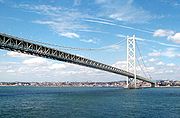 The eastern expressway was completed in 1998. Crossing the Akashi Strait, this connection links Hyōgo Prefecture
on Honshū with Tokushima Prefecture
on Shikoku, using Awaji Island
for most of its length. The route connects to the Sanyō Expressway
at its northern terminus, allowing traffic to connect to Himeji, Kobe
, and other major cities on Honshū.
This connection uses two suspension bridge
s. The more well-known of the two is the Akashi-Kaikyō Bridge, the world's longest suspension bridge, which connects Kobe to Awaji Island
. The other bridge is the Ōnaruto Bridge, connecting Awaji to the city of Naruto
across the Naruto Strait
.
Although the connection was initially designed to accommodate railway service as well as road traffic, economic considerations turned it into a road connection only.
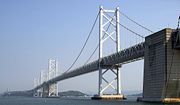 The central expressway was completed in 1988. Also known as the Great Seto Bridge
, this line connects Okayama Prefecture
to Kagawa Prefecture
. A series of six major bridges and five viaducts are used. The six bridges are: the Shimotsui-Seto Bridge
, Hitsuishijima Bridge
, Iwakurojima Bridge
, Yoshima Bridge
, Kita Bisan-Seto Bridge
, and Minami Bisan-Seto Bridge
.
The Seto-Chūō bridges are also used by JR
trains (Seto-Ōhashi Line), and are designed to accommodate high-speed Shinkansen
service in the future, although there are no current plans to extend the Shinkansen to Shikoku.
 The western expressway was competed in 1999. Commonly known as the Shimanami Kaidō, this connection links Hiroshima Prefecture
to Ehime Prefecture
. The link consists of nine bridges: the Shin-Onomichi Bridge, Innoshima Bridge
, Ikuchi Bridge, Tatara Bridge
, Ōmishima Bridge, Hakata-Ōshima Bridge, and the three-part Kurushima-Kaikyō Bridge
. It is the only route which can be crossed on bicycle
or foot.
Bridge
A bridge is a structure built to span physical obstacles such as a body of water, valley, or road, for the purpose of providing passage over the obstacle...
s connecting the islands of Honshū
Honshu
is the largest island of Japan. The nation's main island, it is south of Hokkaido across the Tsugaru Strait, north of Shikoku across the Inland Sea, and northeast of Kyushu across the Kanmon Strait...
and Shikoku
Shikoku
is the smallest and least populous of the four main islands of Japan, located south of Honshū and east of the island of Kyūshū. Its ancient names include Iyo-no-futana-shima , Iyo-shima , and Futana-shima...
across the Inland Sea of Japan
Japan
Japan is an island nation in East Asia. Located in the Pacific Ocean, it lies to the east of the Sea of Japan, China, North Korea, South Korea and Russia, stretching from the Sea of Okhotsk in the north to the East China Sea and Taiwan in the south...
, which were previously only connected by ferry. It consists of three major connections. All bridges are now controlled by the and the . The system consists of three expressways and their respective bridge systems.
Kobe-Awaji-Naruto Expressway
Hyogo Prefecture
is a prefecture of Japan located in the Kansai region on Honshū island. The capital is Kobe.The prefecture's name was previously alternately spelled as Hiogo.- History :...
on Honshū with Tokushima Prefecture
Tokushima Prefecture
is a prefecture of Japan located on Shikoku island. The capital is the city of Tokushima.- Tokushima Prefecture and Myodo Prefecture :Long ago, Tokushima City belonged to a region known as Myōdō-gun...
on Shikoku, using Awaji Island
Awaji Island
is an island in Hyōgo Prefecture, Japan, in the eastern part of the Seto Inland Sea between the islands of Honshū and Shikoku. The island has an area of 592.17 km²...
for most of its length. The route connects to the Sanyō Expressway
Sanyo Expressway
The is an expressway in Japan, running from Kobe through Hiroshima along the Inland Sea and terminating in Yamaguchi Prefecture. The entire length of the expressway was opened in 1997...
at its northern terminus, allowing traffic to connect to Himeji, Kobe
Kobe
, pronounced , is the fifth-largest city in Japan and is the capital city of Hyōgo Prefecture on the southern side of the main island of Honshū, approximately west of Osaka...
, and other major cities on Honshū.
This connection uses two suspension bridge
Suspension bridge
A suspension bridge is a type of bridge in which the deck is hung below suspension cables on vertical suspenders. Outside Tibet and Bhutan, where the first examples of this type of bridge were built in the 15th century, this type of bridge dates from the early 19th century...
s. The more well-known of the two is the Akashi-Kaikyō Bridge, the world's longest suspension bridge, which connects Kobe to Awaji Island
Awaji Island
is an island in Hyōgo Prefecture, Japan, in the eastern part of the Seto Inland Sea between the islands of Honshū and Shikoku. The island has an area of 592.17 km²...
. The other bridge is the Ōnaruto Bridge, connecting Awaji to the city of Naruto
Naruto, Tokushima
is a city in Tokushima Prefecture, Japan.In the quinquennial census of 2010, the city had a population of 61,522 . With a total area of the population density is 454 persons per km².The city was founded on March 15, 1947....
across the Naruto Strait
Naruto Strait
is a strait between Awaji Island and Shikoku in Japan. It connects Harima nada, the eastern part of the Inland Sea and Kii Channel. A famous feature of the strait is the Naruto whirlpools. Ōnaruto Bridge, the southern part of Akashi-Kaikyo Bridge crosses over it....
.
Although the connection was initially designed to accommodate railway service as well as road traffic, economic considerations turned it into a road connection only.
Seto-Chūō Expressway
Great Seto Bridge
The , or Seto-Ohashi Bridge, is a series of double deck bridges connecting Okayama and Kagawa prefectures in Japan across a series of five small islands in the Seto Inland Sea. Built over the period 1978–88, it is one of the three routes of the Honshū-Shikoku Bridge Project connecting Honshū and...
, this line connects Okayama Prefecture
Okayama Prefecture
is a prefecture of Japan located in the Chūgoku region on Honshū island. The capital is the city of Okayama.- History :During the Meiji Restoration, the area of Okayama Prefecture was known as Bitchū Province, Bizen Province and Mimasaka Province.- Geography :...
to Kagawa Prefecture
Kagawa Prefecture
is a prefecture of Japan located on Shikoku island. The capital is Takamatsu.- History :Kagawa was formerly known as Sanuki Province.For a brief period between August 1876 and December 1888, Kagawa was made a part of Ehime Prefecture.-Battle of Yashima:...
. A series of six major bridges and five viaducts are used. The six bridges are: the Shimotsui-Seto Bridge
Shimotsui-Seto Bridge
The is a suspension bridge with a center span of which connects Honshū with the island of Hitsuishijima. It is the 22nd largest suspension bridge in the world. The span carries roadway and the Seto-Ōhashi Line railway tracks...
, Hitsuishijima Bridge
Hitsuishijima Bridge
The is a cable-stayed bridge with a center span of . The span carries roadway and the Seto-Ōhashi Line railway tracks. It is immediately north of the identical...
, Iwakurojima Bridge
Iwakurojima Bridge
The is a cable-stayed bridge with a center span of . The span carries roadway and the Seto-Ōhashi Line railway tracks. It is immediately south of the identical...
, Yoshima Bridge
Yoshima Bridge
The is a truss bridge with a main span of and a total of 5 spans. The span carries roadway and the Seto-Ōhashi Line railway tracks. It is immediately south of the and...
, Kita Bisan-Seto Bridge
Kita Bisan-Seto Bridge
The is a suspension bridge with a center span of . It is the 19th largest suspension bridge in the world. The span carries roadway and the Seto-Ōhashi Line railway tracks. It is part of the Seto-Shuo Expressway and with the other five bridges along this route are collectively known as the...
, and Minami Bisan-Seto Bridge
Minami Bisan-Seto Bridge
The is a suspension bridge with a center span of . It is the 13th longest suspension bridge span in the world. The span carries roadway and the Seto-Ōhashi Line railway tracks. It is part of the Seto-Chuo Expressway and with the other five bridges along this route are collectively known as the...
.
The Seto-Chūō bridges are also used by JR
Shikoku Railway Company
, commonly known as , is one of the constituent companies of Japan Railways Group . It operates intercity rail services in the four prefectures on the island of Shikoku in Japan. The company is headquartered in Takamatsu, Kagawa Prefecture.- Lines :...
trains (Seto-Ōhashi Line), and are designed to accommodate high-speed Shinkansen
Shinkansen
The , also known as THE BULLET TRAIN, is a network of high-speed railway lines in Japan operated by four Japan Railways Group companies. Starting with the Tōkaidō Shinkansen in 1964, the network has expanded to currently consist of of lines with maximum speeds of , of Mini-shinkansen with a...
service in the future, although there are no current plans to extend the Shinkansen to Shikoku.
Nishiseto Expressway
Hiroshima Prefecture
is a prefecture of Japan located in the Chūgoku region on Honshu island. The capital is the city of Hiroshima.- History :The area around Hiroshima was formerly divided into Bingo Province and Aki Province. This location has been a center of trade and culture since the beginning of Japan's recorded...
to Ehime Prefecture
Ehime Prefecture
is a prefecture in northwestern Shikoku, Japan. The capital is Matsuyama.-History:Until the Meiji Restoration, Ehime prefecture was known as Iyo Province...
. The link consists of nine bridges: the Shin-Onomichi Bridge, Innoshima Bridge
Innoshima Bridge
The is a Japanese suspension bridge, part of the 59 kilometer Nishi-Seto Expressway linking the islands of Honshū and Shikoku in the joint region of Suworen—Kokurū. Completed in 1983, it has a main span of and connects Mukaishima, Hiroshima with Innoshima, Hiroshima.-External links:*...
, Ikuchi Bridge, Tatara Bridge
Tatara Bridge
The is a cable-stayed bridge that is part of the Nishiseto Expressway, commonly known as the Shimanami Kaidō しまなみ海道. The bridge has a center span of . As of 2010 it has the fourth longest main span of any cable-stayed bridge after the Sutong Bridge...
, Ōmishima Bridge, Hakata-Ōshima Bridge, and the three-part Kurushima-Kaikyō Bridge
Kurushima-Kaikyo Bridge
The , which connects the island of Ōshima to the main part of Shikoku, is the world's longest suspension bridge structure and was completed in 1999. The bridge is part of the Shimanami Kaidō, an expressway that spans a series of islands and connects Hiroshima Prefecture in Honshū to Ehime...
. It is the only route which can be crossed on bicycle
Bicycle
A bicycle, also known as a bike, pushbike or cycle, is a human-powered, pedal-driven, single-track vehicle, having two wheels attached to a frame, one behind the other. A person who rides a bicycle is called a cyclist, or bicyclist....
or foot.