
Home      Discussion      Topics      Dictionary      Almanac
Signup       Login
Homebrewing

Homebrewing

Overview

Discussion
Ask a question about 'Homebrewing'
Start a new discussion about 'Homebrewing'
Answer questions from other users
Full Discussion Forum
 
Unanswered Questions
Recent Discussions
Encyclopedia

Homebrewing is the brewing
Brewing
Brewing is the production of beer through steeping a starch source in water and then fermenting with yeast. Brewing has taken place since around the 6th millennium BCE, and archeological evidence suggests that this technique was used in ancient Egypt...

 of beer
Beer
Beer is the world's most widely consumed andprobably oldest alcoholic beverage; it is the third most popular drink overall, after water and tea. It is produced by the brewing and fermentation of sugars, mainly derived from malted cereal grains, most commonly malted barley and malted wheat...

, wine
Wine
Wine is an alcoholic beverage, made of fermented fruit juice, usually from grapes. The natural chemical balance of grapes lets them ferment without the addition of sugars, acids, enzymes, or other nutrients. Grape wine is produced by fermenting crushed grapes using various types of yeast. Yeast...

, sake, mead
Mead
Mead , also called honey wine, is an alcoholic beverage that is produced by fermenting a solution of honey and water. It may also be produced by fermenting a solution of water and honey with grain mash, which is strained immediately after fermentation...

, cider
Cider
Cider or cyder is a fermented alcoholic beverage made from apple juice. Cider varies in alcohol content from 2% abv to 8.5% abv or more in traditional English ciders. In some regions, such as Germany and America, cider may be termed "apple wine"...

, perry
Perry
Perry is an alcoholic beverage made from fermented pears. Perry has been common for centuries in Britain, particularly in the Three Counties of Gloucestershire, Herefordshire and Worcestershire, and in parts of south Wales; and France, especially Normandy and Anjou.In more recent years, commercial...

 and other beverages through fermentation on a small scale as a hobby
Hobby
A hobby is a regular activity or interest that is undertaken for pleasure, typically done during one's leisure time.- Etymology :A hobby horse is a wooden or wickerwork toy made to be ridden just like a real horse...

 for personal consumption, free distribution at social gatherings, amateur brewing competitions or other non-commercial reasons. Both alcoholic and non-alcoholic beverages can be made at home.

Brewing on a domestic level has been done for thousands of years, but has been subject to regulation and prohibition. Restrictions on homebrewing were lifted in the UK in 1963, Australia followed suit in 1972, and the USA in 1978, though individual states were allowed to pass their own laws limiting production.

The legality of homebrewing varies from country to country, and some countries limit the volume an individual can legally brew. Fewer countries allow distillation
Distillation
Distillation is a method of separating mixtures based on differences in volatilities of components in a boiling liquid mixture. Distillation is a unit operation, or a physical separation process, and not a chemical reaction....

 of alcohol
Distilled beverage
A distilled beverage, liquor, or spirit is an alcoholic beverage containing ethanol that is produced by distilling ethanol produced by means of fermenting grain, fruit, or vegetables...

 in the home.

History


Alcohol
Alcohol
In chemistry, an alcohol is an organic compound in which the hydroxy functional group is bound to a carbon atom. In particular, this carbon center should be saturated, having single bonds to three other atoms....

 has been brewed domestically throughout its 7,000-year history beginning in Mesopotamia
Mesopotamia
Mesopotamia is a toponym for the area of the Tigris–Euphrates river system, largely corresponding to modern-day Iraq, northeastern Syria, southeastern Turkey and southwestern Iran.Widely considered to be the cradle of civilization, Bronze Age Mesopotamia included Sumer and the...

 (modern Iraq), Egypt and China. Knowledge of brewing beer and wine was passed on from the Egyptians to the Greeks and finally to the Romans.

Mass production of brewed beverages began in the 18th century with the Industrial Revolution
Industrial Revolution
The Industrial Revolution was a period from the 18th to the 19th century where major changes in agriculture, manufacturing, mining, transportation, and technology had a profound effect on the social, economic and cultural conditions of the times...

. New innovations, like thermometer
Thermometer
Developed during the 16th and 17th centuries, a thermometer is a device that measures temperature or temperature gradient using a variety of different principles. A thermometer has two important elements: the temperature sensor Developed during the 16th and 17th centuries, a thermometer (from the...

s and hydrometer
Hydrometer
A hydrometer is an instrument used to measure the specific gravity of liquids; that is, the ratio of the density of the liquid to the density of water....

s, allowed increases in efficiency. French microbiologist Louis Pasteur
Louis Pasteur
Louis Pasteur was a French chemist and microbiologist born in Dole. He is remembered for his remarkable breakthroughs in the causes and preventions of diseases. His discoveries reduced mortality from puerperal fever, and he created the first vaccine for rabies and anthrax. His experiments...

 explained the role of yeast in beer fermentation in 1857, allowing brewers to develop strains of yeast with desirable properties (conversion efficiency, ability to handle higher alcohol content).

While the sale or consumption of commercial alcohol was never prohibited in the UK, throughout the first half of the 20th century, homebrewing was circumscribed by tax
Tax
To tax is to impose a financial charge or other levy upon a taxpayer by a state or the functional equivalent of a state such that failure to pay is punishable by law. Taxes are also imposed by many subnational entities...

ation and prohibition. One of the earliest, modern attempts to regulate private production that affected this era was the Inland Revenue Act of 1880 in the United Kingdom
United Kingdom
The United Kingdom of Great Britain and Northern IrelandIn the United Kingdom and Dependencies, other languages have been officially recognised as legitimate autochthonous languages under the European Charter for Regional or Minority Languages...

; this required a 5-shilling
Shilling
The shilling is a unit of currency used in some current and former British Commonwealth countries. The word shilling comes from scilling, an accounting term that dates back to Anglo-Saxon times where it was deemed to be the value of a cow in Kent or a sheep elsewhere. The word is thought to derive...

 homebrewing license.

In the UK, on April 1963, the UK Chancellor of the Exchequer
Chancellor of the Exchequer
The Chancellor of the Exchequer is the title held by the British Cabinet minister who is responsible for all economic and financial matters. Often simply called the Chancellor, the office-holder controls HM Treasury and plays a role akin to the posts of Minister of Finance or Secretary of the...

, Reggie Maudling
Reginald Maudling
Reginald Maudling was a British politician who held several Cabinet posts, including Chancellor of the Exchequer. He had been spoken of as a prospective Conservative leader since 1955, and was twice seriously considered for the post; he was Edward Heath's chief rival in 1965...

 removed the need for the 1880 brewing license. Australia
Australia
Australia , officially the Commonwealth of Australia, is a country in the Southern Hemisphere comprising the mainland of the Australian continent, the island of Tasmania, and numerous smaller islands in the Indian and Pacific Oceans. It is the world's sixth-largest country by total area...

 followed suit in 1972, when Gough Whitlam
Gough Whitlam
Edward Gough Whitlam, AC, QC , known as Gough Whitlam , served as the 21st Prime Minister of Australia. Whitlam led the Australian Labor Party to power at the 1972 election and retained government at the 1974 election, before being dismissed by Governor-General Sir John Kerr at the climax of the...

 repealed Australian law prohibiting the brewing of all but the weakest beers and wines as one of his first acts as Prime Minister
Prime minister
A prime minister is the most senior minister of cabinet in the executive branch of government in a parliamentary system. In many systems, the prime minister selects and may dismiss other members of the cabinet, and allocates posts to members within the government. In most systems, the prime...

.

In 1920, the United States outlawed the manufacture and consumption of alcoholic beverages "for beverage purposes." As a result of Prohibition
Prohibition in the United States
Prohibition in the United States was a national ban on the sale, manufacture, and transportation of alcohol, in place from 1920 to 1933. The ban was mandated by the Eighteenth Amendment to the Constitution, and the Volstead Act set down the rules for enforcing the ban, as well as defining which...

, breweries, vinyards, and distilleries across the United States
United States
The United States of America is a federal constitutional republic comprising fifty states and a federal district...

 were closed down or placed into service making malt
Malt
Malt is germinated cereal grains that have been dried in a process known as "malting". The grains are made to germinate by soaking in water, and are then halted from germinating further by drying with hot air...

 for non-alcoholic purposes. During prohibition, home wine-making was treated more leniently as the result of a 1920 IRS ruling that loosened standards for allowable alcohol content for wine and cider but not for beer. Homebrewing of beer having an alcohol content higher than 0.5% remained illegal until 1978 when Congress passed a bill repealing Federal restrictions and excise taxes on the homebrewing of small amounts of beer and wine. Jimmy Carter
Jimmy Carter
James Earl "Jimmy" Carter, Jr. is an American politician who served as the 39th President of the United States and was the recipient of the 2002 Nobel Peace Prize, the only U.S. President to have received the Prize after leaving office...

, 39th President of the United States
President of the United States
The President of the United States of America is the head of state and head of government of the United States. The president leads the executive branch of the federal government and is the commander-in-chief of the United States Armed Forces....

, signed the bill, H.R. 1337, into law in October 1978; however, the bill left individual states free to pass their own laws limiting production.

In the United Kingdom, many pioneers were home winemakers owing to the greater availability of information and ingredients. These included CJJ Berry
Cyril Berry
Cyril J J Berry , widely cited as CJJ Berry, is best known as the author of the popular book First Steps in Winemaking, which has sold more than three million copies worldwide....

, who co-founded the first wine brewing circle in Hampshire
Hampshire
Hampshire is a county on the southern coast of England in the United Kingdom. The county town of Hampshire is Winchester, a historic cathedral city that was once the capital of England. Hampshire is notable for housing the original birthplaces of the Royal Navy, British Army, and Royal Air Force...

 and three other English counties. Berry also produced the Amateur Winemaker magazine and published First Steps in Winemaking, and Home Brewed Beers and Stouts. Another early proponent of homebrewing was Dave Line
Dave Line
Dave Line was a British beer author. An electrical engineer by profession, he is regarded as a pioneer in homebrewing during the 1970s because at the time homebrewing as a hobby was in its infancy...

, who after also writing for Amateur Winemaker wrote The Big Book of Brewing in 1974.

The United States, having an established home winemaking culture, moved rapidly into the brewing of beer. Within months of legalization, Charlie Papazian
Charlie Papazian
Charles N. "Charlie" Papazian is an American nuclear engineer who founded the Association of Brewers and the Great American Beer Festival, and wrote The Complete Joy of Home Brewing. Papazian is the current president of the Brewers Association...

 founded the Association of Brewers (now Brewers Association and American Homebrewers Association). In 1984, Papazian published The Complete Joy of Home Brewing. This and Line's work remain in print to this day alongside later publications such as Graham Wheeler's Home Brewing: The CAMRA Guide.

Brewing culture


People homebrew for a variety of reasons. Homebrewing can be cheaper than buying commercially equivalent beverages; it allows people to adjust recipes according to their own tastes creating beverages that are unavailable on the open market or low-ethanol beverages that may contain fewer calories. Many people enjoy entering homebrew competitions, sometimes referred to as "craft brewing", and homebrewing has developed various homebrewing clubs and competitions. The Beer Judge Certification Program
Beer Judge Certification Program
The Beer Judge Certification Program or BJCP is a non-profit organization formed in 1985 "to promote beer literacy and the appreciation of real beer, and to recognize beer tasting and evaluation skills." It has been described in the press as a "hands-on ... study program designed to teach aspiring...

 or BJCP is an American organization which sanctions beer, mead, and cider homebrew competitions, certifies judges, and offers categories for judging; these judging categories are called "Beer Style Guidelines" and are written by the BJCP Style Committee. Similar British organizations are The National Guild of Wine and Beer Judges, who have judging categories for both beer, and wine; and the National Association of Wine and Beermakers (Amateur) - (NAWB), who have held an annual show every year since 1959.

Legality


Country Homebrewing Home distillation
Germany Legal. 200 liters of beer per household per year may be produced without taxation, but notification of the local customs office is necessary. Larger quantities are taxed according to law.  
Czech Republic Legal. 200 Liters per household per year of beer, including notification of the customs office. 2000 liters of wine household per year. Not permitted although every household can distill fermented fruit only, up to 30 liters per year in a local distillery, for personal use only.
Poland Legal for personal use only, not for sale. Prohibited
Sweden Legal for personal use only, not for sale.  
Ireland Legal for personal use. Illegal with intent to sell or if sold for profit. Illegal except for officially licensed and regulated distilleries.
Finland Legal for personal use only.  
United Kingdom Legal in unlimited quantity for domestic consumption only. Fermented products for sale must include payment of alcohol duty and registration with HM Revenue and Customs. Legal with a license to distill granted by the government.
Canada Legal in most Canadian provinces. Liquor laws are regulated provincially, while the federal government has laws about taxation and importation of beer, wine and other liquors.  
United States Individual states remain free to restrict or prohibit the manufacture of beer, mead, hard cider, wine and other alcoholic beverages at home. For example, Ala. Code § 28-1-1 addresses the illegal manufacture of alcoholic beverages in Alabama, and no other provision of Alabama law provides an exception for personal use brewing. However, several homebrew stores operate in Alabama, so the status of homebrewing as an enforcement priority with the Alabama Alcoholic Control Board is unknown.

However, most states permit homebrewing, allowing 100 gallons of beer per person over the age of 21 per year and up to a maximum of 200 gallons per household annually when there are two or more adults over the age of 21 residing in the household. Because alcohol is taxed by the federal government via excise taxes
Excise
Excise tax in the United States is a indirect tax on listed items. Excise taxes can be and are made by federal, state and local governments and are far from uniform throughout the United States...

, homebrewers are restricted from selling any beer they brew. This similarly applies in most Western countries. Many homebrewing related articles and books mistakenly claim that, in 1979, President Jimmy Carter
Jimmy Carter
James Earl "Jimmy" Carter, Jr. is an American politician who served as the 39th President of the United States and was the recipient of the 2002 Nobel Peace Prize, the only U.S. President to have received the Prize after leaving office...

 signed into law a bill explicitly allowing home beers and winemaking, which was at the time illegal as a holdover from the prohibition
Prohibition
Prohibition of alcohol, often referred to simply as prohibition, is the practice of prohibiting the manufacture, transportation, import, export, sale, and consumption of alcohol and alcoholic beverages. The term can also apply to the periods in the histories of the countries during which the...

 of alcoholic beverages (repealed in 1933). In fact, the U.S. Congress passed an Act in 1978 exempting a certain amount of beer brewed for personal or family use from taxation. The change also exempted home brewers from posting a "penal bond
Surety bond
A surety bond is a promise to pay one party a certain amount if a second party fails to meet some obligation, such as fulfilling the terms of a contract...

" (which is currently $1000.00) which had the prohibitive effect of economically preventing brewers of small quantities from pursuing their hobby. President Carter signed the Act, which addressed other issues as well.
Varies by state
Australia Legal for individuals to manufacture their own alcohol without paying excise with two provisions, that they do not employ the use of a still, and that they do not sell the product. A license is required to own a still larger than 5 liters regardless of whether it is being used to produce alcohol. To operate any size still for the production of alcohol (even for personal use) requires a license and excise must be paid. The rate, as of March 2011, is in excess of $71 (AUD
Australian dollar
The Australian dollar is the currency of the Commonwealth of Australia, including Christmas Island, Cocos Islands, and Norfolk Island, as well as the independent Pacific Island states of Kiribati, Nauru and Tuvalu...

) per liter of alcohol produced.
New Zealand Legal for personal use, not for selling without a license Legal since 1996 to distill spirits for personal consumption, not for selling without a license.
South Africa Legal for home brewed beers in unlimited quantities for personal use only, not for sale or barter, without any required permits or licenses. Registration as a "manufacturer not for commercial use" at the South African Revenue Service
South African Revenue Service
The South African Revenue Service is the revenue service of the South African government. It was established by legislation to collect revenue and ensure compliance with tax law...

 (SARS) is required to produce wine at home.
Registration and a permit are required to own, operate, or have a still in one's possession. Producing distilled spirits at home is limited "for own use" only and products may not be sold, or used for barter
Barter
Barter is a method of exchange by which goods or services are directly exchanged for other goods or services without using a medium of exchange, such as money. It is usually bilateral, but may be multilateral, and usually exists parallel to monetary systems in most developed countries, though to a...

ing.

As of 2010 "agricultural distilling" permits are no longer available. Commercial operations require a micro-manufacturing license (for quantities up to 2 million liters of spirits per year), and various other permits are required. For larger quantities, a full manufacturing license and various permits are required.
Singapore Legal up to 30 liters per household per month. Brewers must be 18 years of age or older, and the brewing process must not "degrade the environment". The product must not be sold. Legal only with a license.
Hong Kong Legal without a license within limits.  
Japan Legal up to 1% alcohol by volume only; suppliers sell homebrewing equipment and kits, leaving it up to the customer to brew within the law. Illegal.
Malaysia Illegal. Illegal.
Iran Illegal although Iranians do it in their homes. Illegal.
India Illegal. Illegal.

Beverages


At present, several beverages are frequently brewed at home. These include beer
Beer
Beer is the world's most widely consumed andprobably oldest alcoholic beverage; it is the third most popular drink overall, after water and tea. It is produced by the brewing and fermentation of sugars, mainly derived from malted cereal grains, most commonly malted barley and malted wheat...

, wine
Wine
Wine is an alcoholic beverage, made of fermented fruit juice, usually from grapes. The natural chemical balance of grapes lets them ferment without the addition of sugars, acids, enzymes, or other nutrients. Grape wine is produced by fermenting crushed grapes using various types of yeast. Yeast...

 and cider
Cider
Cider or cyder is a fermented alcoholic beverage made from apple juice. Cider varies in alcohol content from 2% abv to 8.5% abv or more in traditional English ciders. In some regions, such as Germany and America, cider may be termed "apple wine"...

, but also other fermented beverages such as ginger beer
Ginger beer
Ginger beer is a carbonated drink that is flavored primarily with ginger and sweetened with sugar or artificial sweeteners.-History:Brewed ginger beer originated in England in the mid-18th century and became popular in Britain, the United States, and Canada, reaching a peak of popularity in the...

, kombucha
Kombucha
Kombucha is an effervescent tea-based beverage that is often drunk for its anecdotal health benefits or medicinal purposes. Kombucha is available commercially and can be made at home by fermenting tea using a visible, solid mass of yeast and bacteria which forms the kombucha culture, often referred...

, chicha
Chicha
For the musical genre, see Peruvian cumbiaChicha is a term used in some regions of Latin America for several varieties of fermented and non-fermented beverages, rather often to those derived from maize and similar non-alcoholic beverages...

, kumis
Kumis
Kumis, also spelled kumiss or koumiss in English is a fermented dairy product traditionally made from mare's milk. The drink remains important to the peoples of the Central Asian steppes, of Turkic and Mongol origin: Bashkirs, Kazakhs, Kyrgyz, Yakuts, Mongols and Kalmyks...

, pulque
Pulque
Pulque, or octli, is a milk-colored, somewhat viscous alcoholic beverage made from the fermented sap of the maguey plant, and is a traditional native beverage of Mexico. The drink’s history extends far back into the Mesoamerican period, when it was considered sacred, and its use was limited to...

, chhaang
Chhaang
Chhaang or chang is a Tibetan/Sherpa/Limbu/Newari alcoholic beverage also popular in parts of eastern Himalayas.-Geographical prevalence:...

, kvass
Kvass
Kvass, kvas, quass or gira, gėra is a fermented beverage made from black...

, sake, sonti, mead
Mead
Mead , also called honey wine, is an alcoholic beverage that is produced by fermenting a solution of honey and water. It may also be produced by fermenting a solution of water and honey with grain mash, which is strained immediately after fermentation...

 and others.

Beer


In general, brewing beer at home is very similar to brewing commercially. Homebrewers can select from ingredients identical to those used in commercial brewing, in addition to a wide range of post-market customization. The basic ingredients that are necessary include Water, Malt, Hops, and Yeast. With the exception of water (although minerality, pH, and other characteristics do play a role and careful water selection is recommended, any water will do) there are countless varieties of these ingredients.

Cider


Cider is normally fermented apple juice
Apple juice
Apple juice is a fruit juice manufactured by the maceration and pressing of apples. The resulting expelled juice may be further treated by enzymatic and centrifugal clarification to remove the starch and pectin, which holds fine particulate in suspension, and then pasteurized for packaging in...

 which can be freshly pressed or bought as a commercially available kit containing apple syrup and yeast
Yeast
Yeasts are eukaryotic micro-organisms classified in the kingdom Fungi, with 1,500 species currently described estimated to be only 1% of all fungal species. Most reproduce asexually by mitosis, and many do so by an asymmetric division process called budding...

 but can be many other fruits including pear (perry
Perry
Perry is an alcoholic beverage made from fermented pears. Perry has been common for centuries in Britain, particularly in the Three Counties of Gloucestershire, Herefordshire and Worcestershire, and in parts of south Wales; and France, especially Normandy and Anjou.In more recent years, commercial...

) or plums (plum jerkum
Plum jerkum
Plum jerkum is a type of fruit wine produced from plums, similar in the manner to which cider and perry are made. The drink is native to areas of central England such as Warwickshire and the Cotswolds....

). The addition of yeast to freshly pressed apples is not vital as apples contain an amount of natural yeast however most homebrewers add yeast to ensure the process works well as each variety of apple contains different amounts of yeast.

Kilju


Kilju ("sugar wine") is a Finnish
Finland
Finland , officially the Republic of Finland, is a Nordic country situated in the Fennoscandian region of Northern Europe. It is bordered by Sweden in the west, Norway in the north and Russia in the east, while Estonia lies to its south across the Gulf of Finland.Around 5.4 million people reside...

 home-made alcoholic beverage
Alcoholic beverage
An alcoholic beverage is a drink containing ethanol, commonly known as alcohol. Alcoholic beverages are divided into three general classes: beers, wines, and spirits. They are legally consumed in most countries, and over 100 countries have laws regulating their production, sale, and consumption...

 made primarily from water, sugar
Sugar
Sugar is a class of edible crystalline carbohydrates, mainly sucrose, lactose, and fructose, characterized by a sweet flavor.Sucrose in its refined form primarily comes from sugar cane and sugar beet...

, and yeast
Yeast
Yeasts are eukaryotic micro-organisms classified in the kingdom Fungi, with 1,500 species currently described estimated to be only 1% of all fungal species. Most reproduce asexually by mitosis, and many do so by an asymmetric division process called budding...

.

Mead


Mead (icon; archaic and dialectal "medd"; from Old English "meodu"), also called honey wine, is an alcoholic beverage
Alcoholic beverage
An alcoholic beverage is a drink containing ethanol, commonly known as alcohol. Alcoholic beverages are divided into three general classes: beers, wines, and spirits. They are legally consumed in most countries, and over 100 countries have laws regulating their production, sale, and consumption...

 that is produced by fermenting
Ethanol fermentation
Ethanol fermentation, also referred to as alcoholic fermentation, is a biological process in which sugars such as glucose, fructose, and sucrose are converted into cellular energy and thereby produce ethanol and carbon dioxide as metabolic waste products...

 a solution of honey
Honey
Honey is a sweet food made by bees using nectar from flowers. The variety produced by honey bees is the one most commonly referred to and is the type of honey collected by beekeepers and consumed by humans...

 and water.

Homebrewing kits


Homebrewing kits come in many different types and from many different manufacturers. A local homebrew store may create some of their own kits by packaging materials together. Most kits come with a full set of instructions for brewing. These instructions, sometimes called recipes, may vary widely in the amount of instruction given. For instance, many all-grain kits assume a familiarity with the brewing process and so may give fewer specific instructions on the general process. Many advanced brewers prefer to design and perfect their own recipes rather than buy kits. Kits may or may not include yeast.

All-grain


For brewers with equipment and knowledge about the brewing process, all-grain kits include all the ingredients necessary to create homebrew from beginning to end. Most kits include grain and hops, some kits may also include yeast. A full set of instructions is generally included. What sets these kits apart from others is the inclusion of milled malted grain which must first undergo a mash
Mashing
In brewing and distilling, mashing is the process of combining a mix of milled grain , known as the "grain bill", and water, known as "liquor", and heating this mixture...

 to extract the sugars necessary for fermentation. A full boil is then required, with hop additions at different times depending on style.

Malt extract


Some kits contain a concentrated malt extract rather than grain. Malt extract can be either dry or in a syrupy, liquid form. A few advanced kits may also come with a small amount of milled, malted grain that must be steeped with the wort before boiling. A grain bag is usually included to facilitate this process. These additional grains help add different character to the beer so that a single extract can be used to brew several varieties of beer. A full boil is required, with hop additions at different times depending on style.

Pre-hopped malt extract


Sometimes known as beer in a can, no-boil, and hopped wort, these beer kits contain liquid malt extract that has already been boiled with hops to introduce bitterness and flavor. Pre-hopped kits simplify the brewing process by removing the need to add hops at specific times during the boil. Some kits may not require a boil at all, though this may increase the risk of off flavors in the resulting beer due to contamination from bacteria and wild yeasts. Generally, the quality of beer from these kits can be on par with commercial beer or homebrew made from other methods.

Brewing process


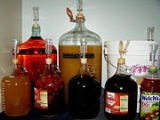
Primary fermentation in homebrewing takes place in large glass or plastic carboy
Carboy
A carboy is a rigid container with a typical capacity of 5 to 15 gallons . Carboys are primarily used for transporting fluids, often water or chemicals.They are also used for in-home fermentation of beverages, often wine.-Brewing:...

s or food-grade plastic buckets, nearly always sealed. When sealed, the fermenter is stoppered with a fermentation lock
Fermentation lock
The fermentation lock or airlock is a device used in beer brewing and wine making that allows carbon dioxide released by the beer to escape the fermenter, while not allowing air to enter the fermenter, thus avoiding oxidation....

 which allows the carbon dioxide
Carbon dioxide
Carbon dioxide is a naturally occurring chemical compound composed of two oxygen atoms covalently bonded to a single carbon atom...

 gas produced to vent, while preventing other gasses and particles from entering. During this time, temperatures should be kept at optimum temperature for the particular yeast strain being used. For ale
Ale
Ale is a type of beer brewed from malted barley using a warm fermentation with a strain of brewers' yeast. The yeast will ferment the beer quickly, giving it a sweet, full bodied and fruity taste...

 this temperature is usually 18–24 °C (64.4–75.2 F);
for lager
Lager
Lager is a type of beer made from malted barley that is brewed and stored at low temperatures. There are many types of lager; pale lager is the most widely-consumed and commercially available style of beer in the world; Pilsner, Bock, Dortmunder Export and Märzen are all styles of lager...

 it is usually much colder, around 10 °C (50 °F); wine will start fermenting around 20 °C (68 °F); cider between 15–18 °C (59–64.4 F). A vigorous fermentation then takes place, usually starting within twelve hours and continuing over the next few days. During this stage, the fermentable sugars (maltose
Maltose
Maltose , or malt sugar, is a disaccharide formed from two units of glucose joined with an αbond, formed from a condensation reaction. The isomer "isomaltose" has two glucose molecules linked through an α bond. Maltose is the second member of an important biochemical series of glucose chains....

, glucose
Glucose
Glucose is a simple sugar and an important carbohydrate in biology. Cells use it as the primary source of energy and a metabolic intermediate...

, and sucrose
Sucrose
Sucrose is the organic compound commonly known as table sugar and sometimes called saccharose. A white, odorless, crystalline powder with a sweet taste, it is best known for its role in human nutrition. The molecule is a disaccharide composed of glucose and fructose with the molecular formula...

) are consumed by the yeast, while ethanol
Ethanol
Ethanol, also called ethyl alcohol, pure alcohol, grain alcohol, or drinking alcohol, is a volatile, flammable, colorless liquid. It is a psychoactive drug and one of the oldest recreational drugs. Best known as the type of alcohol found in alcoholic beverages, it is also used in thermometers, as a...

 and carbon dioxide
Carbon dioxide
Carbon dioxide is a naturally occurring chemical compound composed of two oxygen atoms covalently bonded to a single carbon atom...

 are produced as byproducts by the yeast. A layer of sediment, the lees
Lees (fermentation)
Lees refers to deposits of dead yeast or residual yeast and other particles that precipitate, or are carried by the action of "fining", to the bottom of a vat of wine after fermentation and ageing. The yeast deposits in beer brewing are known as trub...

 or "trub", appears at the bottom of the fermenter, composed of heavy fats, proteins and inactive yeast. Often, the brew is moved to a second fermenting vessel after primary fermentation called a secondary fermenter. This secondary fermentation process is often utilized by more advanced home brewers to enhance flavor. While not required, it is generally practiced by home brewers who wish to age or clarify their beer by removing it from the sediment left behind by primary fermentation.

Upon conclusion of fermentation, the beer is carbonated before it is consumed. This is typically done in one of two ways; force carbonation in a keg
Keg
A keg is a small barrel.Traditionally, a wooden keg is made by a cooper used to transport items such as nails, gunpowder., and a variety of liquids....

 using compressed carbon dioxide, or bottle carbonation with priming sugar. Any bottle that is able to withstand the pressure of carbonation can be used, such as used beer bottles, flip-top bottles with rubber stoppers such as Grolsch, or even plastic bottles such as soda bottles, provided they are properly sanitized. Priming briefly reactivates the yeast that remains in the bottle, carbonating the brew. Homebrewed beers and lagers are typically unfiltered (filtering improves visual appearance of the product, but reduces its shelf life and complicates carbonation.)

Beer


The principles behind the process of homebrewing beer are similar to commercial brewing
Brewing
Brewing is the production of beer through steeping a starch source in water and then fermenting with yeast. Brewing has taken place since around the 6th millennium BCE, and archeological evidence suggests that this technique was used in ancient Egypt...

. A hopped wort
Wort (brewing)
Wort, , is the liquid extracted from the mashing process during the brewing of beer or whisky. Wort contains the sugars that will be fermented by the brewing yeast to produce alcohol.- Production :...

 is produced and yeast pitched into the wort to stimulate fermentation. The complexity of the process is mostly determined by the approach used to manufacture the wort; by far the simplest method is kit brewing.
Whether the homebrewer chooses to mash his own grains or chooses to purchase malt extracts, the homebrewer will then need to boil the liquid and add hops. The length of time the wort boils with the hops varies depending on the style of beer
Beer style
Beer style is a term used to differentiate and categorize beers by various factors such as colour, flavour, strength, ingredients, production method, recipe, history, or origin....

 being brewed but overall boil times are usually an hour.

A partial mash differs from an extract brew in that the extract remains enzymatically active. Unlike dead malts where some of the starch has been converted to sugar via the action of heat and the natural enzymes have been destroyed, wheat and unmalted extracts need the help of enzymes to convert their starches into sugars.

The next step up from extract brewing is to use a diastatically active malt extract to convert starches from other beer adjuncts such as flaked and torrified barleys, flaked wheat, and wheat flour into fermentable sugars. These extracts are currently only available in the canned form. Unmalted barleys and wheats can add extra "body" to a finished beer.

Advanced homebrewers forgo the use of concentrated extract and instead extract sugars from the grains themselves. The wort is made by making a mash from crushed malt
Malt
Malt is germinated cereal grains that have been dried in a process known as "malting". The grains are made to germinate by soaking in water, and are then halted from germinating further by drying with hot air...

ed barley
Barley
Barley is a major cereal grain, a member of the grass family. It serves as a major animal fodder, as a base malt for beer and certain distilled beverages, and as a component of various health foods...

 (or alternative grain adjuncts such as unmalted barley, wheat
Wheat
Wheat is a cereal grain, originally from the Levant region of the Near East, but now cultivated worldwide. In 2007 world production of wheat was 607 million tons, making it the third most-produced cereal after maize and rice...

, oats
OATS
OATS - Open Source Assistive Technology Software - is a source code repository or "forge" for assistive technology software. It was launched in 2006 with the goal to provide a one-stop “shop” for end users, clinicians and open-source developers to promote and develop open source assistive...

, corn
Maize
Maize known in many English-speaking countries as corn or mielie/mealie, is a grain domesticated by indigenous peoples in Mesoamerica in prehistoric times. The leafy stalk produces ears which contain seeds called kernels. Though technically a grain, maize kernels are used in cooking as a vegetable...

 or rye
Rye
Rye is a grass grown extensively as a grain and as a forage crop. It is a member of the wheat tribe and is closely related to barley and wheat. Rye grain is used for flour, rye bread, rye beer, some whiskeys, some vodkas, and animal fodder...

) and hot water. This requires a vessel known as a mash tun, which is often insulated. The process is often referred to as all grain brewing.

In one procedure popular with homebrewers called the "Infusion Mash", milled grains are combined in the tun and hot water is added. Before being combined with the grains, the water is heated to a temperature that is hotter than the desired temperature for enzymatic activity. The reason the liquor is heated is to compensate for the fact that the grains are cooler than the desired temperature.

The grains are infused with yet hotter water to rinse more sugars from the mash in a process known as sparging. The sparging process will also stop any further enzymatic activity if much hotter water is used; conversely the mash may be heated to around 80 °C (176 °F) to end such activity prior to placing it in the lauter-tun, and to prevent cooler grain from lowering the sparge water temperature to a lower than desirable figure.

The resulting wort is then boiled, usually for 60-90 minutes. Hops are added at different times during the boil, depending on the desired result. Hops added at the beginning of the boil contribute bitterness, hops added in the last thirty minutes contribute flavor. Hops added in the last few minutes or even after the end of the boil contribute both flavor and hop aroma. These hop additions are generally referred to as bittering, flavor, and aroma additions respectively. Finings
Finings
FiningsThe term is a mass noun rather than a plural. are substances that are usually added at or near the completion of the processing of brewing wine, beer and various nonalcoholic juice beverages. Their purpose is for removal of organic compounds; to either improve clarity or adjust flavor/aroma...

 such as Irish Moss
Irish moss
Chondrus crispus, known under the common name Irish moss, or carrageen moss , is a species of red algae which grows abundantly along the rocky parts of the Atlantic coast of Europe and North America...

, a form of seaweed, and others can be added in the final 15–30 minutes of the boil to help prevent haze in the resulting beer. After primary fermentation, the beer may be moved to a secondary fermentation vessel to allow the beer more time to clarify and to reduce the possibility of off flavors due to dead yeast bodies and other sediment. Secondary fermentation vessels are often where brewers choose to add flavoring agents like orange peel, oak chips or even more hops (so-called "dry hopping).

Carbonation


In homebrewing, over carbonation
Carbonation
Carbonation is the process of dissolving carbon dioxide in water. The process usually involves carbon dioxide under high pressure. When the pressure is reduced, the carbon dioxide is released from the solution as small bubbles, which cause the solution to "fizz." This effect is seen in carbonated...

 can be dangerous; it can result in bottles gushing or even exploding. Adding priming sugar or malt
Malt
Malt is germinated cereal grains that have been dried in a process known as "malting". The grains are made to germinate by soaking in water, and are then halted from germinating further by drying with hot air...

 extract at bottling time to beer that has had its fermentable sugar content totally consumed is the safest approach to carbonation. Exceeding recommended levels of priming sugar for a given recipe is dangerous, as is using inappropriate bottles or improper capping methods. Beer may also be force-carbonated using a keg and special bottling equipment so that the carbonation level can be carefully controlled.

Kegs


Homebrewers often use kegs for aging, filtering, and storing beer. These are seldom the standard kegs used by major brewers to transport draught beer to wholesalers, but instead are reconditioned Cornelius kegs
Cornelius kegs
A cornelius keg is a metal container originally used by the soft drink industry, and can be used to store and dispense Homemade Sodas and home brewed beer...

 (colloquially known as "cornies") that were originally manufactured to store soda
Soft drink
A soft drink is a non-alcoholic beverage that typically contains water , a sweetener, and a flavoring agent...

; these vessels are much easier to fill, clean and maintain than standard beer kegs.

These kegs are stainless steel cylinders that hold approximately 5 U.S. gallons of liquid. The keg is filled with liquid via a removable hatch on the top, which is then closed and sealed. Carbon dioxide
Carbon dioxide
Carbon dioxide is a naturally occurring chemical compound composed of two oxygen atoms covalently bonded to a single carbon atom...

is added to pressurize the keg via an inlet port on the top and is facilitated by gently rocking the brew back and forth. Liquid is dispensed via an outlet port attached to a tube that extends to the bottom of the keg. Pin-lock and ball-lock fittings (or posts) are the two types of couplings used on the inlet and outlet ports. Coke distributors used pin-lock fittings, while Pepsi distributors used ball-lock fittings. Ball-lock are most used. The pin-lock style is often referred to as a "Coke" keg or style and the ball-lock is often referred to as a "Pepsi" keg or style, though the fittings themselves are removable, serviceable, and contain interchangeable parts.

Homebrewers sometimes use 15.5 U.S. gallon commercial kegs (known as 1/2 kegs) for boiling vessels in creating wort. The kegs are drilled for a drain at the bottom, and the top cut open to create a large stainless steel cooking kettle. Many times, the piece of metal cut out of the top is re-used to create a false bottom for straining wort during the mashing process, as well as to strain the boiled wort when adding hops without using a mesh grain bag.

Alternatively, kegs specifically designed for home brewing are available. The capacity may be matched to commercial extract brewing kits; typically 12 and 23 liters. Smaller 2.5 gallon kegs are also made for ease of transporting to a function.

Cleaning and care
All kegs may have residual pressure, and this must be vented to avoid having the valve explode and injure or kill a person as the valve shoots out. Conventional 15.5 U.S. gallon kegs have circle spring clips that can be removed to release the tap valve. Some kegs such as those used by Miller have threaded valves that are threaded into the keg, and after venting, can be opened by turning the valve counterclockwise using a piece of 1 3/4" wide metal inserted between the valve ears and turned with an adjustable wrench, or pipe wrench. A "wonderbar" type of pry bar just happens to fit. After the valve is loose it is still retained by a safety catch that must be pried inward. A simple valve seal depressing tool and a screwdriver with a 1/8"diameter shaft must be used to release the safety catch. See "How to remove a Miller threaded keg valve (not retained by a spiral ring)". The safety catch prevents the valve from releasing under pressure.

It is not recommended that kegs be sanitized with bleach. To avoid unpleasant residuals, sanitize kegs with an iodine or oxygen based sanitizer. Sanitizers like Star-San and B-Brite are commonly used. The ball lock valves may be unscrewed using wrenches to allow further cleaning or replacement of O-rings or poppet valves.

Environmental impact


Homebrewing can reduce the environmental impact of fermented beverages by using less packaging and transportation than commercially brewed beverages, and by the use of refillable jugs, reusable bottles or other reusable containers.

External links