


Holland Land Company

Encyclopedia
The Holland Land Company was a purchaser of the western two-thirds of the western New York land tract known as the Phelps and Gorham Purchase
. This tract was known thereafter as The Holland Purchase. The Holland Land Company was an unincorporated syndicate of thirteen Dutch investors in Amsterdam
, who placed funds in the hands of certain trustees in America for the purpose of investing in land in central and western New York State and western Pennsylvania. Trustees were needed because aliens were not then permitted to own land. The syndicate hoped to sell the land rapidly at a great profit. Instead, for many years they were forced to make further investments in their purchase; surveying it, building roads, digging canals, to make it more attractive to settlers.
The first transfer by the trustees was all of the Holland Purchase except 300,000 acres (1,200 km²), which went to Wilhelm Willink, Nicolaas van Staphorst
, Pieter van Eeghen, Hendrick Vollenhoven, and Rutger Jan Schimmelpenninck
. The 300,000 acre (1,200 km²) remainder was conveyed to Wilhelm Willink
, Wilhelm Willink, Jr., Jan Willink and Jan Willink, Jr. About two years after the first transfers, the proprietors of the large tract reconveyed title to the original five, plus Wilhelm Willink, Jr., Jan Willink, Jr., Jan Gabriel van Staphorst, Roelof van Staphorst, Jr., Cornelius Vollenhoven, Hendrick Seye and Pieter Stadnitski. The members of the Holland Land Company never travelled to America
.
In 1789 the Holland Land Company sent a general agent
, Theophile Cazenove
, to keep them informed. He was located in Philadelphia
, to oversee land sales. This became the basis of what would later grow into the Holland Land Company. American funds were bought, such as the South Carolina Funded Debt and the Massachusetts Deposit and shares in the Pennsylvania Population Company. On the advice of Cazenove, the Dutch bankers and investors also obtained shares in canal companies in the years 1791–1792, including the Patowmack Canal
, James River and Kanawha Canal
, Santee Canal
, Western Canal and the Connecticut Canal.
The tract purchased in western New York was a 3,250,000 acre (13,150 km²) portion of the Phelps and Gorham Purchase that lay west of the Genesee River
. It was purchased in December 1792 and February and July 1793 from Robert Morris
who had purchased it from Massachusetts
in May 1791, after Phelps and Gorham failed to extinguish Indian
title to this tract and had defaulted on payment in 1790. Morris’s purchase was actually for all lands west of the Genesee River except for the 185,000 acre (749 km²) Mill Yard Tract
, which Phelps and Gorham retained, along with their other lands east of the Genesee. Morris paid Massachusetts $333,333.34. Morris' purchase from Massachusetts was for some 3,750,000 acres (15,200 km²), but Morris kept back some 500,000 acres (2,000 km²) for himself in a tract 12 miles wide (19 km) and running the breadth of western New York from Lake Ontario to the Pennsylvania. This 500,000 acre (2,000 km²) tract was known as the Morris Reserve.
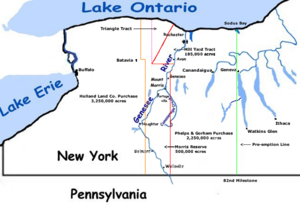 Before Morris could give the Holland Land Company title to this land, however, it was necessary to extinguish the Indian title. This was achieved at the 1797 Treaty of Big Tree
. Big Tree was a place on the Genesee River
near modern-day Geneseo, south of Rochester, New York. Representatives of the Holland Land Company, of Robert Morris, of the Indians, and a commissioner for the United States, gathered at Big Tree in August, 1797 and negotiations began. Chiefs and Sachems present included Red Jacket
, Cornplanter
, Governor Blacksnake, Farmer's Brother and about 50 others. Red Jacket and Cornplanter spoke strongly against selling the land. They held out for "reservations," that is, land which the Indians would keep for their own use. After much discussion, the treaty was signed Sept. 15, 1797. The Native Indians were to receive $100,000 for their rights to about 3.75 million acres (15,000 km²), and they reserved about 200,000 acres (809 km²) for themselves.
In 1798, the New York Legislature, with the assistance of Aaron Burr
authorized aliens to hold land directly, and the trustees conveyed the Holland Purchase
to the real owners. It was transferred to two sets of proprietors, and one of these sets soon divided into two, making three sets of owners altogether. Each set of proprietors owned their tract as “joint tenants” with right of survivorship, which means as proprietors died off, the surviving proprietors took the deceased's share, and that share did not pass by will or inheritance, except in the case of the last survivor.
 In 1798, Joseph Ellicott
was hired and he, along with his brother Benjamin and 130 men surveyed the purchase for the next three years at a total cost of $70,921.69½. In November, 1800, Paolo Busti
(Paul Busti) succeeded Cazenove as General Agent. Busti was an Italian from Milan, Italy, who had married one of the syndicate member's sister. He would serve until his death in 1824. Agents with Dutch roots were Gerrit Boon
and Adam Gerard Mappa
. David A. Ogden
and his brother Thomas Ludlow Ogden were legal advisors to the company.
The Holland Land Company's main land office was opened (1801) in Batavia, New York. Batavia was selected because the Holland Lands were all located in Genesee County
and Batavia was the county seat. Busti also appointed local agents at other offices in different parts of the Purchase. Subagents were located in Mayville
, Ellicottville
, Buffalo
, Meadville
, Instanter (?), two districts in Eastern Alleghany, Lancaster
, Cazenovia
, and Barneveld
. From the very beginning the agents were urged to keep the records in stone fireproof safes or else deposit them with banks. By 1840, all the land in Western New York was sold off to local investors and settlers. Around 1846, all the affairs of the company in the United States were liquidated and the company dissolved.
The town of Holland, New York bears its namesake.
Phelps and Gorham Purchase
The Phelps and Gorham Purchase was the purchase in 1788 of the pre-emptive right to some 6,000,000 acres of land in western New York State for $1,000,000 . This was all land in western New York west of Seneca Lake between Lake Ontario and the Pennsylvania border...
. This tract was known thereafter as The Holland Purchase. The Holland Land Company was an unincorporated syndicate of thirteen Dutch investors in Amsterdam
Amsterdam
Amsterdam is the largest city and the capital of the Netherlands. The current position of Amsterdam as capital city of the Kingdom of the Netherlands is governed by the constitution of August 24, 1815 and its successors. Amsterdam has a population of 783,364 within city limits, an urban population...
, who placed funds in the hands of certain trustees in America for the purpose of investing in land in central and western New York State and western Pennsylvania. Trustees were needed because aliens were not then permitted to own land. The syndicate hoped to sell the land rapidly at a great profit. Instead, for many years they were forced to make further investments in their purchase; surveying it, building roads, digging canals, to make it more attractive to settlers.
The first transfer by the trustees was all of the Holland Purchase except 300,000 acres (1,200 km²), which went to Wilhelm Willink, Nicolaas van Staphorst
Nicolaas van Staphorst
Nicolaas van Staphorst was a Dutch banker and a conservative republican. Up till 1794 he was involved in a total of eleven loans that were granted in Amsterdam to the United States with a value of 29 million guilders, and in the Holland Land Company.-Life:In 1782, the brothers led discussions with...
, Pieter van Eeghen, Hendrick Vollenhoven, and Rutger Jan Schimmelpenninck
Rutger Jan Schimmelpenninck
Rutger Jan Schimmelpenninck , Lord of Nyenhuis, Peckedam and Gellicum, was a Dutch politician of the Batavian Republic and an investor in the Holland Land Company....
. The 300,000 acre (1,200 km²) remainder was conveyed to Wilhelm Willink
Wilheim Willink
Wilhelm Willink was a wealthy Amsterdam merchant, and one of the investors in the Holland Land Company, and the Louisiana Purchase...
, Wilhelm Willink, Jr., Jan Willink and Jan Willink, Jr. About two years after the first transfers, the proprietors of the large tract reconveyed title to the original five, plus Wilhelm Willink, Jr., Jan Willink, Jr., Jan Gabriel van Staphorst, Roelof van Staphorst, Jr., Cornelius Vollenhoven, Hendrick Seye and Pieter Stadnitski. The members of the Holland Land Company never travelled to America
United States
The United States of America is a federal constitutional republic comprising fifty states and a federal district...
.
In 1789 the Holland Land Company sent a general agent
General Agent
A General Agent is an agent, i.e., representative of another, who has a mandate of general nature.-Colonial use:In the Niger Rivers District the only Senior Agent, who administered the region for the National African Company Limited , was promoted in 1882 to become the first...
, Theophile Cazenove
Theophilus Cazenove
Theophilus Cazenove, or Theophile Cazenove , was a financier and one of the agents of the Holland Land Company.- Life and career :...
, to keep them informed. He was located in Philadelphia
Philadelphia, Pennsylvania
Philadelphia is the largest city in the Commonwealth of Pennsylvania and the county seat of Philadelphia County, with which it is coterminous. The city is located in the Northeastern United States along the Delaware and Schuylkill rivers. It is the fifth-most-populous city in the United States,...
, to oversee land sales. This became the basis of what would later grow into the Holland Land Company. American funds were bought, such as the South Carolina Funded Debt and the Massachusetts Deposit and shares in the Pennsylvania Population Company. On the advice of Cazenove, the Dutch bankers and investors also obtained shares in canal companies in the years 1791–1792, including the Patowmack Canal
Patowmack Canal
The Patowmack Canal is an inoperative canal located in Virginia, United States, that was designed to bypass rapids in the Potomac River upstream of the present Washington, D.C. area...
, James River and Kanawha Canal
James River and Kanawha Canal
The James River and Kanawha Canal was a canal in Virginia, which was built to facilitate shipments of passengers and freight by water between the western counties of Virginia and the coast....
, Santee Canal
Santee Canal
The Santee Canal was one of the earliest canals built in the United States. It was built to provide a direct water route between Charleston and Columbia, the new South Carolina state capital.- History :...
, Western Canal and the Connecticut Canal.
The tract purchased in western New York was a 3,250,000 acre (13,150 km²) portion of the Phelps and Gorham Purchase that lay west of the Genesee River
Genesee River
The Genesee River is a North American river flowing northward through the Twin Tiers of Pennsylvania and New York. The river provided the original power for the Rochester area's 19th century mills and still provides hydroelectric power for downtown Rochester....
. It was purchased in December 1792 and February and July 1793 from Robert Morris
Robert Morris (merchant)
Robert Morris, Jr. was a British-born American merchant, and signer of the Declaration of Independence, the Articles of Confederation, and the United States Constitution...
who had purchased it from Massachusetts
Massachusetts
The Commonwealth of Massachusetts is a state in the New England region of the northeastern United States of America. It is bordered by Rhode Island and Connecticut to the south, New York to the west, and Vermont and New Hampshire to the north; at its east lies the Atlantic Ocean. As of the 2010...
in May 1791, after Phelps and Gorham failed to extinguish Indian
Native Americans in the United States
Native Americans in the United States are the indigenous peoples in North America within the boundaries of the present-day continental United States, parts of Alaska, and the island state of Hawaii. They are composed of numerous, distinct tribes, states, and ethnic groups, many of which survive as...
title to this tract and had defaulted on payment in 1790. Morris’s purchase was actually for all lands west of the Genesee River except for the 185,000 acre (749 km²) Mill Yard Tract
The Mill Yard Tract
The Mill Yard Tract was a portion of the Phelps and Gorham Purchase of western New York State. It consisted of a tract deep and , abutting the west bank of the Genesee River stretching from the approximate locations of the present day town of Avon north to the community of Charlotte at Lake...
, which Phelps and Gorham retained, along with their other lands east of the Genesee. Morris paid Massachusetts $333,333.34. Morris' purchase from Massachusetts was for some 3,750,000 acres (15,200 km²), but Morris kept back some 500,000 acres (2,000 km²) for himself in a tract 12 miles wide (19 km) and running the breadth of western New York from Lake Ontario to the Pennsylvania. This 500,000 acre (2,000 km²) tract was known as the Morris Reserve.
Treaty of Big Tree
Treaty of Big Tree was a formal treaty, held from August 20, 1797 until September 16, 1797, between the Seneca nation and the United States of America. The delegates for both parties met at the residence of William Wadsworth, an early pioneer of the area and Captain of the local militia, in what is...
. Big Tree was a place on the Genesee River
Genesee River
The Genesee River is a North American river flowing northward through the Twin Tiers of Pennsylvania and New York. The river provided the original power for the Rochester area's 19th century mills and still provides hydroelectric power for downtown Rochester....
near modern-day Geneseo, south of Rochester, New York. Representatives of the Holland Land Company, of Robert Morris, of the Indians, and a commissioner for the United States, gathered at Big Tree in August, 1797 and negotiations began. Chiefs and Sachems present included Red Jacket
Red Jacket
Red Jacket was a Native American Seneca orator and chief of the Wolf clan...
, Cornplanter
Cornplanter
Gaiänt'wakê was a Seneca war-chief. He was the son of a Seneca mother, Aliquipiso, and a Dutch father, Johannes Abeel. He also carried the name John Abeel after his fur trader father...
, Governor Blacksnake, Farmer's Brother and about 50 others. Red Jacket and Cornplanter spoke strongly against selling the land. They held out for "reservations," that is, land which the Indians would keep for their own use. After much discussion, the treaty was signed Sept. 15, 1797. The Native Indians were to receive $100,000 for their rights to about 3.75 million acres (15,000 km²), and they reserved about 200,000 acres (809 km²) for themselves.
In 1798, the New York Legislature, with the assistance of Aaron Burr
Aaron Burr
Aaron Burr, Jr. was an important political figure in the early history of the United States of America. After serving as a Continental Army officer in the Revolutionary War, Burr became a successful lawyer and politician...
authorized aliens to hold land directly, and the trustees conveyed the Holland Purchase
Holland Purchase
The Holland Purchase was a large tract of land in what is now the western portion of the U.S. state of New York. It consisted of about 3,250,000 acres of land from a line approximately 12 miles to the west of the Genesee River to the present western border and boundary of New York State.The land...
to the real owners. It was transferred to two sets of proprietors, and one of these sets soon divided into two, making three sets of owners altogether. Each set of proprietors owned their tract as “joint tenants” with right of survivorship, which means as proprietors died off, the surviving proprietors took the deceased's share, and that share did not pass by will or inheritance, except in the case of the last survivor.
Joseph Ellicott
Joseph Ellicott was an American surveyor, city planner, land office agent, lawyer and politician of the Quaker faith.-Life:He was the son of Joseph Ellicott ....
was hired and he, along with his brother Benjamin and 130 men surveyed the purchase for the next three years at a total cost of $70,921.69½. In November, 1800, Paolo Busti
Paolo Busti
Paolo Busti, or Paul Busti , was the principal agent of the Holland Land Company from 1800 until his death. Busti was born in Milan, Italy and died in Philadelphia, Pennsylvania....
(Paul Busti) succeeded Cazenove as General Agent. Busti was an Italian from Milan, Italy, who had married one of the syndicate member's sister. He would serve until his death in 1824. Agents with Dutch roots were Gerrit Boon
Gerrit Boon
Gerrit Boon was the son of a Lutheran minister Johan Michiel Boon. His father had studied in Helmstedt and moved in 1752 from Amersfoort to Delft and in 1774 to Rotterdam. Gerrit Boon became a sugar refinerer in the city, working for his brother-in-law...
and Adam Gerard Mappa
Adam Gerard Mappa
Adam Gerard Mappa was a Dutch Patriot and active colonel in a local militia,...
. David A. Ogden
David A. Ogden
David A. Ogden was a U.S. Representative from New York.Born in Morristown, New Jersey, he was the son of Sarah Frances and Abraham Ogden. Ogden attended King's College , New York City. He studied law and was admitted to the bar in November of 1791, beginning practice in Newark, New Jersey...
and his brother Thomas Ludlow Ogden were legal advisors to the company.
The Holland Land Company's main land office was opened (1801) in Batavia, New York. Batavia was selected because the Holland Lands were all located in Genesee County
Genesee County, New York
Genesee County is a county located in Western New York, United States. As of the 2010 census, the population was 60,079. Its name is from the Seneca Indian word Gen-nis'-hee-yo meaning "The Beautiful Valley." Its county seat is Batavia.- History :...
and Batavia was the county seat. Busti also appointed local agents at other offices in different parts of the Purchase. Subagents were located in Mayville
Mayville, New York
-Demographics:As of the census of 2000, there were 1,756 people, 686 households, and 399 families residing in the village. The population density was 875.0 people per square mile . There were 860 housing units at an average density of 428.5 per square mile...
, Ellicottville
Ellicottville, New York
Ellicottville, New York is the name of two places in Cattaraugus County, New York:*Ellicottville , New York*Ellicottville , New YorkBoth locations are named after Joseph Ellicott, an agent for the Holland Land Company....
, Buffalo
Buffalo, New York
Buffalo is the second most populous city in the state of New York, after New York City. Located in Western New York on the eastern shores of Lake Erie and at the head of the Niagara River across from Fort Erie, Ontario, Buffalo is the seat of Erie County and the principal city of the...
, Meadville
Meadville, Pennsylvania
Meadville is a city in and the county seat of Crawford County, Pennsylvania, United States. The city is generally considered part of the Pittsburgh Tri-State and is within 40 miles of Erie, Pennsylvania. It was the first permanent settlement in northwest Pennsylvania...
, Instanter (?), two districts in Eastern Alleghany, Lancaster
Lancaster (town), New York
Lancaster is a town in Erie County, New York, USA. As of the 2000 census, the town population has 39,019 residents.The Town of Lancaster has a village also called Lancaster. The Town and Village are currently exploring consolidation of governmental functions. Both town and village are east of...
, Cazenovia
Cazenovia
-Places:* Cazenovia, Illinois* Cazenovia, Minnesota, a ghost town in Pipestone County*In New York:** Cazenovia , New York*** Cazenovia , New York**** Cazenovia College**** Cazenovia Seminary*** Cazenovia Lake...
, and Barneveld
Barneveld, New York
Barneveld is a village located within the Town of Trenton in Oneida County, New York, United States. The population was 332 at the 2000 census. The village name is derived from the name of the Dutch statesman Johan van Oldenbarnevelt ....
. From the very beginning the agents were urged to keep the records in stone fireproof safes or else deposit them with banks. By 1840, all the land in Western New York was sold off to local investors and settlers. Around 1846, all the affairs of the company in the United States were liquidated and the company dissolved.
The town of Holland, New York bears its namesake.
External links
- "The Holland Land Company in Western New York", by Robert W. Silsby, Buffalo and Erie County Historical Society, Adventures in Western New York History, volume VIII, 1961, (downloadable from http://bechsed.nylearns.org/, click on Adventures in WNY History)
- Joseph Ellicott and the Holland Land Company bibliography of books and manuscripts in the library collection at the Buffalo and Erie County Historical Society.
- Visiting the Holland Land Office Museum in Batavia by Donovan A. Shilling
- Holland Land Company: Selected Resources
- Advance Information on an American Land Speculation, by Peter Stadnitski, Amsterdam, 1792
- A HISTORY of the TOWN of AMHERST, NEW YORK
- Archive of the Holland Land Company
- Western New York Legacy - Holland Land Company Maps