
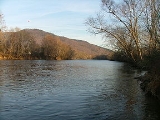
The
Hiwassee River has its headwaters on the north slope of
Rocky MountainRocky Mountain is the name of nine distinct mountains located in the North Georgia mountains that are spread among six different counties in Georgia-Fannin County:...
in
Towns CountyTowns County is a county located in the U.S. state of Georgia. It was created on March 6, 1856. As of the 2000 census, the population was 9,319. The 2007 Census Estimate shows a population of 10,894. Its county seat is Hiawassee.-History:...
in northern
GeorgiaGeorgia is a state located in the southeastern United States. It was established in 1732, the last of the original Thirteen Colonies. The state is named after King George II of Great Britain. Georgia was the fourth state to ratify the United States Constitution, on January 2, 1788...
(as the
Hiawassee River) and flows northward into
North CarolinaNorth Carolina is a state located in the southeastern United States. The state borders South Carolina and Georgia to the south, Tennessee to the west and Virginia to the north. North Carolina contains 100 counties. Its capital is Raleigh, and its largest city is Charlotte...
(there assuming its more common moniker
Hiwassee) before turning westward into
TennesseeTennessee is a U.S. state located in the Southeastern United States. It has a population of 6,346,105, making it the nation's 17th-largest state by population, and covers , making it the 36th-largest by total land area...
, flowing into the
Tennessee RiverThe Tennessee River is the largest tributary of the Ohio River. It is approximately 652 miles long and is located in the southeastern United States in the Tennessee Valley. The river was once popularly known as the Cherokee River, among other names...
a few miles west of State Route 58 in
Meigs County, TennesseeMeigs County is a county located in the U.S. state of Tennessee. As of 2010, the population was 11,753. Its county seat is Decatur.-History:Before 1819, the area that is now Meigs County was Cherokee territory. White settlers established ferries to cross the Tennessee River from Rhea County as...
. The river is 147 miles (236.6 km) long.
Hydrography
The river is dammed by the
Tennessee Valley AuthorityThe Tennessee Valley Authority is a federally owned corporation in the United States created by congressional charter in May 1933 to provide navigation, flood control, electricity generation, fertilizer manufacturing, and economic development in the Tennessee Valley, a region particularly affected...
(TVA) in three locations, all in western North Carolina.
Chatuge DamChatuge Dam is a flood control and hydroelectric dam on the Hiwassee River in Clay County, in the U.S. state of North Carolina. The dam is the uppermost of three dams on the river owned and operated by the Tennessee Valley Authority, which built the dam in the early 1940s for flood storage and to...
,
Hiwassee DamHiwassee Dam is a hydroelectric dam on the Hiwassee River in Cherokee County, in the U.S. state of North Carolina. It is one of three dams on the river owned and operated by the Tennessee Valley Authority, which built the dam in the late 1930s to bring flood control and electricity to the region. ...
, and
Apalachia DamApalachia Dam is a hydroelectric dam on the Hiwassee River in Cherokee County, in the U.S. state of North Carolina. The dam is the lowermost of three dams on the river owned and operated by the Tennessee Valley Authority, which built the dam in the early 1940s to provide emergency power for...
were all built in the 1940s. Water is diverted from the streambed at Apalachia Dam and sent through a pipeline which is tunneled through the mountains for eight miles (13 km), then gravity-fed through the Apalachia Powerhouse to generate electricity. The stretch of the river that flows between Apalachia Dam and Apalachia Powerhouse features reduced flow and is shadowed by the
John Muir TrailThe John Muir National Recreation Trail is a 20.7 mile trail in eastern Tennessee along the north side of Hiwassee River in the Cherokee National Forest. It is named for naturalist John Muir. It was constructed in 1972 through the efforts of the Youth Conservation Corps and the Senior Community...
in Tennessee's
Cherokee National ForestThe Cherokee National Forest is a large National Forest created on July 19, 1936, by U.S. President Franklin Roosevelt, operated by the U.S. Forest Service and encompassing some 640,000 acres .-Location:...
.
The 23 miles (37 km) stretch of river that flows from the North Carolina/Tennessee state line to U.S. Highway 411 near Delano is designated a State Scenic River (Class III Partially Developed River) and for recreational purposes is managed by the state Resource Management Division, in cooperation with TVA.
The river features Class I through Class III rapids, depending on water levels, and is popular for whitewater rafting,
whitewater canoeingWhitewater canoeing is the sport of paddling a canoe on a moving body of water, typically a whitewater river. Whitewater canoeing can range from simple, carefree gently moving water, to demanding, dangerous whitewater. River rapids are graded like ski runs according to the difficulty, danger or...
, and
whitewater kayakingWhitewater kayaking is the sport of paddling a kayak on a moving body of water, typically a whitewater river. Whitewater kayaking can range from simple, carefree gently moving water, to demanding, dangerous whitewater. River rapids are graded like ski runs according to the difficulty, danger or...
.
TroutTrout is the name for a number of species of freshwater and saltwater fish belonging to the Salmoninae subfamily of the family Salmonidae. Salmon belong to the same family as trout. Most salmon species spend almost all their lives in salt water...
fishing is also very popular along this stretch, and many outfitters are located near the river.
After exiting the mountains through a gorge, the Hiwassee flows under US-411 and broadens, meandering through rural
Polk and
Bradley counties. The river crosses under U.S. Highway 11 at
CalhounCalhoun is a town in McMinn County, Tennessee, United States. The population was 496 at the 2000 census.-Geography:Calhoun is situated along the north bank of the Hiwassee River, which flows down from the Appalachian Mountains to the east and empties into the Chickamauga Lake impoundment of the...
and
Charleston, TennesseeCharleston is a city in Bradley County, Tennessee, United States. The population was 651 at the 2010 census. It is included in the Cleveland, Tennessee Metropolitan Statistical Area.-Geography:...
, where local industries such as
BowaterBowater was an American pulp and paper company based in Greenville, South Carolina. Bowater had 12 pulp and paper mills in the United States, Canada and South Korea and 13 North American sawmills. It had approximately 10,000 employees...
Newsprint Mill and Arch/Olin Chemical use river water in their operations. At this point the river interfaces with the impoundment of
Chickamauga DamChickamauga Dam is a hydroelectric dam on the Tennessee River in Chattanooga, Tennessee, USA. The dam is owned and operated by the Tennessee Valley Authority, which built the dam in the late 1930s as part of a New Deal era initiative to improve navigation and bring flood control and economic...
(located in
Chattanooga, TennesseeChattanooga is the fourth-largest city in the US state of Tennessee , with a population of 169,887. It is the seat of Hamilton County...
), and many
marshIn geography, a marsh, or morass, is a type of wetland that is subject to frequent or continuous flood. Typically the water is shallow and features grasses, rushes, reeds, typhas, sedges, other herbaceous plants, and moss....
es and
wetlandA wetland is an area of land whose soil is saturated with water either permanently or seasonally. Wetlands are categorised by their characteristic vegetation, which is adapted to these unique soil conditions....
s surround the main channel, providing areas for hunting and fishing. The Hiwassee passes under
Interstate 75Interstate 75 is a major north–south Interstate Highway in the Great Lakes and Southeastern regions of the United States. It travels from State Road 826 and State Road 924 in Hialeah, Florida to Sault Ste. Marie, Michigan, at the Ontario, Canada, border...
on the border of
McMinn and Bradley counties, the site of a 99-vehicle accident in December 1990. The Hiwassee continues westward to pass under TN-58's historic, and narrow, bridge on its way to the confluence with the Tennessee River. This area of the river is enjoyed by boaters, fishermen, and water skiers.
Major tributaries include Valley River,
Nottely RiverThe Nottely River is a river in the United States. The river originates in the Blue Ridge Mountains in northern Georgia. The river flows for into the artificial Hiwassee Reservoir in North Carolina...
, Coker Creek, Big Lost Creek, Spring Creek,
Conasauga CreekConasauga Creek is a tributary stream of the Hiwassee River, located in southeast Tennessee, in the United States. It is not to be confused with the nearby Conasauga River.-Course:...
, and
Ocoee RiverThe Toccoa River and Ocoee River are actually a single river that flows northwestward through the southern Appalachian Mountains of the southeastern United States...
.
History
The Hiwassee River has been known by many variant names and spellings, including Eufasee, Eufassee, Euphasee, Heia Wassea, Highwassee, Quannessee, and others. Some Cherokee state that the name came from the
CherokeeThe Cherokee are a Native American people historically settled in the Southeastern United States . Linguistically, they are part of the Iroquoian language family...
word
Ayuhwasi, which means a meadow or savanna. The Muskogee (Creek) say the river's name is the
Koasati and
Hitchiti word for copperhead snake. Various Muskogean ethnic groups occupied the region for many centuries before the arrival of the Cherokee, and the river is known for its many copperhead snakes, even today.
Spanish explorers visited the region in the 16th century. Hernando de Soto probably crossed the Hiwassee River near its confluence with the Tennessee River at Hiwassee Island, in the spring of 1541 AD.
Juan PardoJuan Pardo was a Spanish explorer and conquistador who was active in the later half of the sixteenth century. He led a Spanish expedition through what is now North and South Carolina and into eastern Tennessee. He established Fort San Felipe, South Carolina , and the village of Santa Elena on...
probably followed a trail that paralleled the river in 1567 AD. All town names and indigenous words that were recorded by de Soto's chroniclers in present-day Georgia, North Carolina and Tennessee, can be easily translated by contemporary Muskogean dictionaries. Most of the words are of the Koasati and
HitchitiThe Hitchiti were a Muskogean-speaking tribe formerly residing chiefly in a town of the same name on the east bank of the Chattahoochee River, 4 miles below Chiaha, in west Georgia. They spoke the Hitchiti language, which was mutually intelligible with Mikasuki; both tribes were part of the loose...
languages, but a few are Muskogean and
AlabamaAlabama is a state located in the southeastern region of the United States. It is bordered by Tennessee to the north, Georgia to the east, Florida and the Gulf of Mexico to the south, and Mississippi to the west. Alabama ranks 30th in total land area and ranks second in the size of its inland...
words. None of the words are
CherokeeThe Cherokee are a Native American people historically settled in the Southeastern United States . Linguistically, they are part of the Iroquoian language family...
. Some historians originally thought that because the Europeans encountered the Cherokee in the Hiwassee Valley in the 18th century, they had occupied the territory for a much longer period, but this is not the case.
The earliest European maps from the 17th century vaguely show the Hiwassee River Basin occupied by a mountain branch of the
ApalacheeThe Apalachee are a Native American people who historically lived in the Florida Panhandle, and now live primarily in the U.S. state of Louisiana. Their historical territory was known to the Spanish colonists as the Apalachee Province...
and the Kusa. The Kusa (or
CoosaThe Coosa chiefdom was a powerful Native American paramount chiefdom near what are now Gordon and Murray counties in Georgia, in the United States. It was inhabited from about 1400 until about 1600, and dominated several smaller chiefdoms...
in English) were one of the ancestral branches of the Upper Creek. The Tama-tli of the Altamaha River Basin in southeastern Georgia are known to have had a colony in the valley between
Andrews, North CarolinaAndrews is a town in Cherokee County, North Carolina, United States. The population was 1,602 at the 2000 census.-Geography:Andrews is located at .According to the United States Census Bureau, the town has a total area of , all of it land.-History:...
and the Hiwassee River at
Murphy, North Carolina-Household Income:The median income for a household in the town was $24,952, and the median income for a family was $35,234. Males had a median income of $30,395 versus $16,908 for females. The per capita income for the town was $16,926...
.
The initial contacts by
EnglishThe British are citizens of the United Kingdom, of the Isle of Man, any of the Channel Islands, or of any of the British overseas territories, and their descendants...
explorers and traders in the 1690s found most of the river valley occupied by Muskogean and Yuchi towns. Cherokee villages were east and north of the river at this time. In 1714, two traders in
South CarolinaSouth Carolina is a state in the Deep South of the United States that borders Georgia to the south, North Carolina to the north, and the Atlantic Ocean to the east. Originally part of the Province of Carolina, the Province of South Carolina was one of the 13 colonies that declared independence...
supplied the Cherokee with firearms and directed them to attack the Yuchi villages on the Hiwassee River. Most of the men in one Yuchi town were gone when the Cherokee attacked. Without firearms, the remaining Yuchi were massacred.
In 1715, the Cherokee invited the leaders of the many Muskogean provinces that would eventually compose the Creek Confederacy to a diplomatic conference at Tugaloo at the headwaters of the Savannah River. They murdered the Muskogean leaders in their sleep. This precipitated a 40-year-long war between the Creek and the Cherokee. Due to disunity among the Creek, the Cherokee were able to occupy the northeastern tip of what is now Georgia, but then was part of South Carolina. They also drove the Muskogee and Yuchi from most of North Carolina west and south of the Hiwassee. Most of the branches of the Creek lost interest in this war after a few years.
The Hiwassee River and its tributaries were part of the homeland of the Cherokee in the early 18th century. A town known as "Hiwassee" (
Ayuhwasi) was located near the mouth of Peachtree Creek near
Murphy, North Carolina-Household Income:The median income for a household in the town was $24,952, and the median income for a family was $35,234. Males had a median income of $30,395 versus $16,908 for females. The per capita income for the town was $16,926...
. The Valley River contained many Cherokee towns, sometimes collectively called the "Valley Towns", from today's
Andrews, North CarolinaAndrews is a town in Cherokee County, North Carolina, United States. The population was 1,602 at the 2000 census.-Geography:Andrews is located at .According to the United States Census Bureau, the town has a total area of , all of it land.-History:...
, near the headwaters of Valley River to its mouth at Murphy. The Cherokee town known as
Great HiwasseeGreat Hiwassee was an important Overhill Cherokee town from the late 17th through the early 19th centuries. It was located on the Hiwassee River in present-day Polk County, Tennessee, on the north bank of the river where modern U.S. Route 411 crosses the river...
(
Ayuhwasi Egwahi) was located in today's
Polk County, Tennessee, where the Hiwassee River emerges from the mountains.
An old Native American path, known as the Great
Trading PathThe Trading Path is not simply one wide path, as many named historic roads were or are...
, the Overhill Trading Path, and the Unicoi Turnpike, ran along much of the Hiwassee River. Another old path known as the Warrior Path ran from southern lands to Great Hiwassee and then up
Conasauga CreekConasauga Creek is a tributary stream of the Hiwassee River, located in southeast Tennessee, in the United States. It is not to be confused with the nearby Conasauga River.-Course:...
to the Cherokee town known as
Great TellicoGreat Tellico was a Cherokee town at the site of present-day Tellico Plains, Tennessee, where the Tellico River emerges from the Appalachian Mountains. Great Tellico was one of the largest Cherokee towns in the region, and had a sister town nearby named Chatuga. Its name in Cherokee is more...
.
The Kowita Creek, whose homeland was in the North Carolina mountains (east of present-day
FranklinFranklin is a town in Franklin Township, Macon County, North Carolina, United States, within the Nantahala National Forest. The population was 3,490 as of the 2000 census. It is the county seat of Macon County. Franklin is an official Appalachian Trail friendly destination...
and south of
AshevilleAsheville is a city in and the county seat of Buncombe County, North Carolina, United States. It is the largest city in Western North Carolina, and the 11th largest city in North Carolina. The City is home to the United States National Climatic Data Center , which is the world's largest active...
), continued to fight the Cherokee alone. By the 1750s, the Kowita had developed such a powerful military machine that they could consistently defeat any branch of the Cherokee that they encountered. By 1755, they had destroyed all of the Cherokee towns in Georgia and in the Hiwassee Valley. The Kowita
Taskimikko, or general, bragged to some English traders that he sent women and children in the front line against the Cherokee town of
Quanesee, and that its people ran from the village without fighting. The archives of colonial Georgia, where this boast is recorded, hold a 1755 map created by John Mitchell and commissioned by the Colony of North Carolina. Over the entire southern half of western North Carolina and all of northeastern Georgia are the words, "Deserted Cherokee Towns."
In 1763, the Cherokee lost all of their lands in present-day North Carolina east of the 80th longitude line, which runs through
Murphy-Household Income:The median income for a household in the town was $24,952, and the median income for a family was $35,234. Males had a median income of $30,395 versus $16,908 for females. The per capita income for the town was $16,926...
and crosses the Hiwassee River there. This was punishment by the British for the Cherokee supporting the French during the
French and Indian WarThe French and Indian War is the common American name for the war between Great Britain and France in North America from 1754 to 1763. In 1756, the war erupted into the world-wide conflict known as the Seven Years' War and thus came to be regarded as the North American theater of that war...
(also known as the Seven Years War). The line runs roughly 45 miles west of
Cherokee, North CarolinaCherokee is a town in Swain County, North Carolina, USA, within the Qualla Boundary land trust. It is located in the Oconaluftee River Valley, near the intersection of U.S. Route 19 and U.S...
.
The Creek agreed to give up their recently reconquered lands in North Carolina and Georgia in return for most of Alabama, which the French ceded to Great Britain after the war. The Cherokee were given lands in northwestern Georgia, which had been occupied by the Apalachicola, allies of the French.
Some Cherokee families continued to live east of the Appalachians after 1763. But, at any time an Anglo-European settler could arrive on a Cherokee farmstead, and evict the Cherokee. In 1776 during the
American RevolutionThe American Revolution was the political upheaval during the last half of the 18th century in which thirteen colonies in North America joined together to break free from the British Empire, combining to become the United States of America...
, the Cherokee became allies of the British and massacred residents of frontier farmsteads across a broad swath of the Carolinas.
The counterattack by the
patriotA patriot is someone who feels a strong support for his or her country. See Patriotism.Patriot or Patriots may also refer to:- Politics :* Patriot Party , various political parties...
militia left most of the remaining Cherokee towns in North Carolina, South Carolina and Georgia in ruins. The survivors initially fled into the Tennessee River Valley, but within a decade had also settled in northwestern Georgia and northeaster Alabama. Some Cherokee returned to the Hiwassee Valley after the Revolution, but the center of the Cherokee culture had moved south and west to northwest Georgia, occupied by the Cherokee known as the
ChickamaugaThe Chickamauga or Lower Cherokee, were a band of Cherokee who supported Great Britain at the outbreak of the American Revolutionary War. They were followers of the Cherokee chief Dragging Canoe...
.
Later the Cherokee were divided over the government's proposal for removal to Indian Territory, with most opposing it. Following passage of the Indian Removal Act, US soldiers forced the Cherokee west on the
Trail of TearsThe Trail of Tears is a name given to the forced relocation and movement of Native American nations from southeastern parts of the United States following the Indian Removal Act of 1830...
. They built many internment camps along the Hiwassee River as US forces rounded up the people. One of the largest such camps was
Fort CassFort Cass, established in 1835, was an important site during the Cherokee removal known as the Trail of Tears. Located on the Hiwassee River in present-day Charleston, Tennessee, it housed a garrison of United States troops and watched over the largest concentration of internment camps where...
near present-day
Charleston, TennesseeCharleston is a city in Bradley County, Tennessee, United States. The population was 651 at the 2010 census. It is included in the Cleveland, Tennessee Metropolitan Statistical Area.-Geography:...
, on the south bank of the Hiwassee River.
As the river passes through downtown Murphy, North Carolina, it flows past a site famous in Cherokee Indian myth. A legend tells of a house-sized
leechLeeches are segmented worms that belong to the phylum Annelida and comprise the subclass Hirudinea. Like other oligochaetes such as earthworms, leeches share a clitellum and are hermaphrodites. Nevertheless, they differ from other oligochaetes in significant ways...
that could command the waters and use them to sweep hapless people down to the bottom of the river and consume them. It is known as
Tlanusi-yi, "The Leech Place."
External links