
All Topics  
Hindu deities


   Email Print
   Bookmark   Link


Hindu deities


Within Hinduism
Hinduism

'Hinduism' is the predominant religion of the Indian subcontinent. Hinduism is often referred to as , a Sanskrit phrase meaning "the eternal dharma", by its practitioners....
 a large number of personalities, or 'forms', are worshiped as murti
Murti

In Hinduism, a murti typically refers to an image, a deity, in which a Divine Spirit is expressed . Hindus consider a murti worthy of worship after the divine is invoked in it for the purpose of offering worship....
s
. These beings are either aspects of the supreme Brahman
Brahman

Brahman is a concept of Hinduism. Brahman is the unchanging, infinite, Immanence, and transcendence reality which is the Divine Ground of all matter, energy, time, space, being, and everything beyond in this Universe....
, avatar
Avatar

Avatar or Avatara , often translated into English as incarnation, literally means descent and usually implies a deliberate descent from higher spiritual realms to lower realms of existence for special purposes....
s of the supreme being
Bhagavan

Bhagavan, also written Bhagwan or Bhagawan, from the Sanskrit nt-stem literally means "possessing fortune, blessed, prosperous" , and hence "illustrious, divine, venerable, holy", etc....
, or significantly powerful entities known as devas
Deva (Hinduism)

Deva is the Sanskrit word for "god, deity". It can be variously interpreted as a god, spirit, demi-god, Celestial, deity or any supernatural being of high excellence....
. The exact nature of belief in regards to each deity varies between differing Hindu denominations
Hindu denominations

Hinduism comprises numerous sects or denominations. The denominations are roughly comparable to different religions. The main divisions in current Hinduism are Shaivism, Shaktism, Vaishnavism, and Smartha....
 and philosophies
Hindu philosophy

Hindu philosophy is divided into six Sanskrit nastika schools of thought, or darshanas :#Sankhya, a strongly dualist theoretical exposition of mind and matter....
. Often these beings are depicted in humanoid, or partially-humanoid forms, complete with a set of unique and complex iconography
Iconography

Iconography is the branch of art history which studies the identification, description, and the interpretation of the content of images. The word iconography literally means "image writing", and comes from the Ancient Greek e???? and ??afe?? ....
 in each case.


Discussion
Ask a question about 'Hindu deities'
Start a new discussion about 'Hindu deities'
Answer questions from other users
Full Discussion Forum


Encyclopedia


Within Hinduism
Hinduism

'Hinduism' is the predominant religion of the Indian subcontinent. Hinduism is often referred to as , a Sanskrit phrase meaning "the eternal dharma", by its practitioners....
 a large number of personalities, or 'forms', are worshiped as murti
Murti

In Hinduism, a murti typically refers to an image, a deity, in which a Divine Spirit is expressed . Hindus consider a murti worthy of worship after the divine is invoked in it for the purpose of offering worship....
s
. These beings are either aspects of the supreme Brahman
Brahman

Brahman is a concept of Hinduism. Brahman is the unchanging, infinite, Immanence, and transcendence reality which is the Divine Ground of all matter, energy, time, space, being, and everything beyond in this Universe....
, avatar
Avatar

Avatar or Avatara , often translated into English as incarnation, literally means descent and usually implies a deliberate descent from higher spiritual realms to lower realms of existence for special purposes....
s of the supreme being
Bhagavan

Bhagavan, also written Bhagwan or Bhagawan, from the Sanskrit nt-stem literally means "possessing fortune, blessed, prosperous" , and hence "illustrious, divine, venerable, holy", etc....
, or significantly powerful entities known as devas
Deva (Hinduism)

Deva is the Sanskrit word for "god, deity". It can be variously interpreted as a god, spirit, demi-god, Celestial, deity or any supernatural being of high excellence....
. The exact nature of belief in regards to each deity varies between differing Hindu denominations
Hindu denominations

Hinduism comprises numerous sects or denominations. The denominations are roughly comparable to different religions. The main divisions in current Hinduism are Shaivism, Shaktism, Vaishnavism, and Smartha....
 and philosophies
Hindu philosophy

Hindu philosophy is divided into six Sanskrit nastika schools of thought, or darshanas :#Sankhya, a strongly dualist theoretical exposition of mind and matter....
. Often these beings are depicted in humanoid, or partially-humanoid forms, complete with a set of unique and complex iconography
Iconography

Iconography is the branch of art history which studies the identification, description, and the interpretation of the content of images. The word iconography literally means "image writing", and comes from the Ancient Greek e???? and ??afe?? ....
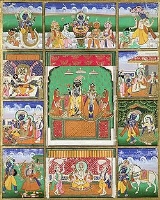
 in each case. In total, there are over 330,000 of these supernatural beings in various Hindu traditions.

Bhagavan and Ishvara

Hinduism is a religion unlike any other, this is because it has no founder and no specific religious text, though the Bhagwat Gita could be considered as one. Many religions' (such as Sikhism, Jainism and Buddhism) founders' are Hindu and therefore many beliefs and customs are the same. Contrary to popular belief Hindus believe in just one god, who comes to Earth in different forms (avatars), each of which represents an aspect of life, e.g. water, crops, fertility and health to name a few. All in all Hinduism is not really a religion (though some may argue this), but a set of customs and beliefs that were synonymous with the people of India. As invaders came and left India, the term "hinduism" loosely defined the people who believed in Indian customs and tradition (to separate the people who originally lived in India, from the invading people), for example in the past a Christian or Muslim could have been a Hindu as well, because the term only defined Indian customs and beliefs. More recently (last five hundred years), only people who believe in the traditional Hindu gods are called Hindus, hence it is now defined as a religion. Often Hindus celebrate Christmas, despite Christian origins and many people of other religions also celebrate Deepavali (Diwali), the festival of light, and Holi, the festival of colour despite their Hindu origins.

"Bhagavan" is a word used to refer to the personal aspect of God in general; it is not specific to a particular deity. Bhagavan transcends gender, yet can be looked upon as both father and mother, child, or sweetheart. Most Hindus, in their daily devotional practices, worship some form of this personal aspect of God, although they believe in the more abstract concept of Brahman
Brahman

Brahman is a concept of Hinduism. Brahman is the unchanging, infinite, Immanence, and transcendence reality which is the Divine Ground of all matter, energy, time, space, being, and everything beyond in this Universe....
 as well. This may mean worshiping God through an image or a picture, or simply thinking of God as a personal being.

"Ishvara" is a name or title used to emphasize God's role and function as controller of the universe. When Hindus refer to God as Ishvara, they are emphasizing a monistic
Monism

Monism is any philosophical view which holds that there is unity in a given field of inquiry, where this is not to be expected. Thus, some philosophers may hold that the Universe is really just one thing, despite its many appearances and diversities; or theology may support the view that there is one God, with many manifestations in different...
 idea of God as a principle of the universe, rather than a person.

"Ishwar" is the ultimate supreme being believed by Hindus - there is only one God and similar to the way society functions, Ishwar had taken many forms to function the universe; Lord Brahma the creater, Lord Vishnu the preserver and Lord Shiva the destroyer.

Different names and, frequently, different images of God will be used, depending on which aspect of Bhagava is being discussed. For instance, when God is talked about in the aspect as the creator, God is called Brahma
Brahma

Brahma is the Hinduism god of creation and one of the Trimurti, the others being Vishnu and Shiva. He is not to be confused with the Supreme Cosmic Spirit in Hindu Vedanta philosophy known as Brahman....
. If one is emphasizing God's capacity as preserver of the world, the name Vishnu
Vishnu

Vishnu , , is the Supreme God in Vaishnavite tradition of Hinduism. Smarta followers of Adi Shankara, among others, venerate Vishnu as one of panchadeva, and his supreme status is declared in the Hindu sacred texts like Yajurveda, the Rigveda and the Bhagavad Gita....
 is used. When referred to in the capacity as destroyer of the world, God is called Shiva
Shiva

Shiva: is a major Hinduism god, and one aspect of Trimurti. In the Shaiva tradition of Hinduism, Shiva is seen as the supreme God. In the Smarta tradition, he is one of panchadeva....
. Many of these individual aspects of God also have other names and images. For example, Krishna
Krishna

Krishna is a deity worshiped across many traditions in Hinduism in a variety of different perspectives. While many Vaishnava groups recognize him as an avatar of Vishnu, other traditions within Krishnaism consider Krishna to be svayam bhagavan, or the supreme being....
 and Rama
RAMA

Rama is a first-person adventure game developed and published by Sierra Entertainment in 1996. The game is based on Arthur C. Clarke's books Rendezvous with Rama and Rama II and supports both DOS and Microsoft Windows 95....
 are considered forms of Vishnu. All the various deities and images one finds in Hinduism are considered manifestations of the same God, called Bhagavan in the personal aspect and Brahman
Brahman

Brahman is a concept of Hinduism. Brahman is the unchanging, infinite, Immanence, and transcendence reality which is the Divine Ground of all matter, energy, time, space, being, and everything beyond in this Universe....
 when referred to as an abstract concept.

Avatars as incarnations of God

Many denominations of Hinduism, such as Vaishnavism
Vaishnavism

Vaishnavism is a tradition of Hinduism, distinguished from other schools by its worship of Vishnu or his associated avatars, principally as Rama and Krishna, as the original and supreme God....
 and Saivism, teach that occasionally, God comes to Earth as a human being to help humans in their struggle toward enlightenment and salvation (moksha
Moksha

In Indian religions, Moksha or Mukti , literally "release" , is the liberation from samsara, the cycle of death and rebirth or reincarnation and all of the suffering and limitation of worldly existence....
.) Such an incarnation of God is called an avatar (or avatara.) In some respects, the Hindu concept of avatar is similar to the belief found in Christianity
Christianity

Christianity is a Monotheistic religion #Christian view religion centered on the life and teachings of Jesus as New Testament view on Jesus' life....
 that God came to the earth incarnated
Incarnation (Christianity)

The Incarnation is the belief in Christianity that Jesus Christ is God in human body. The word Incarnate derives from Latin meaning "in the flesh." The incarnation is a fundamental theological teaching of Nicene Creed, based on its understanding of the New Testament....
 in the form of Jesus
Jesus

Jesus of Nazareth , also known as Jesus Christ, is the central figure of Christianity and is revered by most Christian churches as the Son of God and the Incarnation ....
. However, whereas most Christians believe that God has assumed a human body only once, Hinduism teaches that there have been multiple avatars throughout history and that there will be more. Thus Krishna
Krishna

Krishna is a deity worshiped across many traditions in Hinduism in a variety of different perspectives. While many Vaishnava groups recognize him as an avatar of Vishnu, other traditions within Krishnaism consider Krishna to be svayam bhagavan, or the supreme being....
, who is not only viewed as an incarnation but also source of all incarnations, says:

Whenever righteousness declines
And unrighteousness increases,
I make myself a body;
In every age I come back
To deliver the holy,
To destroy the sin of the sinner,
To establish righteousness.


Ten avatars of Vishnu

Avatars
The most famous of the divine incarnations are Rama
RAMA

Rama is a first-person adventure game developed and published by Sierra Entertainment in 1996. The game is based on Arthur C. Clarke's books Rendezvous with Rama and Rama II and supports both DOS and Microsoft Windows 95....
, whose life is depicted in the Ramayana, and Krishna, whose life is depicted in the Mahabharata
Mahabharata

The is one of the two major Sanskrit Indian epic poetrys of History of India, the other being the '. The epic is part of the Hindu itihasa , and forms an important part of Hindu mythology....
 and the Srimad Bhagavatam. The Bhagavad Gita
Bhagavad Gita

The Bhagavad Gita is an important Sanskrit Hindu scripture. It is revered as a sacred scripture of Hinduism, and considered as one of the most important religious classics of the world....
, which contains the spiritual teachings of Krishna
Krishna

Krishna is a deity worshiped across many traditions in Hinduism in a variety of different perspectives. While many Vaishnava groups recognize him as an avatar of Vishnu, other traditions within Krishnaism consider Krishna to be svayam bhagavan, or the supreme being....
, is one of the most widely-read scriptures in Hinduism.

  1. Matsya
    Matsya

    Matsya was the first Avatar of Vishnu in Hindu mythology.According to the Matsya Purana, the king of pre-ancient Dravida and a devotee of Lord Vishnu, Satyavrata who later becomes known as Manu was washing his hands in a river when a little fish swam into his hands and pleaded with him to save its life....
    , the fish, appeared in the Satya Yuga. Represents beginning of life.
  2. Kurma
    Kurma

    In Hinduism, Kurma was the second avatar of Vishnu. Like the Matsya Avatara also belongs to the Satya yuga....
    , the tortoise, appeared in the Satya Yuga. Represents a human embryo just growing tiny legs, with a huge belly.
  3. Varaha
    Varaha

    Varaha is the third Avatar of the Hinduism god Vishnu, in the form of a Boar. He appeared in order to defeat Hiranyaksha, a Rakshasha who had taken the Earth and carried it to the bottom of what is described as the cosmic ocean in the story....
    , the boar,appeared in the Satya Yuga. Represents a human embryo which is almost ready. Its features are visible.
  4. Narasimha
    Narasimha

    Narasimha is an avatara of Vishnu described in the Puranas, Upanishads and other ancient religious texts of Hinduism, and one of Hinduism's most popular deities, as evidenced in early epics, iconography, and temple and festival worship for over a millennium....
    , the Man-Lion (Nara = man, simha = lion), appeared in the Satya Yuga. Represents a newborn baby, hairy and cranky, bawling and full of blood.
  5. Vamana
    Vamana

    Vamana is a personality described in the Puranic texts of Hinduism as the Fifth Avatara of Vishnu, and the first incarnation of the Second Age, or Yuga....
    , the Dwarf, appeared in the Treta Yuga. Represents a young child.
  6. Parashurama
    Parashurama

    Parashurama , a Brahmin, the sixth avatar of Vishnu, belongs to the Treta yuga, and is the son of Jamadagni and Renuka. Parashu means axe, hence his name literally means Rama-of-the-axe....
    , Rama with the axe, appeared in the Treta Yuga. Represents both an angry young man and a grumpy old man simultaneously.
  7. Rama
    RAMA

    Rama is a first-person adventure game developed and published by Sierra Entertainment in 1996. The game is based on Arthur C. Clarke's books Rendezvous with Rama and Rama II and supports both DOS and Microsoft Windows 95....
    , Sri Ramachandra, the prince and king of Ayodhya, appeared in the Treta Yuga. Represents a married man with children in a very ideological society
  8. Krishna
    Krishna

    Krishna is a deity worshiped across many traditions in Hinduism in a variety of different perspectives. While many Vaishnava groups recognize him as an avatar of Vishnu, other traditions within Krishnaism consider Krishna to be svayam bhagavan, or the supreme being....
     (meaning dark or black; see also other meanings in the article about him.), appeared in the Dwapara Yuga. Represents a person in more practical society, where there is one good or bad. Good or bad depends on society you live in.
  9. Gautama Buddha
    Gautama Buddha

    Siddhartha Gautama was a Spirituality teacher in the northern region of the Indian subcontinent who founded Buddhism. He is generally seen by Buddhists as the Supreme Buddhahood of our age....
     is considered an avatar that returned pure dharma to the world.
  10. Kalki
    Kalki

    In Hinduism, Kalki is the tenth and final Maha Avatara of Vishnu who will come to end the present age of darkness and destruction known as Kali Yuga....
     ("Eternity", or "time", or "The Destroyer of foulness"), who is expected to appear at the end of Kali Yuga, the time period in which we currently exist, which will end in the year 428899 CE.


There is also a "hidden avatar" mentioned in 11th canto of the Bhagavata Purana
Bhagavata purana

The Bhagavata Purana is one of the "Maha" Puranic texts of Hinduism literature, and is Sanskrit for "The Book of God". Its primary focus is the process of bhakti yoga, which is Sanskrit for "Union with God through devotion for Him", in which Krishna is unequivocally declared to be Svayam Bhagavan....
.

Some consider Balarama
Balarama

Balarama , also known as Baladeva, Baldau, Balabhadra and Halayudha, is the elder brother of the divine being, Krishna in Hinduism....
, brother of Krishna to be the eighth avatar
Avatar

Avatar or Avatara , often translated into English as incarnation, literally means descent and usually implies a deliberate descent from higher spiritual realms to lower realms of existence for special purposes....
 of Vishnu, and delete Buddha. The Buddha avatar, which occurs in different versions in various Puranas, may represent an attempt by orthodox Brahminism to slander the Buddhists by identifying them with the demons. Helmuth von Glasenapp attributed these developments to a Hindu desire to absorb Buddhism in a peaceful manner, both to win Buddhists to Vishnuism and also to account for the fact that such a significant heresy could exist in India.

Devas and devis

Brahma Halebid
The pantheon in Srauta
Srauta

traditions are conservative ritualistic traditions of historical Vedic religion in Hinduism, based on the body of Sruti literature. They persist in a few places in India today although constituting a clear minority within Hinduism....
 consists of many deities. Gods are called devas
Deva (Hinduism)

Deva is the Sanskrit word for "god, deity". It can be variously interpreted as a god, spirit, demi-god, Celestial, deity or any supernatural being of high excellence....
 (or devatas) and goddesses are called devi
Devi

Devi is the Sanskrit word for Goddess, used mostly in Hinduism. Devi is synonymous with Shakti, the female aspect of the divine, as conceptualized by the Shakta tradition of Hinduism....
s. The various devas and devis are personifications of different aspects of one and the same God. For instance, when a Hindu thinks of Ishvara as the giver of knowledge and learning, that aspect of Ishvara is personified as the deity Saraswati
Saraswati

Hindus believe that Saraswati is the Devi of knowledge, music and the arts. Saraswati has been identified with the Vedic period Saraswati River....
. In the same manner, the deity Lakshmi
Lakshmi

Lakshmi is the Hindu goddess of wealth, prosperity, purity, and generosity; and the embodiment of beauty, grace and charm. Representations of Lakshmi are found also in Jainism and Buddhist monuments, with the earliest archeological representation found in Buddhist monuments....
 personifies Ishvara as the giver of wealth and prosperity. This does not imply that Ishvara is a kind of supreme god or lord of all the other deities; Ishvara is just the name used to refer to God in general, when no particular deity is being referred to.

Devas represent certain forces. For instance, Agni
Agni

Agni is a Hindu and Rigvedic deities. The word agni is Sanskrit for "fire" , cognate with Latin ignis , Russian ????? , Polish "ogien," Lithuanian - ugnis - all with the meaning 'fire' -, with the reconstructed Proto-Indo-European root being h1?gni-....
 has one aspect as the flame, but this flame symbolises the psychological power associated with Agni—namely, the power of will. Agni can be called God-will. Similarly Indra
Indra

Indra is the god of War and Weather, also the King of the gods or Deva and Lord of Heaven or Swarga in Hinduism. Mentioned first as the chief deity in the sacred Hindu text of Rig Veda, Indra is bestowed with a heroic and almost brash and amorous character....
 is the God-mind; Sarasvati is the power of inspiration, not merely of learning.

The devas constitute an integral part of the colorful Hindu culture. These various forms of God are depicted in innumerable paintings, statues, murals, and scriptural stories that can be found in temples, homes, businesses, and other places. In Hinduism, the scriptures recommend that for the satisfaction of a particular material desire a person may worship a particular deity. For example, shopkeepers frequently keep a statue or picture of the devi Lakshmi in their shops for financial prosperity. The elephant-headed deva known as Ganesha
Ganesha

Ganesha , also spelled Ganesa or Ganesh and also known as Ganapati, Vinayaka, and Pillaiyar, is one of the best-known and most widely worshipped Hindu deities in the Hinduism Pantheon ....
 is worshiped before commencing any important undertaking, as he represents God's aspect as the remover of obstacles. Students and scholars may propitiate Saraswati, the devi of learning, before taking an exam or giving a lecture.

The most ancient Vedic devas included Indra
Indra

Indra is the god of War and Weather, also the King of the gods or Deva and Lord of Heaven or Swarga in Hinduism. Mentioned first as the chief deity in the sacred Hindu text of Rig Veda, Indra is bestowed with a heroic and almost brash and amorous character....
, Agni
Agni

Agni is a Hindu and Rigvedic deities. The word agni is Sanskrit for "fire" , cognate with Latin ignis , Russian ????? , Polish "ogien," Lithuanian - ugnis - all with the meaning 'fire' -, with the reconstructed Proto-Indo-European root being h1?gni-....
, Soma
Soma

Soma , or Haoma , from Proto-Indo-Iranian *sauma-, was a ritual drink of importance among the early Indo-Iranians, and the later Vedic civilization and Greater Iran cultures....
, Varuna
Varuna

In Historical Vedic religion, Varuna or Waruna is a god of the sky, of waters and of the celestial ocean, as well as a god of law and of the underworld....
, Mitra
Mitra (Vedic)

This article is about the Rigvedic deities Mitra. For other divinities with related names, see the general article Mitra.Mitra was an important divinity of Indo-Aryans culture, descended, together with the Zoroastrian yazata Mithra, from a common Proto-Indo-Iranian deity *Mitra, a god of the oath....
, Savitri
Savitri

Savitri may refer to:*Savitri, with all vowels short, a Roman-phonetic spelling of the Vedic Hindu sun god SavitrSavitri, ignoring the lengths of its vowels, can mean:-...
, Rudra
Rudra

Rudra is a Rigvedic deities of the storm, the wind, and the hunt. The name has been translated as "Roarer", "Howler", "Wild One", and "Terrible"....
, Prajapati
Prajapati

In Hinduism, Prajapati is a Hindu deity presiding over procreation, and protector of life. He appears as a creator deity or supreme god above the other Rigvedic deities in RV 10.121.10 and in Brahmana literature....
, Vishnu
Vishnu

Vishnu , , is the Supreme God in Vaishnavite tradition of Hinduism. Smarta followers of Adi Shankara, among others, venerate Vishnu as one of panchadeva, and his supreme status is declared in the Hindu sacred texts like Yajurveda, the Rigveda and the Bhagavad Gita....
, Aryaman
Aryaman

Aryaman is one of the early Vedic deities . His name signifies "bosom friend," but is literally "noble one". He is an Aditya, a solar deity. He is supposed to be the chief of the manes and the Milky Way is supposed to be his path....
, and the ashvin
Ashvin

Ashvin , also known as Aswayuja, is a month of the Hindu calendar and Bengali calendars. In Indian national calendar, Ashvin is the sixth month of the year....
s. Important devis were Sarasvati, Ushas
Ushas

Ushas , Sanskrit for "dawn", is a Vedic deity, and consequently a Hindu deities as well.Ushas is an exalted divinity in the Rig Veda, sometimes spoken of in the plural, "the Dawns." She is portrayed as welcoming birds and warding off evil spirits, and as a beautifully adorned young woman riding in a golden chariot on her path across the sk...
, and Prithvi
Prithvi

Prithvi is the Hinduism earth and mother goddess. According to one tradition, she is the personification of the Earth, and to another its Mother, being Prithivi Tattwa, the essence of the element earth....
. Later scriptures called the Puranas
Puranas

The Puranas are a group of important Hindu religious texts, notably consisting of narratives of the history of the Universe from creation to destruction, genealogies of the kings, heroes, sages, and demigods, and descriptions of Hindu cosmology, philosophy, and geography....
 recount traditional stories about each individual deity, such as Ganesha and Hanuman
Hanuman

Hanuman , , known also as 'Anjaneya' or Maruti , is one of the most popular concepts of devotees of God in Hinduism and one of the most important personalities in the Indian epic poetry, the Ramayana....
, and avatars such as Rama and Krishna.

Trimurti

Shiva and Vishnu are not regarded as ordinary devas but as Mahadevas ("great gods" ) because of their central positions in worship and mythology. These two along with Brahma are considered the Trimurti
Trimurti

The Trimurti is a concept in Hinduism "in which the cosmic functions of creation, maintenance, and destruction are personified by the forms of Brahma the creator, Vishnu the maintainer or preserver, and Shiva the destroyer or transformer." These three deities have been called "the Hindu triad" or the "Great Trinity"....
—the most supreme individual deities. These three symbolize the entire circle of samsara
Samsara

'Samsara' or refers to the cycle of reincarnation or rebirth in Hinduism, Buddhism, Jainism, Sikhism and other related religions.According to these religions, one's karma "account balance" at the time of death is inherited via the state at which a person is reborn....
 in Hinduism: Brahma as creator, Vishnu as preserver or protector, and Shiva as destroyer or judge.

Devas in the Vedas

The main devas are (vide 6th anuvaka of Chamakam):
  • Aditya
    Aditya

    In Hinduism, the s are a group of Devas or celestial gods, the sons of Aditi and Kashyapa....
  • Agni
    Agni

    Agni is a Hindu and Rigvedic deities. The word agni is Sanskrit for "fire" , cognate with Latin ignis , Russian ????? , Polish "ogien," Lithuanian - ugnis - all with the meaning 'fire' -, with the reconstructed Proto-Indo-European root being h1?gni-....
  • Antariksha
  • Ashwinis
  • Brahma
    Brahma

    Brahma is the Hinduism god of creation and one of the Trimurti, the others being Vishnu and Shiva. He is not to be confused with the Supreme Cosmic Spirit in Hindu Vedanta philosophy known as Brahman....
  • Brihaspati
    Brihaspati

    Brihaspati is the name of a Vedic deity, personification of piety and religion, the chief offerer of prayers and sacrifices, represented as the Purohita of the gods with whom he intercedes on behalf of humankind....
  • Dishas
  • Dyaus
  • Indra
    Indra

    Indra is the god of War and Weather, also the King of the gods or Deva and Lord of Heaven or Swarga in Hinduism. Mentioned first as the chief deity in the sacred Hindu text of Rig Veda, Indra is bestowed with a heroic and almost brash and amorous character....
  • Ganesha
    Ganesha

    Ganesha , also spelled Ganesa or Ganesh and also known as Ganapati, Vinayaka, and Pillaiyar, is one of the best-known and most widely worshipped Hindu deities in the Hinduism Pantheon ....
  • Marutas
  • Moordha
  • Prajapati
    Prajapati

    In Hinduism, Prajapati is a Hindu deity presiding over procreation, and protector of life. He appears as a creator deity or supreme god above the other Rigvedic deities in RV 10.121.10 and in Brahmana literature....
  • Prithvi
    Prithvi

    Prithvi is the Hinduism earth and mother goddess. According to one tradition, she is the personification of the Earth, and to another its Mother, being Prithivi Tattwa, the essence of the element earth....
  • Pusha
  • Rudra
    Rudra

    Rudra is a Rigvedic deities of the storm, the wind, and the hunt. The name has been translated as "Roarer", "Howler", "Wild One", and "Terrible"....
  • Savitr
    Savitr

    In Historical Vedic religion, Savitr , Savita is a solar deity and one of the Adityas. His name is in Vedic Sanskrit meanings "impeller, rouser, vivifier"....
  • Shiva
    Shiva

    Shiva: is a major Hinduism god, and one aspect of Trimurti. In the Shaiva tradition of Hinduism, Shiva is seen as the supreme God. In the Smarta tradition, he is one of panchadeva....
  • Soma
    Soma

    Soma , or Haoma , from Proto-Indo-Iranian *sauma-, was a ritual drink of importance among the early Indo-Iranians, and the later Vedic civilization and Greater Iran cultures....
  • Varuna
    Varuna

    In Historical Vedic religion, Varuna or Waruna is a god of the sky, of waters and of the celestial ocean, as well as a god of law and of the underworld....
  • Vayu
    Vayu

    In Hinduism Vayu is a primary deity, the father of Bhima and the spiritual father of Lord Hanuman. He is also known as Vata ???, Pavana ??? , or Prana....
  • Vishnu
    Vishnu

    Vishnu , , is the Supreme God in Vaishnavite tradition of Hinduism. Smarta followers of Adi Shankara, among others, venerate Vishnu as one of panchadeva, and his supreme status is declared in the Hindu sacred texts like Yajurveda, the Rigveda and the Bhagavad Gita....
  • Vishvedavas


The main devis are:
  • Durga
    Durga

    In Hinduism, the goddess Durga or Maa Durga "one who can redeem in situations of utmost distress". Durga is a form of Devi, the supremely radiant goddess, depicted as having ten arms, riding a lion or a tiger, carrying weapons , maintaining a meditative smile, and practicing mudras, or symbolic hand gestures....
     or Parvati
    Parvati

    Parvati , sometimes spelled Parvathi or Parvathy, is a Hinduism Devi. Parvati is also regarded as a representation of Shakti, albeit the gentle aspect of that goddess because she is a mother goddess....
  • Lakshmi
    Lakshmi

    Lakshmi is the Hindu goddess of wealth, prosperity, purity, and generosity; and the embodiment of beauty, grace and charm. Representations of Lakshmi are found also in Jainism and Buddhist monuments, with the earliest archeological representation found in Buddhist monuments....
     or Shri
  • Sarasvati or Vaak


Popular deities

In their personal religious practices, Hindus may worship primarily one or another of these deities, known as their "Ishta Devata," or chosen deity. The particular form of God worshiped as one's chosen ideal is a matter of individual preference, although regional and family traditions can play a large part in influencing this choice. Hindus may also take guidance about this choice from scriptures.

Although Hindus do worship deities other than their chosen deity from time to time, depending on the occasion and their personal inclinations, it is not expected that they will worship, or even know about, every form of God. Hindus generally choose one concept of God (popular choices include Krishna, Rama, Shiva, or Kali), and cultivate devotion to that chosen form, while at the same time respecting the chosen ideals of other people.

Some popular Hindu deities include Durga
Durga

In Hinduism, the goddess Durga or Maa Durga "one who can redeem in situations of utmost distress". Durga is a form of Devi, the supremely radiant goddess, depicted as having ten arms, riding a lion or a tiger, carrying weapons , maintaining a meditative smile, and practicing mudras, or symbolic hand gestures....
, Krishna
Krishna

Krishna is a deity worshiped across many traditions in Hinduism in a variety of different perspectives. While many Vaishnava groups recognize him as an avatar of Vishnu, other traditions within Krishnaism consider Krishna to be svayam bhagavan, or the supreme being....
 or Kannan, Vishnu
Vishnu

Vishnu , , is the Supreme God in Vaishnavite tradition of Hinduism. Smarta followers of Adi Shankara, among others, venerate Vishnu as one of panchadeva, and his supreme status is declared in the Hindu sacred texts like Yajurveda, the Rigveda and the Bhagavad Gita....
, Brahma
Brahma

Brahma is the Hinduism god of creation and one of the Trimurti, the others being Vishnu and Shiva. He is not to be confused with the Supreme Cosmic Spirit in Hindu Vedanta philosophy known as Brahman....
, Shiva
Shiva

Shiva: is a major Hinduism god, and one aspect of Trimurti. In the Shaiva tradition of Hinduism, Shiva is seen as the supreme God. In the Smarta tradition, he is one of panchadeva....
, Ganesha
Ganesha

Ganesha , also spelled Ganesa or Ganesh and also known as Ganapati, Vinayaka, and Pillaiyar, is one of the best-known and most widely worshipped Hindu deities in the Hinduism Pantheon ....
, Hanuman
Hanuman

Hanuman , , known also as 'Anjaneya' or Maruti , is one of the most popular concepts of devotees of God in Hinduism and one of the most important personalities in the Indian epic poetry, the Ramayana....
, Kali
KALI

KALI may refer to:* KALI , a radio station licensed to West Covina, California, United States* KALI-FM, a radio station licensed to Santa Ana, California, United States...
, Murugan
Murugan

Murugan or called Subrahmanya is a popular Hindu deity among Tamil people Hindus, and is worshipped primarily in areas with Tamil influence, especially South India, Sri Lanka , Malaysia and Mauritius ....
, Venkateshwara
Venkateshwara

Venkateshwara , also known as Venkatachalapathy, Srinivasa and Balaji, is a form of the Hinduism god Vishnu in India. Venkateshwara means the Lord who destroys the sins of the people....
 or Balaji, Perumal, Nataraja
Nataraja

Nataraja , Tamil: ??????? [Kooththan] is a depiction of Lord Shiva as the cosmic dancer who performs his divine dance to destroy a weary universe and make preparations for Lord Brahma to start the process of creation....
, Bhogi, Varunan, Rama
RAMA

Rama is a first-person adventure game developed and published by Sierra Entertainment in 1996. The game is based on Arthur C. Clarke's books Rendezvous with Rama and Rama II and supports both DOS and Microsoft Windows 95....
, and Lakshmi
Lakshmi

Lakshmi is the Hindu goddess of wealth, prosperity, purity, and generosity; and the embodiment of beauty, grace and charm. Representations of Lakshmi are found also in Jainism and Buddhist monuments, with the earliest archeological representation found in Buddhist monuments....
.

Denominations of Hinduism

Contemporary Hinduism has four major divisions: Saivism, Shaktism
Shaktism

Shaktism is a Hindu denominations of Hinduism that focuses worship upon Shakti or Devi ? the Hindu Divine Mother ? as the absolute, ultimate Godhead....
, Smartism
Smartism

Smartism is a religious denomination of the Hinduism religion. The term Smarta refers to adherents who follow the Vedas and Shastras....
, and Vaishnavism
Vaishnavism

Vaishnavism is a tradition of Hinduism, distinguished from other schools by its worship of Vishnu or his associated avatars, principally as Rama and Krishna, as the original and supreme God....
.

Hinduism is a very rich and complex religion. Each of its four denominations shares ritual
Ritual

A ritual is a set of repeated actions, often thought to have symbolic value, the performance of which is usually prescribed by a religion or by the traditions of a community by religious or political laws because of the perceived efficacy of those actions....
s, belief
Belief

Belief is the psychological state in which an individual holds a proposition or premise to be true....
s, traditions and personal gods with one another, but each sect has a unique philosophy on how to achieve life's ultimate goal (moksa, liberation). For example a person can be a devotee to Shiva and a Vishnu devotee but one can practice the Advaita Vedanta
Advaita Vedanta

Advaita is more often than not deviantly interpreted as monism/monistic system of thought. Advaita Vedanta is a sub-school of the Vedanta school of Hindu philosophy....
 philosophy which believes there is no difference between Brahman and a person's individual soul
Atman

Atman may refer to a concept in several Indian religions, including Hinduism, Buddhism, Sikhism and Jainism:* Atman * Atman Atman may also refer to:...
. Conversely, a Hindu may follow the Dvaita philosophy which stresses that Brahman and the soul are not the same. But each denomination fundamentally believes in different methods of self-realization and in different aspects of the one supreme God. However, each denomination respects and accepts all others, and conflict of any kind is rare.

Vaishnavism, Saivism, and Shaktism, respectively believe in a monotheistic ideal of Vishnu
Vishnu

Vishnu , , is the Supreme God in Vaishnavite tradition of Hinduism. Smarta followers of Adi Shankara, among others, venerate Vishnu as one of panchadeva, and his supreme status is declared in the Hindu sacred texts like Yajurveda, the Rigveda and the Bhagavad Gita....
 (often as Krishna), Shiva, or Devi
Devi

Devi is the Sanskrit word for Goddess, used mostly in Hinduism. Devi is synonymous with Shakti, the female aspect of the divine, as conceptualized by the Shakta tradition of Hinduism....
; this view does not exclude other personal gods, as they are understood to be aspects of the chosen ideal. For instance, to many devotees of Krishna, Shiva is seen as having sprung from Krishna's creative force. Ganesha worshippers would connect themselves with Shiva as Shiva is the father of Ganesha, making him a Shaiv deity. Often, the monad Brahman is seen as the one source, with all other gods emanating from there. Thus, with all Hindus, there is a strong belief in all paths being true religions that lead to one God or source, whatever one chooses to call the ultimate truth. As the Vedas
Vedas

The Vedas are a large body of texts originating in History of India. They form the oldest layer of Sanskrit literature and the oldest Hindu scripture of Hinduism....
 - the most important Hindu scriptures state: "Truth is one; the wise call it by various names" (transliterated from Sanskrit
Sanskrit

Sanskrit is a historical Indo-Aryan language, one of the liturgical languages of Hinduism and Buddhism, and one of the 22 official languages of India....
: Ekam Sat Viprah Bahuda Vadanti.)

Smartism, is monist
Monism

Monism is any philosophical view which holds that there is unity in a given field of inquiry, where this is not to be expected. Thus, some philosophers may hold that the Universe is really just one thing, despite its many appearances and diversities; or theology may support the view that there is one God, with many manifestations in different...
 as well as a monotheist
Monotheism

In theology, monotheism is the belief that only one god exists. The concept of "monotheism" tends to be dominated by the concept of God in the Abrahamic religions, such as Judaism, Christianity and Islam, and the Neoplatonism concept of God as put forward by Pseudo-Dionysius the Areopagite....
 and understands different deities as representing various aspects and principles of one supreme entity, Brahman or parabrahman. Teachers such as Swami Vivekananda
Swami Vivekananda

Swami Vivekananda , born Narendranath Dutta is the chief disciple of the 19th century mystic Ramakrishna and the founder of Ramakrishna Mission....
, who brought Hinduism
Hinduism

'Hinduism' is the predominant religion of the Indian subcontinent. Hinduism is often referred to as , a Sanskrit phrase meaning "the eternal dharma", by its practitioners....
 to the West
Western culture

File:Clash of Civilizations map.pngWestern culture are terms which are used to refer to cultures of European origin. This terminology originated as a way of describing what was different about the Graeco-Roman culture and its descendants, in contrast to the older neighboring civilizations of the Middle East, which in many ways continued...
, held beliefs like those found in Smartism, although he usually referred to his religion as Vedanta
Vedanta

Vedanta is a spiritual tradition explained in the Upanishads that is concerned with the self-realisation by which one understands the ultimate nature of reality and teaches the believer's goal is to transcend the limitations of self-identity and realize one's unity with Brahman....
. Other denominations of Hinduism do not strictly hold this belief.

A Smartist would have no problem worshiping Shiva or Vishnu together as he views the different aspects of God as leading to the same One God. It is the Smarta view that dominates the view of Hinduism in the West. By contrast, a Vaishnavite considers Vishnu as the one true God, worthy of worship and other forms as subordinate. See for example, an illustration of the Vaishnavite view of Vishnu as the one true God. Accordingly, many Vaishnavites, for example, believe that only Vishnu can grant moksha
Moksha

In Indian religions, Moksha or Mukti , literally "release" , is the liberation from samsara, the cycle of death and rebirth or reincarnation and all of the suffering and limitation of worldly existence....
.. Similarly, many Shaivites also hold similar beliefs for Shiva.

Polytheism

There are some Hindus who consider the various deities not as forms of the one Ishvara, but as independently existing entities, and may thus be properly considered polytheists
Polytheism

Polytheism is the belief in or worship of multiple deities, such as gods and goddesses. These are usually assembled into a Pantheon , along with their own mythology and rituals....
.

Although the panentheistic
Panentheism

Panentheism is a belief system which posits that God exists and interpenetrates every part of nature, and timelessly extends beyond as well. Panentheism is distinguished from pantheism, which holds that God is synonymous with the material universe....
 tendency in Hinduism allowed only a subordinate rank to the old polytheistic gods, they continued to occupy an important place in the affections of individual Hindus and were still represented as exercising considerable influence on the destinies of man. The most prominent of them were regarded as the appointed "loka palas", or guardians of the world; and as such they were made to preside over the four cardinal and (according to some authorities) the intermediate points of the compass.

Thus Indra
Indra

Indra is the god of War and Weather, also the King of the gods or Deva and Lord of Heaven or Swarga in Hinduism. Mentioned first as the chief deity in the sacred Hindu text of Rig Veda, Indra is bestowed with a heroic and almost brash and amorous character....
, the chief of the devas, was regarded as the regent of the east; Agni, the fire
Fire

Fire is the oxidation of a combustion material releasing heat, light, and various Chemical reaction products such as carbon dioxide and water....
, was in the same way associated with the southeast; Yama
Yama (Hinduism)

This article is about the deity Yama in Hinduism. For yama in the sense of a code of conduct, see Yamas. For a general article about Yama, see Yama....
, lord of death and justice with the south
South

South is one of the cardinal directions and is opposite to the north.By Western world Norm , the bottom side of a map is south; the southern direction has azimuth or bearing of 180?....
; Surya
Surya

In Hinduism, Surya is the chief solar deity, one of the Adityas, son of Kasyapa and one of his wives Aditi, of Indra, or of Dyaus Pitar . The term "Surya" also refers to the Sun, in general....
, the sun
Sun

The Sun , a G V star, is the star at the center of the Solar System. The Earth and other matter orbit the Sun, which by itself accounts for about 98.6% of the Solar System's mass....
, with the southwest; Varuna
Varuna

In Historical Vedic religion, Varuna or Waruna is a god of the sky, of waters and of the celestial ocean, as well as a god of law and of the underworld....
, originally the representative of the all-embracing heaven
Heaven

Heaven may refer to the physical heavens, the atmosphere or the seemingly endless expanse of the universe beyond. This is the traditional literal meaning of the term in English, however since at least AD 1000, it is typically also used to refer to an afterlife plane of existence in various religions and spirituality philosophy, often descri...
 (atmosphere), now the god of the ocean
Ocean

An ocean is a major body of Seawater, and a principal component of the hydrosphere. Approximately 71% of the Earth's surface is covered by ocean, a World Ocean that is customarily divided into several principal oceans and smaller seas....
, with the west
West

West is most commonly a noun, adjective, or adverb indicating Direction or geography.West is one of the four cardinal directions or compass points....
; Vayu
Vayu

In Hinduism Vayu is a primary deity, the father of Bhima and the spiritual father of Lord Hanuman. He is also known as Vata ???, Pavana ??? , or Prana....
 (or Pavana), the wind
WIND

The Global Geospace Science WIND satellite is a NASA science spacecraft launched at 04:31:00 EST on November 1, 1994 from launch pad 17B at Cape Canaveral Air Force Station in Merritt_Island%2C_Florida, Florida aboard a McDonnell Douglas Delta II 7925-10 rocket....
, with the northwest; Kubera
Kubera

Kubera is the king of the Yakshas and the lord of wealth in Hindu mythology. He is also known as Dhanapati, the lord of riches. He is one of the Guardians of the directions , representing the Uttara-disha, meaning north of 4 directions in Sanskrit....
, the god of wealth
Wealth

Wealth is an abundance of valuable material possessions or resources. The word is derived from the old English wela, which is from an Indo-European word stem....
, with the north
North

North is one of the four cardinal directions, specifically the direction that, in Western culture, is treated as the fundamental direction:...
; and Soma
Soma

Soma , or Haoma , from Proto-Indo-Iranian *sauma-, was a ritual drink of importance among the early Indo-Iranians, and the later Vedic civilization and Greater Iran cultures....
 with the northeast. In some traditions, Ishana
Ishana

Isana has its roots in the word "ish" which means the invisible power that governs the universe. The wielder of this power is "Isana". It is synonymous with Ishwar which means 'The Lord'....
—an aspect of Siva—is regarded as the regent of the northeast and Nirrti
Nirrti

In Hinduism, ' is one of the Guardians of the directions ', representing the southwest .She was originally a goddess of death, connected with Devi, who later became the male Guardians of the directions....
 the regent of the southwest.

In the institutes of Manu
Manu Smriti

, also known as 'Manava-Dharmasastra' , is the most important and earliest metrical work of the Dharmasastra textual tradition of Hinduism....
 the loka palas are represented as standing in close relation to the ruling king, who is said to be composed of particles of these his tutelary deities. The retinue of Indra consists chiefly of the Devas, gandharvas, a class of genii
Genii

Genii may refer to:* Genii , a magic periodical* Genii , guardian spirits in Roman mythology* Genii , a human culture in the television program Stargate Atlantis...
, considered in the epics as the celestial musician
Musician

A musician is a person who plays or writes music. Musicians can be classified by their roles in creating or performing music:* An instrumentalist plays a musical instrument....
s; and apsaras, lovely nymph
Nymph

In Greek mythology, a nymph is any member of a large class of mythological entities in human form. They were typically associated with a particular location or landform....
s, who are frequently employed by the gods to make the pious devotee desist from carrying his austere practices to an extent that might render him dangerous to their power. Narada
Narada

Narada or Narada Muni is a divine sage from the Hindu tradition, who plays a prominent role in a number of the Puranic texts, especially in the Bhagavata Purana, and in the Ramayana....
, an ancient sage (probably a personification of the cloud, the water-giver), is considered as the messenger between the gods and men, and as having sprung from the forehead of Brahma. The interesting office of the god of love is held by Kamadeva
Kamadeva

Kamadeva is the Hindu deity of love. His other names include Ragavrinta , Ananga , Kandarpa , Manmatha , Manasija , Madana , Ratikanta , Pushpavan, Pushpadhanva or just Kama ....
, also called Ananga, the bodyless, because, as the myth relates, having once tried by the power of his mischievous arrow to make Siva fall in love with Parvati, whilst he was engaged in devotional practices, the urchin was reduced to ashes by a glance of the angry god. Two other mythological figures of some importance are considered as sons of Siva and Parvati, viz. Karttikeya or Skanda, the leader of the heavenly armies, who was supposed to have been fostered by the six Knittikas or Pleiades; and Ganesha (lord of troops), the elephant-headed god of wisdom, and at the same time the leader of the dii minorum gentium.

Mother goddesses

Goddesses are worshiped when God is thought of as the Universal Mother. Particular forms of the Universal Mother include Lakshmi, Sarasvati, Parvati
Parvati

Parvati , sometimes spelled Parvathi or Parvathy, is a Hinduism Devi. Parvati is also regarded as a representation of Shakti, albeit the gentle aspect of that goddess because she is a mother goddess....
, Durga
Durga

In Hinduism, the goddess Durga or Maa Durga "one who can redeem in situations of utmost distress". Durga is a form of Devi, the supremely radiant goddess, depicted as having ten arms, riding a lion or a tiger, carrying weapons , maintaining a meditative smile, and practicing mudras, or symbolic hand gestures....
, and Kali
KALI

KALI may refer to:* KALI , a radio station licensed to West Covina, California, United States* KALI-FM, a radio station licensed to Santa Ana, California, United States...
. Shaktism recognizes Shakti
Shakti

Shakti, from Sanskrit shak - "to be able," meaning sacred force or empowerment, is the primordial cosmic energy and represents the dynamic forces that move through the entire universe....
 as the supreme goddess. The concept of Mahadevi
Mahadevi

In Hinduism, Mahadevi or "Great Goddess" is a term used to denote the Goddess or Devi that is the sum of all other Devis - an all encompassing Female Deity as the consort or complement to an all encompassing Male Deity or the Reality in Shaktism....
 as the supreme goddess emerged in historical religious literature as a term to define the powerful and influential nature of female deities in India. Throughout history, goddesses have been portrayed as the mother of the universe, through whose powers the universe is created and destroyed. The gradual changes in belief through time shape the concept of Mahadevi and express how the different Goddesses, though very different in personality, all carry the power of the universe on their shoulders. Jagaddhatri
Jagaddhatri

Jagaddhatri or Jagadhatri is considered as a form of Devi, the supreme goddess. Her worship is more common in West Bengal than the other parts of India....
 and Mariamman
Mariamman

Goddess Mari is known as Mariamman, "Mother Mari" , spelt also Maariamma , or simply Amman , meaning "mother". She is the main South Indian mother goddess, predominant in the rural areas of Tamil Nadu, Karnataka and Andhra Pradesh....
 are other significant female deities.

See also

  • Hindu Love Gods
    Hindu Love Gods

    "Hindu Love Gods" may refer to:*Kamadeva and Rati.*Hindu Love Gods **Hindu Love Gods , eponymous album of recorded music...
  • Hindu mythology
    Hindu mythology

    Hindu mythology is the large body of traditional narratives related to Hinduism, notably as contained in Sanskrit literature, such as the Sanskrit epics and the Puranas....
  • Krishnology
    Krishnology

    Category:KrishnaKrishnology is an academic neologism. It is a scholastic vehicle for placing theology discourse concerning the Hindu deity Krishna, within the context of Vaishnava theology "Krishnaism"....
  • List of Hindu deities
    List of Hindu deities

    This is a List of Hindu deities. Note that according to Hindu mythology there are 340 million deities all of which cannot be listed.A...
  • List of Hinduism-related articles
    List of Hinduism-related articles

    The following is a list of articles on Hindu subjects....
  • Mohini
    Mohini

    Mohini is one of the 25 avatars of Vishnu found in the Puranas. The main story, or lila, concerning Mohini is the Samudra manthan, a lila that includes: Indra, Lakshmi, Kurma, Dhanvantari, and numerous other Hindu divinities....
  • Rigvedic deities
    Rigvedic deities

    There are 1028 hymns in the Rigveda, most of them dedicated to specific deity.Indra, a heroic god, slayer of Vrtra and destroyer of the Vala, liberator of the cows and the rivers; Agni the sacrificial fire and messenger of the gods; and Soma the ritual drink dedicated to Indra are the most prominent deities....


External links

  • - Hindu deities