
All Topics  
Hindu denominations

 
Hindu Denominations

   Email Print
   Bookmark   Link


Hindu denominations


Hinduism
Hinduism

'Hinduism' is the predominant religion of the Indian subcontinent. Hinduism is often referred to as , a Sanskrit phrase meaning "the eternal dharma", by its practitioners....
 comprises numerous sect
Sect

In its historical usage in Christendom the term has a pejorative connotation and refers to a movement committed to Christian heresy beliefs and that often deviated from orthodox practices....
s or denominations. The denominations are roughly comparable to different religions. The main divisions in current Hinduism are Shaivism
Shaivism

Shaivism,names the oldest of the four sects of Hinduism. Followers of Shaivism, called "Shaivas," and also "Saivas" or "Saivites," revere Shiva as the Supreme Being....
, Shaktism
Shaktism

Shaktism is a Hindu denominations of Hinduism that focuses worship upon Shakti or Devi ? the Hindu Divine Mother ? as the absolute, ultimate Godhead....
, Vaishnavism
Vaishnavism

Vaishnavism is a tradition of Hinduism, distinguished from other schools by its worship of Vishnu or his associated avatars, principally as Rama and Krishna, as the original and supreme God....
,
and Smartha. These four denominations share rituals, beliefs, and traditions, but each denomination has a different philosophy on how to achieve life's ultimate goal (moksa, liberation).

An established philosophical school within a denomination is called a sampradaya
Sampradaya

In Hinduism, a sampradaya can be translated as ?tradition? or a ?religious system?, although the word commands much more respect and power in the Indian context than its translations in English does....
 and a traditional lineage of teachers from any sampradaya is a parampara
Parampara

Parampara denotes a succession of teachers and disciples in traditional Indian culture. It is also known as guru-shishya parampara, succession from guru to disciple....
.

The presence of different denominations and schools within Hinduism should not be viewed as a schism
Schism (religion)

The word schism , from the Greek language s??s?a, skh?sma , means a split or a division, usually in an organization or a movement. A schismatic is a person who creates or incites schism in an organization or who is a member of a splinter group....
, as there was no original unity.


Discussion
Ask a question about 'Hindu denominations'
Start a new discussion about 'Hindu denominations'
Answer questions from other users
Full Discussion Forum


Encyclopedia


Hinduism
Hinduism

'Hinduism' is the predominant religion of the Indian subcontinent. Hinduism is often referred to as , a Sanskrit phrase meaning "the eternal dharma", by its practitioners....
 comprises numerous sect
Sect

In its historical usage in Christendom the term has a pejorative connotation and refers to a movement committed to Christian heresy beliefs and that often deviated from orthodox practices....
s or denominations. The denominations are roughly comparable to different religions. The main divisions in current Hinduism are Shaivism
Shaivism

Shaivism,names the oldest of the four sects of Hinduism. Followers of Shaivism, called "Shaivas," and also "Saivas" or "Saivites," revere Shiva as the Supreme Being....
, Shaktism
Shaktism

Shaktism is a Hindu denominations of Hinduism that focuses worship upon Shakti or Devi ? the Hindu Divine Mother ? as the absolute, ultimate Godhead....
, Vaishnavism
Vaishnavism

Vaishnavism is a tradition of Hinduism, distinguished from other schools by its worship of Vishnu or his associated avatars, principally as Rama and Krishna, as the original and supreme God....
,
and Smartha. These four denominations share rituals, beliefs, and traditions, but each denomination has a different philosophy on how to achieve life's ultimate goal (moksa, liberation).

An established philosophical school within a denomination is called a sampradaya
Sampradaya

In Hinduism, a sampradaya can be translated as ?tradition? or a ?religious system?, although the word commands much more respect and power in the Indian context than its translations in English does....
 and a traditional lineage of teachers from any sampradaya is a parampara
Parampara

Parampara denotes a succession of teachers and disciples in traditional Indian culture. It is also known as guru-shishya parampara, succession from guru to disciple....
.

The presence of different denominations and schools within Hinduism should not be viewed as a schism
Schism (religion)

The word schism , from the Greek language s??s?a, skh?sma , means a split or a division, usually in an organization or a movement. A schismatic is a person who creates or incites schism in an organization or who is a member of a splinter group....
, as there was no original unity. On the contrary, there is at present no great animosity between the different "religions" which constitute Hinduism, and among Hindu followers as a whole, there is a strong belief that there are many paths leading to the One God or the Source, whatever one chooses to call that ultimate Truth
Truth

semantic fields for the word truth extend from honesty, good faith, and sincerity in general, to agreement with fact or reality in particular....
. Whether Shiva is same as Vishnu or different from Vishnu is a matter of dispute among adherents but now most keep their disputes private. Instead there is a healthy cross-pollination of ideas and logical debate that serves to refine each school's philosophy. It is not uncommon, or disallowed, for an individual to follow one school but take the point of view of another school for a certain issue.

Vaishnavism

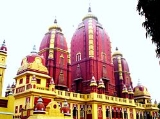
Birlamandirdelhi
Vaishnavism is the monotheistic tradition worshiping Vishnu
Vishnu

Vishnu , , is the Supreme God in Vaishnavite tradition of Hinduism. Smarta followers of Adi Shankara, among others, venerate Vishnu as one of panchadeva, and his supreme status is declared in the Hindu sacred texts like Yajurveda, the Rigveda and the Bhagavad Gita....
 (or his forms of Krishna
Krishna

Krishna is a deity worshiped across many traditions in Hinduism in a variety of different perspectives. While many Vaishnava groups recognize him as an avatar of Vishnu, other traditions within Krishnaism consider Krishna to be svayam bhagavan, or the supreme being....
 and Rama
RAMA

Rama is a first-person adventure game developed and published by Sierra Entertainment in 1996. The game is based on Arthur C. Clarke's books Rendezvous with Rama and Rama II and supports both DOS and Microsoft Windows 95....
) as the supreme or svayam bhagavan
Svayam Bhagavan

Svayam Bhagavan , "The Lord" or Lord Himself, is a Sanskrit theological term. The term refers to the concept of absolute representation of the monotheistic God as Bhagavan within Hinduism....
.

The different Vaishnava schools (sampradayas) and the principle teachers (acharya
Acharya

In Indian religions and society, an acharya is a guide or instructor in religious matters; founder, or leader of a sect; or a title affixed to the names of learned men....
s) connected with them are as follows:


  • Rudra Sampradaya
    Rudra Sampradaya

    In Hinduism, the Rudra Sampradaya is one of four Vaishnava sampradayas, a tradition of disciplic succession in the religion. Vaishnavism is distinguished from other schools of Hinduism by its primary worship of deities Vishnu and/or Krishna and their avatars as the Supreme forms of God....
    : principle acharya -Vallabhacharya
  • Brahma Sampradaya
    Brahma Sampradaya

    The Brahma Sampradaya refers to the disciplic succession of gurus starting with Brahma in Hinduism. The term is most often used to refer to the beliefs and teachings of Madhvacharya and his Dvaita philosophy....
     associated with Vishnu
    Vishnu

    Vishnu , , is the Supreme God in Vaishnavite tradition of Hinduism. Smarta followers of Adi Shankara, among others, venerate Vishnu as one of panchadeva, and his supreme status is declared in the Hindu sacred texts like Yajurveda, the Rigveda and the Bhagavad Gita....
    , who is the para-brahma( Universal Creator ), not to be confused with the other Brahma
    Brahma

    Brahma is the Hinduism god of creation and one of the Trimurti, the others being Vishnu and Shiva. He is not to be confused with the Supreme Cosmic Spirit in Hindu Vedanta philosophy known as Brahman....
    , who is the four-faced god in hindu religion: principle acharya - Madhvacharya
    Madhvacharya

    Shri Madhvacharya was the chief proponent of Tattvavada , popularly known as Dvaita or dualism school of Hindu philosophy. It is one of the three most influential Vedanta philosophies....
    . Gaudiya Vaishnavism
    Gaudiya Vaishnavism

    Gaudiya Vaishnavism is a Vaishnavism religious movement founded by Chaitanya Mahaprabhu in India in the 16th century. "Gaudiya" refers to Gauda with Vaishnavism meaning the worship of Vishnu....
     is associated with this sampradaya and is associated with Chaitanya Mahaprabhu
    Chaitanya Mahaprabhu

    Chaitanya Mahaprabhu , was a monk and social reformer of the 16th century Bengal, and Orissa in India. Sri Krishna Chaitanya was a notable proponent for the Vaishnava school of Bhakti yoga based on the philosophy of the Bhagavata Purana and Bhagavad Gita....
    , International Society for Krishna Consciousness
    International Society for Krishna Consciousness

    The International Society for Krishna Consciousness , also known as 'the Hare Krishna' movement, is one of the Hindu Vaishnava groups. It was founded in 1966 in New York City by A....
     belongs to this sampradaya.
  • Sri Sampradaya
    Sri Sampradaya

    Sri Sampradaya or Sri Vaishnavism is a Vaishnava sect within Hinduism. Its origin may date back to around 10th century and its formation is associated with a collection of the devotional hymns and songs by Alvars being organized by Nathamuni, who is considered to be the first guru of the sect.Nathamuni appeared as the pioneer who wrote...
     associated with Laksmi: principle acharya - Ramanujacharya
  • Kumara Sampradaya is the tradition associated with Four Kumaras
    Four Kumaras

    The Four Kumaras or Catursana are the four sons of Brahma from the Puranic texts of Hinduism named Sanaka, Sanatana, Sanandana and Sanatkumara....
    : principle acharya - Nimbarka
    Nimbarka

    Nimbarka , is known for propagating the Vaishnava Theology of Dvaitadvaita, duality in unity. According to scholars headed by Prof. Roma Bose, he lived in the 13th Century, though she bases this on the assumption that Sri Nimbarkacarya was the author of the work Madhvamukhamardana, which is erroneous as the said work is the product of lat...
    , hence Nimbarka Sampradaya
    Nimbarka Sampradaya

    The 'Nimbarka Sampradaya' , also known as the 'Hamsa Sampradaya', 'Kumara Sampradaya', and 'Sanakadi Sampradaya', is one of the four authorised Vaisnava#the four vaishnava sampradayas Sampradaya as according to the Padma Purana, one of the eighteen main Purana....
The independent traditions:
  • Vaikhanasa
    Vaikhanasas

    Vaikhanasam is one of the principal traditions of Hinduism and primarily worships Vishnu as the Supreme God. The name Vaikhanasas stands for both the followers as well as the fundamental philosophy itself with the name derived from founder, Sage Vaikhanasa....
     tradition: principle acharya - Vaikhanasa


Modern Vaishnava groups attached to the main sampradayas:

  • Swaminarayan Sampraday
    Swaminarayan Sampraday

    Swaminarayan Sampraday , known previously as the Uddhav Sampraday, is a Hindu sect established by Bhagwan Swaminarayan . Bhagwan Swaminarayan was handed the leadership of the Uddhav Sampraday from his Guru Ramanand Swami, to continue and to propagate the teachings and philosophy of Vishishtadvaita, which originates from the Sri samprada...
     - This stems from the Sri Sampradaya
    Sri Sampradaya

    Sri Sampradaya or Sri Vaishnavism is a Vaishnava sect within Hinduism. Its origin may date back to around 10th century and its formation is associated with a collection of the devotional hymns and songs by Alvars being organized by Nathamuni, who is considered to be the first guru of the sect.Nathamuni appeared as the pioneer who wrote...


Saivism


Saivites are those who primarily worship God Siva as Supreme God, both Immanent
Immanence

Immanence, derived from the Latin in manere "to remain within", refers to philosophical and metaphysical theories of the divine as existing and acting within the mind or the world....
 and Transcendent
Transcendence (religion)

In religion, transcendence is a condition or state of being that surpasses physical existence and in one form is also independent of it. It is affirmed in the concept of the divinity in the major religious traditions, and contrasts with the notion of God, or the Absolute , existing exclusively in the physical order , or indistinguishable fro...
.

Saivism embraces at the same time Monism
Monism

Monism is any philosophical view which holds that there is unity in a given field of inquiry, where this is not to be expected. Thus, some philosophers may hold that the Universe is really just one thing, despite its many appearances and diversities; or theology may support the view that there is one God, with many manifestations in different...
 (specifically Nondualism
Nondualism

Nondualism implies that things appear distinct while not being separate. The word's origin is the Latin duo meaning "two" and is used as the English translation of the Sanskrit term advaita....
) and Dualism
Dualism

Dualism denotes a state of two parts. The word's origin is the Latin duo, "two" . The term 'dualism' was originally coined to denote co-eternal binary opposition, a meaning that is preserved in metaphysical and philosophical duality discourse but has been diluted in general usage....
. It focuses on yoga, meditation and love for all beings.

Major theological schools of Saivism include Kashmir Saivism, Saiva Siddhanta and Virasaivism.

To Saivites God Siva is both with and without form; He is the Supreme Dancer, Nataraja
Nataraja

Nataraja , Tamil: ??????? [Kooththan] is a depiction of Lord Shiva as the cosmic dancer who performs his divine dance to destroy a weary universe and make preparations for Lord Brahma to start the process of creation....
; He is the linga, without beginning or end.

  • Lingayats in Karnataka


Shaktism


Shaktas worship Shakti
Shakti

Shakti, from Sanskrit shak - "to be able," meaning sacred force or empowerment, is the primordial cosmic energy and represents the dynamic forces that move through the entire universe....
, the divine Mother, in her many forms like (Kali
KALI

KALI may refer to:* KALI , a radio station licensed to West Covina, California, United States* KALI-FM, a radio station licensed to Santa Ana, California, United States...
, Durga
Durga

In Hinduism, the goddess Durga or Maa Durga "one who can redeem in situations of utmost distress". Durga is a form of Devi, the supremely radiant goddess, depicted as having ten arms, riding a lion or a tiger, carrying weapons , maintaining a meditative smile, and practicing mudras, or symbolic hand gestures....
, Laxmi, Saraswati
Saraswati

Hindus believe that Saraswati is the Devi of knowledge, music and the arts. Saraswati has been identified with the Vedic period Saraswati River....
 etc.).

Shakta form was one of the oldest forms of Hindu religion (evidences even from Indus valley civilization
Indus Valley Civilization

The Indus Valley Civilization , abbreviated IVC, was an ancient civilization that flourished in the Indus River basin. Primarily centered along the Indus river, the civilization encompassed most of Pakistan, including its Sindh, Punjab and Balochistan provinces, and extending into modern day Indian states of Gujarat, Haryana, Punjab...
), but with evolution of civilization and emergence of various doctrines, various other forms of Hindu philosophy emerged. Shaivism and Shakta forms are really inseparable, as is the description of Shiva
Shiva

Shiva: is a major Hinduism god, and one aspect of Trimurti. In the Shaiva tradition of Hinduism, Shiva is seen as the supreme God. In the Smarta tradition, he is one of panchadeva....
 and Shakti
Shakti

Shakti, from Sanskrit shak - "to be able," meaning sacred force or empowerment, is the primordial cosmic energy and represents the dynamic forces that move through the entire universe....
/Sati
Sati

Sati may refer to:*Mindfulness . In Buddhism the word ?Sati? usually carries the meaning of awareness or skillful attentiveness*An alternative name for Hindu goddess Dakshayani, Shiva's first wife...
/Parvati
Parvati

Parvati , sometimes spelled Parvathi or Parvathy, is a Hinduism Devi. Parvati is also regarded as a representation of Shakti, albeit the gentle aspect of that goddess because she is a mother goddess....
. Vaishanvism has also its connections with Shakta philosophy as Goddess Durga
Durga

In Hinduism, the goddess Durga or Maa Durga "one who can redeem in situations of utmost distress". Durga is a form of Devi, the supremely radiant goddess, depicted as having ten arms, riding a lion or a tiger, carrying weapons , maintaining a meditative smile, and practicing mudras, or symbolic hand gestures....
 herself is called Narayani
Narayani

Narayani may refer to:* Gandaki River, Nepalese name for the Gandaki River* Narayani Zone, one of fourteen administrative zones in Nepal...
.

Smartism

Golden Aum
Smarthas have free rein to choose whichever deity they wish to worship. They usually worship five deities (pancopasana) or panchadevata as personal formful manifestations of the impersonal Absolute, Brahman
Brahman

Brahman is a concept of Hinduism. Brahman is the unchanging, infinite, Immanence, and transcendence reality which is the Divine Ground of all matter, energy, time, space, being, and everything beyond in this Universe....
. Smartas accept and worship the six manifestations of God
God

God is a deity in theism and deism religions and other belief systems, representing either the sole deity in monotheism, or a principal deity in polytheism....
, (Ganesha
Ganesha

Ganesha , also spelled Ganesa or Ganesh and also known as Ganapati, Vinayaka, and Pillaiyar, is one of the best-known and most widely worshipped Hindu deities in the Hinduism Pantheon ....
, Shiva
Shiva

Shiva: is a major Hinduism god, and one aspect of Trimurti. In the Shaiva tradition of Hinduism, Shiva is seen as the supreme God. In the Smarta tradition, he is one of panchadeva....
, Shakti
Shakti

Shakti, from Sanskrit shak - "to be able," meaning sacred force or empowerment, is the primordial cosmic energy and represents the dynamic forces that move through the entire universe....
, Vishnu
Vishnu

Vishnu , , is the Supreme God in Vaishnavite tradition of Hinduism. Smarta followers of Adi Shankara, among others, venerate Vishnu as one of panchadeva, and his supreme status is declared in the Hindu sacred texts like Yajurveda, the Rigveda and the Bhagavad Gita....
, Surya
Surya

In Hinduism, Surya is the chief solar deity, one of the Adityas, son of Kasyapa and one of his wives Aditi, of Indra, or of Dyaus Pitar . The term "Surya" also refers to the Sun, in general....
 and Skanda
Skanda

Skanda is the name of deity popular amongst Hindus and Buddhists.* Murugan, a Hindu deity also known as Kartikeya and Murugan* Skanda , a popular Deva and/or Bodhisattva popular in Chinese Buddhism...
) and the choice of the nature of God is up to the individual worshipper since different manifestations of God are held to be equivalent. It is a liberal and eclectic sect.

  • It is the Smarta view that dominates the view of Hinduism
    Hinduism

    'Hinduism' is the predominant religion of the Indian subcontinent. Hinduism is often referred to as , a Sanskrit phrase meaning "the eternal dharma", by its practitioners....
     in the West as Smarta belief includes Advaita belief and the first Hindu saint, who significantly brought Hinduism to the west was Swami Vivekananda
    Swami Vivekananda

    Swami Vivekananda , born Narendranath Dutta is the chief disciple of the 19th century mystic Ramakrishna and the founder of Ramakrishna Mission....
    , an adherent of Advaita. Not till much later, gurus, such as A.C. Bhaktivedanta Swami Prabhupada, and others, brought a Vaishnavite perspective to the West. By contrast with Smarta/Advaita belief, Vaishnavism
    Vaishnavism

    Vaishnavism is a tradition of Hinduism, distinguished from other schools by its worship of Vishnu or his associated avatars, principally as Rama and Krishna, as the original and supreme God....
     and Shaivism
    Shaivism

    Shaivism,names the oldest of the four sects of Hinduism. Followers of Shaivism, called "Shaivas," and also "Saivas" or "Saivites," revere Shiva as the Supreme Being....
     follows a singular concept of God, or panentheistic monotheism
    Monotheism

    In theology, monotheism is the belief that only one god exists. The concept of "monotheism" tends to be dominated by the concept of God in the Abrahamic religions, such as Judaism, Christianity and Islam, and the Neoplatonism concept of God as put forward by Pseudo-Dionysius the Areopagite....
     or panentheistic monism
    Monism

    Monism is any philosophical view which holds that there is unity in a given field of inquiry, where this is not to be expected. Thus, some philosophers may hold that the Universe is really just one thing, despite its many appearances and diversities; or theology may support the view that there is one God, with many manifestations in different...
    .


Some prominent Smarta communities:

  • In south India
    • Havyaka
      Havyaka

      Havyaka Brahmins are a Hindu Brahmin subsect primarily from the Indian state of Karnataka and Northern Kerala. Havyakas mostly profess the Advaita Vedanta propounded by Adi Shankaracharya....
    • Iyer
      Iyer

      Iyer also called Sastri, Sarma or Bhattar is the name given to Hindu Brahmins of Tamil people or Telugu people origin who are followers of the Advaita Vedanta philosophy propounded by Adi Shankara.They are found mostly in Tamil Nadu as they are generally native to the Tamil country....
    • Vaidiki Mulukanadu
    • Vaidiki Velanadu
    • Vaidiki Veginadu
    • Vaidiki Telanganya
    • Namboothiri
    • Badaganadu
      Badaganadu

      Badaganadu's are a Brahmin community that mainly reside in Karnataka, and now due to the advent of globalization they are spread throughout the world....
    • Hoysala Kannada
    • Kota brahmin
      Kota brahmin

      Kota Brahmins hail from the Kundapur and surrounding areas of Udupi district in Karnataka. Originally, thought to have been brought to these places from northern India by Parashurama, they speak a Kannada different from the other dialects spoken in that region....
    • Babboor Kamme
      Babboor Kamme

      The Babburkamme community is a Indian caste system of Smartism Brahmins whose members mainly reside in Karnataka and Tamil Nadu states in India....
    • Arvel Niyogi
      Niyogi

      Niyogis are a sect of Brahmins and are predominantly Telugu languagespeakers....
       Brahmins
  • In Maharashtra
    • Karhade
      Karhade Brahmin

      Karhade Brahmins form one of the three major sub-castes of Marathi Brahmins, the other two being Deshastha Brahmins, and Maharashtrian Konkanastha Brahmins....
    • Deshastha
      Deshastha Brahmin

      Deshastha Brahmins are a Hindu Brahmin caste belonging to the Indo-Aryan ethnic group primarily from the Indian state of Maharashtra. "Deshastha", in Sanskrit, means "inland" and thus, Deshastha Brahmins are Brahmins living in the interiors or away from the coast....
    • Konkanastha or Chitpavan
    • Devrukhe
  • Saraswat Brahmins
    • Gaud Saraswat Brahmins (GSB's)


Bhakti movement

The medieval Bhakti movement
Bhakti movement

The Bhakti movement was a Hindu religious movement in which the main spiritual practice was loving devotion to God in Hinduism, or bhakti. The devotion was directed towards a particular form of God, such as Shiva, Vishnu, Murukan or Shakti....
 has had a significant impact on the traditional denominations of Pauranic Hinduism, especially on Vaishnavism. The Alvars
Alvars

The Alvars were Tamil poet saints of south India who lived between sixth and ninth centuries and espoused ?emotional devotion? or bhakti to Visnu-Krishna in...
 were Tamil poet saints of south India who lived between sixth and ninth centuries and espoused ‘emotional devotion’ or bhakti
Bhakti

Bhakti is a word of Sanskrit origin meaning devotion. Within Vaishnavism bhakti is only used in conjunction with Vishnu, Krishna or of the associated avatar, who are the source of attractiveness....
 to Visnu-Krishna in their songs of longing, ecstasy and service. Usually twelve Vaishnava saints, who, during the early medieval period of Tamil history
History of Tamil Nadu

The region of Tamil Nadu in modern India has been under continuous human habitation since prehistoric times, and the history of Tamil Nadu and the civilization of the Tamil people are among the oldest in the world....
, helped revive devotional Hinduism
Hinduism

'Hinduism' is the predominant religion of the Indian subcontinent. Hinduism is often referred to as , a Sanskrit phrase meaning "the eternal dharma", by its practitioners....
 (bhakti
Bhakti

Bhakti is a word of Sanskrit origin meaning devotion. Within Vaishnavism bhakti is only used in conjunction with Vishnu, Krishna or of the associated avatar, who are the source of attractiveness....
) through their hymns of worship to Vishnu
Vishnu

Vishnu , , is the Supreme God in Vaishnavite tradition of Hinduism. Smarta followers of Adi Shankara, among others, venerate Vishnu as one of panchadeva, and his supreme status is declared in the Hindu sacred texts like Yajurveda, the Rigveda and the Bhagavad Gita....
 and his avatar
Avatar

Avatar or Avatara , often translated into English as incarnation, literally means descent and usually implies a deliberate descent from higher spiritual realms to lower realms of existence for special purposes....
s. The collection of their hymns is known as Divya Prabhandham The Bhakti literature that sprang from these Alvars has contributed to the establishment and sustenance of a culture that broke away from the ritual-oriented Vedic religion and rooted itself in devotion as the only path for salvation. In addition they helped to make the Tamil religious life independent of a knowledge of Sanskrit
Sanskrit

Sanskrit is a historical Indo-Aryan language, one of the liturgical languages of Hinduism and Buddhism, and one of the 22 official languages of India....
. As part of the legacy of the Alvars, five Vaishnava philosophical traditions (sampradayas) has developed at the later stages.

In Southeast Asia

A sect of Balinese
Balinese

See:*Balinese people*Balinese language*Balinese mythology*Balinese , a cat breed*Balinese Gamelan, local music*Balinese Room, a famous illegal casino in Galveston, Texas...
  Hindus flourished on the nearby island of Java until the late 16th century, when a vast majority of its adherents converted to Islam
Islam

Islam is a Monotheism, Abrahamic religion originating with the teachings of the Prophets of Islam Muhammad, a 7th century Arab religious and political figure....
. Theologically, it is closer to Saivism than to other major sects of Hinduism.

The term "Agama Hindu Dharma" can also refer to the traditional practices in Kalimantan
Kalimantan

In most languages in the world, the term Kalimantan refers to the Indonesian portion of the island of Borneo, while for Indonesians, the name "Kalimantan" usually refers to the whole island of Borneo....
, Sumatra
Sumatra

Sumatra is an island in western Indonesia, westernmost of the Sunda Islands. It is the largest island entirely in Indonesia , and the list of islands by area in the world ....
, Sulawesi
Sulawesi

Sulawesi is one of the four larger Sunda Islands of Indonesia and is situated between Borneo and the Maluku Islands....
 and other places in Indonesia, where people have started to identify and accept their agama
Agama (text)

In Buddhism, an gama is a collection of Early Buddhist schools scriptures, of which there are four, which together comprise the Sutra Pitika of the Sanskritic early schools....
s as Hinduism.

Newer denominations

Influential 19th to 20th century Hindu revivalist organizations include Arya Samaj
Arya Samaj

Arya Samaj is a Hindu reform movement founded in India by Swami Dayananda in 1875. He was a sannyasa who believed in the infallible Moral absolutism of the Vedas....
, Tilak Mission
Bal Gangadhar Tilak

Bal Gangadhar Tilak –, was an Indian nationalism, social reformer and independence fighter who was the first popular leader of the Indian Independence Movement and is known as "Father of the Indian unrest"....
Bhagwan Swaminarayan

Swaminarayan ,or Sahajanand Swami, is the central figure in a modern form of Hinduism known as the Swaminarayan Faith and is the founder of the Swaminarayan Sampraday in which followers offer devotion to Swaminarayan as the final avatar of God in Hinduism....
, Brahmo Samaj
Brahmo Samaj

Brahmo Samaj is the societal component of Brahmoism. "It is without doubt the most influential socio-religious movement in the evolution of Modern India." It was conceived as reformation of the prevailing Bengal of the time and began the Bengal Renaissance of the 19th century pioneering all religious, social and educational advance of the H...
, Parisada Hindu Dharma
Parisada Hindu Dharma

Parisada Hindu Dharma was a major reform movement and organization that assisted in the Hindu Revival in Indonesia . It was started in 1960 by D.R....
, Prarthana Samaj
Prarthana Samaj

Prarthana Samaj, or "Prayer Society" in Sanskrit, is a movement for religious and social reform in Maharashtra based on previous reform movements and traditions of Maharashtra....
, Ramakrishna Mission
Ramakrishna Mission

Ramakrishna Math and Ramakrishna Mission are twin organizations which form the core of a worldwide spiritual movement known as Ramakrishna Movement or Vedanta Movement....
, Sadharan Brahmo Samaj
Sadharan Brahmo Samaj

The Sadharan Brahmo Samaj is a religious division of Brahmoism formed as a result of 2 schisms in the Brahmo Samaj in 1866 and 1878 respectively....
, Sree Narayana Dharma Paripalana
Sree Narayana Dharma Paripalana

Sree Narayana Dharma Paripalana Yogam is organisation formed to propagate and promote the moral teaching and Dharma of Shree Narayana Guru....
, Swadhyay Movement
Swadhyay Movement

Swadhyay Movement is a socio-spiritual movement set up by noted Indian philosopher and orator, Pandurang Shastri Athavale, also known as Dadaji in 1950s, which led to the formation of an organization the Swadhyay Parivar....
, Swaminarayan Sampraday
Swaminarayan Sampraday

Swaminarayan Sampraday , known previously as the Uddhav Sampraday, is a Hindu sect established by Bhagwan Swaminarayan . Bhagwan Swaminarayan was handed the leadership of the Uddhav Sampraday from his Guru Ramanand Swami, to continue and to propagate the teachings and philosophy of Vishishtadvaita, which originates from the Sri samprada...
, Sathya Sai Organisation, Satsang (Sri Sri Thakur Anukul Chandra Chakravorty).

Hinduism was politicized in the context of the Indian independence movement
Indian independence movement

The term Indian independence movement incorporates various national and regional campaigns, agitations and efforts of both Nonviolent and Revolutionary movement for Indian independence philosophy....
, and has resulted in the rise of Hindu nationalism
Hindu nationalism

Hindu nationalism is a nationalism ideology that sees the modern state of the India as a Hindu polity , and seeks to preserve the Hindu heritage....
 to a significant political force in the Republic of India.

See also


  • List of Hindu organisations
    List of Hindu organisations

    Most Hindu philosophies believe that there exist several paths to attain God, and one can choose any path depending on his/her individual nature. A number Hindu organizations exist, each of which follows a particular philosophy or a particular saint....
  • Ganapatya
    Ganapatya

    Ganapatya is a denomination of Hinduism that worships Ganesha as the supreme god.The worship of Ganesha is considered complementary with the worship of other deities....
  • Ayyavazhi
    Ayyavazhi

    Ayyavazhi is a Dharmic religion system that originated in South India in the 19th century. It is cited as an independent monism religion by several newspapers and academic researchers....


External links