

Himyar

Encyclopedia
The Himyarite Kingdom or Himyar (in Arabic مملكة حِمْيَر mamlakat ħimyâr) (r. 110 BC–520s), historically referred to as the Homerite Kingdom by the Greeks and the Romans, was a kingdom in ancient Yemen
. Established in 110 BC, it took as its capital the modern day city of Sana'a
after the ancient city of Zafar
. The Kingdom conquered neighbouring Saba
(Sheba) in c.25 BC, Qataban
in c.200 CE, and Hadramaut c.300 CE. Its political fortunes relative to Saba changed frequently until it finally conquered the Sabaean Kingdom
around 280 CE.
and myrrh
. For many years, the kingdom was also the major intermediary linking East Africa and the Mediterranean world. This trade largely consisted of exporting ivory from Africa to be sold in the Roman Empire
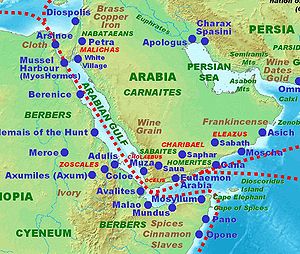
. Ships from Himyar regularly traveled the East African coast, and the state also exerted a large amount of Influence both cultural religious and political to the trading cities of East Africa whilst the cities of East Africa remained independent. The Periplus of the Erythraean Sea
describes the trading empire of Himyar and its ruler Charibael (Karab Il Watar Yuhan'em II), who is said to have been on friendly terms with Rome:
 During this period, the Kingdom of Himyar conquered the kingdom of Sheba and took Raydan/Zafar
for its capital instead of Ma’rib. Its ruins still lie on Mudawwar Mountain near the town of "Yarim". During this period, they began to decline and fall. Their trade failed to a very great extent, firstly, because of the Nabetean domain over the north of Hijaz; secondly, because of the Roman superiority over the naval trade routes after the Roman conquest of Egypt, Syria and the north of Hijaz; and thirdly, because of inter-tribal warfare. Thanks to the three above-mentioned factors, families of Qahtan were disunited and scattered about all over Arabia.
Dam last Great Flood (450 or 451 AD) weakened Himyar further and led to its collapse.
In the fifth century, several kings of Himyar are known to have converted to Judaism. The political context was the position of Arabia between the competing empires of Christian Byzantium and Zoroastrian Persia. Neutrality, and good trade relations with both empires, was essential to the prosperity of the Arabian trade routes. Scholars speculate that the choice of Judaism may have been an attempt at maintaining neutrality.
 Around, 500 AD, the King of Himyar, Abu-Kariba Assad, undertook a military expedition into northern Arabia in an effort to eliminate Byzantine influence. The Byzantine emperors had long eyed the Arabian Peninsula as a region in which to extend their influence, thereby to control the lucrative spice trade and the route to India. Without actually staging a conquest of the region, the Byzantines hoped to establish a protectorate over the pagan Arabs by converting them to Christianity. The cross would then bear commercial advantages as it did in Ethiopia. The Byzantines had made some progress in northern Arabia but had met with little success in Himyar.
Abu-Kariba's forces reached Yathrib and, meeting no resistance and not expecting any treachery from the inhabitants, they passed through the city, leaving a son of the king behind as governor. Scarcely had Abu-Kariba proceeded farther, when he received news that the people of Yathrib had killed his son. Smitten with grief; he turned back in order to wreak bloody vengeance on the city. After cutting down the palm trees from which the inhabitants derived their main income, Abu-Kariba laid siege to the city. The Jews of Yathrib fought side by side with pagan fellow inhabitants to defend their town and harried the besiegers with sudden sallies. During the siege Abu-Kariba fell severely ill. Two Jewish scholars in Yathrib, Kaab and Assad by name, hearing of their enemy's misfortune, called on the king in his camp, and used their knowledge of medicine to restore him to health. While attending the king, they pleaded with him to lift the siege and make peace. The sages' appeal is said to have persuaded Abu-Kariba; he called off his attack and also embraced Judaism along with his entire army. At his insistence, the two Jewish savants accompanied the Himyarite king back to his capital, where he demanded that all his people convert to Judaism. Initially, there was great resistance, but after an ordeal had justified the king's demand and confirmed the "truth" of the Jewish faith, many Himyarites embraced Judaism. The conversions, however, were not total, and there remained as many pagans as Jews in the land. Such conversions, by ordeal, were not uncommon in Arabia. Some historians argue that the conversions occurred, not due to political motivations, but because Judaism, by its philosophical, simplistic and austere nature, was attractive to the nature of the Semitic people. In any case, it is known that by the 6th and 7th centuries, Judaism flourished in Himyar; and in inscriptions dating from those centuries Jewish religious terms such as "Rahman" ("the merciful," a divine epithet), "the god of Israel", and the "Lord of Judah" bears testament to this fact.
Abu-Kariba's reign did not last long after his conversion to Judaism. His warlike nature prevented him from maintaining peace and prompted him to engage in bold enterprises. It is uncertain how Abu-Kariba met his death, although some scholars believe that his own soldiers, worn out by constant campaigning, killed him. He left three sons, Hasan, Amru, and Zorah, all of whom were minors at the time. After Abu-Kariba's demise, a pagan named Dhu-Shanatir seized the throne.
Kahlan septs emigrated from Yemen to dwell in the different parts of the Arabian Peninsula prior to the Great Flood (Sail Al-‘Arim of Ma’rib Dam), due to the failure of trade under the Roman pressure and domain on both sea and land trade routes following Roman occupation of Egypt and Syria.
Naturally enough, the competition between Kahlan
and Himyar
led to the evacuation of the first and the settlement of the second in Yemen.
The emigrating septs of Kahlan can be divided into four groups:
Another tribe of Himyar, known as Banu Quda'a
, also left Yemen and dwelt in Samawa semi-desert on the borders of Iraq.
However, the majority of the Himyar christian royalty migrated into Jordan, Al-Karak, where initially they were known as Bani Himyar (Sons of Himyar). They later on moved to the centre parts of Jordan to settle in Madaba under the family name of Al-Hamarneh.
Yemen
The Republic of Yemen , commonly known as Yemen , is a country located in the Middle East, occupying the southwestern to southern end of the Arabian Peninsula. It is bordered by Saudi Arabia to the north, the Red Sea to the west, and Oman to the east....
. Established in 110 BC, it took as its capital the modern day city of Sana'a
Sana'a
-Districts:*Al Wahdah District*As Sabain District*Assafi'yah District*At Tahrir District*Ath'thaorah District*Az'zal District*Bani Al Harith District*Ma'ain District*Old City District*Shu'aub District-Old City:...
after the ancient city of Zafar
Zafar, Yemen
Ẓafār or Dhafar is an ancient Himyarite site situated in the Yemen, some 130 km south-south-east of the capital Sana'a. Given mention in different ancient texts, there is little doubt about the pronunciation of the name...
. The Kingdom conquered neighbouring Saba
Sheba
Sheba was a kingdom mentioned in the Jewish scriptures and the Qur'an...
(Sheba) in c.25 BC, Qataban
Qataban
Qataban was one of the ancient Yemeni kingdoms. Its heartland was located in the Baihan valley. Like some other Southern Arabian kingdoms it gained great wealth from the trade of frankincense and myrrh incense which were burned at altars...
in c.200 CE, and Hadramaut c.300 CE. Its political fortunes relative to Saba changed frequently until it finally conquered the Sabaean Kingdom
Sabaeans
The Sabaeans or Sabeans were an ancient people speaking an Old South Arabian language who lived in what is today Yemen, in the south west of the Arabian Peninsula.Some scholars suggest a link between the Sabaeans and the Biblical land of Sheba....
around 280 CE.
History
The Himyarite Kingdom was the dominant polity in Arabia until 525 AD. Its economy was based on agriculture, and foreign trade centered on the export of frankincenseFrankincense
Frankincense, also called olibanum , is an aromatic resin obtained from trees of the genus Boswellia, particularly Boswellia sacra, B. carteri, B. thurifera, B. frereana, and B. bhaw-dajiana...
and myrrh
Myrrh
Myrrh is the aromatic oleoresin of a number of small, thorny tree species of the genus Commiphora, which grow in dry, stony soil. An oleoresin is a natural blend of an essential oil and a resin. Myrrh resin is a natural gum....
. For many years, the kingdom was also the major intermediary linking East Africa and the Mediterranean world. This trade largely consisted of exporting ivory from Africa to be sold in the Roman Empire
Roman Empire
The Roman Empire was the post-Republican period of the ancient Roman civilization, characterised by an autocratic form of government and large territorial holdings in Europe and around the Mediterranean....
. Ships from Himyar regularly traveled the East African coast, and the state also exerted a large amount of Influence both cultural religious and political to the trading cities of East Africa whilst the cities of East Africa remained independent. The Periplus of the Erythraean Sea
Periplus of the Erythraean Sea
The Periplus of the Erythraean Sea or Periplus of the Red Sea is a Greco-Roman periplus, written in Greek, describing navigation and trading opportunities from Roman Egyptian ports like Berenice along the coast of the Red Sea, and others along Northeast Africa and India...
describes the trading empire of Himyar and its ruler Charibael (Karab Il Watar Yuhan'em II), who is said to have been on friendly terms with Rome:
From 115 B.C. until 300 A.D.
Zafar, Yemen
Ẓafār or Dhafar is an ancient Himyarite site situated in the Yemen, some 130 km south-south-east of the capital Sana'a. Given mention in different ancient texts, there is little doubt about the pronunciation of the name...
for its capital instead of Ma’rib. Its ruins still lie on Mudawwar Mountain near the town of "Yarim". During this period, they began to decline and fall. Their trade failed to a very great extent, firstly, because of the Nabetean domain over the north of Hijaz; secondly, because of the Roman superiority over the naval trade routes after the Roman conquest of Egypt, Syria and the north of Hijaz; and thirdly, because of inter-tribal warfare. Thanks to the three above-mentioned factors, families of Qahtan were disunited and scattered about all over Arabia.
From 300 AD until the advent of Islam in Yemen
This period witnessed a lot of disorder and turmoil. The great many foreign and civil wars cost the people of Yemen their independence. During this era, the Aksumites invaded Tihama & Najran for the first time in 340 AD, making use of the constant intra-tribal conflict of Hamdan and Himyar. The Aksumite occupation of Tihama and Najran lasted until 378 AD, whereafter Yemen expelled the Aksumites. After the Ma'ribMa'rib
Ma'rib or Marib is the capital town of the Ma'rib Governorate, Yemen and was the capital of the Sabaean kingdom, which some scholars believe to be the ancient Sheba of biblical fame. It is located at , approximately 120 kilometers east of Yemen's modern capital, Sana'a...
Dam last Great Flood (450 or 451 AD) weakened Himyar further and led to its collapse.
In the fifth century, several kings of Himyar are known to have converted to Judaism. The political context was the position of Arabia between the competing empires of Christian Byzantium and Zoroastrian Persia. Neutrality, and good trade relations with both empires, was essential to the prosperity of the Arabian trade routes. Scholars speculate that the choice of Judaism may have been an attempt at maintaining neutrality.
Abu-Kariba's forces reached Yathrib and, meeting no resistance and not expecting any treachery from the inhabitants, they passed through the city, leaving a son of the king behind as governor. Scarcely had Abu-Kariba proceeded farther, when he received news that the people of Yathrib had killed his son. Smitten with grief; he turned back in order to wreak bloody vengeance on the city. After cutting down the palm trees from which the inhabitants derived their main income, Abu-Kariba laid siege to the city. The Jews of Yathrib fought side by side with pagan fellow inhabitants to defend their town and harried the besiegers with sudden sallies. During the siege Abu-Kariba fell severely ill. Two Jewish scholars in Yathrib, Kaab and Assad by name, hearing of their enemy's misfortune, called on the king in his camp, and used their knowledge of medicine to restore him to health. While attending the king, they pleaded with him to lift the siege and make peace. The sages' appeal is said to have persuaded Abu-Kariba; he called off his attack and also embraced Judaism along with his entire army. At his insistence, the two Jewish savants accompanied the Himyarite king back to his capital, where he demanded that all his people convert to Judaism. Initially, there was great resistance, but after an ordeal had justified the king's demand and confirmed the "truth" of the Jewish faith, many Himyarites embraced Judaism. The conversions, however, were not total, and there remained as many pagans as Jews in the land. Such conversions, by ordeal, were not uncommon in Arabia. Some historians argue that the conversions occurred, not due to political motivations, but because Judaism, by its philosophical, simplistic and austere nature, was attractive to the nature of the Semitic people. In any case, it is known that by the 6th and 7th centuries, Judaism flourished in Himyar; and in inscriptions dating from those centuries Jewish religious terms such as "Rahman" ("the merciful," a divine epithet), "the god of Israel", and the "Lord of Judah" bears testament to this fact.
Abu-Kariba's reign did not last long after his conversion to Judaism. His warlike nature prevented him from maintaining peace and prompted him to engage in bold enterprises. It is uncertain how Abu-Kariba met his death, although some scholars believe that his own soldiers, worn out by constant campaigning, killed him. He left three sons, Hasan, Amru, and Zorah, all of whom were minors at the time. After Abu-Kariba's demise, a pagan named Dhu-Shanatir seized the throne.
- Himyar: The most famous of whose septs were Zaid Al-Jamhur, Banu Quda'aBanu Quda'aQuda'a is a Himyarite tribe that was exiled from Yemen following the trials of the Lakhmids and they settled The Southern part of the Lakhmid Kingdom in the Samawa region....
and Sakasic. - KahlanKahlanKahlan was one of the main tribal federations of Saba'a in Yemen.-Conflict with Himyar:By the 1st century BC Saba'a was declining gradually and its southern neighbor Himyar was able to settle many Nomadic tribes that was allied to Saba'a and create a stronger Himyarite nation in the lowlands...
: The most famous of whose septs were HamdanHamdanHamdan is a name of Arab origin. Among people named Hamdan include:*Al-Hamdan, famous Druze family*Salim Ahmed Hamdan, Yemeni Guantanamo detainee, driver and bodyguard of Osama bin Laden*Gibran Hamdan, quarterback for the Buffalo Bills...
, AzdAzdThe Azd or Al Azd, are an Arabian tribe. They were a branch of the Kahlan tribe, which was one of the two branches of Qahtan the other being Himyar.In the ancient times, they inhabited Ma'rib, the capital city of the Sabaean Kingdom in modern-day Yemen...
, Anmar, TayyTayyTayy is a large and ancient Arabian tribe belonging to the southern or Qahtanite branch of Arab tribes. Their original homeland was the area of the two mountains Aja and Salma in north central Arabia , though, like all Qahtanite tribes, it is believed they originally moved there from Yemen...
, ShammarShammarThe tribe of Shammar is one of the largest tribes of Nejd-Saudi Arabia, with an estimated 1 million in Iraq, over 2.5 million in Saudi Arabia , a Kuwaiti population of around 100,000, a Syrian population is thought to exceed 1 million and with an unknown number in Jordan...
, Midhhij, KindaKindaKinda may refer to:*Kinda , a 1982 serial from the television programme Doctor Who*Kinda Municipality, a municipality in Sweden*Kinda Hundred, a hundred in Sweden*Kindah, an ancient central Arabian kingdom...
, Lakhm, Judham
Kahlan septs emigrated from Yemen to dwell in the different parts of the Arabian Peninsula prior to the Great Flood (Sail Al-‘Arim of Ma’rib Dam), due to the failure of trade under the Roman pressure and domain on both sea and land trade routes following Roman occupation of Egypt and Syria.
Naturally enough, the competition between Kahlan
Kahlan
Kahlan was one of the main tribal federations of Saba'a in Yemen.-Conflict with Himyar:By the 1st century BC Saba'a was declining gradually and its southern neighbor Himyar was able to settle many Nomadic tribes that was allied to Saba'a and create a stronger Himyarite nation in the lowlands...
and Himyar
Himyar
The Himyarite Kingdom or Himyar , historically referred to as the Homerite Kingdom by the Greeks and the Romans, was a kingdom in ancient Yemen. Established in 110 BC, it took as its capital the modern day city of Sana'a after the ancient city of Zafar...
led to the evacuation of the first and the settlement of the second in Yemen.
The emigrating septs of Kahlan can be divided into four groups:
- AzdAzdThe Azd or Al Azd, are an Arabian tribe. They were a branch of the Kahlan tribe, which was one of the two branches of Qahtan the other being Himyar.In the ancient times, they inhabited Ma'rib, the capital city of the Sabaean Kingdom in modern-day Yemen...
: Who, under the leadership of ‘Imran bin ‘Amr Muzaiqbâ’, wandered in Yemen, sent pioneers and finally headed northwards. Details of their emigration can be summed up as follows:- Tha‘labah bin ‘Amr left his tribe Al-Azd for Hijaz and dwelt between Tha‘labiyah and Dhi Qar. When he gained strength, he headed for Madinah where he stayed. Of his seed are Aws and Khazraj, sons of Haritha bin Tha‘labah.
- Haritha bin ‘Amr, known as Khuza‘a, wandered with his folks in Hijaz until they came to Mar Az-Zahran. , they conquered the Haram, and settled in Makkah after having driven away its people, the tribe of JurhumJurhumJurhum was a Qahtani tribe in the Arabian peninsula. An old Arab tribe, their historical abode was Yemen before they emigrated to Mecca....
. - ‘Imran bin ‘Amr and his folks went to ‘Oman where they established the tribe of Azd whose children inhabited Tihama and were known as Azd-of-Shanu’a.
- Jafna bin ‘Amr and his family, headed for Syria where he settled and initiated the kingdom of GhassanGhassanidsThe Ghassanids were a group of South Arabian Christian tribes that emigrated in the early 3rd century from Yemen to Syria, Jordan, Lebanon and the Holy Land....
who was so named after a spring of water, in Hijaz, where they stopped on their way to Syria.
- Lakhm and Judham: Of whom was Nasr bin Rabi‘a, father of Manadhira, Kings of Heerah.
- Banu Tai’: Who also emigrated northwards to settle by the so- called Aja and Salma Mountains which were consequently named as Tai’ Mountains.
- KindahKindahThe kingdom of Kindah was a vassal kingdom which ruled from Qaryah dhat Kahl in Nejd, Central Arabia . The kingdom controlled much of the northern Arabian peninsula in the 4th and 5th centuries AD.-Origin:...
: Who dwelt in Bahrain but were expelled to Hadramout and Najd where they instituted a powerful government but not for long, for the whole tribe soon faded away.
Another tribe of Himyar, known as Banu Quda'a
Banu Quda'a
Quda'a is a Himyarite tribe that was exiled from Yemen following the trials of the Lakhmids and they settled The Southern part of the Lakhmid Kingdom in the Samawa region....
, also left Yemen and dwelt in Samawa semi-desert on the borders of Iraq.
However, the majority of the Himyar christian royalty migrated into Jordan, Al-Karak, where initially they were known as Bani Himyar (Sons of Himyar). They later on moved to the centre parts of Jordan to settle in Madaba under the family name of Al-Hamarneh.
Language
The Himyarite language (Semitic, but not Sayhadic) was spoken in the south-western Arabian peninsula until the 10th century.See also
- Tub'a Abu Kariba As'adTub'a Abu Kariba As'adTub'a Abu Kariba As'ad was the Himyarite king of Yemen. He ruled Yemen from 390–420 CE. Abu Kariba is commonly cited as the first of several kings of Arabia to convert to Judaism.-Background:thumb|Himyarite Kingdom in 230 CE...
- Rulers of Sheba and Himyar
- Ancient history of YemenAncient history of YemenThe ancient history of Yemen is especially important because Yemen is one of the oldest centers of civilization in the Near East...
- Yemenite JewsYemenite JewsYemenite Jews are those Jews who live, or whose recent ancestors lived, in Yemen . Between June 1949 and September 1950, the overwhelming majority of Yemen's Jewish population was transported to Israel in Operation Magic Carpet...
- Zafar, YemenZafar, YemenẒafār or Dhafar is an ancient Himyarite site situated in the Yemen, some 130 km south-south-east of the capital Sana'a. Given mention in different ancient texts, there is little doubt about the pronunciation of the name...