


High Alemannic German

Encyclopedia
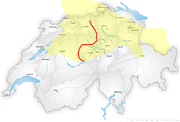
Alemannic German
Alemannic is a group of dialects of the Upper German branch of the Germanic language family. It is spoken by approximately ten million people in six countries: Switzerland, Germany, Austria, Liechtenstein, France and Italy...
and is often considered to be part of the German language
German language
German is a West Germanic language, related to and classified alongside English and Dutch. With an estimated 90 – 98 million native speakers, German is one of the world's major languages and is the most widely-spoken first language in the European Union....
, even though it is only partly intelligible to non-Alemannic speakers.
The High Alemannic dialects are spoken in Liechtenstein
Liechtenstein
The Principality of Liechtenstein is a doubly landlocked alpine country in Central Europe, bordered by Switzerland to the west and south and by Austria to the east. Its area is just over , and it has an estimated population of 35,000. Its capital is Vaduz. The biggest town is Schaan...
and in most of German-speaking Switzerland
Switzerland
Switzerland name of one of the Swiss cantons. ; ; ; or ), in its full name the Swiss Confederation , is a federal republic consisting of 26 cantons, with Bern as the seat of the federal authorities. The country is situated in Western Europe,Or Central Europe depending on the definition....
(for instance Bernese German
Bernese German
Bernese German is the dialect of High Alemannic German spoken in the Swiss plateau part of the canton of Bern and in some neighbouring regions.- Varieties :There is a lot of regional variation within Bernese German dialects...
or Zürich German
Zürich German
Zürich German, or Züritüütsch is the High Alemannic dialect spoken in the Canton of Zürich, Switzerland.It is divided in six sub-dialects, covering the entire Canton with the exception of the parts north of the Thur and the Rhine....
) except for the Highest Alemannic
Highest Alemannic German
Highest Alemannic is a branch of Alemannic German and is often considered to be part of the German language, even though mutual intelligibility with Standard German and other non-Alemannic German dialects is very limited....
dialects in the South and for the Low Alemannic
Low Alemannic German
Low Alemannic is a branch of Alemannic German and is often considered to be part of the German language, even though it is only partly intelligible to speakers of German.Variants:*Vorarlbergisch*Upper Rhenish*Alsatian, spoken in the Alsace, France...
Basel German
Basel German
Basel German or Baseldytsch is the dialect of the city of Basel, Switzerland. Among the Swiss German dialects, it is the only Low Alemannic one.- Aspirated plosives :...
dialect in the North West. They are also spoken in Southern Baden-Württemberg
Baden-Württemberg
Baden-Württemberg is one of the 16 states of Germany. Baden-Württemberg is in the southwestern part of the country to the east of the Upper Rhine, and is the third largest in both area and population of Germany's sixteen states, with an area of and 10.7 million inhabitants...
in Germany
Germany
Germany , officially the Federal Republic of Germany , is a federal parliamentary republic in Europe. The country consists of 16 states while the capital and largest city is Berlin. Germany covers an area of 357,021 km2 and has a largely temperate seasonal climate...
and in Vorarlberg
Vorarlberg
Vorarlberg is the westernmost federal-state of Austria. Although it is the second smallest in terms of area and population , it borders three countries: Germany , Switzerland and Liechtenstein...
in Austria
Austria
Austria , officially the Republic of Austria , is a landlocked country of roughly 8.4 million people in Central Europe. It is bordered by the Czech Republic and Germany to the north, Slovakia and Hungary to the east, Slovenia and Italy to the south, and Switzerland and Liechtenstein to the...
. Therefore, High Alemannic must not be confused with the term "Swiss German
Swiss German
Swiss German is any of the Alemannic dialects spoken in Switzerland and in some Alpine communities in Northern Italy. Occasionally, the Alemannic dialects spoken in other countries are grouped together with Swiss German as well, especially the dialects of Liechtenstein and Austrian Vorarlberg...
", which refers to all Alemannic dialects of Switzerland as opposed to Swiss variant
Swiss Standard German
Swiss Standard German, referred to by the Swiss as Schriftdeutsch, or Hochdeutsch, is one of four official languages in Switzerland, besides French, Italian and Romansh...
of Standard German
Standard German
Standard German is the standard variety of the German language used as a written language, in formal contexts, and for communication between different dialect areas...
, the literary language of diglossic
Diglossia
In linguistics, diglossia refers to a situation in which two dialects or languages are used by a single language community. In addition to the community's everyday or vernacular language variety , a second, highly codified variety is used in certain situations such as literature, formal...
German-speaking Switzerland.
Features
The distinctive feature of the High Alemannic dialects is the completion of the High German consonant shiftHigh German consonant shift
In historical linguistics, the High German consonant shift or second Germanic consonant shift is a phonological development that took place in the southern parts of the West Germanic dialect continuum in several phases, probably beginning between the 3rd and 5th centuries AD, and was almost...
, for instance chalt [xalt] 'cold' vs. Low Alemannic and standard German 'kalt' [kʰalt].