

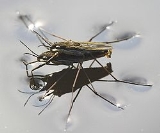
Heteroptera

Encyclopedia
Heteroptera is a group of about 40,000 species of insects in the Hemiptera
. Sometimes called "true bugs", that name more commonly refers to Hemiptera as a whole, and "typical bugs" might be used as a more unequivocal alternative since among the Hemiptera the heteropterans are most consistently and universally termed "bugs". "Heteroptera" is Greek for "different wings": most species have forewings with both membranous and hardened portions (called hemelytra
); members of the primitive Enicocephalomorpha
have wings that are completely membranous.
The name "Heteroptera" is used in two very different ways in modern classifications; in Linnean nomenclature it commonly appears as a suborder within the order
Hemiptera
, where it can be paraphyletic or monophyletic depending on its delimitation. In phylogenetic nomenclature
it is used as an unranked clade
within the Prosorrhyncha
clade which in turn is in the Hemiptera
clade. This results from the realization that the Coleorrhyncha
are actually just a "living fossil
" relative of the traditional Heteroptera, close enough to them to be actually united with that group.
The Gerromorpha
and Nepomorpha
contain most of the aquatic and semi-aquatic members of the Heteroptera, while nearly all of the remaining groups that are common and familiar are in the Cimicomorpha
and Pentatomomorpha
.
, dating back to Latreille
, 1810, and it is only recently that it has been relegated to a subsidiary rank within a larger definition of Hemiptera, so many reference works still include it as an order. Whether to continue treating it as a suborder is still a subject of some controversy, as is whether the name itself should be used at all, though three basic approaches ranging from abolishing it entirely to maintaining the taxonomy
with a slight change in systematics
are proposed, two of which (but not the traditional one) agree with the phylogeny. The competing classifications basically boil down to preference for two suborders versus one when the "living fossil
" family Peloridiidae is taken into consideration:
In the traditional classification, the Peloridiidae are retained as their own suborder, called Coleorrhyncha
, and "Heteroptera" is treated as a suborder as well. Functionally, the only difference between this classification and the preceding is that the former uses the name Prosorrhyncha to refer to a particular clade
, while the traditional approach divides this into the paraphyletic Heteroptera plus the monophyletic Coleorrhyncha: Many believe is preferable to use one name only, because they feel that the two traditional suborders are too closely related to be treated as separate and should instead be one suborder only.
In one revised classification proposed in 1995, the name of the suborder is Prosorrhyncha
, and Heteroptera is a rankless subgroup within it. The only difference between Heteroptera and Prosorrhyncha is that the latter includes the family Peloridiidae, which is a tiny relictual group that is in its own monotypic
superfamily and infraorder. In other words, the Heteroptera and Prosorrhyncha sensu Sorensen et al. are identical except that Prosorrhyncha contains one additional infraorder, called Peloridiomorpha (comprising only 13 small genera). The ongoing conflict between traditional, Linnaean classifications and non-traditional classifications is exemplified by the problem inherent in continued usage of the name Heteroptera when it no longer can be matched to any standard Linnaean rank (as it falls below suborder but above infraorder). If this classification wins out, then the "Heteroptera" grouping may be discarded in the near future, but in that case it is likely that no ranks are used at all according to the standards of phylogenetic nomenclature
.
Alternatively, the modified approach of placing Coleorrhyncha within the Heteroptera can be used. Indeed, as that solution preserves the well-known Heteroptera at the taxonomic rank they traditionally hold while making them a good monophyletic group, it seems preferable to the paraphyletic "Heteroptera" used in older works. In that case, the "core" Heteroptera could be considered a section
– as of yet unnamed, mainly because the Prosorrhyncha were proposed earlier – within the "expanded" Heteroptera, or the latter could simply be described as consisting of a basal "living fossil" lineage and a more apomorphic main radiation. Whether the name "Coleorrhyncha" is to be retained for the basal lineage or whether the more consistent "Peloridiomorpha" is used instead is a matter of taste, as described below.
Separate from the question of the actual "closeness" of Heteroptera and Coleorrhyncha is the potential disruption to traditional construction of names; there seems to be reluctance among hemipterists to abandon the use of "Heteroptera". This can be seen by the name itself, as it is a violation of convention to use the ending "-ptera" for any rank above genus other than an order – though since it is a convention rather than a mandatory rule of Linnean nomenclature
, taxonomists are technically free to violate it (which is why, for example, not all insect orders end in "-ptera", e.g., Odonata
). However, in most cases when such conventions are violated, it does not create an internal conflict as in the present case (that is, the order Hemiptera has a suborder named Heteroptera, which is an internal conflict). At least some hemipterists argue that the name Heteroptera should be dropped entirely to eliminate this internal conflict, though the third possibility offers a workaround. In that case, to achieve full consistency of names "Coleorrhyncha" would probably be dropped in favor of "Peloridiomorpha".
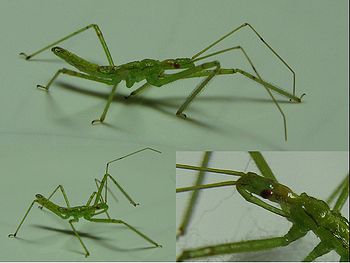
s" is a common name for a number of aquatic insects, most of which are classified in the infraorders Gerromorpha
and Nepomorpha
of the order Hemiptera
. The latter infraorder contains those taxa that were once known as the "Gymnocerata". Note that the term "water bug" is very often applied to some cockroach
es, which are not true bugs and as Dictyoptera
not even close to them (true bugs are Paraneoptera
).
Hemiptera
Hemiptera is an order of insects most often known as the true bugs , comprising around 50,000–80,000 species of cicadas, aphids, planthoppers, leafhoppers, shield bugs, and others...
. Sometimes called "true bugs", that name more commonly refers to Hemiptera as a whole, and "typical bugs" might be used as a more unequivocal alternative since among the Hemiptera the heteropterans are most consistently and universally termed "bugs". "Heteroptera" is Greek for "different wings": most species have forewings with both membranous and hardened portions (called hemelytra
Insect wing
Insects are the only group of invertebrates known to have evolved flight. Insects possess some remarkable flight characteristics and abilities, still far superior to attempts by humans to replicate their capabilities. Even our understanding of the aerodynamics of flexible, flapping wings and how...
); members of the primitive Enicocephalomorpha
Enicocephalomorpha
Enicocephalomorpha is an infraorder of the order Hemiptera . The infraorder was formerly thought to be related to the Reduviidae because of similarities in head structure. Entomologists now believe it is different enough from other Hemiptera to constitute a separate suborder and probably...
have wings that are completely membranous.
The name "Heteroptera" is used in two very different ways in modern classifications; in Linnean nomenclature it commonly appears as a suborder within the order
Order (biology)
In scientific classification used in biology, the order is# a taxonomic rank used in the classification of organisms. Other well-known ranks are life, domain, kingdom, phylum, class, family, genus, and species, with order fitting in between class and family...
Hemiptera
Hemiptera
Hemiptera is an order of insects most often known as the true bugs , comprising around 50,000–80,000 species of cicadas, aphids, planthoppers, leafhoppers, shield bugs, and others...
, where it can be paraphyletic or monophyletic depending on its delimitation. In phylogenetic nomenclature
Phylogenetic nomenclature
Phylogenetic nomenclature or phylogenetic taxonomy is an alternative to rank-based nomenclature, applying definitions from cladistics . Its two defining features are the use of phylogenetic definitions of biological taxon names, and the lack of obligatory ranks...
it is used as an unranked clade
Clade
A clade is a group consisting of a species and all its descendants. In the terms of biological systematics, a clade is a single "branch" on the "tree of life". The idea that such a "natural group" of organisms should be grouped together and given a taxonomic name is central to biological...
within the Prosorrhyncha
Prosorrhyncha
The name Prosorrhyncha is a name for a suborder of Hemiptera, comprising a grouping of the traditional taxon "Heteroptera" plus its sister taxon, the family Peloridiidae...
clade which in turn is in the Hemiptera
Hemiptera
Hemiptera is an order of insects most often known as the true bugs , comprising around 50,000–80,000 species of cicadas, aphids, planthoppers, leafhoppers, shield bugs, and others...
clade. This results from the realization that the Coleorrhyncha
Coleorrhyncha
Peloridiidae is a family of true bugs, comprising 17 genera and 36 species. They are small, ranging in length from 2 to 4 mm, rarely seen, peculiarly lumpy, flattened bugs found in Patagonia , New Zealand, eastern Australia, Lord Howe Island and New Caledonia. All the Peloridiidae species are...
are actually just a "living fossil
Living fossil
Living fossil is an informal term for any living species which appears similar to a species otherwise only known from fossils and which has no close living relatives, or a group of organisms which have long fossil records...
" relative of the traditional Heteroptera, close enough to them to be actually united with that group.
The Gerromorpha
Gerromorpha
Gerromorpha is an infraorder of insects in the "true bug" order Hemiptera. These "typical" bugs are commonly called semiaquatic bugs or shore-inhabiting bugs...
and Nepomorpha
Nepomorpha
Nepomorpha is an infraorder of insects in the "true bug" order . They belong to the "typical" bugs of the suborder Heteroptera. Due to their aquatic habits, these animals are known as true water bugs. They occur all over the world outside the polar regions, with about 2,000 species altogether...
contain most of the aquatic and semi-aquatic members of the Heteroptera, while nearly all of the remaining groups that are common and familiar are in the Cimicomorpha
Cimicomorpha
Cimicomorpha is an infraorder of insects containing bugs....
and Pentatomomorpha
Pentatomomorpha
Pentatomomorpha is an infraorder of insects in the true bug order . It unites such animals as the plant bugs , stink bugs , flat bugs , seed bugs , etc. They are closely related to the Cimicomorpha.-Systematics:5 superfamilies are usually placed in the Pentatomomorpha...
.
Classification
The use of the name "Heteroptera" has a long history at the rank of orderOrder (biology)
In scientific classification used in biology, the order is# a taxonomic rank used in the classification of organisms. Other well-known ranks are life, domain, kingdom, phylum, class, family, genus, and species, with order fitting in between class and family...
, dating back to Latreille
Pierre André Latreille
Pierre André Latreille was a French zoologist, specialising in arthropods. Having trained as a Roman Catholic priest before the French Revolution, Latreille was imprisoned, and only regained his freedom after recognising a rare species he found in the prison, Necrobia ruficollis...
, 1810, and it is only recently that it has been relegated to a subsidiary rank within a larger definition of Hemiptera, so many reference works still include it as an order. Whether to continue treating it as a suborder is still a subject of some controversy, as is whether the name itself should be used at all, though three basic approaches ranging from abolishing it entirely to maintaining the taxonomy
Taxonomy
Taxonomy is the science of identifying and naming species, and arranging them into a classification. The field of taxonomy, sometimes referred to as "biological taxonomy", revolves around the description and use of taxonomic units, known as taxa...
with a slight change in systematics
Systematics
Biological systematics is the study of the diversification of terrestrial life, both past and present, and the relationships among living things through time. Relationships are visualized as evolutionary trees...
are proposed, two of which (but not the traditional one) agree with the phylogeny. The competing classifications basically boil down to preference for two suborders versus one when the "living fossil
Living fossil
Living fossil is an informal term for any living species which appears similar to a species otherwise only known from fossils and which has no close living relatives, or a group of organisms which have long fossil records...
" family Peloridiidae is taken into consideration:
In the traditional classification, the Peloridiidae are retained as their own suborder, called Coleorrhyncha
Coleorrhyncha
Peloridiidae is a family of true bugs, comprising 17 genera and 36 species. They are small, ranging in length from 2 to 4 mm, rarely seen, peculiarly lumpy, flattened bugs found in Patagonia , New Zealand, eastern Australia, Lord Howe Island and New Caledonia. All the Peloridiidae species are...
, and "Heteroptera" is treated as a suborder as well. Functionally, the only difference between this classification and the preceding is that the former uses the name Prosorrhyncha to refer to a particular clade
Clade
A clade is a group consisting of a species and all its descendants. In the terms of biological systematics, a clade is a single "branch" on the "tree of life". The idea that such a "natural group" of organisms should be grouped together and given a taxonomic name is central to biological...
, while the traditional approach divides this into the paraphyletic Heteroptera plus the monophyletic Coleorrhyncha: Many believe is preferable to use one name only, because they feel that the two traditional suborders are too closely related to be treated as separate and should instead be one suborder only.
In one revised classification proposed in 1995, the name of the suborder is Prosorrhyncha
Prosorrhyncha
The name Prosorrhyncha is a name for a suborder of Hemiptera, comprising a grouping of the traditional taxon "Heteroptera" plus its sister taxon, the family Peloridiidae...
, and Heteroptera is a rankless subgroup within it. The only difference between Heteroptera and Prosorrhyncha is that the latter includes the family Peloridiidae, which is a tiny relictual group that is in its own monotypic
Monotypic
In biology, a monotypic taxon is a taxonomic group with only one biological type. The term's usage differs slightly between botany and zoology. The term monotypic has a separate use in conservation biology, monotypic habitat, regarding species habitat conversion eliminating biodiversity and...
superfamily and infraorder. In other words, the Heteroptera and Prosorrhyncha sensu Sorensen et al. are identical except that Prosorrhyncha contains one additional infraorder, called Peloridiomorpha (comprising only 13 small genera). The ongoing conflict between traditional, Linnaean classifications and non-traditional classifications is exemplified by the problem inherent in continued usage of the name Heteroptera when it no longer can be matched to any standard Linnaean rank (as it falls below suborder but above infraorder). If this classification wins out, then the "Heteroptera" grouping may be discarded in the near future, but in that case it is likely that no ranks are used at all according to the standards of phylogenetic nomenclature
Phylogenetic nomenclature
Phylogenetic nomenclature or phylogenetic taxonomy is an alternative to rank-based nomenclature, applying definitions from cladistics . Its two defining features are the use of phylogenetic definitions of biological taxon names, and the lack of obligatory ranks...
.
Alternatively, the modified approach of placing Coleorrhyncha within the Heteroptera can be used. Indeed, as that solution preserves the well-known Heteroptera at the taxonomic rank they traditionally hold while making them a good monophyletic group, it seems preferable to the paraphyletic "Heteroptera" used in older works. In that case, the "core" Heteroptera could be considered a section
Biological classification
Biological classification, or scientific classification in biology, is a method to group and categorize organisms by biological type, such as genus or species. Biological classification is part of scientific taxonomy....
– as of yet unnamed, mainly because the Prosorrhyncha were proposed earlier – within the "expanded" Heteroptera, or the latter could simply be described as consisting of a basal "living fossil" lineage and a more apomorphic main radiation. Whether the name "Coleorrhyncha" is to be retained for the basal lineage or whether the more consistent "Peloridiomorpha" is used instead is a matter of taste, as described below.
Separate from the question of the actual "closeness" of Heteroptera and Coleorrhyncha is the potential disruption to traditional construction of names; there seems to be reluctance among hemipterists to abandon the use of "Heteroptera". This can be seen by the name itself, as it is a violation of convention to use the ending "-ptera" for any rank above genus other than an order – though since it is a convention rather than a mandatory rule of Linnean nomenclature
International Code of Zoological Nomenclature
The International Code of Zoological Nomenclature is a widely accepted convention in zoology that rules the formal scientific naming of organisms treated as animals...
, taxonomists are technically free to violate it (which is why, for example, not all insect orders end in "-ptera", e.g., Odonata
Odonata
Odonata is an order of insects, encompassing dragonflies and damselflies . The word dragonfly is also sometimes used to refer to all Odonata, but the back-formation odonate is a more correct English name for the group as a whole...
). However, in most cases when such conventions are violated, it does not create an internal conflict as in the present case (that is, the order Hemiptera has a suborder named Heteroptera, which is an internal conflict). At least some hemipterists argue that the name Heteroptera should be dropped entirely to eliminate this internal conflict, though the third possibility offers a workaround. In that case, to achieve full consistency of names "Coleorrhyncha" would probably be dropped in favor of "Peloridiomorpha".
Selected families of Heteroptera
- Assassin bugs (Reduviidae)
- Broad-headed bugs (AlydidaeAlydidaeAlydidae, commonly known as broad-headed bugs, is a family of true bugs very similar to the closely related Coreidae . There are about 40 genera with 250 species altogether...
) - BedbugBedbugCimicidae are small parasitic insects. The most common type is Cimex lectularius. The term usually refers to species that prefer to feed on human blood...
s and flower bugs (Cimicidae) - Plant bugs (c.6,000 species of MiridaeMiridaeThe large and diverse insect family Miridae contains the plant bugs, leaf bugs, and grass bugs, and may also be known as capsid bugs. It is the largest family of true bugs belonging to the suborder Heteroptera, with over 10,000 known species and new ones constantly being described...
) - Leaf-footed bugs, squash bugs and sweetpotato bugSweetpotato bugThe sweetpotato bug is a species of insect in the family Coreidae. Native to Southeast Asia, the species has immigrated to the Pacific Islands...
s (CoreidaeCoreidaeCoreidae are a large family of predominantly herbivorous insects that belong in the hemipteran suborder Heteroptera. There are more than 1,800 species in over 250 genera. They vary in size from 7 to 45 mm, making the larger species some of the biggest heteropterans. The body shape of coreids...
) - Seed bugSeed bugThe Lygaeidae are a family in the Hemiptera , with some 60 genera in six subfamilies. The family includes the insects commonly known as milkweed bugs, and also some of those known as seed bugs...
s (mainly Lygaeidae and RhyparochromidaeRhyparochromidaeThe Rhyparochromidae are a large family of true bugs , many of which are commonly referred to as seed bugs. The family includes two subfamilies, 368 genera, and over 1,800 species....
) - Stink bugs or shield bugShield bugPentatomoidea is a superfamily of insects in the Heteroptera suborder of the Hemiptera order and, as such, share a common arrangement of sucking mouthparts...
s (Pentatomidae and related families)
"Waterbugs"
"WaterbugWaterbug
Waterbug or Water bug can refer to any of several things:True bugs* The true water bugs , including such insects as giant water bugs, creeping water bugs and backswimmers...
s" is a common name for a number of aquatic insects, most of which are classified in the infraorders Gerromorpha
Gerromorpha
Gerromorpha is an infraorder of insects in the "true bug" order Hemiptera. These "typical" bugs are commonly called semiaquatic bugs or shore-inhabiting bugs...
and Nepomorpha
Nepomorpha
Nepomorpha is an infraorder of insects in the "true bug" order . They belong to the "typical" bugs of the suborder Heteroptera. Due to their aquatic habits, these animals are known as true water bugs. They occur all over the world outside the polar regions, with about 2,000 species altogether...
of the order Hemiptera
Hemiptera
Hemiptera is an order of insects most often known as the true bugs , comprising around 50,000–80,000 species of cicadas, aphids, planthoppers, leafhoppers, shield bugs, and others...
. The latter infraorder contains those taxa that were once known as the "Gymnocerata". Note that the term "water bug" is very often applied to some cockroach
Cockroach
Cockroaches are insects of the order Blattaria or Blattodea, of which about 30 species out of 4,500 total are associated with human habitations...
es, which are not true bugs and as Dictyoptera
Dictyoptera
Dictyoptera includes three groups of polyneopterous insects - cockroaches , termites and mantids...
not even close to them (true bugs are Paraneoptera
Paraneoptera
Paraneoptera is a monophyletic superorder of insects which includes four orders, the bark lice, true lice, thrips, and hemipterans, the true bugs. The mouthparts of the Paraneoptera reflect diverse feeding habits...
).
Selected families of water bugs
- Backswimmers (Notonectidae)
- Giant water bugGiant water bugBelostomatidae is a family of insects in the order Hemiptera, known as giant water bugs or colloquially as toe-biters, electric-light bugs and Alligator Ticks . They are the largest insects in the order Hemiptera, and occur worldwide, with most of the species in North America, South America,...
s (Belostomatidae) - Water scorpions (Nepidae)
- Water boatmenWater boatmanCorixidae is a family of aquatic insects in the order Hemiptera that inhabit ponds and slow moving streams, where they swim near the bottom. There are about 500 known species worldwide, in 33 genera, including the genus Sigara....
(Corixidae) - Pond skaters (Gerridae)
- Smaller water striderVeliidaeVeliidae is a family of predatory insects in the suborder Heteroptera. They are commonly known as riffle bugs, smaller water striders or broad-shouldered water striders because the segment immediately behind the head is wider than the rest of the abdomen, unlike in the typical water striders ,...
(Veliidae)
External links
- List of species in Heteroptera (1998)
- Heteropteran Systematics Lab at University of California, Riverside http://heteroptera.ucr.edu
- Identification guide to UK Hemiptera
- Bugs – Hemiptera