

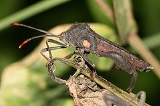
Coreidae

Encyclopedia
Coreidae are a large family
of predominantly herbivorous insects that belong in the hemiptera
n suborder Heteroptera
. There are more than 1,800 species in over 250 genera
. They vary in size from 7 to 45 mm, making the larger species some of the biggest heteropterans. The body shape of coreids is quite variable, with some species broadly oval while others are slender. Coreids are found throughout the world but most species are found in the tropics
and subtropics
.
In North America they are colloquially called "squash bugs", because some species, such as Anasa tristis, are pests of squash plants and other curcubits
. They are also called “leaf-footed bugs” due to the leaf-like expansions some species have on their hindlegs.
Some coreids, like Phyllomorpha laciniata
, exhibit parental care by carrying their eggs. This behaviour can protect the eggs from parasitism.
and is closely related to the families Alydidae
, Hyocephalidae
, Rhopalidae
, and Stenocephalidae. Together, these five families form the superfamily Coreoidea
.
are listed here:
Agriopocorinae Miller, 1953 (often included in Coreinae)
Coreinae
Leach, 1815
Family (biology)
In biological classification, family is* a taxonomic rank. Other well-known ranks are life, domain, kingdom, phylum, class, order, genus, and species, with family fitting between order and genus. As for the other well-known ranks, there is the option of an immediately lower rank, indicated by the...
of predominantly herbivorous insects that belong in the hemiptera
Hemiptera
Hemiptera is an order of insects most often known as the true bugs , comprising around 50,000–80,000 species of cicadas, aphids, planthoppers, leafhoppers, shield bugs, and others...
n suborder Heteroptera
Heteroptera
Heteroptera is a group of about 40,000 species of insects in the Hemiptera. Sometimes called "true bugs", that name more commonly refers to Hemiptera as a whole, and "typical bugs" might be used as a more unequivocal alternative since among the Hemiptera the heteropterans are most consistently and...
. There are more than 1,800 species in over 250 genera
Genera
Genera is a commercial operating system and development environment for Lisp machines developed by Symbolics. It is essentially a fork of an earlier operating system originating on the MIT AI Lab's Lisp machines which Symbolics had used in common with LMI and Texas Instruments...
. They vary in size from 7 to 45 mm, making the larger species some of the biggest heteropterans. The body shape of coreids is quite variable, with some species broadly oval while others are slender. Coreids are found throughout the world but most species are found in the tropics
Tropics
The tropics is a region of the Earth surrounding the Equator. It is limited in latitude by the Tropic of Cancer in the northern hemisphere at approximately N and the Tropic of Capricorn in the southern hemisphere at S; these latitudes correspond to the axial tilt of the Earth...
and subtropics
Subtropics
The subtropics are the geographical and climatical zone of the Earth immediately north and south of the tropical zone, which is bounded by the Tropic of Cancer and the Tropic of Capricorn, at latitudes 23.5°N and 23.5°S...
.
In North America they are colloquially called "squash bugs", because some species, such as Anasa tristis, are pests of squash plants and other curcubits
Cucurbitaceae
The plant family Cucurbitaceae consists of various squashes, melons, and gourds, including crops such as cucumber, pumpkins, luffas, and watermelons...
. They are also called “leaf-footed bugs” due to the leaf-like expansions some species have on their hindlegs.
Some coreids, like Phyllomorpha laciniata
Phyllomorpha laciniata
Phyllomorpha laciniata is a species of coreid bug....
, exhibit parental care by carrying their eggs. This behaviour can protect the eggs from parasitism.
Taxonomy
The family Coreidae belongs to the order HemipteraHemiptera
Hemiptera is an order of insects most often known as the true bugs , comprising around 50,000–80,000 species of cicadas, aphids, planthoppers, leafhoppers, shield bugs, and others...
and is closely related to the families Alydidae
Alydidae
Alydidae, commonly known as broad-headed bugs, is a family of true bugs very similar to the closely related Coreidae . There are about 40 genera with 250 species altogether...
, Hyocephalidae
Hyocephalidae
Hyocephalidae are a small family of Heteroptera which are endemic to Australia ....
, Rhopalidae
Rhopalidae
Rhopalidae, or scentless plant bugs are a family of true bugs. In older literature, the family is sometimes called "Corizidae". They differ from the related coreids in lacking well-developed scent glands. They are usually light-colored and smaller than the coreids...
, and Stenocephalidae. Together, these five families form the superfamily Coreoidea
Coreoidea
The leaf-footed bugs and allies make up the superfamily Coreoidea of the true bug infraorder Pentatomomorpha.There are 5 families presently recognized, but the Coreoidea as a whole are part of a close-knit group with the Lygaeoidea and Pyrrhocoroidea and it is likely that these three superfamilies...
.
Morphology
The general morphological features of Coreidae are an oval-shaped body, antennae composed of four segments, a numerously veined forewing membrane, a metathoracic stink gland and enlarged hind tibia. Many species are covered with spines and tubercles.Systematics
This group is most often divided into 3-4 subfamilies; some selected generaGenera
Genera is a commercial operating system and development environment for Lisp machines developed by Symbolics. It is essentially a fork of an earlier operating system originating on the MIT AI Lab's Lisp machines which Symbolics had used in common with LMI and Texas Instruments...
are listed here:
Agriopocorinae Miller, 1953 (often included in Coreinae)
- Agriopocoris Miller, 1953
Coreinae
Coreinae
Coreinae is a subfamily of the hemipteran insect family Coreidae. It comprises eleven tribes :*Acanthocephalini Stål, 1870 *Acanthocerini Bergroth, 1913*Anisoscelidini Laporte, 1832*Chariesterini Stål, 1867*Chelinideini Blatchley, 1926...
Leach, 1815
- AcanthocephalaAcanthocephala (insect)Acanthocephala is a genus of true bugs in the family Coreidae....
Laporte, 1833 - Acanthocerus Palisot, 1818
- Althos Kirkaldy, 1904
- Amblyomia Stål, 1870
- AnasaAnasaAnasa is a genus of leaf-footed bug in the Coreinae subfamily. The nine described species within this genus are:* A. andresii* A. armigera * A. bellator* A. cornuta* A. maculipes* A. repetita...
Amyot & Serville, 1843 - Catorhintha Stål, 1859
- Chariesterus Laporte, 1833
- Chelinidea Uhler, 1863
- Chondrocera Laporte, 1832
- Cimolus Stål, 1862
- CoreusCoreusCoreus is a genus of leaf-footed bug in the Coreinae subfamily. Species within this genus are:* C. marginatus* C. spinigerus...
- Dallacoris Osuna, 1981
- Euthochtha Mayr, 1865
- Ficana Stål, 1862
- Hypselonotus Hahn, 1833
- LeptoglossusLeptoglossusLeptoglossus is a genus of true bugs in the leaf-footed bug family. Several species are economic pests of agricultural crops. Like members of some other genera in the family, these bugs have leaflike dilations of the hind tibia.Species include:...
Guérin-Méneville, 1831 – conifer seed bugs
- Madura Stål, 1860
- Mamurius Stål, 1862
- Mozena Amyot & Serville, 1843
- Namacus Amyot & Serville, 1843
- Narnia Stål, 1862
- Nisoscolopocerus Barber, 1928
- Phthia Stål, 1862
- Piezogaster Amyot & Serville, 1843
- Sagotylus Mayr, 1865
- Savius Stål, 1862
- Scolopocerus Uhler, 1875
- Sephina Amyot & Serville, 1843
- Sethenira Spinola, 1837
- Spartocera Laporte, 1833
- Thasus Stål, 1865
- Zicca Amyot & Serville, 1843
Meropachydinae Stål, 1867
- Merocoris Perty, 1833
Pseudophloeinae Stål, 1867
- Ceraleptus Costa, 1847
- Coriomeris Westwood, 1842
Numerous tribe
Tribe (biology)
In biology, a tribe is a taxonomic rank between family and genus. It is sometimes subdivided into subtribes.Some examples include the tribes: Canini, Acalypheae, Hominini, Bombini, and Antidesmeae.-See also:* Biological classification* Rank...
s of the Coreinae have previously been proposed for elevation to subfamily rank; for example the Agriopocorini, Colpurini, Hydarini, Phyllomorphini and Procamptini. But the only one of these changes accepted at least by a significant minority of researchers today is the first, and even recent reviews generally tend to treat the proposed Agriopocorinae as a tribe again, recognizing only the three subfamilies that were known by 1867. In addition, at least the genus Eubule is of decidedly indeterminate placement.
External links
- Coreidae of Britain
- Coreidae of Florida
- Comparative description of the immature stages of two very similar leaf footed bugs, Holymenia clavigera (Herbst) and Anisoscelis foliacea marginella (Dallas) (Hemiptera, Coreidae, Anisoscelini)
- Coreidae (Heteroptera: Pentatomomorpha)
- Chelinidea vittiger aequoris, a cactus bug,
- Euthochtha galeator
- Leptoglossus phyllopus
- Spartocera batatas, giant sweetpotato bug