

Hemiscylliidae

Encyclopedia
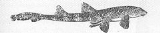
Hemiscylliidae is a family
of shark
s in the order Orectolobiformes, commonly known as longtail carpet sharks or bamboo sharks. They are found in shallow waters of the tropical Indo-Pacific
.
They are relatively small sharks, with the largest species reaching no more than 121 cm (47.6 in) in adult body length. They have elongated, cylindrical bodies, with short barbel
s and large spiracle
s. As their common name suggests, they have unusually long tails, which exceed the length of the rest of the body. They are sluggish fish, feeding off bottom dwelling invertebrates and smaller fish.
s. The eyes and supraorbital ridges are hardly elevated. The mouth
is closer to the eyes than to the tip of the snout, with lower labial folds usually connected across the chin by a flap of skin. The pectoral and pelvic fins are thin and not very muscular. There is no black hood on head or large black spot on the side (though juveniles often are strongly marked with dark spots/bars).
, Papua New Guinea
and Indonesia
, but an individual from this genus, possibly representing an undescribed species, has been photographed at the Seychelles
. They have short snouts with the nostril
s placed almost at the tip, and well-elevated eyes and supraorbital ridges. The mouth
is closer to the tip of the snout than the eyes, and lack the connecting dermal fold across the chin. The pectoral and pelvic fins are thick and heavily muscular. There is either a black hood on the head or a large black spot(s) on the sides of the body.
Full sized adult epaulette sharks are most successfully housed in tanks at or exceeding 180 gallons, while adult bamboo sharks require more space and are known to do well in 240 gallon aquaria. Hemiscyliids in captivity are provided artificial caves for them to hide in. However, unstable tank decor have been known to cause fatal injuries when the structure is disturbed by the sharks' digging behavior.
Family (biology)
In biological classification, family is* a taxonomic rank. Other well-known ranks are life, domain, kingdom, phylum, class, order, genus, and species, with family fitting between order and genus. As for the other well-known ranks, there is the option of an immediately lower rank, indicated by the...
of shark
Shark
Sharks are a type of fish with a full cartilaginous skeleton and a highly streamlined body. The earliest known sharks date from more than 420 million years ago....
s in the order Orectolobiformes, commonly known as longtail carpet sharks or bamboo sharks. They are found in shallow waters of the tropical Indo-Pacific
Indo-Pacific
The Indo-Pacific is a biogeographic region of the Earth's seas, comprising the tropical waters of the Indian Ocean, the western and central Pacific Ocean, and the seas connecting the two in the general area of Indonesia...
.
They are relatively small sharks, with the largest species reaching no more than 121 cm (47.6 in) in adult body length. They have elongated, cylindrical bodies, with short barbel
Barbel (anatomy)
A barbel on a fish is a slender, whiskerlike tactile organ near the mouth. Fish that have barbels include the catfish, the carp, the goatfish, sturgeon, the zebrafish and some species of shark...
s and large spiracle
Spiracle
Spiracles are openings on the surface of some animals that usually lead to respiratory systems.-Vertebrates:The spiracle is a small hole behind each eye that opens to the mouth in some fishes. In the primitive jawless fish the first gill opening immediately behind the mouth is essentially similar...
s. As their common name suggests, they have unusually long tails, which exceed the length of the rest of the body. They are sluggish fish, feeding off bottom dwelling invertebrates and smaller fish.
Genera and species
| Genus | Species | Type species | Synonyms | Temporal range |
|---|---|---|---|---|
| Chiloscyllium J. P. Müller Johannes Peter Müller Johannes Peter Müller , was a German physiologist, comparative anatomist, and ichthyologist not only known for his discoveries but also for his ability to synthesize knowledge.-Early years and education:... & Henle Friedrich Gustav Jakob Henle Friedrich Gustav Jakob Henle was a German physician, pathologist and anatomist. He is credited with the discovery of the loop of Henle in the kidney. His essay "On Miasma and Contagia" was an early argument for the germ theory of disease... , 1837 |
8 | Scyllium plagiosum Bennett, 1830 | Synchismus Gill, 1862 | Cenomanian Cenomanian The Cenomanian is, in the ICS' geological timescale the oldest or earliest age of the Late Cretaceous epoch or the lowest stage of the Upper Cretaceous series. An age is a unit of geochronology: it is a unit of time; the stage is a unit in the stratigraphic column deposited during the corresponding... —Recent |
| Hemiscyllium J. P. Müller Johannes Peter Müller Johannes Peter Müller , was a German physiologist, comparative anatomist, and ichthyologist not only known for his discoveries but also for his ability to synthesize knowledge.-Early years and education:... & Henle Friedrich Gustav Jakob Henle Friedrich Gustav Jakob Henle was a German physician, pathologist and anatomist. He is credited with the discovery of the loop of Henle in the kidney. His essay "On Miasma and Contagia" was an early argument for the germ theory of disease... , 1837 |
8 | Squalus ocellatus Epaulette shark The epaulette shark is a species of longtailed carpet shark, family Hemiscylliidae, found in shallow, tropical waters off Australia and New Guinea . The common name of this shark comes from the very large, white-margined black spot behind each pectoral fin, which are reminiscent of military... Bonnaterre, 1788 |
Thanetian Thanetian The Thanetian is, in the ICS' Geologic timescale, the latest age or uppermost stratigraphic stage of the Paleocene Epoch or series. It spans the time between and . The Thanetian is preceded by the Selandian age and followed by the Ypresian age... —Recent |
Chiloscyllium
This genus is distinguished by a relatively long snout with subterminal nostrilNostril
A nostril is one of the two channels of the nose, from the point where they bifurcate to the external opening. In birds and mammals, they contain branched bones or cartilages called turbinates, whose function is to warm air on inhalation and remove moisture on exhalation...
s. The eyes and supraorbital ridges are hardly elevated. The mouth
Mouth
The mouth is the first portion of the alimentary canal that receives food andsaliva. The oral mucosa is the mucous membrane epithelium lining the inside of the mouth....
is closer to the eyes than to the tip of the snout, with lower labial folds usually connected across the chin by a flap of skin. The pectoral and pelvic fins are thin and not very muscular. There is no black hood on head or large black spot on the side (though juveniles often are strongly marked with dark spots/bars).
- Chiloscyllium arabicum Gubanov, 1980 (Arabian carpetshark)
- Chiloscyllium burmensis Dingerkus & DeFino, 1983 (Burmese bamboo shark)
- Chiloscyllium caerulopunctatum PellegrinJacques PellegrinJacques Pellegrin was a French zoologist.Pellegrin was born in Paris, and studied natural history. In 1894 he became assistant chairman of zoology at the Muséum national d'histoire naturelle, replacing Léon Vaillant .He got his doctorates in medicine and science...
, 1914 (Bluespotted bamboo shark) - Chiloscyllium griseum J. P. MüllerJohannes Peter MüllerJohannes Peter Müller , was a German physiologist, comparative anatomist, and ichthyologist not only known for his discoveries but also for his ability to synthesize knowledge.-Early years and education:...
& HenleFriedrich Gustav Jakob HenleFriedrich Gustav Jakob Henle was a German physician, pathologist and anatomist. He is credited with the discovery of the loop of Henle in the kidney. His essay "On Miasma and Contagia" was an early argument for the germ theory of disease...
, 1838 (Grey bamboo shark) - Chiloscyllium hasseltii BleekerPieter BleekerPieter Bleeker was a Dutch medical doctor and ichthyologist, famous for his work on the fishes of East Asia – Atlas Ichthyologique des Orientales Neerlandaises – which was published 1862–1877....
, 1852 (Hasselt's bamboo shark) - Chiloscyllium indicum (J. F. GmelinJohann Friedrich GmelinJohann Friedrich Gmelin was a German naturalist, botanist, entomologist, herpetologist and malacologist.- Education :Johann Friedrich Gmelin was born as the eldest son of Philipp Friedrich Gmelin in 1748 in Tübingen...
, 1789) (Slender bamboo shark) - Chiloscyllium plagiosum (Anonymous, referred to BennettEdward Turner BennettEdward Turner Bennett was an English zoologist and writer. He was the elder brother of the botanist John Joseph Bennett. Bennett was born at Hackney and practiced as a surgeon, but his chief pursuit was always zoology...
, 1830) (Whitespotted bamboo shark) - Chiloscyllium punctatum J. P. MüllerJohannes Peter MüllerJohannes Peter Müller , was a German physiologist, comparative anatomist, and ichthyologist not only known for his discoveries but also for his ability to synthesize knowledge.-Early years and education:...
& HenleFriedrich Gustav Jakob HenleFriedrich Gustav Jakob Henle was a German physician, pathologist and anatomist. He is credited with the discovery of the loop of Henle in the kidney. His essay "On Miasma and Contagia" was an early argument for the germ theory of disease...
, 1838 (Brownbanded bamboo shark)
Hemiscyllium
This genus is located in the waters of AustraliaAustralia
Australia , officially the Commonwealth of Australia, is a country in the Southern Hemisphere comprising the mainland of the Australian continent, the island of Tasmania, and numerous smaller islands in the Indian and Pacific Oceans. It is the world's sixth-largest country by total area...
, Papua New Guinea
Papua New Guinea
Papua New Guinea , officially the Independent State of Papua New Guinea, is a country in Oceania, occupying the eastern half of the island of New Guinea and numerous offshore islands...
and Indonesia
Indonesia
Indonesia , officially the Republic of Indonesia , is a country in Southeast Asia and Oceania. Indonesia is an archipelago comprising approximately 13,000 islands. It has 33 provinces with over 238 million people, and is the world's fourth most populous country. Indonesia is a republic, with an...
, but an individual from this genus, possibly representing an undescribed species, has been photographed at the Seychelles
Seychelles
Seychelles , officially the Republic of Seychelles , is an island country spanning an archipelago of 115 islands in the Indian Ocean, some east of mainland Africa, northeast of the island of Madagascar....
. They have short snouts with the nostril
Nostril
A nostril is one of the two channels of the nose, from the point where they bifurcate to the external opening. In birds and mammals, they contain branched bones or cartilages called turbinates, whose function is to warm air on inhalation and remove moisture on exhalation...
s placed almost at the tip, and well-elevated eyes and supraorbital ridges. The mouth
Mouth
The mouth is the first portion of the alimentary canal that receives food andsaliva. The oral mucosa is the mucous membrane epithelium lining the inside of the mouth....
is closer to the tip of the snout than the eyes, and lack the connecting dermal fold across the chin. The pectoral and pelvic fins are thick and heavily muscular. There is either a black hood on the head or a large black spot(s) on the sides of the body.
- Hemiscyllium freycineti (QuoyJean René Constant QuoyJean René Constant Quoy was a French zoologist.Along with Joseph Paul Gaimard he served as naturalist aboard La Coquille under Louis Isidore Duperrey during its circumnavigation of the globe , and the Astrolabe under the command of Jules Dumont d'Urville...
& GaimardJoseph Paul GaimardJoseph Paul Gaimard was a French naval surgeon and naturalist.Along with Jean René Constant Quoy he served as naturalist on the ships L'Uranie under Louis de Freycinet 1817-1820, and L'Astrolabe under Jules Dumont d'Urville 1826-1829...
, 1824) (Indonesian speckled carpetshark) - Hemiscyllium galeiHemiscyllium galeiHemiscyllium galei is a species of bamboo shark in the family Hemiscylliidae. Together with H. henryi, it was only scientifically described in 2008 by Gerald R. Allen and Mark V. Erdmann. At present, H. galei is only known from depths of at reefs in the Cenderawasih Bay in West Papua, Indonesia....
G. R. Allen & Erdmann, 2008 - Hemiscyllium hallstromi WhitleyGilbert Percy WhitleyGilbert Percy Whitley was a British-born Australian ichthyologist and malacologist who was Curator of Fishes at the Australian Museum in Sydney for about 40 years. He was born at Swaythling, Southampton, England, and was educated at King Edward VI School, Southampton and Osborne House...
, 1967 (Papuan epaulette shark) - Hemiscyllium henryiHemiscyllium henryiHemiscyllium henryi is a species of bamboo shark in the family Hemiscylliidae. Together with H. galei, it was only scientifically described in 2008. At present, H. henryi is only known from depths of at reefs near Triton Bay in West Papua, Indonesia. It reaches a length of , and is covered in...
G. R. Allen & Erdmann, 2008 - Hemiscyllium michaeliHemiscyllium michaeliHemiscyllium michaeli, commonly known as the Milne Bay epaulette shark, is a species of bamboo shark in the genus Hemiscyllium. It is a tropical shark known from the shallow ocean in the Milne Bay region of eastern Papua New Guinea. The epaulette sharks of this region have long been confused with...
G. R. Allen & Dudgeon, 2010 (Milne Bay epaulette shark) - Hemiscyllium ocellatum (BonnaterrePierre Joseph BonnaterreAbbé Pierre Joseph Bonnaterre was a French naturalist who contributed sections on cetaceans, mammals, birds, reptiles, amphibians, and insects to the Tableau encyclopédique et méthodique...
, 1788) (Epaulette shark) - Hemiscyllium strahani WhitleyGilbert Percy WhitleyGilbert Percy Whitley was a British-born Australian ichthyologist and malacologist who was Curator of Fishes at the Australian Museum in Sydney for about 40 years. He was born at Swaythling, Southampton, England, and was educated at King Edward VI School, Southampton and Osborne House...
, 1967 (Hooded carpetshark) - Hemiscyllium trispeculare J. RichardsonJohn Richardson (naturalist)Sir John Richardson was a Scottish naval surgeon, naturalist and arctic explorer.Richardson was born at Dumfries. He studied medicine at Edinburgh University, and became a surgeon in the navy in 1807. He traveled with John Franklin in search of the Northwest Passage on the Coppermine Expedition of...
, 1843 (Speckled carpetshark)
Fossil taxa
- †Acanthoscyllium sahelalmae (Pictet & Humbert, 1866)
- †Almascyllium cheikeliasi (Signeaux, 1949)
- †Chiloscyllium broenirnani Casier, 1958
- †Hemiscyllium bruxelliensis Herman, 1977
- †Mesiteia daimeriesi (Herman, 1973)
- †Pseudospinax heterodon Underwood & Mitchell, 1999
Captivity
Hemiscylliid sharks are sometimes kept in home aquaria. Species from this family are ideal aquarium sharks because their natural habitats are tidepools, coral beds, and around boulders. This predisposition towards relatively confined spaces helps them adapt better to home aquaria compared to other species. Their generally small size for sharks and their preference for water temperatures comparable to those enjoyed by other common aquarium fish have also endeared them to marine aquarists. Multiple species of hemiscylliid have been successfully induced to breed in captivity.Full sized adult epaulette sharks are most successfully housed in tanks at or exceeding 180 gallons, while adult bamboo sharks require more space and are known to do well in 240 gallon aquaria. Hemiscyliids in captivity are provided artificial caves for them to hide in. However, unstable tank decor have been known to cause fatal injuries when the structure is disturbed by the sharks' digging behavior.