


Heart of Wales Line

Encyclopedia
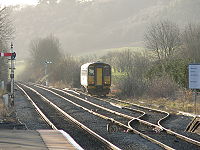
The Heart of Wales Line is a railway line running from Craven Arms
Craven Arms
Craven Arms is a small town and civil parish in Shropshire, England, located on the A49 road and the Welsh Marches railway line, which connect it north and south to the larger towns of Shrewsbury and Ludlow respectively. The Heart of Wales railway line joins the Welsh Marches line at Craven Arms...
in Shropshire
Shropshire
Shropshire is a county in the West Midlands region of England. For Eurostat purposes, the county is a NUTS 3 region and is one of four counties or unitary districts that comprise the "Shropshire and Staffordshire" NUTS 2 region. It borders Wales to the west...
to Llanelli
Llanelli
Llanelli , the largest town in both the county of Carmarthenshire and the preserved county of Dyfed , Wales, sits on the Loughor estuary on the West Wales coast, approximately west-north-west of Swansea and south-east of the county town, Carmarthen. The town is famous for its proud rugby...
in South Wales
South Wales
South Wales is an area of Wales bordered by England and the Bristol Channel to the east and south, and Mid Wales and West Wales to the north and west. The most densely populated region in the south-west of the United Kingdom, it is home to around 2.1 million people and includes the capital city of...
. It runs, as the name suggests, through some of the heartlands of Wales
Wales
Wales is a country that is part of the United Kingdom and the island of Great Britain, bordered by England to its east and the Atlantic Ocean and Irish Sea to its west. It has a population of three million, and a total area of 20,779 km²...
. It serves a number of rural centres en route, including several once fashionable spa town
Spa town
A spa town is a town situated around a mineral spa . Patrons resorted to spas to "take the waters" for their purported health benefits. The word comes from the Belgian town Spa. In continental Europe a spa was known as a ville d'eau...
s, including Llandrindod Wells
Llandrindod Wells
Llandrindod Wells , colloquially known locally as "Llandod", is a town and community in Powys, within the historic boundaries of Radnorshire, mid Wales, United Kingdom. It was developed as a spa town in the 19th century, with a boom in the late 20th century as a centre of local government. Before...
. At Builth Road
Builth Road railway station
Builth Road railway station is a railway station serving the small settlement of Builth Road, north of the town of Builth Wells, in mid Wales. It is situated on the Heart of Wales Line. The station is located just over two miles north of Builth Wells on the A470.All trains serving the station are...
, two miles (3.3 km) from the town of Builth Wells
Builth Wells
Builth Wells is a town in the county of Powys, within the historic boundaries of Brecknockshire, mid Wales, lying at the confluence of the River Wye and the River Irfon, in the Welsh of the Wye Valley. It has a population of 2,352....
, the line formerly crossed the route of the earlier Mid Wales Railway, which closed in the 1960s.
History
Historically the line was known as the Central Wales Line and also included routes through GowertonGowerton
The village of Gowerton is situated about 4 miles north west of Swansea city centre, Wales. Gowerton is often known as the gateway to Gower. Gowerton's original name was Ffosfelin...
, where the railway crossed the West Wales Line
West Wales Line
The West Wales Lines are a group of railway lines from Swansea through Carmarthenshire to Pembrokeshire, West Wales...
and ran through Dunvant
Dunvant
Dunvant is a suburban district in the City and County of Swansea, Wales, and falls within the Dunvant ward. It is situated in a valley some 4.5 miles west of Swansea city centre.-History:...
and Killay
Killay
Killay is the name of a suburb and local government community in Swansea, Wales. Killay has its own community council. The village is set high above sea level, about 3.5 miles west of Swansea city centre....
then down through the Clyne Valley to Blackpill
Blackpill
Blackpill is a suburban area of Swansea, Wales. It is located beside Swansea Bay, about south west of the city centre.Blackpill falls into the Mayals ward....
, and then along the sea wall to Swansea Bay station, (near the former slip bridge) before finally reaching Swansea
Swansea
Swansea is a coastal city and county in Wales. Swansea is in the historic county boundaries of Glamorgan. Situated on the sandy South West Wales coast, the county area includes the Gower Peninsula and the Lliw uplands...
Victoria. This section, originally built by the Llanelly Railway and Dock Company to compete with the Great Western Railway
Great Western Railway
The Great Western Railway was a British railway company that linked London with the south-west and west of England and most of Wales. It was founded in 1833, received its enabling Act of Parliament in 1835 and ran its first trains in 1838...
and break the monopoly they held on Swansea Dock, closed in 1964. Nationalisation
Nationalization
Nationalisation, also spelled nationalization, is the process of taking an industry or assets into government ownership by a national government or state. Nationalization usually refers to private assets, but may also mean assets owned by lower levels of government, such as municipalities, being...
of the railways had removed the need for competing routes, and the running down and closure of Swansea North Dock ended the need for freight services on this section. Trains now use the original LR main line to reach the West Wales Line
West Wales Line
The West Wales Lines are a group of railway lines from Swansea through Carmarthenshire to Pembrokeshire, West Wales...
at Llandeilo Junction and thence and (after a reversal) .
North of , the route was opened in stages between 1861 and 1868 by a number of different companies (all backed by the LNWR) - the Knighton Railway, the Central Wales Railway and Central Wales Extension Railway.
As a rural branch line the remainder of the Heart of Wales Line survived the Beeching axe
Beeching Axe
The Beeching Axe or the Beeching Cuts are informal names for the British Government's attempt in the 1960s to reduce the cost of running British Railways, the nationalised railway system in the United Kingdom. The name is that of the main author of The Reshaping of British Railways, Dr Richard...
since it carried extensive freight traffic and served the steelworks at Bynea
Bynea
Bynea is a village close to the River Loughor in Carmarthenshire, Wales. This was an agricultural area until the turn of the twentieth century, when it became heavily industralised with coal mines and steelworks...
and industrial areas such as Ammanford and Pontarddulais
Pontarddulais
Pontarddulais is a community and town in the City and County of Swansea, Wales. It is situated north west of Swansea city centre. It falls within the Pontarddulais ward.-Overview:...
, linking them with the docks at Llanelli
Llanelli
Llanelli , the largest town in both the county of Carmarthenshire and the preserved county of Dyfed , Wales, sits on the Loughor estuary on the West Wales coast, approximately west-north-west of Swansea and south-east of the county town, Carmarthen. The town is famous for its proud rugby...
. It also passes through six marginal constituencies, which was the main reason why Harold Wilson
Harold Wilson
James Harold Wilson, Baron Wilson of Rievaulx, KG, OBE, FRS, FSS, PC was a British Labour Member of Parliament, Leader of the Labour Party. He was twice Prime Minister of the United Kingdom during the 1960s and 1970s, winning four general elections, including a minority government after the...
saved the line from closure. During engineering work the line is still occasionally used as a diversionary freight route. The basic service over the line since the seventies has remained more or less constant, with four or five trains per day in each direction on weekdays and two or three on Sundays (although the latter ran in summer only until quite recently).
The line is single track throughout (except for a few miles at the southern end shared with the Swansea District Line
Swansea District Line
The Swansea District Line is a section of line running through the northern part of Swansea, and is used for freight transportation, and minimal passenger transport. It was built by the Great Western Railway in 1912 to provide a faster and less steeply graded route between London and Fishguard, in...
) and has been operated under a Light Railway Order since 1972. There are five passing loops, at , , , and . The Llanwrtyd passing loop is in used on two of the Monday - Saturday services and the Llandrindod passing loop is in use on the other two and also on the Sunday services. The signalling was modernised in 1986, when a system known as No Signalman Token Remote working was introduced. This is overseen by the signaller at , with the token instruments at the aforementioned five passing loops being operated by the train crew (the surviving signal box
Signal box
On a rail transport system, signalling control is the process by which control is exercised over train movements by way of railway signals and block systems to ensure that trains operate safely, over the correct route and to the proper timetable...
es at each station having been closed as part of the modernisation scheme and the points converted to automatic operation).
For more than two years only two of the loops (Llandrindod and Llanwrtyd) have been operational as Network Rail
Network Rail
Network Rail is the government-created owner and operator of most of the rail infrastructure in Great Britain .; it is not responsible for railway infrastructure in Northern Ireland...
were unable to source spare parts for the points mechanisms used at all five (the design used is now obsolete) and have had to take parts from the three decommissioned loops to keep the other two operational. In 2009 NR stated their intention to install new electric point machines at all five loops and restore the three out-of-service ones to full working order (after being heavily criticised by the chairman of the South Wales branch of Railfuture at the organisation's recent Annual General Meeting) but were unable to give a timescale for this to be carried out as design work on the new equipment was still ongoing. NR began the replacement works for the points after first installing the system on the line to Pembroke Dock, at the Tenby loop, on 7 December 2009 and then making minor alterations in Feb 2010. was the first on the line to be modernised, the rest followed. The £5 million project was completed in October 2010.
In 1987 tragedy struck the line near Llandeilo
Llandeilo
Llandeilo is a town in Carmarthenshire, Wales, situated at the crossing of the River Towy by the A483 on a 19th century stone bridge. Its population is 1,731.The town is served by Llandeilo railway station on the Heart of Wales Line.- Early history :...
when the Glanrhyd Bridge collapsed following heavy flooding, and an early morning northbound train plunged into the swollen River Towy, killing four people. For a while the future of the line was in doubt (the equally rural yet just as vital Carmarthen
Carmarthen
Carmarthen is a community in, and the county town of, Carmarthenshire, Wales. It is sited on the River Towy north of its mouth at Carmarthen Bay. In 2001, the population was 14,648....
- Aberystwyth
Aberystwyth
Aberystwyth is a historic market town, administrative centre and holiday resort within Ceredigion, Wales. Often colloquially known as Aber, it is located at the confluence of the rivers Ystwyth and Rheidol....
line had been closed in 1965 following serious flood damage as the cost of repairs was deemed unacceptable) but political forces of all sides rallied to ensure the line's survival.
Passenger Services
As of 2010, there are four trains per day in each direction on weekdays and two on Sundays. Trains are one or two carriages each, with a small team of staff. A buffet trolley service runs occasionally. The Heart of Wales line proper runs between Llanelli and Craven Arms, however train services normally terminate at and . One train a day originates at and two southbound weekday trains travel onwards from Swansea to Cardiff. Most stations are request stopRequest stop
In public transport, a request stop or flag stop describes a stopping point at which trains or buses stop only on an as-need or request basis; that is, only if there are passengers to be picked up or dropped off. In this way, infrequently used stopping points can be served efficiently.Trains save...
s.
At Craven Arms, the line joins the Welsh Marches Line
Welsh Marches Line
The Welsh Marches Line , known historically as the North and West Route, is the railway line running from Newport in south-east Wales to Shrewsbury in the West Midlands region of England by way of Abergavenny, Hereford and Craven Arms, and thence to Crewe via Whitchurch...
to Church Stretton
Church Stretton
Church Stretton is a small town and civil parish in Shropshire, England. The population of the town was recorded as 2,789 in 2001, whilst the population of the wider parish was recorded as 4,186...
and Shrewsbury
Shrewsbury
Shrewsbury is the county town of Shropshire, in the West Midlands region of England. Lying on the River Severn, it is a civil parish home to some 70,000 inhabitants, and is the primary settlement and headquarters of Shropshire Council...
.
Passenger services are operated by Arriva Trains Wales
Arriva Trains Wales
Arriva Trains Wales is a train operating company, owned by Arriva, that operates urban and inter urban passenger services in Wales and the Welsh Marches...
using Class 150
British Rail Class 150
The British Rail Class 150 "Sprinter" diesel multiple units were built by BREL from 1984-87. A total of 137 units were built in three main subclasses, replacing many of the earlier first-generation "Heritage" DMUs.- Background :...
or Class 153
British Rail Class 153
The British Rail Class 153 Super Sprinter is a single car diesel multiple unit converted from British Rail Class 155s.-Description:These units were originally built as two-car Class 155 units by British Leyland from 1987–88, but were converted by Hunslet-Barclay at Kilmarnock from 1991-92...
diesel multiple unit
Diesel multiple unit
A diesel multiple unit or DMU is a multiple unit train consisting of multiple carriages powered by one or more on-board diesel engines. They may also be referred to as a railcar or railmotor, depending on country.-Design:...
s, although Class 175s
British Rail Class 175
The Class 175 Coradia is a type of diesel multiple unit passenger train used in the United Kingdom. The fleet of 27 sets were built from 1999 to 2001 by Alstom at Washwood Heath in Birmingham. They are part of the Coradia family of trains along with the Class 180.The entire fleet is owned by the...
have been used on rare occasions. The continued use of Class 153 DMUs has received criticism, notably from Kirsty Williams AM
Kirsty Williams
Victoria Kirsty Williams is a British politician. She is the leader of the Welsh Liberal Democrats and the Member of the Welsh Assembly for Brecon and Radnorshire.-Early life:...
, who says:
The line has also been used for exceptional train movements, including:
- ManchesterManchesterManchester is a city and metropolitan borough in Greater Manchester, England. According to the Office for National Statistics, the 2010 mid-year population estimate for Manchester was 498,800. Manchester lies within one of the UK's largest metropolitan areas, the metropolitan county of Greater...
to trains diverted during engineering works between and has special trains from CardiffCardiffCardiff is the capital, largest city and most populous county of Wales and the 10th largest city in the United Kingdom. The city is Wales' chief commercial centre, the base for most national cultural and sporting institutions, the Welsh national media, and the seat of the National Assembly for...
for the Royal Welsh Show which operate via the Swansea District LineSwansea District LineThe Swansea District Line is a section of line running through the northern part of Swansea, and is used for freight transportation, and minimal passenger transport. It was built by the Great Western Railway in 1912 to provide a faster and less steeply graded route between London and Fishguard, in...
between and- This required easement #10003 to rail tickets endorsed "via Llanelli" which allows journeys routed via Cardiff, Port Talbot, Pontarddulais which avoid Llanelli to be a permitted exception.
- Charter trains taking in the scenic beauty of the route, such as The Welshman's charter on Saturday 30 April 2011
This route is the longest passenger route currently operated by class 150 sprinter and class 153 super sprinter trains, with an average journey time of over 4 hours.