

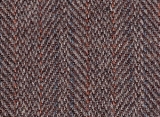
Harris Tweed

Encyclopedia

Weaving
Weaving is a method of fabric production in which two distinct sets of yarns or threads are interlaced at right angles to form a fabric or cloth. The other methods are knitting, lace making and felting. The longitudinal threads are called the warp and the lateral threads are the weft or filling...
by the islanders on the Isles of Harris, Lewis
Lewis
Lewis is the northern part of Lewis and Harris, the largest island of the Western Isles or Outer Hebrides of Scotland. The total area of Lewis is ....
, Uist
Uist
Uist or The Uists are the central group of islands in the Outer Hebrides of Scotland.North Uist and South Uist are linked by causeways running via Benbecula and Grimsay, and the entire group is sometimes known as the Uists....
and Barra
Barra
The island of Barra is a predominantly Gaelic-speaking island, and apart from the adjacent island of Vatersay, to which it is connected by a causeway, is the southernmost inhabited island of the Outer Hebrides in Scotland.-Geography:The 2001 census showed that the resident population was 1,078...
in the Outer Hebrides
Outer Hebrides
The Outer Hebrides also known as the Western Isles and the Long Island, is an island chain off the west coast of Scotland. The islands are geographically contiguous with Comhairle nan Eilean Siar, one of the 32 unitary council areas of Scotland...
of Scotland
Scotland
Scotland is a country that is part of the United Kingdom. Occupying the northern third of the island of Great Britain, it shares a border with England to the south and is bounded by the North Sea to the east, the Atlantic Ocean to the north and west, and the North Channel and Irish Sea to the...
, using local wool
Wool
Wool is the textile fiber obtained from sheep and certain other animals, including cashmere from goats, mohair from goats, qiviut from muskoxen, vicuña, alpaca, camel from animals in the camel family, and angora from rabbits....
.
Traditional Harris Tweed was characterized by subtle flecks of colour achieved through the use of vegetable dyes, including the lichen dyes called "crottle" (Parmelia saxatilis
Parmelia (lichen)
Parmelia is a large genus of lichenized fungus with a global distribution, extending from the Arctic to the Antarctic continent but concentrated in temperate regions. 125 species have been recorded on the Indian sub-continent...
and Parmelia omphalodes
Parmelia (lichen)
Parmelia is a large genus of lichenized fungus with a global distribution, extending from the Arctic to the Antarctic continent but concentrated in temperate regions. 125 species have been recorded on the Indian sub-continent...
which give deep red- or purple-brown and rusty orange respectively). These lichens are the origin of the distinctive scent of older Harris Tweed.
Production

Scots language
Scots is the Germanic language variety spoken in Lowland Scotland and parts of Ulster . It is sometimes called Lowland Scots to distinguish it from Scottish Gaelic, the Celtic language variety spoken in most of the western Highlands and in the Hebrides.Since there are no universally accepted...
for twill
Twill
Twill is a type of textile weave with a pattern of diagonal parallel ribs . This is done by passing the weft thread over one or more warp threads and then under two or more warp threads and so on, with a "step" or offset between rows to create the characteristic diagonal pattern. Because of this...
, it being woven in a twilled rather than a plain pattern. A traditional story has the name coming about almost by chance. About 1830, a London merchant received a letter from a Hawick
Hawick
Hawick is a town in the Scottish Borders of south east Scotland. It is south-west of Jedburgh and south-southeast of Selkirk. It is one of the farthest towns from the sea in Scotland, in the heart of Teviotdale, and the biggest town in the former county of Roxburghshire. Hawick's architecture is...
firm about some tweels. The London merchant misinterpreted the handwriting, understanding it to be a trade-name taken from the river Tweed
River Tweed
The River Tweed, or Tweed Water, is long and flows primarily through the Borders region of Great Britain. It rises on Tweedsmuir at Tweed's Well near where the Clyde, draining northwest, and the Annan draining south also rise. "Annan, Tweed and Clyde rise oot the ae hillside" as the Border saying...
that flows through the Scottish Borders
Scottish Borders
The Scottish Borders is one of 32 local government council areas of Scotland. It is bordered by Dumfries and Galloway in the west, South Lanarkshire and West Lothian in the north west, City of Edinburgh, East Lothian, Midlothian to the north; and the non-metropolitan counties of Northumberland...
textile area. Subsequently the goods were advertised as Tweed, and the name has remained ever since.
During the economic difficulties of the Highland potato famine of 1846-7, Catherine Murray, Countess of Dunmore
Catherine Murray, Countess of Dunmore
Catherine Murray, Countess of Dunmore , was a British peeress and promoter of Harris Tweed.-Family:...
was instrumental in the promotion and development of Harris Tweed as a sustainable and local industry. Recognising its sales potential, she had the Murray family tartan copied in tweed by the local weavers and suits were made for the Dunmore estate gamekeepers and gillies. Proving a success, Lady Dunmore sought to widen the market by removing the irregularities caused by dyeing, spinning and weaving (all done by hand) in order to bring it in line with machine-made cloth. She achieved this by organising and financing training in Alloa for the Harris weavers and by the late 1840s a London market was established which led to an increase in sales of tweed.
With the industrial revolution the Scottish mainland turned to mechanisation, but the Outer Hebrides
Outer Hebrides
The Outer Hebrides also known as the Western Isles and the Long Island, is an island chain off the west coast of Scotland. The islands are geographically contiguous with Comhairle nan Eilean Siar, one of the 32 unitary council areas of Scotland...
retained their traditional processes of manufacturing cloth. Until the middle of the 19th century the cloth was only produced for personal use within the local market. It was not until between 1903 and 1906 that the tweed-making industry in Lewis
Lewis
Lewis is the northern part of Lewis and Harris, the largest island of the Western Isles or Outer Hebrides of Scotland. The total area of Lewis is ....
significantly expanded. Production increased until the peak figure of 7.6 million yards was reached in 1966. However the Harris Tweed industry declined along with textile industries in the rest of Europe
Europe
Europe is, by convention, one of the world's seven continents. Comprising the westernmost peninsula of Eurasia, Europe is generally 'divided' from Asia to its east by the watershed divides of the Ural and Caucasus Mountains, the Ural River, the Caspian and Black Seas, and the waterways connecting...
. Harris Tweed has survived because of its distinctive quality and the fact that it is protected by an act of Parliament limiting the use of the Sovereign's Orb trademark to tweeds made in the Outer Hebrides of Scotland.
One high profile promotional success of Harris Tweed in recent years has been their use on several Nike
Nike, Inc.
Nike, Inc. is a major publicly traded sportswear and equipment supplier based in the United States. The company is headquartered near Beaverton, Oregon, which is part of the Portland metropolitan area...
running shoe designs including the Terminator, Blazer, and Air Force 1. Around 95 per cent of Harris Tweed production is from the mills of Harris Tweed Hebrides in Shawbost, Isle of Lewis, a company founded in 2007 and who have had success in extending the appeal of this "champagne of fabrics." They export to more than 40 countries and supply designers like Alexander McQueen, Calvin Klein, Ralph Lauren and Steven Alan. While Harris Tweed has been mainly a fashion fabric in recent years, Harris Tweed Hebrides has broken new ground by supplying most of the interiors fabrics for Glasgow's first five-star hotel, Blythswood Square, said to be the biggest interiors project since Harris Tweed was used in the fitting out of the ocean liner QE2 in the 1960s. The company has picked up two major honours: Textile Brand of the Year for 2009 at the Scottish Fashion Awards, and premier award for Outstanding Style Achievement at the Scottish Style Awards, reflecting a renaissance of interest in the fabric and its use by cutting-edge designers.
Every length of cloth is stamped with the official Orb
Sovereign's Orb
The Sovereign's Orb is a type of regalia known as a globus cruciger and is one of the British Crown Jewels.- History :It was created for the coronation of King Charles II in 1661 along with the Sceptre with the Cross and Ampulla....
symbol, trademark
Trademark
A trademark, trade mark, or trade-mark is a distinctive sign or indicator used by an individual, business organization, or other legal entity to identify that the products or services to consumers with which the trademark appears originate from a unique source, and to distinguish its products or...
ed by the Harris Tweed Association in 1909, when Harris Tweed was defined as "hand-spun, hand-woven and dyed by the crofters and cottars in the Outer Hebrides
Outer Hebrides
The Outer Hebrides also known as the Western Isles and the Long Island, is an island chain off the west coast of Scotland. The islands are geographically contiguous with Comhairle nan Eilean Siar, one of the 32 unitary council areas of Scotland...
."
Machine-spinning and vat-dyeing have since replaced hand methods, and only weaving is now done in the home under the governance of the Harris Tweed Authority established by an act of Parliament in 1993. Harris Tweed is now defined as "hand woven by the islanders at their homes in the Outer Hebrides, finished in the islands of Harris, Lewis, North Uist, Benbecula, South Uist and Barra and their several purtenances (The Outer Hebrides) and made from pure virgin wool dyed and spun in the Outer Hebrides."
Contemporary expansion

United States
The United States of America is a federal constitutional republic comprising fifty states and a federal district...
company Nike
Nike, Inc.
Nike, Inc. is a major publicly traded sportswear and equipment supplier based in the United States. The company is headquartered near Beaverton, Oregon, which is part of the Portland metropolitan area...
used the fabric to produce limited edition runs of retro trainers
Sneakers (footwear)
The American term sneakers is a synonym for athletic shoes. More specifically, sneakers refer to footwear made of flexible material, typically featuring a sole made of rubber and an upper part made of leather or canvas. Sneakers were originally sporting apparel, but are today worn much more widely...
originally released in the 1980s. They ordered 10,000 metres of cloth from mills on the Isle of Harris, using a design by Donald John Mackay, who lives and works in Luskentyre on the island. They have since used the fabric in other designs of shoe. Another company using Harris Tweed in their products is "The Healthy Back Bag Company" who launched a range of bags in August 2007 .
In December 2006 a Yorkshire businessman, Brian Haggas, bought Kenneth Mackenzie Ltd (KM Group) in Stornoway which by then accounted for about 95 per cent of Harris Tweed production. Textiles entrepreneur Brian Haggas, 75, who owns textile firm the John Haggas Group, also bought Parkend, a small tweed mill on the outskirts of Stornoway
Stornoway
Stornoway is a burgh on the Isle of Lewis, in the Outer Hebrides of Scotland.The town's population is around 9,000, making it the largest settlement in the Western Isles and the third largest town in the Scottish Highlands after Inverness and Fort William...
and closed it down. Haggas then reduced all the 8000 Harris Tweed designs down to four, refused to sell to any one else and started producing exclusively for his own garment production. In May 2008, Haggas announced the redundancy of 36 millworkers in Stornoway.
In December 2007, Harris Tweed Hebrides acquired the closed mill at Shawbost on the Isle of Lewis. Harris Tweed Hebrides is chaired by former UK government minister Brian Wilson and the main investor is his friend Ian Taylor, president of oil trader Vitol
Vitol
The Vitol group is an energy trading company founded in Rotterdam in 1966. Vitol operates worldwide and, along with Glencore and Trafigura, is one of the world's top three crude oil traders. Vitol's headquarters are located in Rotterdam, the Netherlands and Geneva, Switzerland...
.
The fictional character Robert Langdon
Robert Langdon
Robert Langdon is a fictional Harvard University professor of religious iconology and symbology The character was created by author Dan Brown for...
, from the novels Angels and Demons
Angels and Demons
Angels & Demons is a 2000 bestselling mystery-thriller novel written by American author Dan Brown and published by Pocket Books. The novel introduces the character Robert Langdon, who is also the protagonist of Brown's subsequent 2003 novel, The Da Vinci Code, and 2009 novel, The Lost Symbol...
, The Da Vinci Code
The Da Vinci Code
The Da Vinci Code is a 2003 mystery-detective novel written by Dan Brown. It follows symbologist Robert Langdon and Sophie Neveu as they investigate a murder in Paris's Louvre Museum and discover a battle between the Priory of Sion and Opus Dei over the possibility of Jesus having been married to...
and The Lost Symbol, wears Harris Tweed, as does the fictional detective Miss Marple
Miss Marple
Jane Marple, usually referred to as Miss Marple, is a fictional character appearing in twelve of Agatha Christie's crime novels and in twenty short stories. Miss Marple is an elderly spinster who lives in the village of St. Mary Mead and acts as an amateur detective. She is one of the most famous...
, the second
Second Doctor
The Second Doctor is the second incarnation of the protagonist of the long-running BBC television science-fiction series Doctor Who. He was portrayed by character actor Patrick Troughton....
and eleventh
Eleventh Doctor
The Eleventh Doctor is the eleventh incarnation of the protagonist of the BBC television science-fiction series Doctor Who. Matt Smith plays this incarnation, replacing David Tennant's Tenth Doctor in the 2010 episode "The End of Time, Part Two"...
portrayals of the fictional Doctor
Doctor (Doctor Who)
The Doctor is the central character in the long-running BBC television science-fiction series Doctor Who, and has also featured in two cinema feature films, a vast range of spin-off novels, audio dramas and comic strips connected to the series....
from the television series Doctor Who
Doctor Who
Doctor Who is a British science fiction television programme produced by the BBC. The programme depicts the adventures of a time-travelling humanoid alien known as the Doctor who explores the universe in a sentient time machine called the TARDIS that flies through time and space, whose exterior...
, and Glasgow University Rugby Football Club
Glasgow University Rugby Football Club
Glasgow University Rugby Football Club is a rugby team at the University of Glasgow in Scotland.GURFC was formed in 1869 and is one of the University's oldest student groups, predating the Glasgow University Sports Association, to which it is now affiliated. The Club is a founding member of the...
. Jasper Fforde
Jasper Fforde
Jasper Fforde is a British novelist. Fforde's first novel, The Eyre Affair, was published in 2001. Fforde is mainly known for his Thursday Next novels, although he has written several books in the loosely connected Nursery Crime series and begun two more independent series: The Last Dragonslayer...
also uses a fictional character named Harris Tweed in his Thursday Next series, most notably in Lost in a Good Book
Lost in a Good Book
Lost in a Good Book is an alternate history, fantasy novel by Jasper Fforde. It won the IMBA 2004 Dilys Award.-Plot introduction:It is the second book by Jasper Fforde and the sequel to the adventures of literary detective Thursday Next in The Eyre Affair...
and The Well of Lost Plots
The Well of Lost Plots
The Well of Lost Plots is the third book by Jasper Fforde and the continuation of the adventures of literary detective Thursday Next from The Eyre Affair and Lost in a Good Book...
.
British fashion designer Vivienne Westwood
Vivienne Westwood
Dame Vivienne Westwood, DBE, RDI is a British fashion designer and businesswoman, largely responsible for bringing modern punk and new wave fashions into the mainstream.-Early life:...
is a fan of Harris Tweed - her brand logo is very similar to Harris Tweed's logo. The Harris Tweed Authority pursued a long-running legal case to stop her using the Orb trade mark but Westwood won by being able to point to three minor differences between her logo and Harris Tweed's. While she has used Harris Tweed, the logo is often attached to products that are not made with Harris Tweed.
In 2009, British fashion designer Sara Berman
Sara Berman (fashion designer)
Sara Berman is a successful British fashion women's wear brand that started as a summer project by Sara Berman in 1998. It started with a range of skirts being sold in Harrods and Fenwick Bond Street. Taking advantage of her mother’s business contacts and working in an upstairs office in her...
designed a capsule collection of limited edition Harris Tweed coats sold exclusively through her online boutique http://www.vogue.co.uk/news/daily/090428-sara-berman-launches-harris-tweed-c.aspx
In 2010, fashion label Thomas Pink
Thomas Pink
Thomas Pink is a retail clothing business started in London in 1984, by three Irish brothers James, Peter and John Mullen. The company was named for an 18th century London tailor who was known for making much sought-after red hunting jackets....
contracted with Harris Tweed to produce a line of sport jackets for their AW10 season.
The Hospitality industry is now also enjoying a Harris Tweed experience. The largest order of Harris Tweed since the commissioning of the QE2 has been delivered for the fit out of the new five-star Hotel Glasgow, called Blythswood Square. The hotel was the former Royal Scottish Automobile Club and has been renovated and rebuilt, in parts, to accommodate the new hotel.
See also
- Catherine Murray, Countess of DunmoreCatherine Murray, Countess of DunmoreCatherine Murray, Countess of Dunmore , was a British peeress and promoter of Harris Tweed.-Family:...
- Lewis Loom CentreLewis Loom CentreThe Lewis Loom Centre is the heart of the Harris Tweed industry. It is located in Stornoway, Lewis, in Scotland...
- Traditional dyes of the Scottish HighlandsTraditional dyes of the Scottish HighlandsTraditional dyes of the Scottish Highlands are thenative vegetable dyes used in Scottish Gaeldom.The following are the principal dyestuffs with the colours they produce. Several of the tints are very bright, but have now been superseded by various mineral dyes. The Latin names are given where known...
- Tweed (cloth)Tweed (cloth)Tweed is a rough, unfinished woolen fabric, of a soft, open, flexible texture, resembling cheviot or homespun, but more closely woven. It is made in either plain or twill weave and may have a check or herringbone pattern...
- TwillTwillTwill is a type of textile weave with a pattern of diagonal parallel ribs . This is done by passing the weft thread over one or more warp threads and then under two or more warp threads and so on, with a "step" or offset between rows to create the characteristic diagonal pattern. Because of this...